Washington Warranty Deed for Conversion of Community Property to Joint Tenancy
Overview of this form
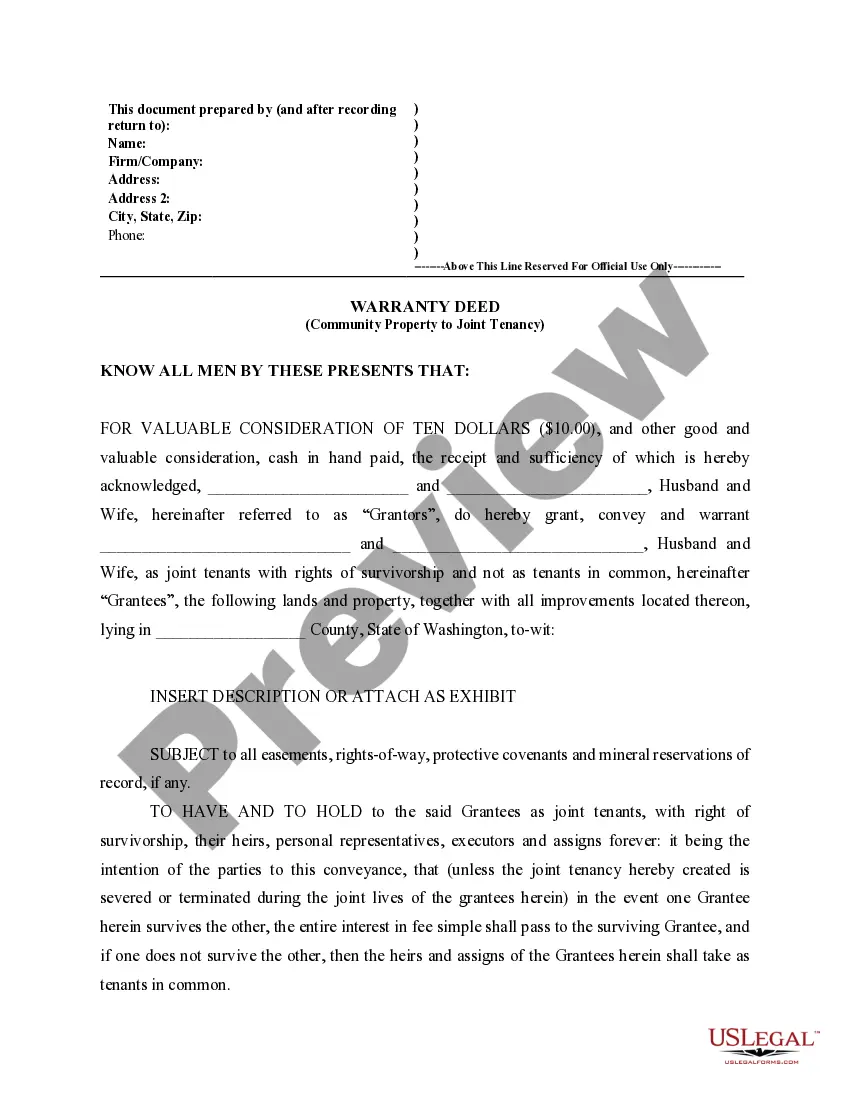
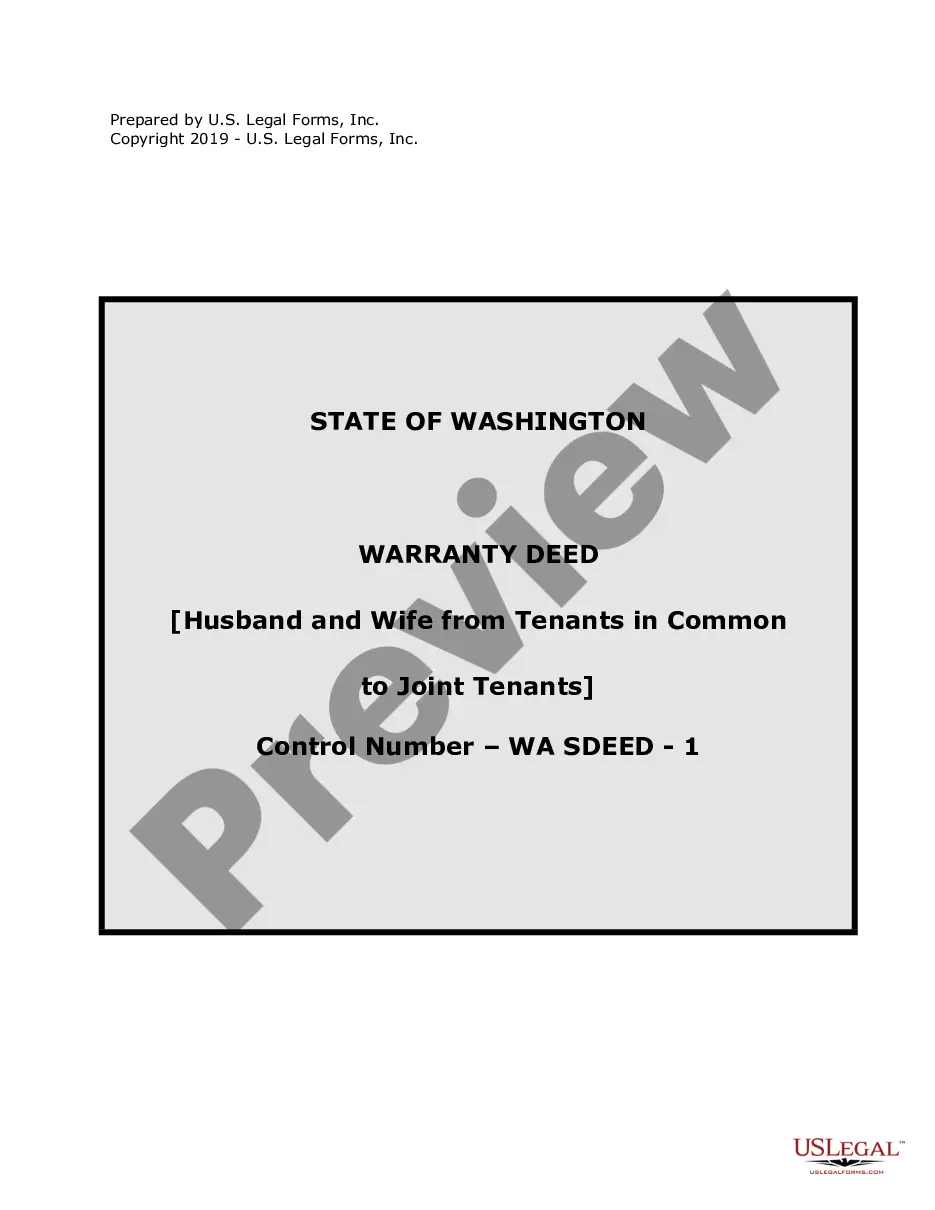
The Warranty Deed for Conversion of Community Property to Joint Tenancy is a legal document that allows spouses to convert their shared community property into a joint tenancy ownership. This form is particularly relevant for couples who wish to ensure that both parties own the property equally, with rights of survivorship, unlike typical community property, which may have different implications upon the death of one spouse. This form represents an important step in estate planning and property ownership for married couples in Washington State.
Key parts of this document
- Identification of the grantors and grantees involved in the property transfer.
- Description of the property being converted to joint tenancy.
- Legal language indicating the intention for joint ownership and rights of survivorship.
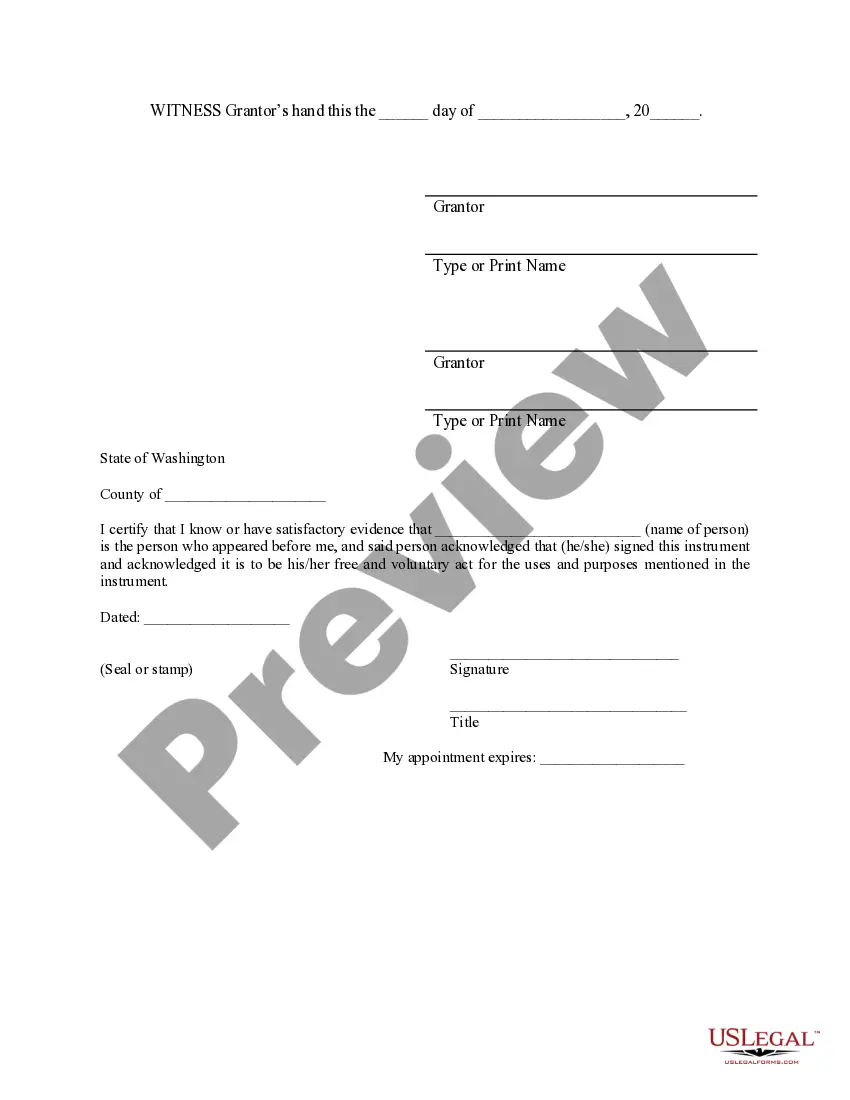
- Spaces for dates and signatures of the parties involved.
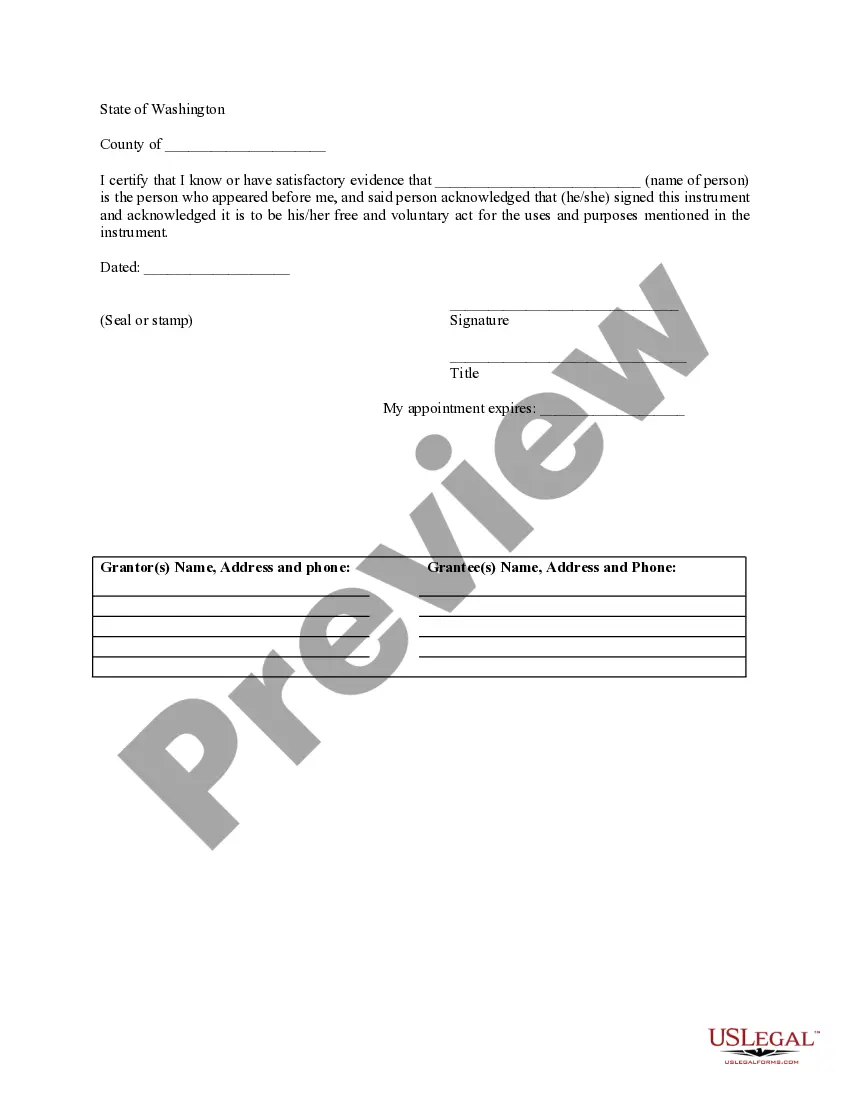
- Notary acknowledgment section for legal validation.


When to use this document
This form should be used when a husband and wife want to change the ownership structure of their community property to joint tenancy. This might be necessary if they are planning for future estate issues or simply wish to ensure that the surviving spouse retains full ownership of the property upon the death of the other. It can also be used in cases where both parties agree to modify their property rights as part of a legal or financial restructuring.
Intended users of this form
- Married couples who own community property in Washington State.
- Spouses wanting to establish joint tenancy for estate planning purposes.
- Couples preparing for changes in property rights due to financial, legal, or personal changes.
Steps to complete this form
- Identify the grantors (the spouses) and enter their names.
- Provide a detailed description of the property involved.
- Specify the intended date of the property transfer.
- Each grantor must sign and print their name where indicated.
- Complete the notary acknowledgment section with a notarization date and signatures.
Notarization guidance
Yes, this form must be notarized to be legally valid. A notary public will verify the identities of the grantors and their willingness to sign the document. US Legal Forms provides online notarization services that are available 24/7, allowing you to complete this process securely via a video call, ensuring your document remains legally binding without the need for in-person visits.
Get your form ready online
Our built-in tools help you complete, sign, share, and store your documents in one place.
Make edits, fill in missing information, and update formatting in US Legal Forms—just like you would in MS Word.
Download a copy, print it, send it by email, or mail it via USPS—whatever works best for your next step.
Sign and collect signatures with our SignNow integration. Send to multiple recipients, set reminders, and more. Go Premium to unlock E-Sign.
If this form requires notarization, complete it online through a secure video call—no need to meet a notary in person or wait for an appointment.
We protect your documents and personal data by following strict security and privacy standards.

Make edits, fill in missing information, and update formatting in US Legal Forms—just like you would in MS Word.

Download a copy, print it, send it by email, or mail it via USPS—whatever works best for your next step.

Sign and collect signatures with our SignNow integration. Send to multiple recipients, set reminders, and more. Go Premium to unlock E-Sign.

If this form requires notarization, complete it online through a secure video call—no need to meet a notary in person or wait for an appointment.

We protect your documents and personal data by following strict security and privacy standards.
Mistakes to watch out for
- Failing to provide a complete and accurate property description.
- Leaving the notary section incomplete or unsigned.
- Not specifying the date of the transaction accurately.
- Forgetting to print names legibly where required.
Advantages of online completion
- Convenience of downloading and filling out the form at your own pace.
- Ability to edit the form using Microsoft Word, making it easier to customize.
- Access to a secure and legally compliant format, ensuring your document's validity.
- Instant access to the form without the need to visit an attorney's office.
Looking for another form?
Form popularity
FAQ
A Washington special warranty deed form conveys Washington real estate from the current owner (grantor) to a new owner (grantee) with a warranty of title that is limited to the period that the grantor owned the property.It has no legislative origin and is not explicitly recognized in the Washington statutes.
The original deed is returned to the owner of the property from the office of the recorder after proper entry. The office of the Recorder of Deeds maintains a set of indexes about each deed recorded, for an easy search. Almost all states have a grantor-grantee index including a reference to all documents recorded.
What Is the Difference Between a Warranty Deed & a Survivorship Deed?A warranty deed is the most comprehensive and provides the most guarantees. Survivorship isn't so much a deed as a title. It's a way to co-own property where, upon the death of one owner, ownership automatically passes to the survivor.
Survivorship rights take precedence over any contrary terms in a person's will because property subject to rights of survivorship is not legally part of their estate at death and so cannot be distributed through a will.
Special warranties allow the transfer of property title between seller and buyer. The purchase of title insurance can mitigate the risk of prior claims to the special warranty deed.
Typically, the lender will provide you with a copy of the deed of trust after the closing. The original warranty deeds are often mailed to the grantee after they are recorded. These are your original copies and should be kept in a safe place, such as a fireproof lockbox or a safe deposit box at a financial institution.
In title law, when we talk about tenants, we're talking about people who own property.When joint tenants have right of survivorship, it means that the property shares of one co-tenant are transferred directly to the surviving co-tenant (or co-tenants) upon their death.
A joint tenant can indeed sever the right of survivorship WITHOUT the consent of the other joint tenants.In order to sever the right of survivorship, a tenant must only record a new deed showing that his or her interest in the title is now held in a Tenancy-in-Common or as Community Property.
With a Survivorship Deed in place, when one of the parties in a joint tenancy dies, the other party (or parties) takes over the deceased party's interest in the property instead of it passing to the deceased's heirs or beneficiaries.