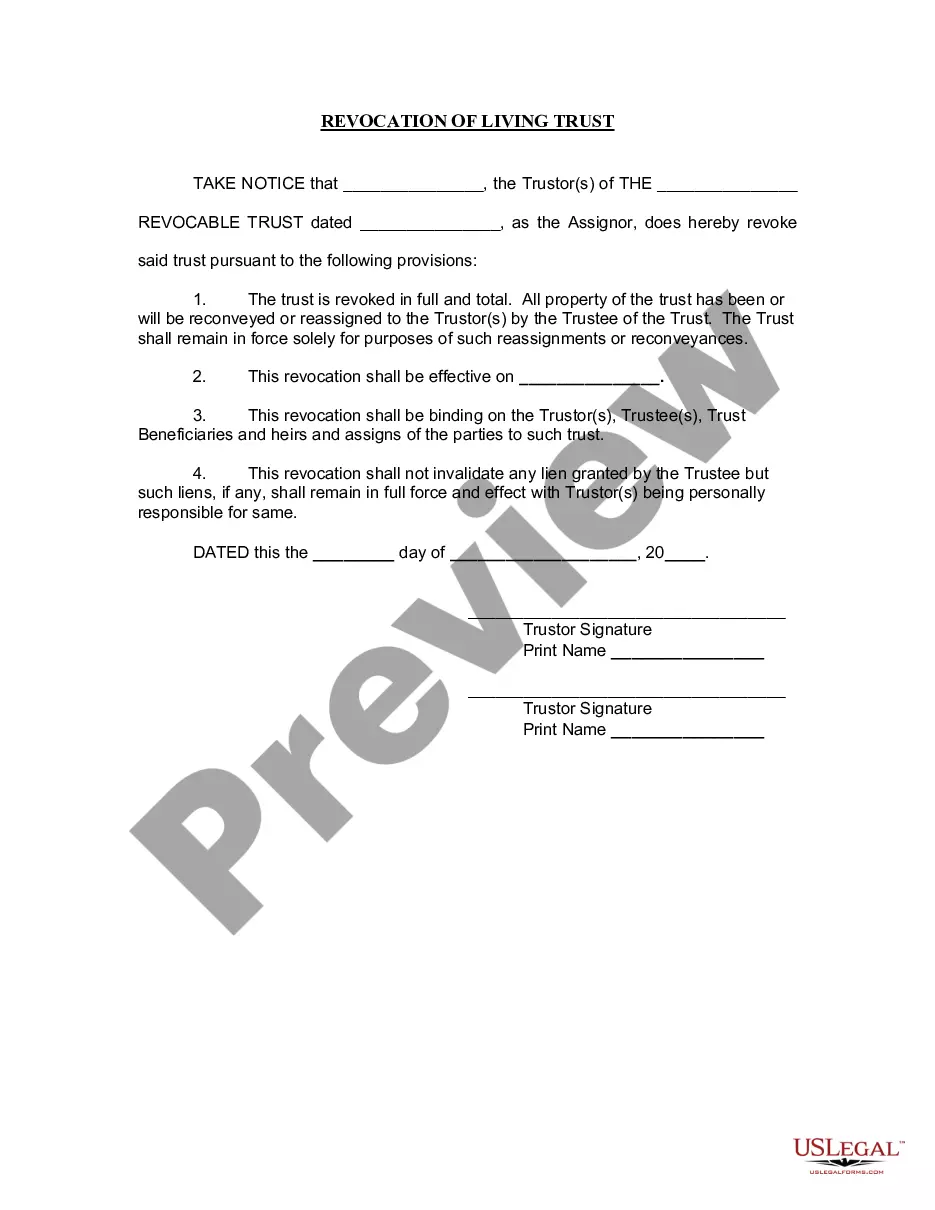
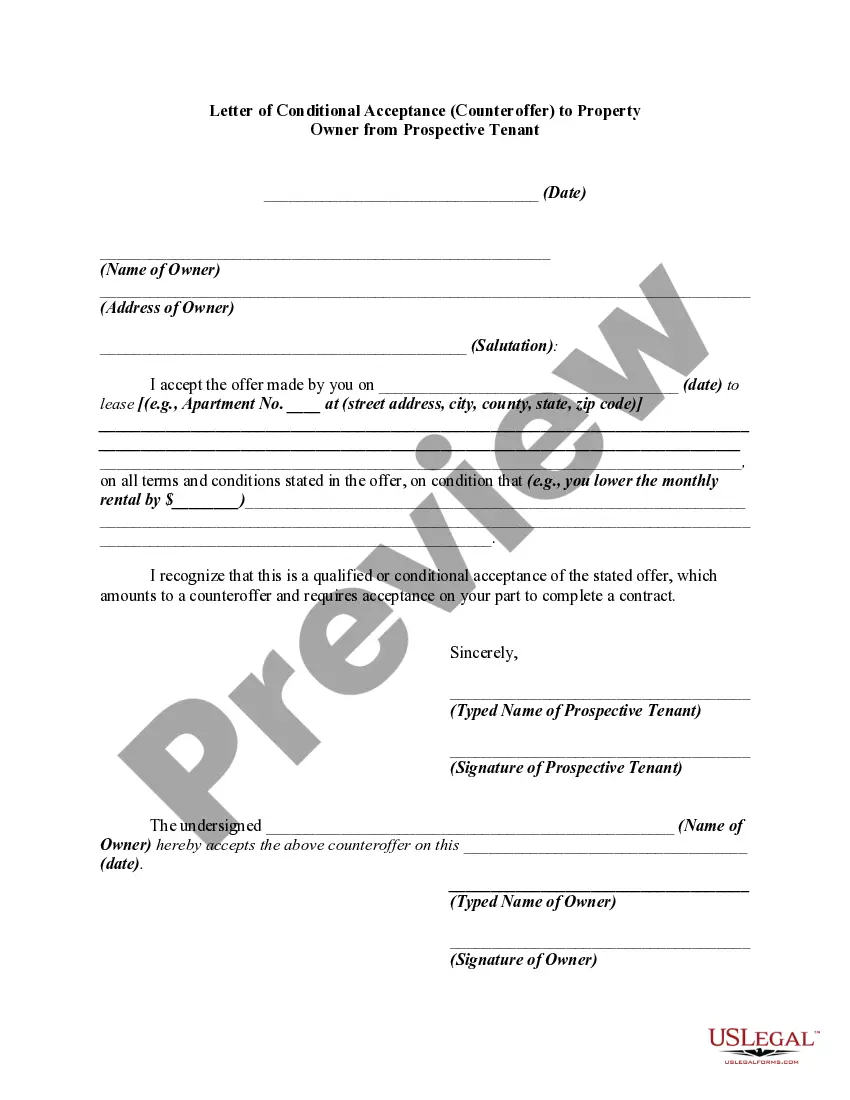
Letter of Conditional Acceptance - Counter offer to Property Owner from Prospective Tenant
Understanding this form
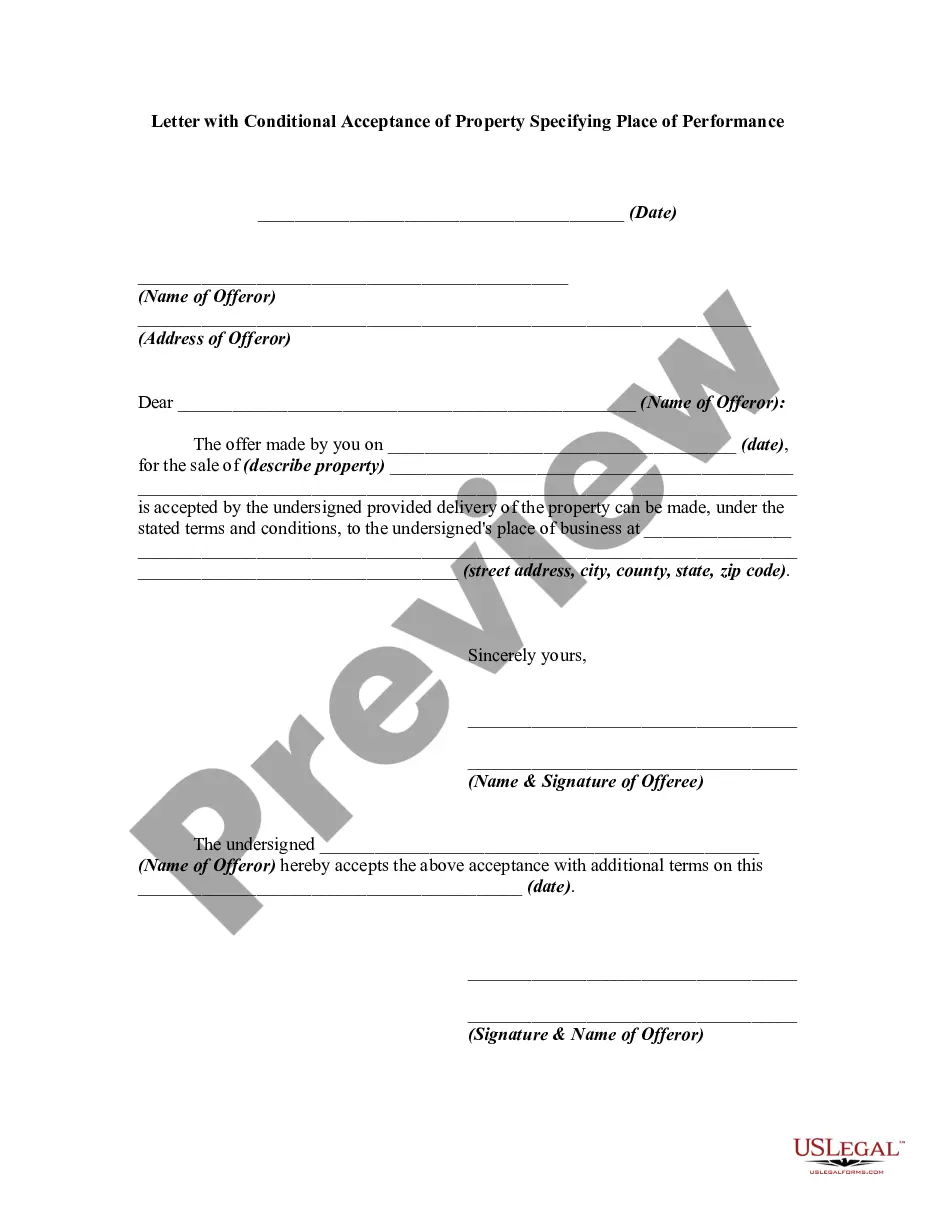
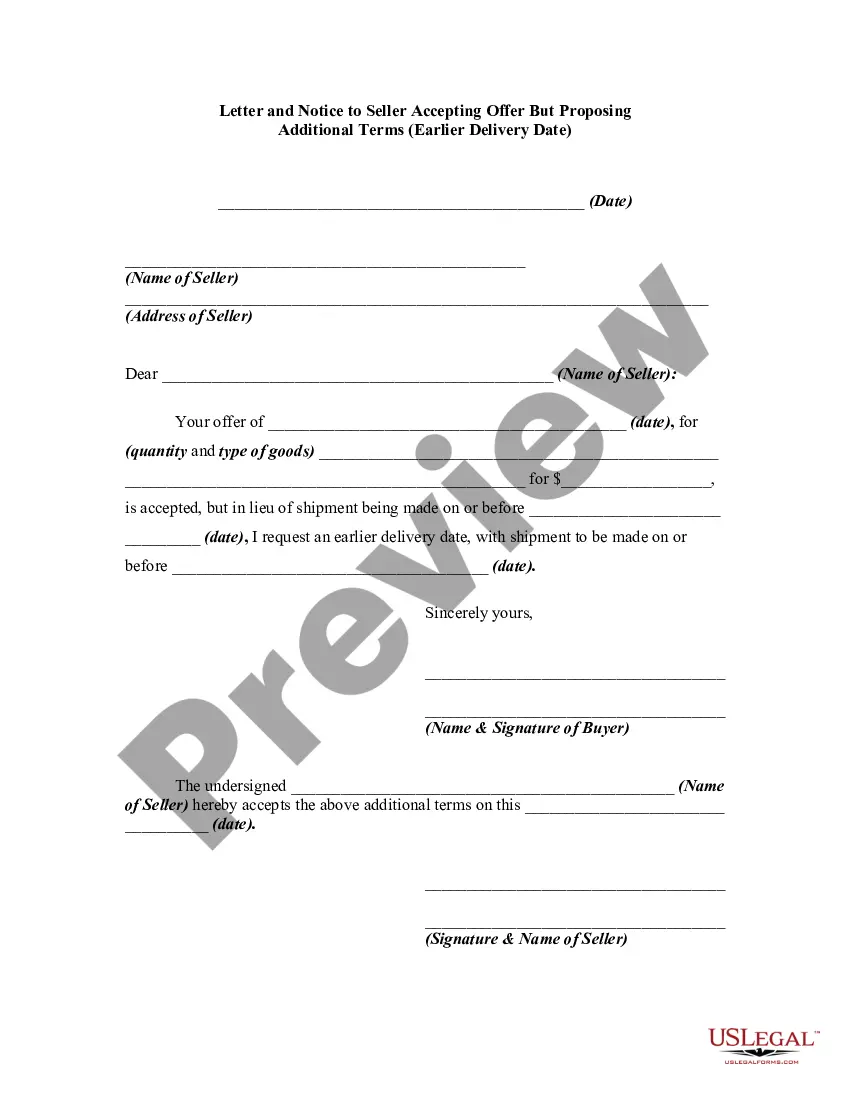
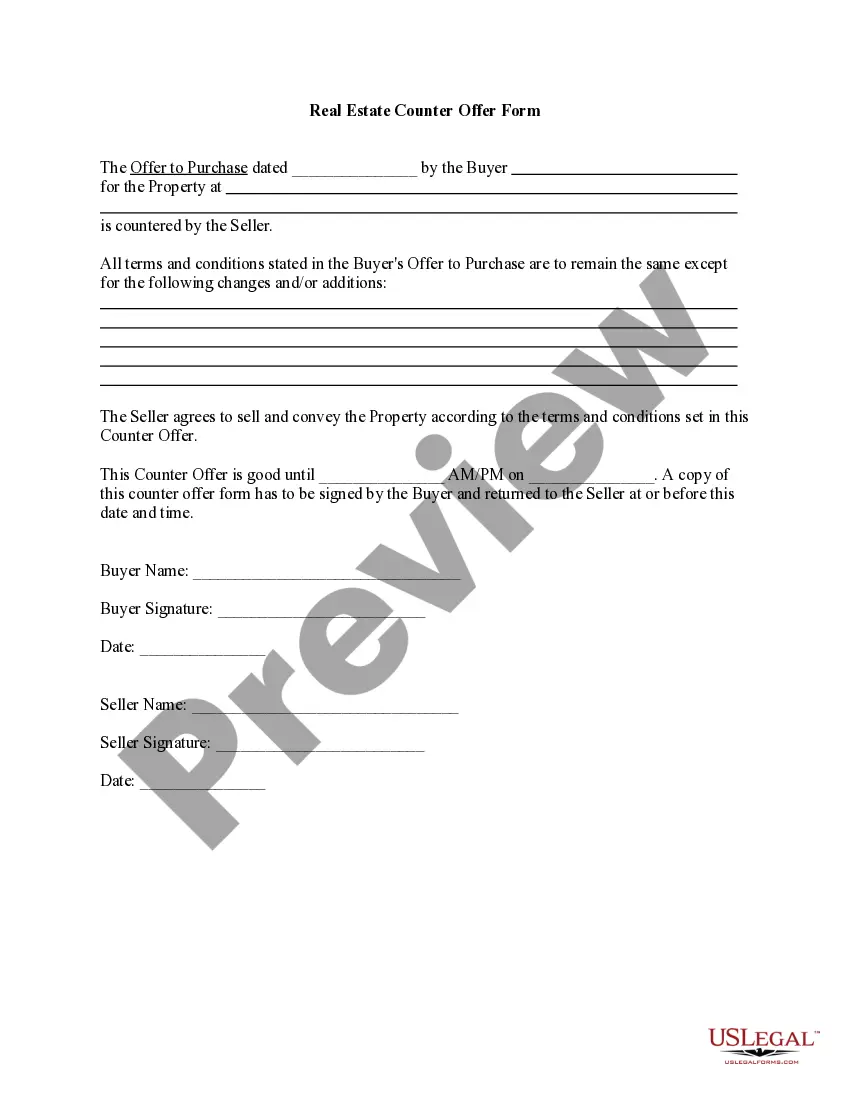
The Letter of Conditional Acceptance is a legal document used by a prospective tenant to respond to a property owner's lease offer with a counter offer. This form outlines the specific terms that the tenant is willing to accept, while also indicating that the original offer is no longer valid unless the owner agrees to the new conditions. By making a conditional acceptance, the tenant proposes changes while still showing interest in leasing the property. This process helps clarify negotiations and facilitates communication between both parties.
Main sections of this form
- Date of the original lease offer.
- Name and address of the property owner.
- Salutation addressing the property owner.
- Details of the original lease offer being accepted conditionally.
- Specific conditions of acceptance by the tenant.
- Signature and printed name of the prospective tenant.
- Acceptance section for the property owner to sign if they agree to the counter offer.
When this form is needed
This form is typically used when a prospective tenant wishes to negotiate terms of a rental agreement after receiving an initial lease offer. Situations may include requesting a lower monthly rent, asking for additional amenities, or modifying lease duration. It is an essential tool in rental negotiations to facilitate clearer communication and ensure both parties are on the same page.
Intended users of this form
- Prospective tenants looking to negotiate terms before accepting a lease.
- Property owners receiving counter offers from potential renters.
- Real estate professionals who assist clients in lease negotiations.
Instructions for completing this form
- Identify the date on which the original offer was made.
- Fill in the name and address of the property owner.
- Provide a salutation (e.g., "Dear [Owner's Name]").
- Clearly state the acceptance of the original offer along with any conditions you are proposing.
- Include the signature and printed name of the prospective tenant.
- Allow space for the property owner to accept the counter offer with their signature and date.
Does this form need to be notarized?
This form usually doesn’t need to be notarized. However, local laws or specific transactions may require it. Our online notarization service, powered by Notarize, lets you complete it remotely through a secure video session, available 24/7.
Get your form ready online
Our built-in tools help you complete, sign, share, and store your documents in one place.
Make edits, fill in missing information, and update formatting in US Legal Forms—just like you would in MS Word.
Download a copy, print it, send it by email, or mail it via USPS—whatever works best for your next step.
Sign and collect signatures with our SignNow integration. Send to multiple recipients, set reminders, and more. Go Premium to unlock E-Sign.
If this form requires notarization, complete it online through a secure video call—no need to meet a notary in person or wait for an appointment.
We protect your documents and personal data by following strict security and privacy standards.

Make edits, fill in missing information, and update formatting in US Legal Forms—just like you would in MS Word.

Download a copy, print it, send it by email, or mail it via USPS—whatever works best for your next step.

Sign and collect signatures with our SignNow integration. Send to multiple recipients, set reminders, and more. Go Premium to unlock E-Sign.

If this form requires notarization, complete it online through a secure video call—no need to meet a notary in person or wait for an appointment.

We protect your documents and personal data by following strict security and privacy standards.
Typical mistakes to avoid
- Not specifying clear conditions for acceptance, leading to potential misunderstandings.
- Failing to sign the document, which invalidates the counter offer.
- Overlooking the inclusion of important dates, which can impact the negotiation timeline.
Why use this form online
- Convenience of downloading the form from anywhere at any time.
- Editability allows users to customize the form to meet specific needs quickly.
- Reliable templates created by licensed attorneys, ensuring legal validity.
Main things to remember
- The Letter of Conditional Acceptance serves as a counteroffer in rental negotiations.
- Clarity is essential when outlining the conditions of acceptance.
- Ensure all parties sign the document to formalize the agreement.
- This form can facilitate efficient and effective communication between tenants and property owners.
Looking for another form?
Form popularity
FAQ
If the seller changes her mind after accepting an offer, especially if the terms of the listing agreement have been met, she usually still owes the broker a commission.Once the offer is accepted, the contract often binds both parties so no one can change their mind without the consent of the other party.
Step 1: Study The Buyer's Original Offer. It is obvious that the buyer always quotes the price very low from the original tag in the initial purchase offer. Step 2: Address Your Concerns. Step 3: Connect With the Buyer Personally. Step 4: Let Them Know How Serious You Are. Step 5: Keep It Short. Step 6: Stick To The Format.
Conditional Acceptance is an agreement to pay a draft on the occurrence or nonoccur-rence of a particular event.This type of acceptance operates as a counteroffer. A counteroffer must be accepted by the original offeror before a contract can be established between the parties.
Any change to an offer creates a new offer, called a "counteroffer." Like an offer, a counteroffer can be withdrawn by the seller at any time before it is signed by the buyer and the signed acceptance is delivered back to the seller or his agent.
"Although this will cause some pushback and sometimes isn't looked at as the most ethical, a seller can legally still accept any other offer up until attorney review conclude as the deal isn't officially under contract." For the most part, though, buyers more commonly back out of contracts rather than sellers.
The seller can counter more than one buyer's offer at a time IF they use appropriate language when doing so with the separate parties to let them know the situation.The seller does not have to accept the highest offer. They only have to accept the offer they want.
Because once your offer is accepted (or you accept the seller's counter offer) the seller cannot back out unless you are not performing. This is great news: In California, buyers have 17 days to change their mind once the offer is accepted. Sellers have 0 days.
The seller might believe that the buyer isn't serious about purchasing the property if the offer is too lowball. Sellers can easily feel insulted and may be too angry to respond. They'll reject the offer outright with no further discussion.
You're finally ready to take the plunge and put in an offer on your dream house. Make Your Offer As Clean As Possible. Avoid Asking For Personal Property. Write A Personal Letter To The Seller. Offer Above-Asking. Put Down A Stronger Earnest Money Deposit (EMD) Waive The Appraisal Contingency.