Demand for Accounting from a Fiduciary such as an Executor, Conservator, Trustee or Legal Guardian
About this form
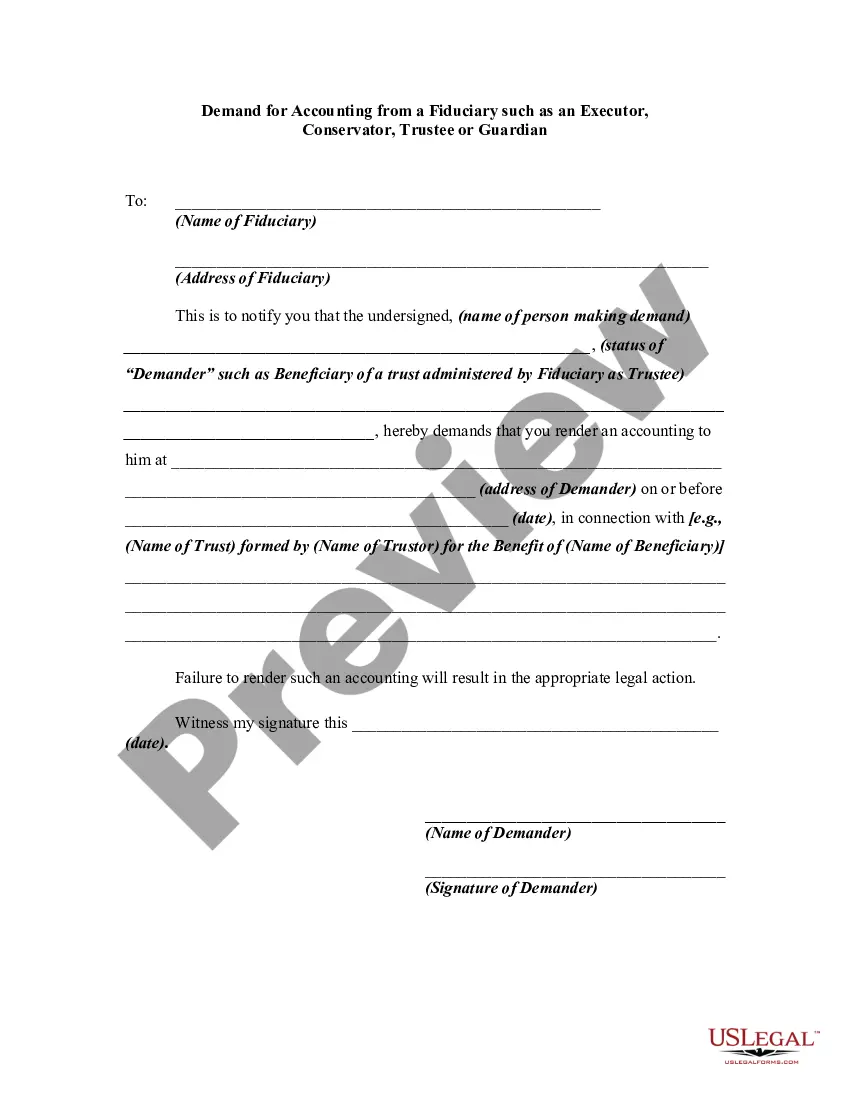
A Demand for Accounting from a Fiduciary is a legal document used to request a detailed report of financial dealings and assets managed by a fiduciary, such as an executor, conservator, trustee, or legal guardian. This accounting typically includes an inventory of assets, debts, income, expenditures, and other relevant items. Unlike informal requests, this form sets a formal tone and establishes a deadline for the fiduciary to provide the accounting, which may be crucial in contexts like estate administration or guardianship.
Main sections of this form
- Name and address of the fiduciary
- Name and status of the person making the demand
- Deadline for providing the accounting
- Details of the trust or estate in question
- Consequences for failure to comply
- Signature of the demander


Common use cases
This form should be used when a beneficiary, heir, or interested party believes that a fiduciary has not provided adequate information regarding the management of a trust, estate, or guardianship. It is an essential step before considering legal action to ensure transparency and accountability in financial matters managed by the fiduciary.
Who needs this form
- Beneficiaries of a trust or estate
- Heirs of a deceased person
- Individuals involved in guardianship or conservatorship arrangements
- Any party with a legitimate interest in the fiduciary's management of assets
How to complete this form
- Identify the fiduciary and provide their name and address.
- Enter your name and your status concerning the trust or estate.
- Set a deadline for when you expect the accounting to be delivered.
- Include relevant details about the trust or estate that the accounting pertains to.
- Sign and date the form to formally submit your demand.
Does this form need to be notarized?
This form does not typically require notarization to be legally valid. However, some jurisdictions or document types may still require it. US Legal Forms provides secure online notarization powered by Notarize, available 24/7 for added convenience.
Get your form ready online
Our built-in tools help you complete, sign, share, and store your documents in one place.
Make edits, fill in missing information, and update formatting in US Legal Forms—just like you would in MS Word.
Download a copy, print it, send it by email, or mail it via USPS—whatever works best for your next step.
Sign and collect signatures with our SignNow integration. Send to multiple recipients, set reminders, and more. Go Premium to unlock E-Sign.
If this form requires notarization, complete it online through a secure video call—no need to meet a notary in person or wait for an appointment.
We protect your documents and personal data by following strict security and privacy standards.

Make edits, fill in missing information, and update formatting in US Legal Forms—just like you would in MS Word.

Download a copy, print it, send it by email, or mail it via USPS—whatever works best for your next step.

Sign and collect signatures with our SignNow integration. Send to multiple recipients, set reminders, and more. Go Premium to unlock E-Sign.

If this form requires notarization, complete it online through a secure video call—no need to meet a notary in person or wait for an appointment.

We protect your documents and personal data by following strict security and privacy standards.
Mistakes to watch out for
- Filing the form without without ensuring the fiduciary has been made aware of the request.
- Not specifying a clear deadline for the accounting.
- Omitting critical information about the trust or estate involved.
- Failing to sign the document before submission.
Why use this form online
- Convenient access to the document anytime and anywhere.
- Easy to edit and customize based on your specific situation.
- Reliability of professionally drafted templates by licensed attorneys.
Legal use & context
- This form represents a formal request, which can protect your rights as a beneficiary or interested party.
- Failure to comply with this demand may lead to further legal actions.
- Using this form ensures there is clear documentation of the demand made on the fiduciary.
Main things to remember
- A Demand for Accounting from a Fiduciary is essential for transparency in the management of trusts and estates.
- Ensure to include all relevant details to avoid delays or complications.
- Always keep a copy of the submitted demand for your records.
Looking for another form?


Form popularity
FAQ
If the trustee fails to account, he or she is in violation of the statute and his or her fiduciary duty. If the beneficiaries are harmed by the lack of accounting, the trustee may be liable. Further, the court may become involved, may levy sanctions and could even remove the trustee.
To familiarise itself with the terms of the trust especially beneficiaries and trust property; to act honestly, reasonably and in good faith; to preserve and not waste the value of the trust assets; to accumulate or pay income as directed by the trust instrument;
Generally, the trustee only has to provide the annual accounting to each beneficiary to whom income or principal is required or authorized in the trustee's discretion to be currently distributed. The trust document has to be read and interpreted to determine who is entitled to accountings.
The trustee's fiduciary duties include a duty of loyalty, a duty of prudence, and subsidiary duties. The duty of loyalty requires that the trustee administer the trust solely in the interest of the beneficiaries.
Before distributing assets to beneficiaries, the executor must pay valid debts and expenses, subject to any exclusions provided under state probate laws.The executor must maintain receipts and related documents and provide a detailed accounting to estate beneficiaries.
Before distributing assets to beneficiaries, the executor must pay valid debts and expenses, subject to any exclusions provided under state probate laws.The executor must maintain receipts and related documents and provide a detailed accounting to estate beneficiaries.
Taxes paid, disbursements made to trust beneficiaries, and gains and losses on trust assets. Fees and expenses paid to advisors of the trustee, such as attorneys, CPAs, and financial advisors.
The executor of a will has a fiduciary duty to act in the best interest of the estate. This means that the law prevents you from acting in your own interest to the detriment of the estate. As an extension of this duty, executors also have several responsibilities to the beneficiaries of the will.
The executor gathers assets, pays bills and taxes, and eventually distributes what's left to the people who inherit it. We may not be so familiar with the person who has the comparable role when someone uses a trust, not a will, to leave property. That person is called a successor trustee.