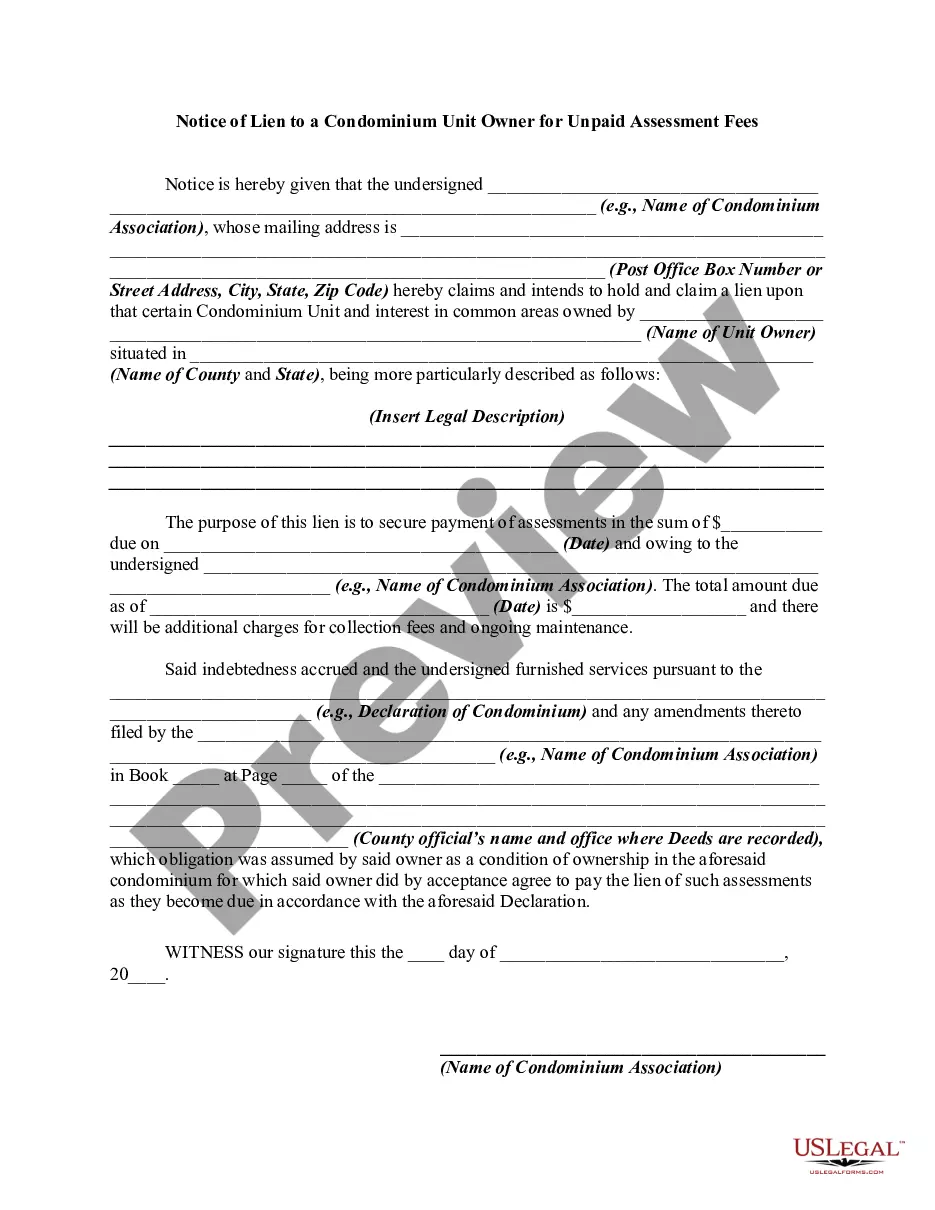
Notice of Lien to a Condominium Unit Owner for Unpaid Assessment Fees
Overview of this form
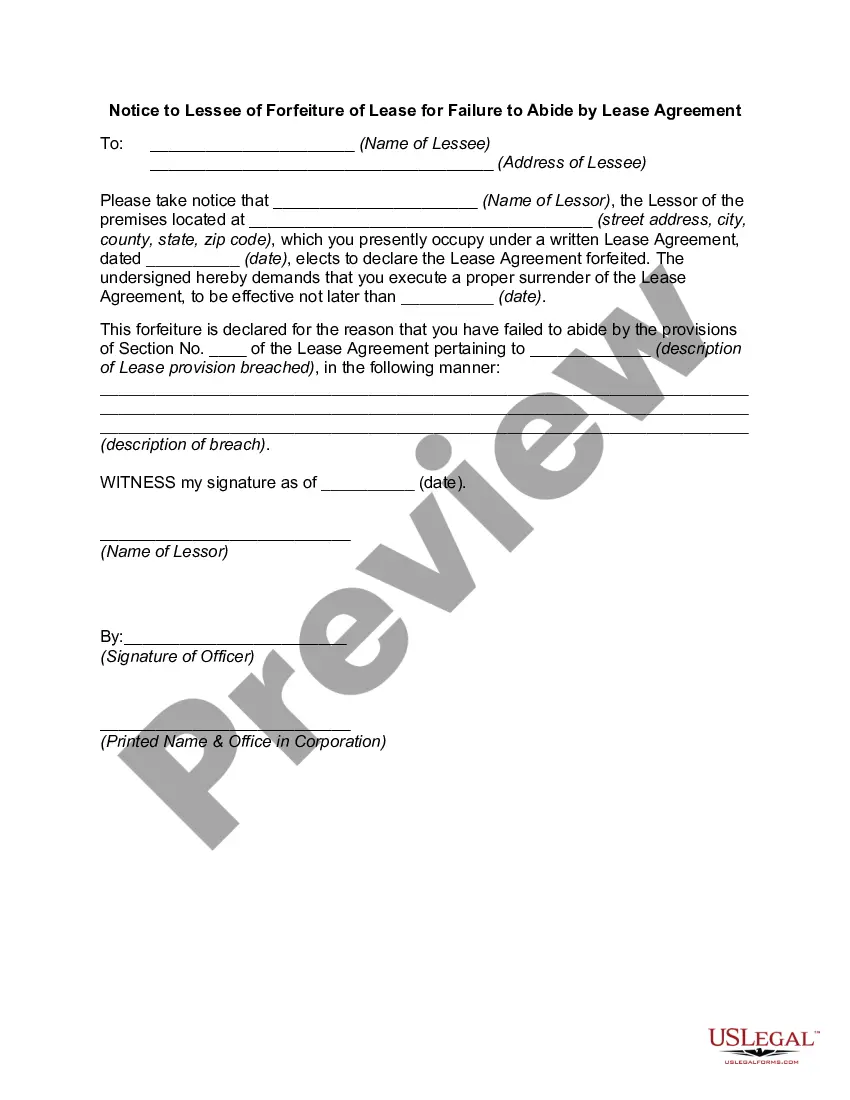
The Notice of Lien to a Condominium Unit Owner for Unpaid Assessment Fees is a legal document used by condominium associations to notify unit owners of an outstanding debt related to unpaid assessments. This form establishes a formal claim against the property, indicating the condominium association's intention to secure payment for amounts owed. Unlike other debt notifications, this form specifically addresses assessment fees pertinent to shared ownership in a condominium setting.
What’s included in this form
- Identification of the condominium association claiming the lien.
- Name and address of the unit owner who owes the assessment fees.
- Legal description of the condominium unit in question.
- Amount of unpaid assessments and date due.
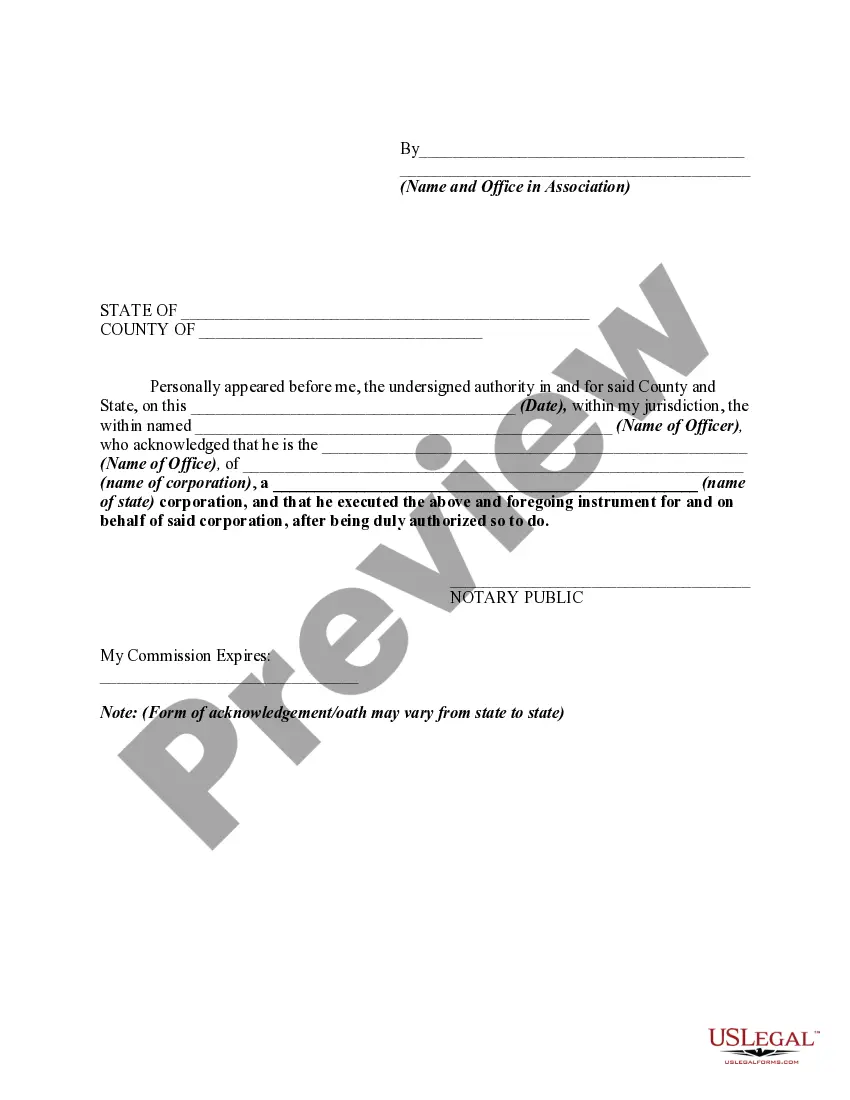
- Signature and acknowledgment of the condominium association.
- Notary section for validation of the document.
When this form is needed
This form should be used when a condominium unit owner has failed to pay their assessment fees as required by the condominium association's bylaws. It serves as a formal notification to the unit owner and documents the association's legal right to place a lien against the unit until the debt is resolved. Common scenarios include unpaid common area maintenance fees or special assessments for repairs.
Who should use this form
This form is intended for:
- Condominium associations seeking to enforce payment of dues from unit owners.
- Property managers involved in the administration of condominiums.
- Unit owners who need to understand the implications of unpaid assessments.
Instructions for completing this form
- Identify the condominium association by entering the name and mailing address.
- Fill in the name and address of the unit owner who owes fees.
- Provide the legal description of the condominium unit.
- Specify the amount due and the date it was originally assessed.
- Sign and date the form in the appropriate section, with an authorized person's title.
- Have the document notarized as required.
Is notarization required?
Notarization is required for this form to take effect. Our online notarization service, powered by Notarize, lets you verify and sign documents remotely through an encrypted video session, available 24/7.
Get your form ready online
Our built-in tools help you complete, sign, share, and store your documents in one place.
Make edits, fill in missing information, and update formatting in US Legal Forms—just like you would in MS Word.
Download a copy, print it, send it by email, or mail it via USPS—whatever works best for your next step.
Sign and collect signatures with our SignNow integration. Send to multiple recipients, set reminders, and more. Go Premium to unlock E-Sign.
If this form requires notarization, complete it online through a secure video call—no need to meet a notary in person or wait for an appointment.
We protect your documents and personal data by following strict security and privacy standards.

Make edits, fill in missing information, and update formatting in US Legal Forms—just like you would in MS Word.

Download a copy, print it, send it by email, or mail it via USPS—whatever works best for your next step.

Sign and collect signatures with our SignNow integration. Send to multiple recipients, set reminders, and more. Go Premium to unlock E-Sign.

If this form requires notarization, complete it online through a secure video call—no need to meet a notary in person or wait for an appointment.

We protect your documents and personal data by following strict security and privacy standards.
Avoid these common issues
- Failing to include a complete legal description of the unit.
- Not specifying all applicable fees, including collection costs.
- Omitting signatures from authorized representatives of the association.
- Incorrectly completing the notary section or failing to notarize the document.
Why use this form online
- Convenient access to legal documents without the need for in-person visits.
- Edit and customize the form quickly to fit specific needs.
- Receive guidance on completing the form accurately.
- Secure storage and retrieval of legally compliant documents.
Looking for another form?





Form popularity
FAQ
If a homeowner doesn't pay the required assessments, the HOA may choose to try to collect those dues through normal collection processes (like by making collection calls and sending demand letters), by filing a civil suit to obtain a personal judgment against the homeowner, or by initiating a foreclosure.
The special assessment becomes an obligation of the owners on the date the board or the membership adopts the resolution. The owner at the time the assessment is adopted is responsible for the payment of the special assessment, though the adoption of the assessment may create a lien against the owner's property.
Typically, the duration is 20-25 years.
If collection attempts for a special assessment fails as a personal obligation, the HOA can place a lien on the owner's property. The HOA records a notice of delinquent assessment with the county against the owner's interest in the development.
Most condo or HOA homeowners pay monthly fees. In some instances, assessments are tacked on to the monthly condo fees in small amounts until the debt is paid off; in other cases, the assessment is a one-time charge that must be paid by each homeowner as a lump sum.
Open the Lines of Communication. Negotiations can't take place if the HOA board and the management company are unable to communicate with delinquent homeowners. Work on a Payment Plan. Offer to Eliminate Fines. Terminate Privileges. Bring in Your Legal Team.
If an HOA has a lien on a homeowner's property, it may forecloseeven if the home already has a mortgage on itas permitted by the CC&Rs and state law. The HOA can foreclose either through judicial foreclosure or a nonjudicial foreclosure, depending on state law and the terms in the CC&Rs.
To remove a lien on a property, homeowners must first satisfy the debt owed to the homeowners association. To pay off an HOA lien, the homeowner must make payment to the association in the amount of the delinquent assessments, plus interest and any applicable fees.
Majority of Members Must Consent to Dissolution of HOA Because an HOA technically consists of two parts, the legal entity plus its membership, one part usually needs the consent and approval of the other in order to take an extreme action like dissolution.