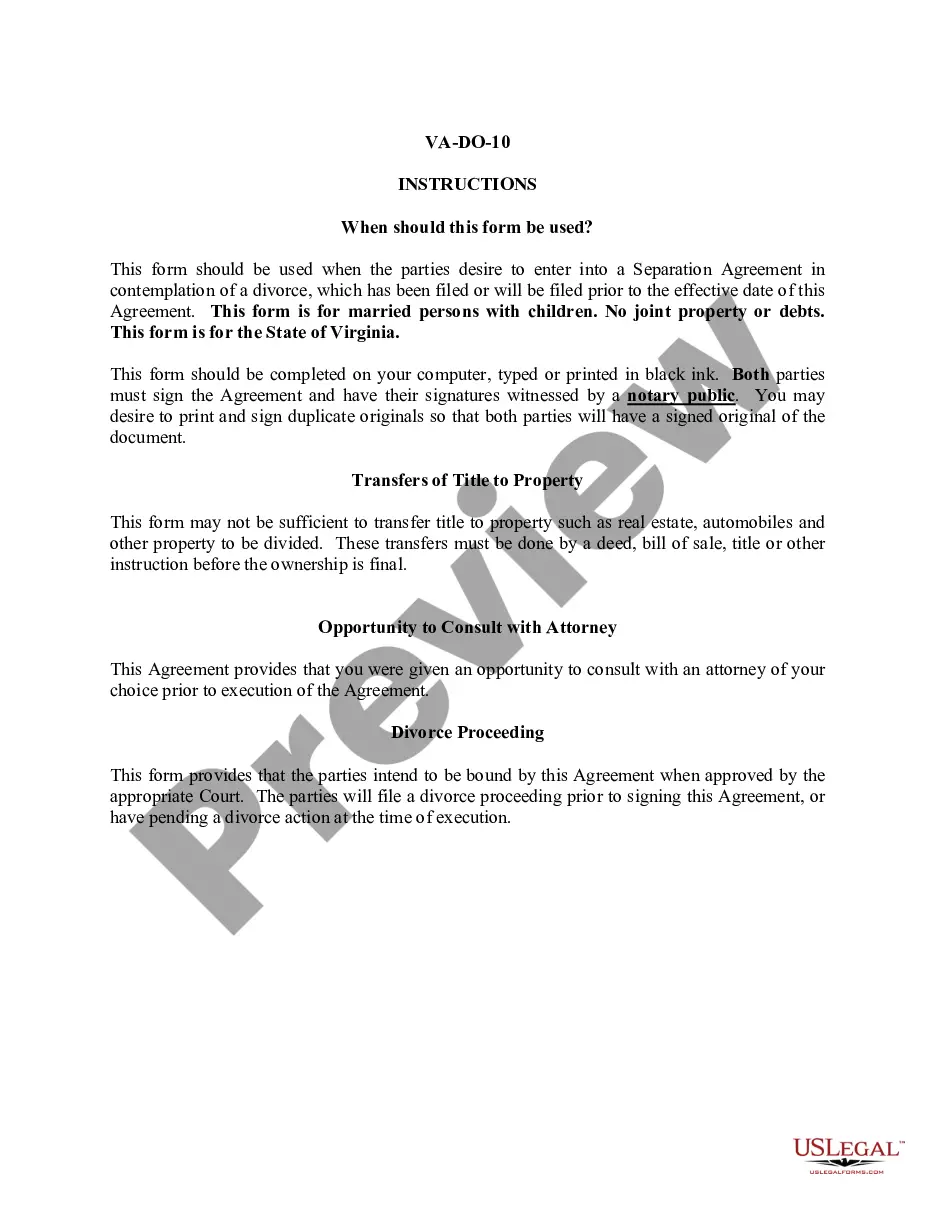
Nonexclusive License to Hunt and Fish on Property or Land of Another
Understanding this form
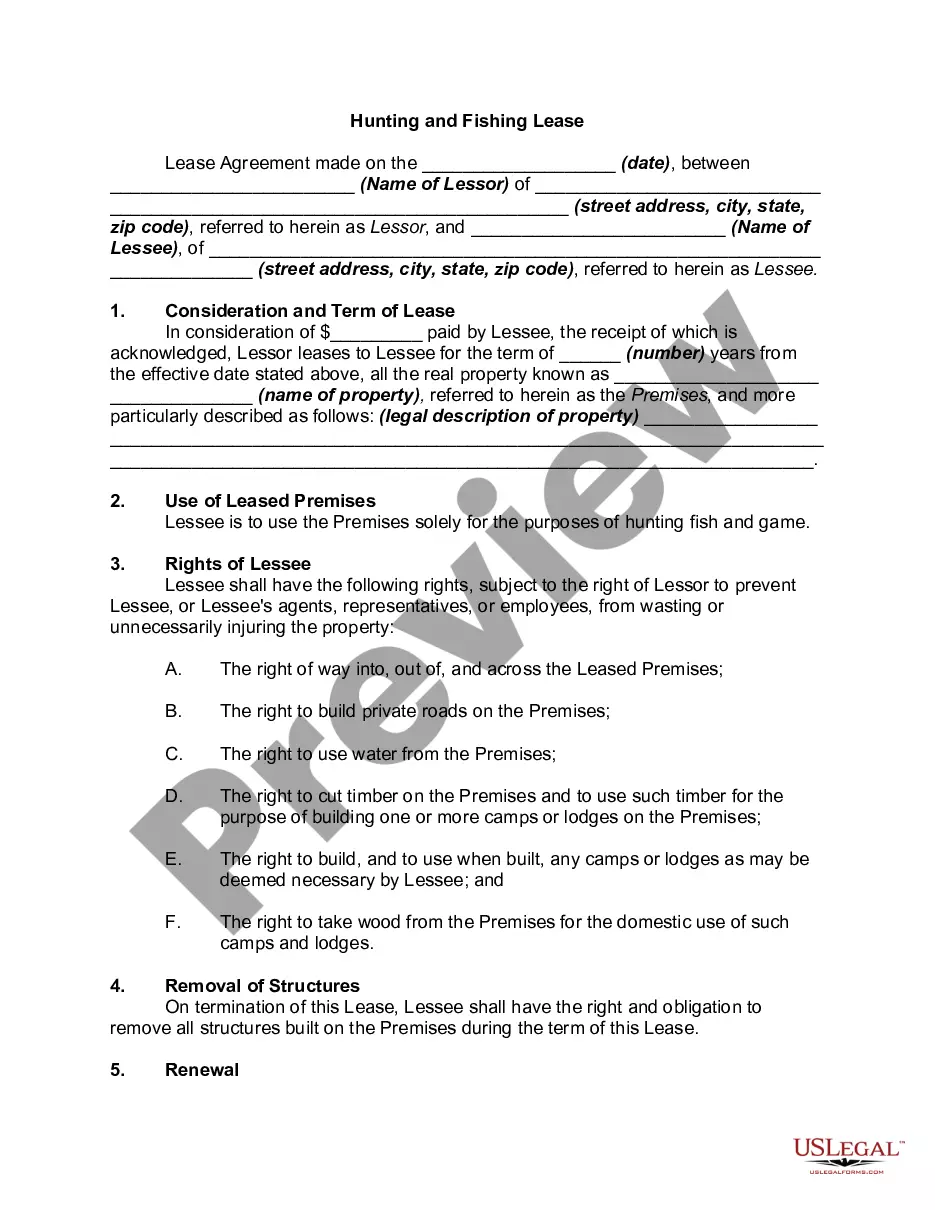
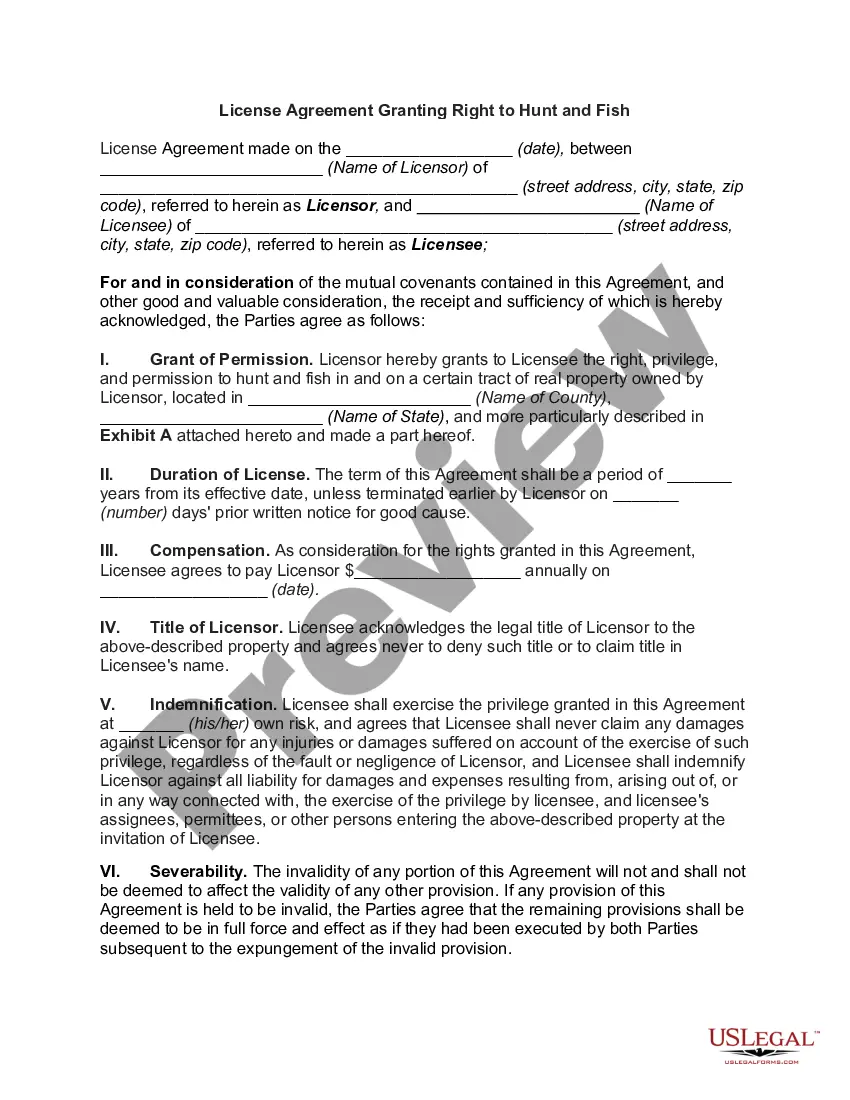
A Nonexclusive License to Hunt and Fish on Property or Land of Another is a legal document that grants permission to an individual (the Licensee) to hunt and fish on someone else's property (the Licensor). This permission is revocable and does not create any ownership rights over the land. Unlike a lease or a rental agreement, a license does not provide a permanent right to use the property and can be terminated at any time by the landowner.
Main sections of this form
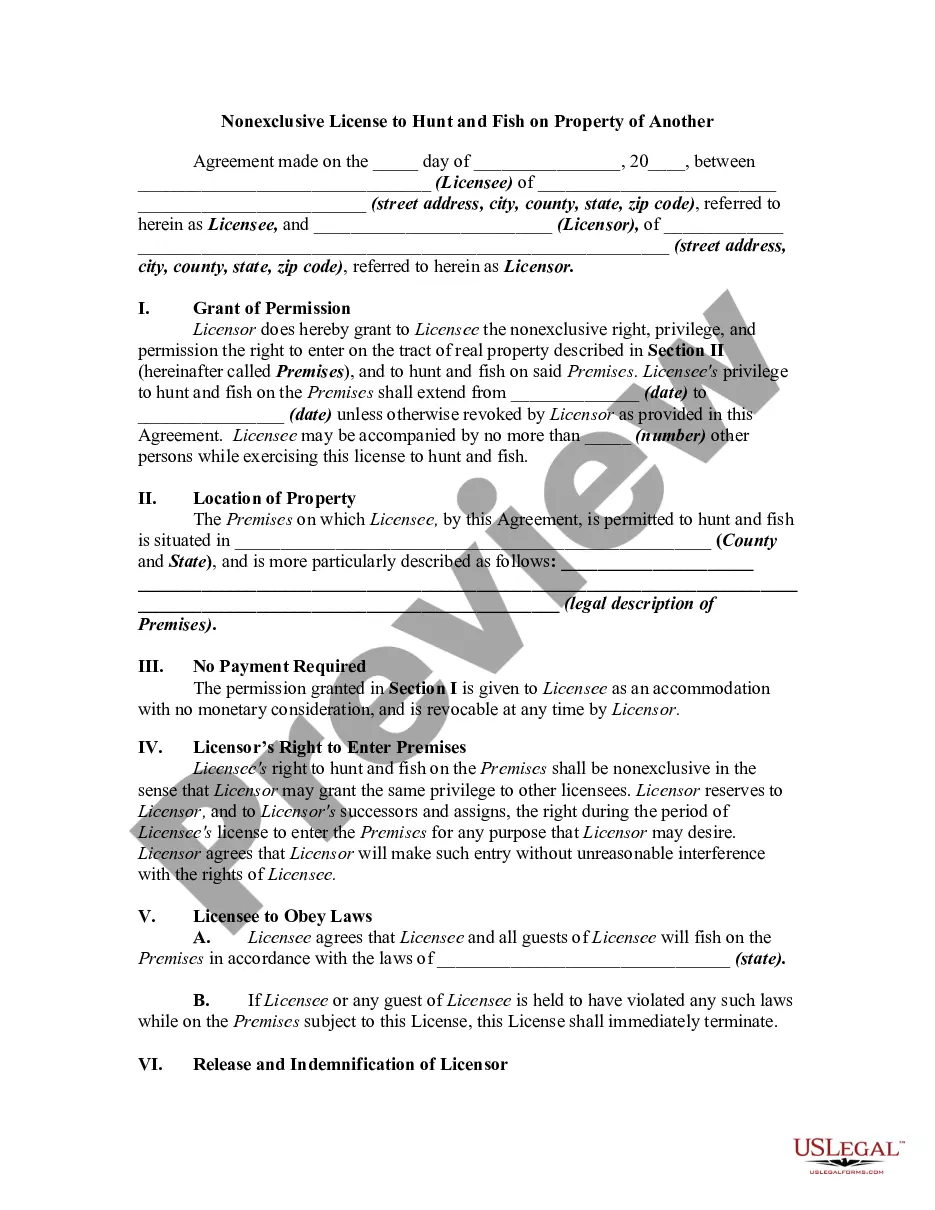
- Grant of Permission: Permits the Licensee to enter the property for hunting and fishing.
- Location of Property: Specifies the address and legal description of the premises.
- No Payment Required: States that the license is granted without any financial compensation.
- Licensor's Right to Enter: Clarifies that the Licensor can also access the property without disrupting the Licensee's activities.
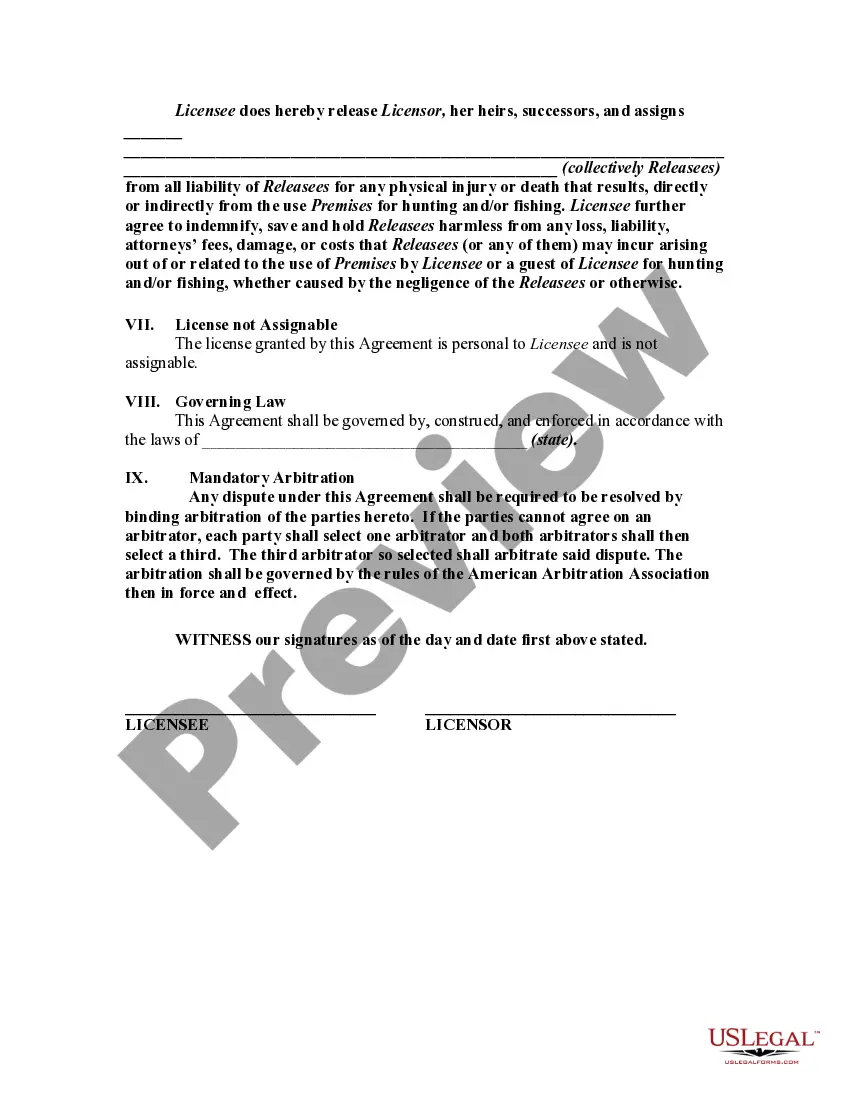
- Release and Indemnification: The Licensee agrees to release the Licensor from liability for any injuries or damages.
- Licenses Not Assignable: Specifies that the license cannot be transferred to another party.
When to use this document
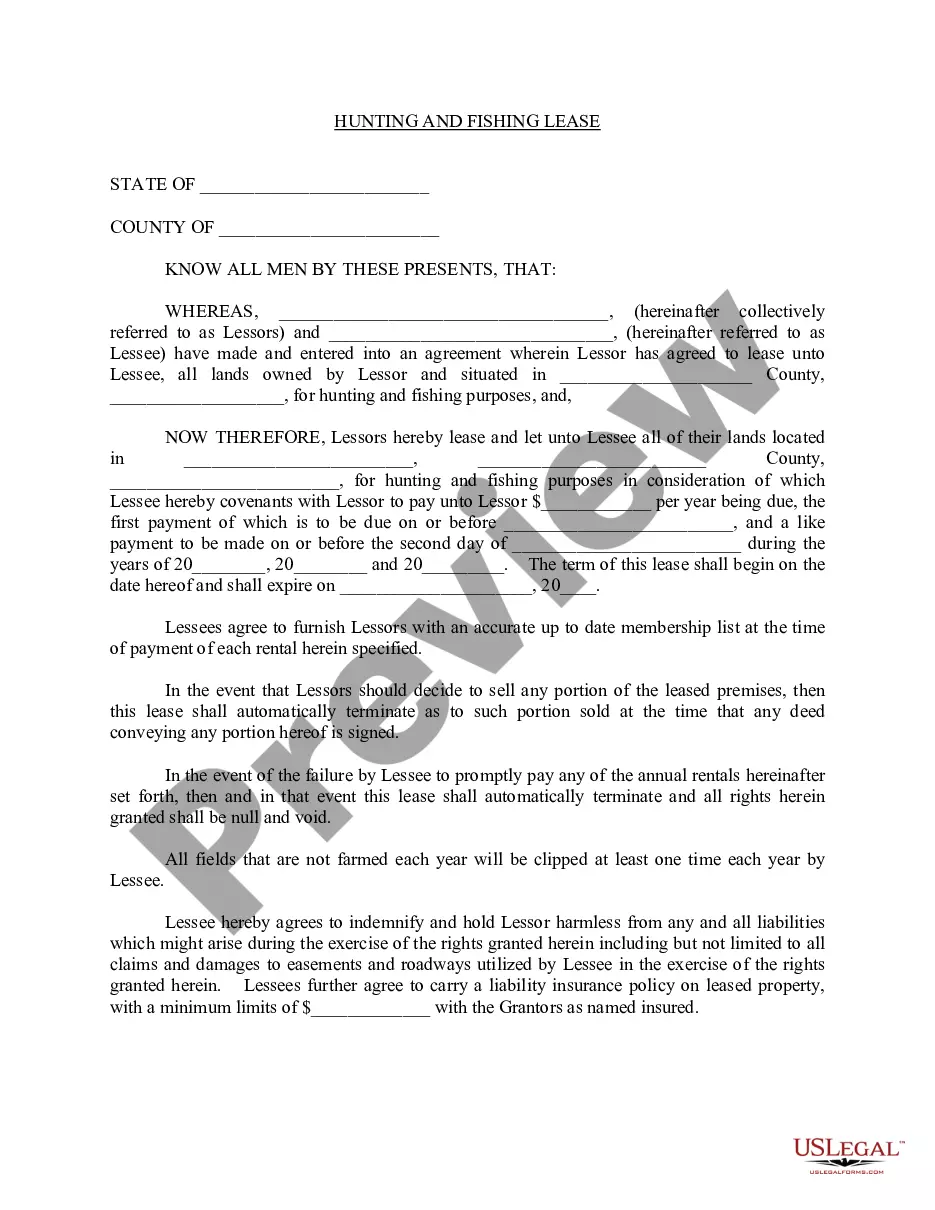
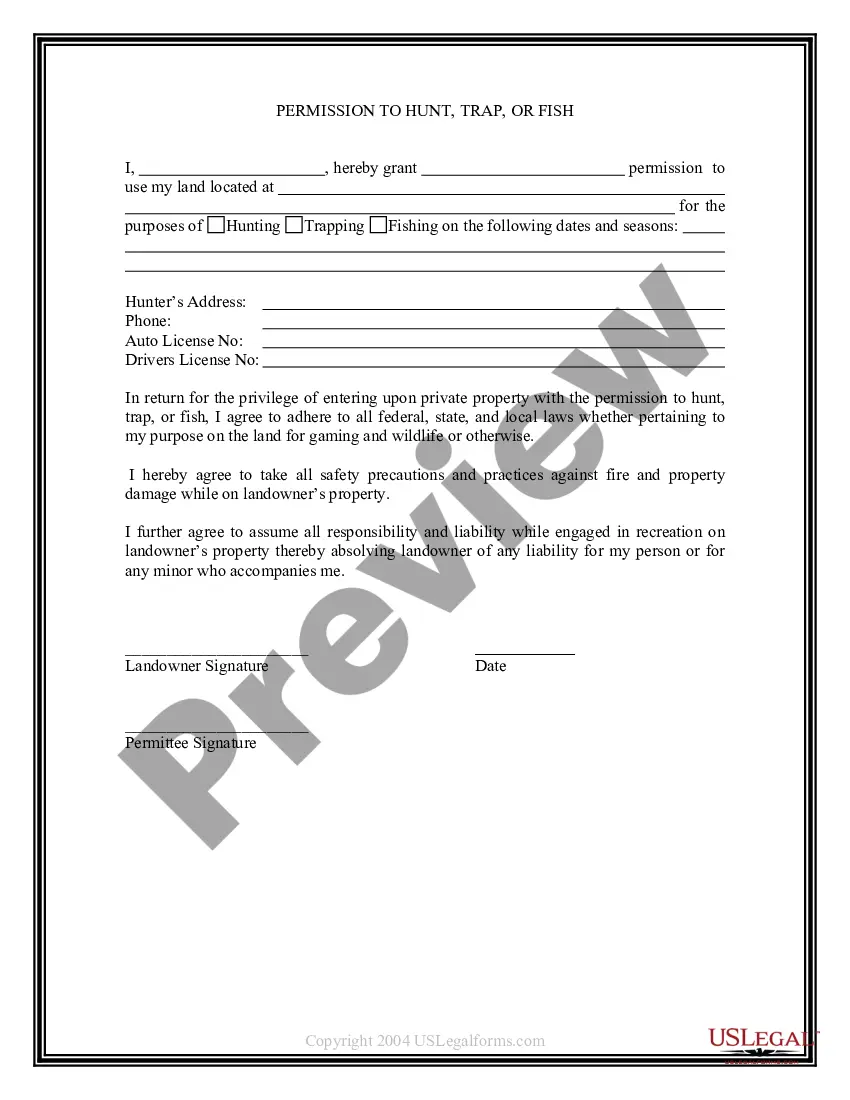
This form is utilized when a landowner wishes to allow another individual the privilege of hunting and fishing on their property. It is beneficial for informal arrangements where the landowner does not want to enter into a lease agreement, but still wishes to control access to their land while avoiding any potential liabilities.
Who should use this form
- Landowners (Licensors) who want to allow others to hunt and fish on their property.
- Individuals (Licensees) seeking permission to hunt and fish on someone else's land.
- Both parties who wish to clearly define the terms of the license and responsibilities.
How to prepare this document
- Identify the parties: Fill in the names and addresses of both the Licensor and Licensee.
- Specify the property: Enter the legal description and location of the property where hunting and fishing will occur.
- Set the duration: Indicate the start and end date of the license.
- State the number of guests: Specify how many additional individuals are allowed to accompany the Licensee.
- Review and sign: Both parties should read the terms and sign to acknowledge agreement.
Does this document require notarization?
This form does not typically require notarization unless specified by local law. However, always check your jurisdiction's specific requirements to ensure compliance.
Get your form ready online
Our built-in tools help you complete, sign, share, and store your documents in one place.
Make edits, fill in missing information, and update formatting in US Legal Forms—just like you would in MS Word.
Download a copy, print it, send it by email, or mail it via USPS—whatever works best for your next step.
Sign and collect signatures with our SignNow integration. Send to multiple recipients, set reminders, and more. Go Premium to unlock E-Sign.
If this form requires notarization, complete it online through a secure video call—no need to meet a notary in person or wait for an appointment.
We protect your documents and personal data by following strict security and privacy standards.

Make edits, fill in missing information, and update formatting in US Legal Forms—just like you would in MS Word.

Download a copy, print it, send it by email, or mail it via USPS—whatever works best for your next step.

Sign and collect signatures with our SignNow integration. Send to multiple recipients, set reminders, and more. Go Premium to unlock E-Sign.

If this form requires notarization, complete it online through a secure video call—no need to meet a notary in person or wait for an appointment.

We protect your documents and personal data by following strict security and privacy standards.
Common mistakes
- Not including the legal description of the property.
- Failing to specify the duration of the license properly.
- Not including the state laws that may govern hunting and fishing.
- Leaving out the signatures of both parties.
Why use this form online
- Convenient access to templates that can be downloaded and filled out at any time.
- Editability: Users can make changes easily to fit their specific needs.
- Cost-effective: Eliminates the need for hiring a lawyer for straightforward agreements.
- Reliability: Forms are drafted by licensed attorneys, ensuring they meet legal standards.
Legal use & context
- This form serves as a binding agreement that specifies the terms under which hunting and fishing can occur on private property.
- While a license grants permission, it does not grant any ownership interest in the property.
- Without a written agreement, misunderstandings and legal disputes may arise.
Quick recap
- The Nonexclusive License to Hunt and Fish on Property is a flexible way to grant hunting rights.
- This form protects both the Licensee and Licensor by outlining permissions and liabilities.
- It is important to understand state-specific laws that may affect hunting and fishing activities.
Looking for another form?







Form popularity
FAQ
First, the DNR officer is subject to the same constitutional restrictions as any police office. He has no right to enter private property without a search warrant or a valid exception to the search...
Landowner permission is required to hunt, fish or trap on the lands of another.Non-Resident - All non-resident hunters, except minors under the age of sixteen (16), are required to obtain a hunting license while hunting in the State of Mississippi.
Types of Licenses. RESIDENT HUNTING, COMBO OR SPORTSMAN'S LICENSE is required for all resident hunters 16 years of age or older, except when hunting or fishing on one's own land or land owned by immediate family (blood or dependent relationship) residing in the same household.
How many deer can I shoot with my license? You are allowed to harvest one deer per license (with the exception of the deer license bundle, youth hunt/trap license, or lifetime license.)
Unless the DNR change the law you can hunt on your own land for small game without a hunting license.
Name, date of birth, Indiana Driver's License number, and Social Security number (required by IC 14-22-11-3) Hunter education certificate number if born after Dec. 31, 1986. Complete address, city, state, Zip code, and phone number.
Exemptions: Landowners or lessees of farmland who farm that land and are residents of Indiana are not required to obtain a permit while hunting, fishing, or trapping on the land they own or lease. A license is also NOT required for the landowner's or lessee's spouse or children living with them.
Much of the land in Michigan is privately owned. Hunters can typically freely take game animals hunted on their own private property, or may seek permission from a landowner to hunt on private property.Hunters must ensure they respect the rights and property of the landowner at all times.
It is illegal to use bait, salt, snares, dogs, or other domesticated animals to take deer. Bait is considered any product that is transported into a hunting area and placed there for animal consumption.Artificial deer decoys are legal for deer hunting.