Presumption of Innocence
Understanding this form
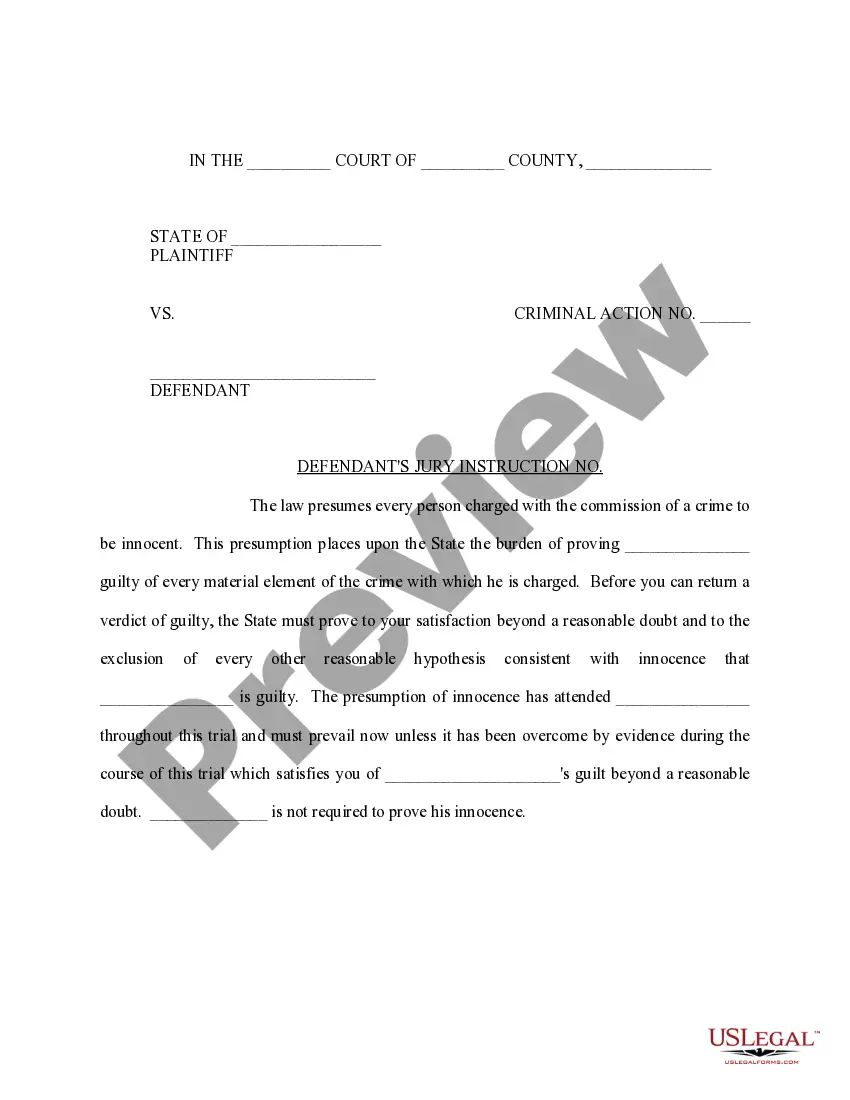
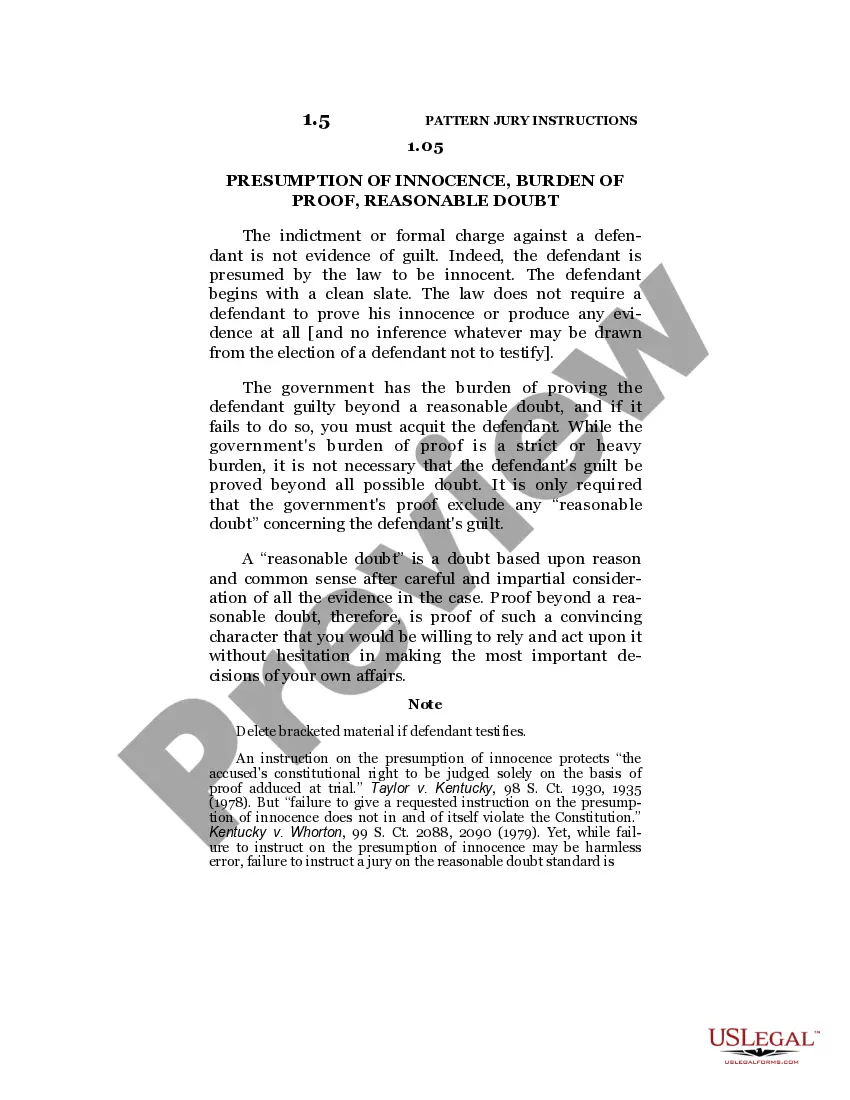
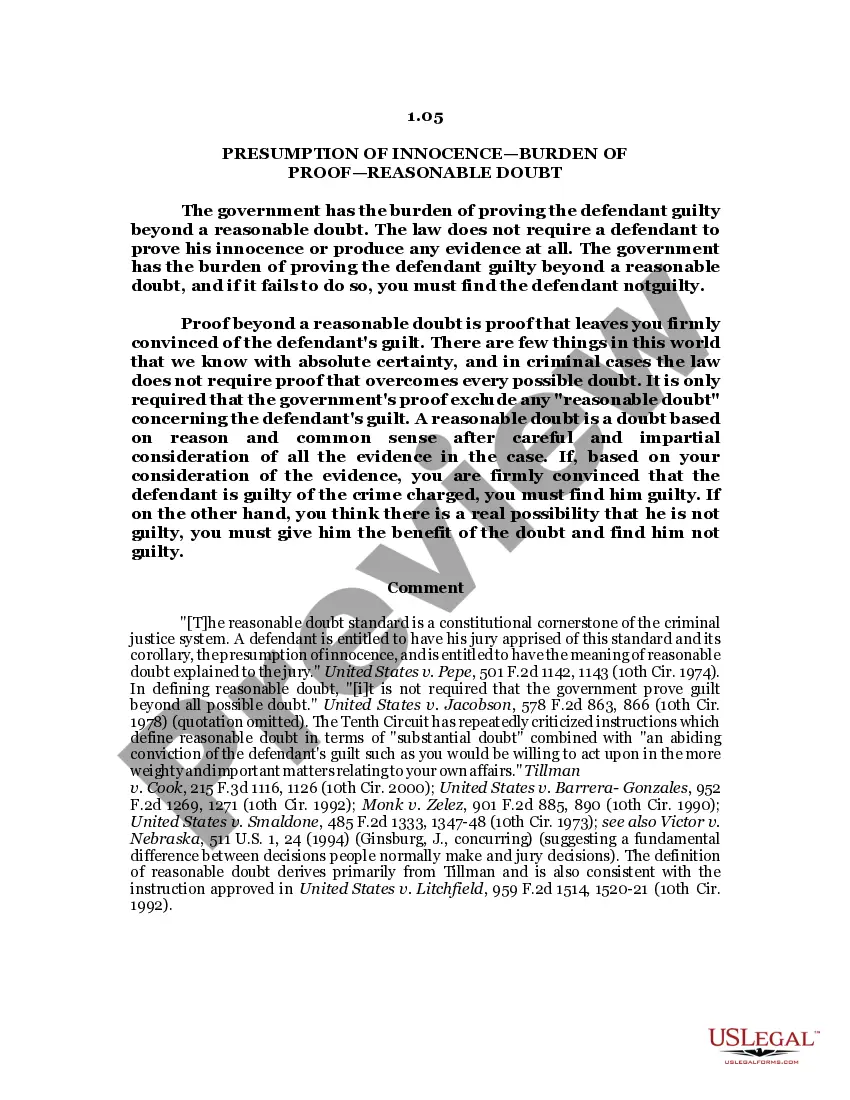
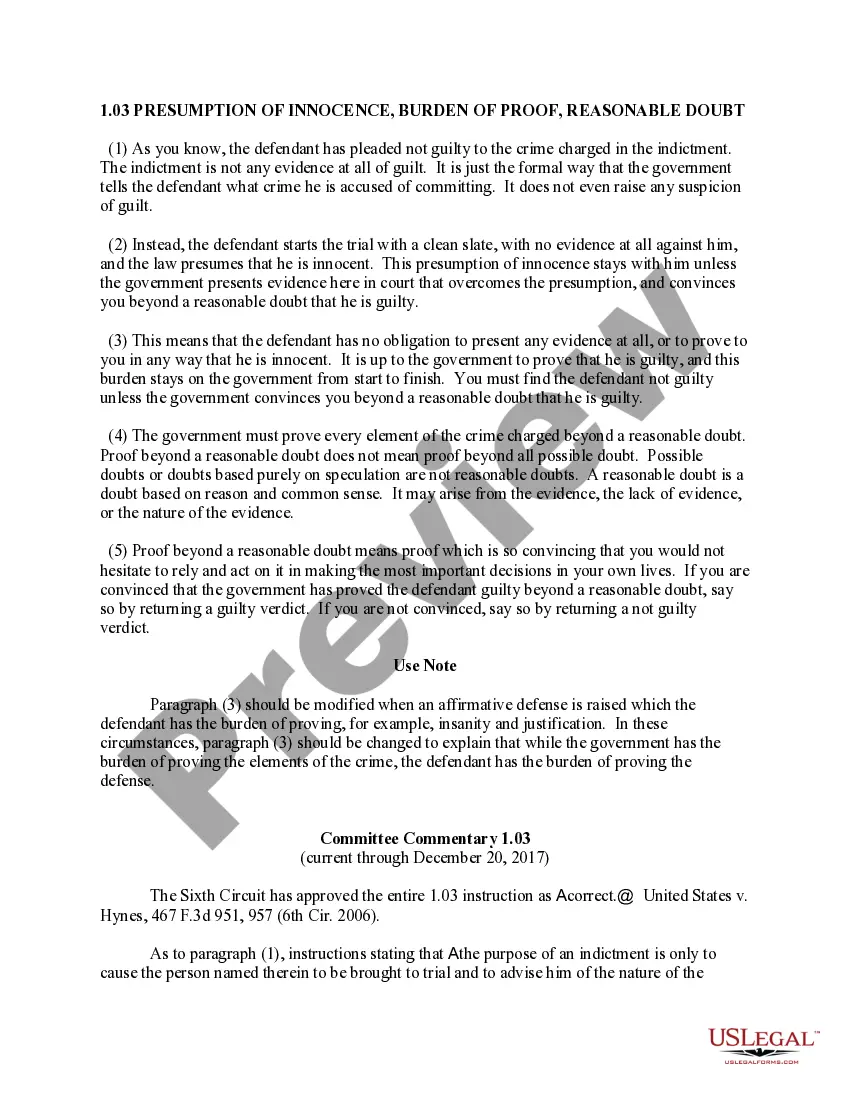
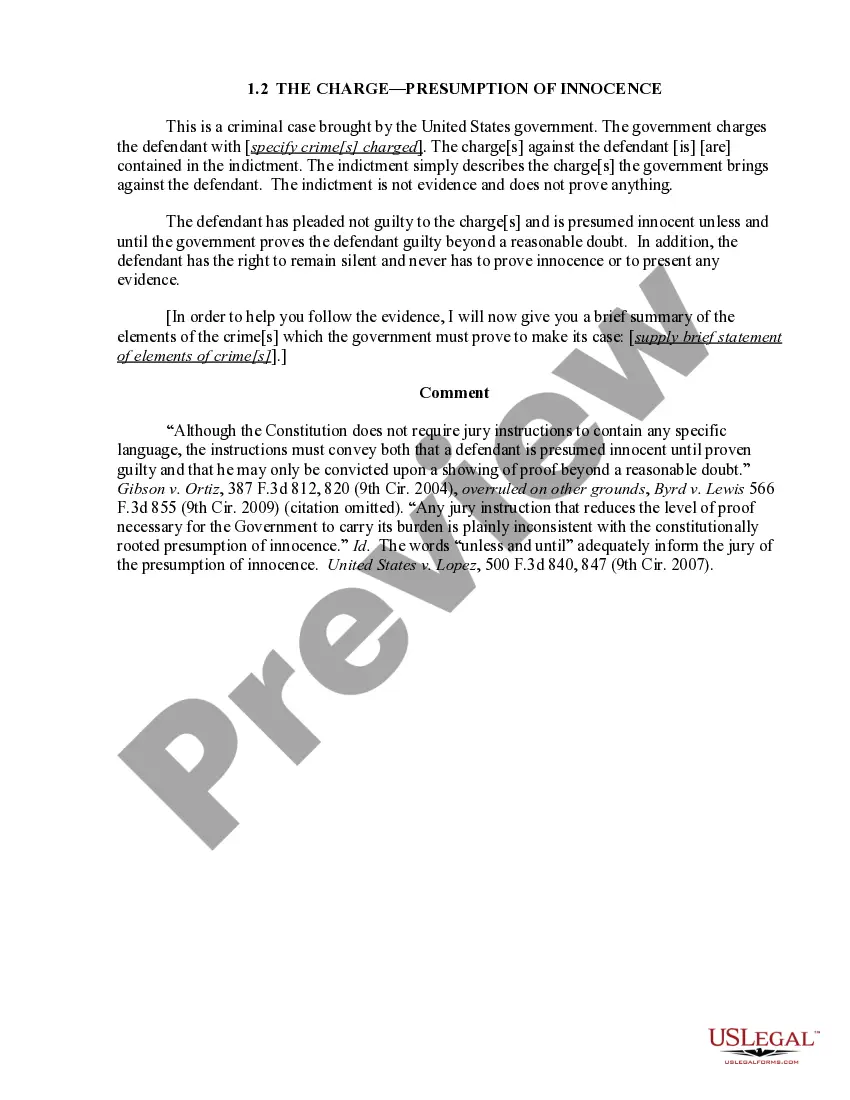
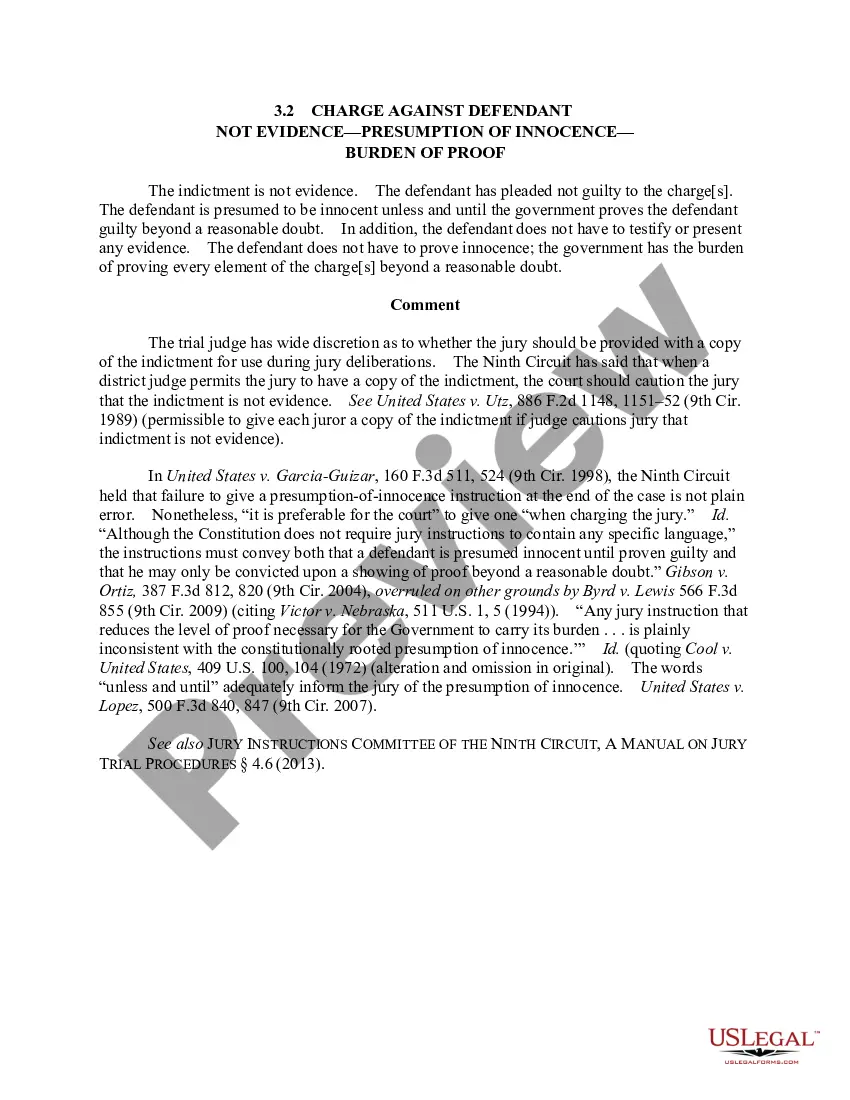
The Presumption of Innocence form serves as a jury instruction in criminal trials, emphasizing that every individual charged with a crime is presumed innocent until proven guilty. This instruction clarifies the prosecution's burden to prove guilt beyond a reasonable doubt. It distinguishes itself from other legal documents by specifically targeting the jury's understanding of a defendant's rights and the standards required for a guilty verdict.
Key components of this form
- The title identifying the case and the parties involved.
- The presumption clause stating that the defendant is innocent until proven guilty.
- The burden of proof requiring the state to prove guilt beyond a reasonable doubt.
- Language affirming that the defendant is not required to demonstrate their innocence.
- Space for the specific details of the defendant and charges.
When to use this document
This form is utilized during criminal trials as part of jury instructions. It is essential when a jury must understand its duty to uphold the presumption of innocence during deliberations. It can be used in any criminal case where the jury is tasked with determining the guilt of the accused.
Who this form is for
- Judges presiding over criminal trials who need to instruct the jury.
- Legal practitioners involved in criminal law.
- Jurors who want to understand their responsibilities in weighing evidence.
Steps to complete this form
- Enter the state where the trial is taking place.
- Fill in the names of the plaintiff and defendant.
- Specify the criminal action number.
- Complete the sections requiring the names of the parties as described.
- Ensure all information carefully reflects the specifics of the case being tried.
Is notarization required?
Notarization is not commonly needed for this form. However, certain documents or local rules may make it necessary. Our notarization service, powered by Notarize, allows you to finalize it securely online anytime, day or night.
Get your form ready online
Our built-in tools help you complete, sign, share, and store your documents in one place.
Make edits, fill in missing information, and update formatting in US Legal Forms—just like you would in MS Word.
Download a copy, print it, send it by email, or mail it via USPS—whatever works best for your next step.
Sign and collect signatures with our SignNow integration. Send to multiple recipients, set reminders, and more. Go Premium to unlock E-Sign.
If this form requires notarization, complete it online through a secure video call—no need to meet a notary in person or wait for an appointment.
We protect your documents and personal data by following strict security and privacy standards.

Make edits, fill in missing information, and update formatting in US Legal Forms—just like you would in MS Word.

Download a copy, print it, send it by email, or mail it via USPS—whatever works best for your next step.

Sign and collect signatures with our SignNow integration. Send to multiple recipients, set reminders, and more. Go Premium to unlock E-Sign.

If this form requires notarization, complete it online through a secure video call—no need to meet a notary in person or wait for an appointment.

We protect your documents and personal data by following strict security and privacy standards.
Mistakes to watch out for
- Failing to adjust the language to comply with state-specific jury instruction laws.
- Omitting critical details about the case, such as action numbers or parties' names.
- Assuming the instruction is universally accepted without verification.
Why use this form online
- Easy access to professionally drafted legal language.
- Convenient download in Word and Rich Text formats for easy editing.
- Time-saving when needing immediate access to legal documentation.
Looking for another form?
Form popularity
FAQ
The presumption of innocence is an important part of our criminal law system. Basically it means that if you are accused of a crime, you don't have to prove you are innocent.These are deliberate feature of our system designed to protect the rights of individuals when the state accuses them of a crime.
The presumption of innocence is a fundamental principle of the common law. The UN Human Rights Committee has stated that the presumption of innocence imposes on the prosecution the burden of proving the charge and guarantees that no guilt can be presumed until the charge has been proved beyond reasonable doubt.
Due to the presumption of innocence, a person cannot be compelled to confess guilt or give evidence against him/herself.It is for the state to produce evidence of guilt, not for the defendant to prove innocence.
The presumption of innocence until proven guilty means that the burden of proof is always on the government to satisfy you that defendant is guilty of the crime with which he/she is charged beyond a reasonable doubt.
There is a connection between the Eighth Amendment of the Constitution and the presumption of innocence. In a basic sense, when a person is presumed innocent of a crime until proven guilty, he or she should be afforded the opportunity to post bail, except in certain cases.
What is the presumption of innocence? The presumption of innocence imposes on the prosecution the burden of proving the charge and guarantees that no guilt can be presumed until the charge has been proved beyond reasonable doubt.
While the phrase presumption of innocence is not in the Constitution, the Fifth and Fourteenth Amendments both touch on due process. Due process generally means that the government cannot deprive you of your freedom or property unless they go through the right processes.
The Importance of Innocent Until Proven Guilty The Fifth Amendment to the U.S. Constitution assures citizens that no one shall be "deprived of life, liberty, or property without due process of law." The Fourteenth Amendment applies this principle to all of the U.S states.
What is the presumption of innocence? The presumption of innocence imposes on the prosecution the burden of proving the charge and guarantees that no guilt can be presumed until the charge has been proved beyond reasonable doubt.