Competence - Form of Verdict
Understanding this form
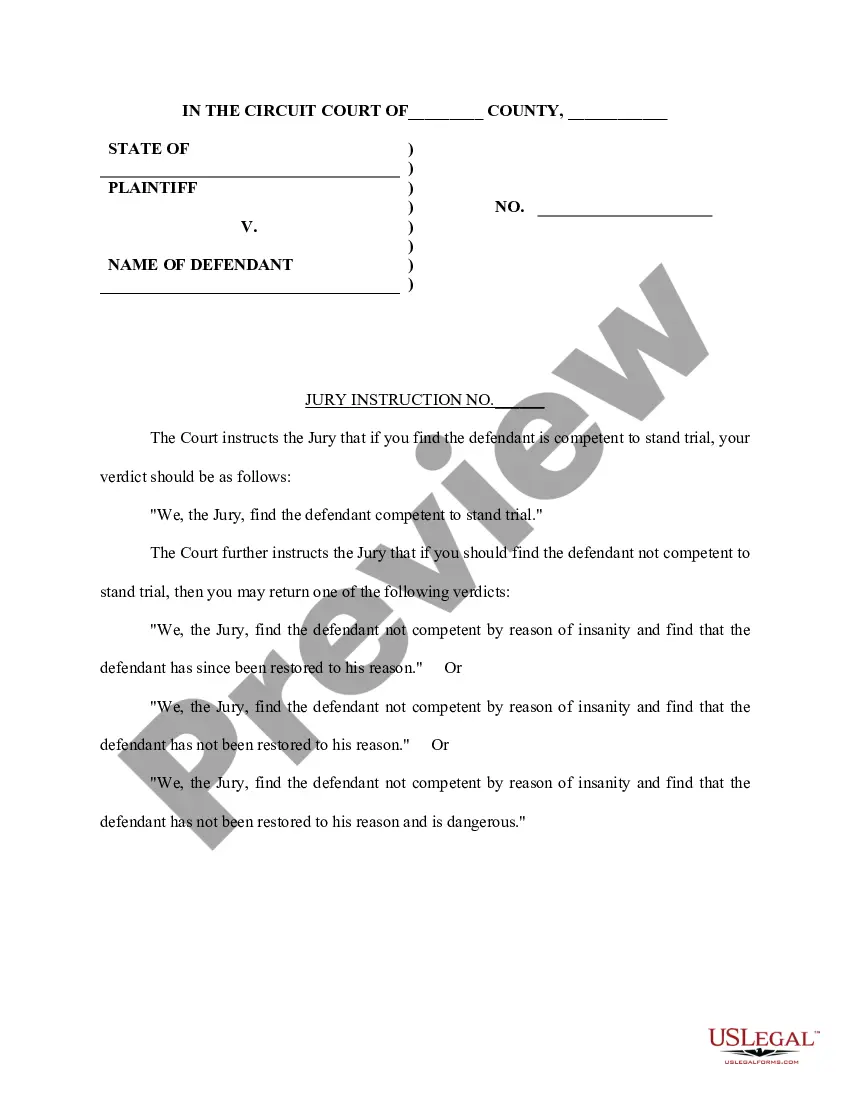
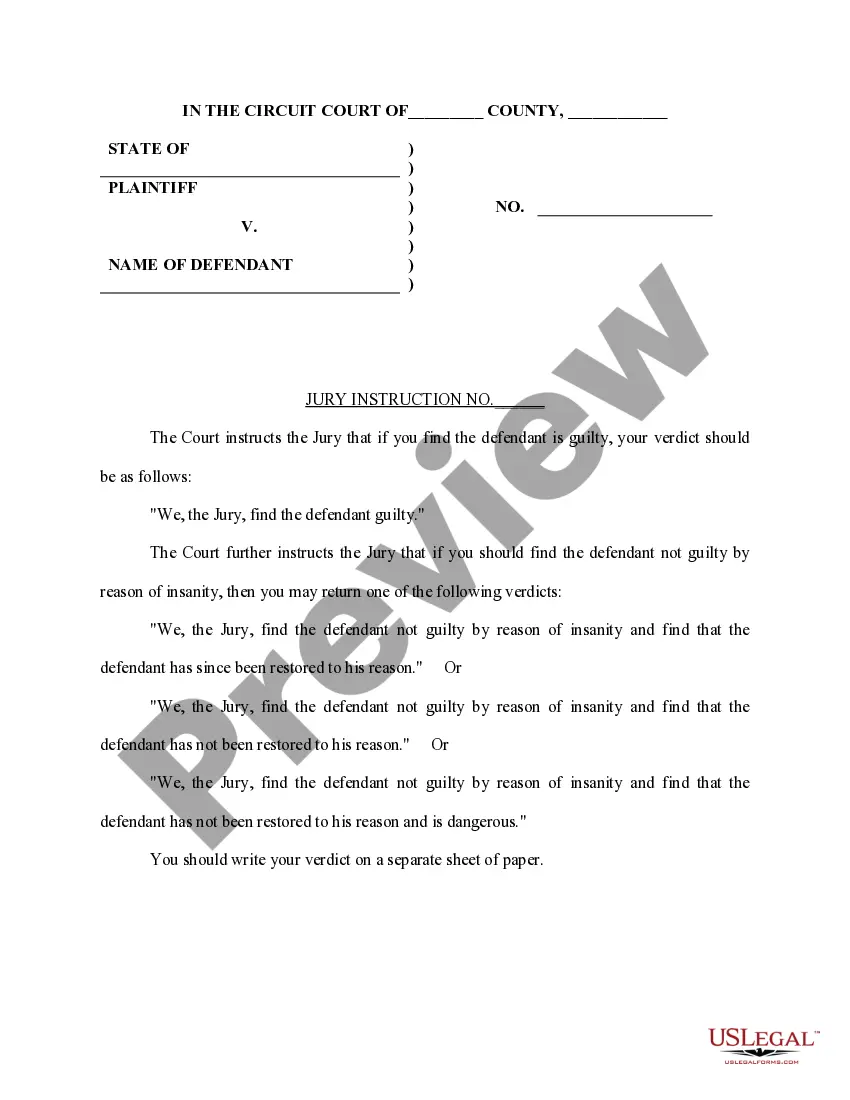
The Competence - Form of Verdict is a legal document used during trials to instruct a jury on determining whether a defendant is competent to stand trial. This form provides specific verdict options for the jury, depending on the defendant's mental competency or insanity status. It ensures that the jury's findings are clearly stated and offers guidance on how to deliver a verdict regarding the defendant's mental fitness for trial.
Main sections of this form
- Instructions for deciding the defendant's competency status.
- Verdict options when the defendant is found competent.
- Verdict options when the defendant is found not competent by reason of insanity.
- Clarification on the state of restoration of the defendant's mental capacity.
- Signing section for the jury foreperson to confirm the verdict.
When to use this form
This form should be used in legal cases where a defendant's competency to stand trial is in question. It is typically utilized during criminal trials when the defense raises concerns about the defendant's mental health, arguing they may not be fit to participate in their defense. The form helps the jury provide a clear and legally sufficient verdict based on their findings regarding the defendant's mental state.
Who needs this form
- Attorneys representing defendants in criminal cases.
- Judges overseeing trials involving claims of insanity or incompetency.
- Jurors tasked with determining the competency of a defendant to stand trial.
Instructions for completing this form
- Read the court's instructions carefully regarding the definitions of competency and insanity.
- Consider the evidence and testimony presented during the trial.
- Select the appropriate verdict based on your findings regarding the defendant's competency.
- Clearly write or indicate your decision on the provided verdict options.
- Have the jury foreperson sign and date the form to confirm the verdict.
Notarization requirements for this form
Notarization is not commonly needed for this form. However, certain documents or local rules may make it necessary. Our notarization service, powered by Notarize, allows you to finalize it securely online anytime, day or night.
Get your form ready online
Our built-in tools help you complete, sign, share, and store your documents in one place.
Make edits, fill in missing information, and update formatting in US Legal Forms—just like you would in MS Word.
Download a copy, print it, send it by email, or mail it via USPS—whatever works best for your next step.
Sign and collect signatures with our SignNow integration. Send to multiple recipients, set reminders, and more. Go Premium to unlock E-Sign.
If this form requires notarization, complete it online through a secure video call—no need to meet a notary in person or wait for an appointment.
We protect your documents and personal data by following strict security and privacy standards.

Make edits, fill in missing information, and update formatting in US Legal Forms—just like you would in MS Word.

Download a copy, print it, send it by email, or mail it via USPS—whatever works best for your next step.

Sign and collect signatures with our SignNow integration. Send to multiple recipients, set reminders, and more. Go Premium to unlock E-Sign.

If this form requires notarization, complete it online through a secure video call—no need to meet a notary in person or wait for an appointment.

We protect your documents and personal data by following strict security and privacy standards.
Common mistakes
- Failing to fully understand the definitions of competency and insanity before deliberating.
- Leaving the form incomplete or unclear regarding the verdict decision.
- Not following court instructions carefully during the deliberation process.
Why use this form online
- Easy access to the form from any device, allowing for convenience in a legal setting.
- Downloadable and editable format enables customization to fit specific case needs.
- Instant availability allows for timely filing and compliance with court requirements.
Looking for another form?
Form popularity
FAQ
Following the instructions from the judge, the jury will be taken to a private room to discuss the verdict.All jurors must reach a unanimous verdict of either guilty or not guilty. If the jury deadlocks and cannot reach a unanimous decision, this results in a hung jury and a mistrial.
Deliberation is a process of thoughtfully weighing options, usually prior to voting.In legal settings a jury famously uses deliberation because it is given specific options, like guilty or not guilty, along with information and arguments to evaluate.
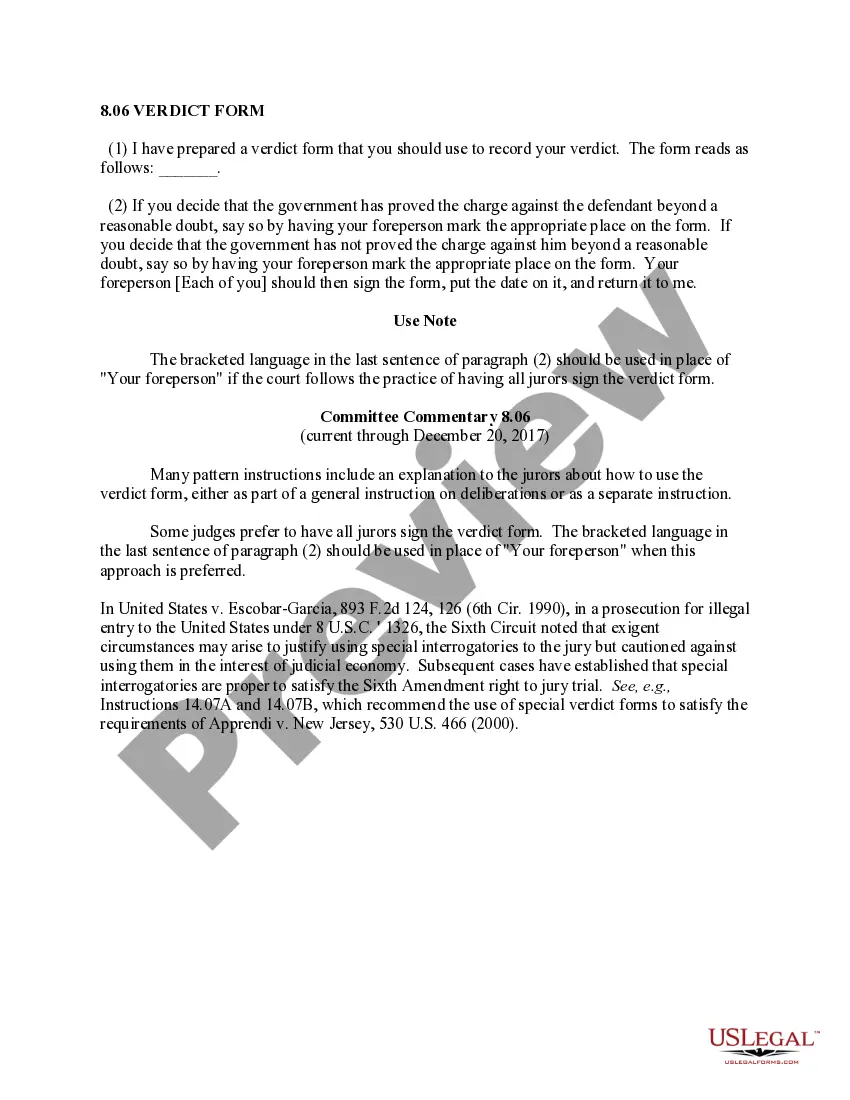
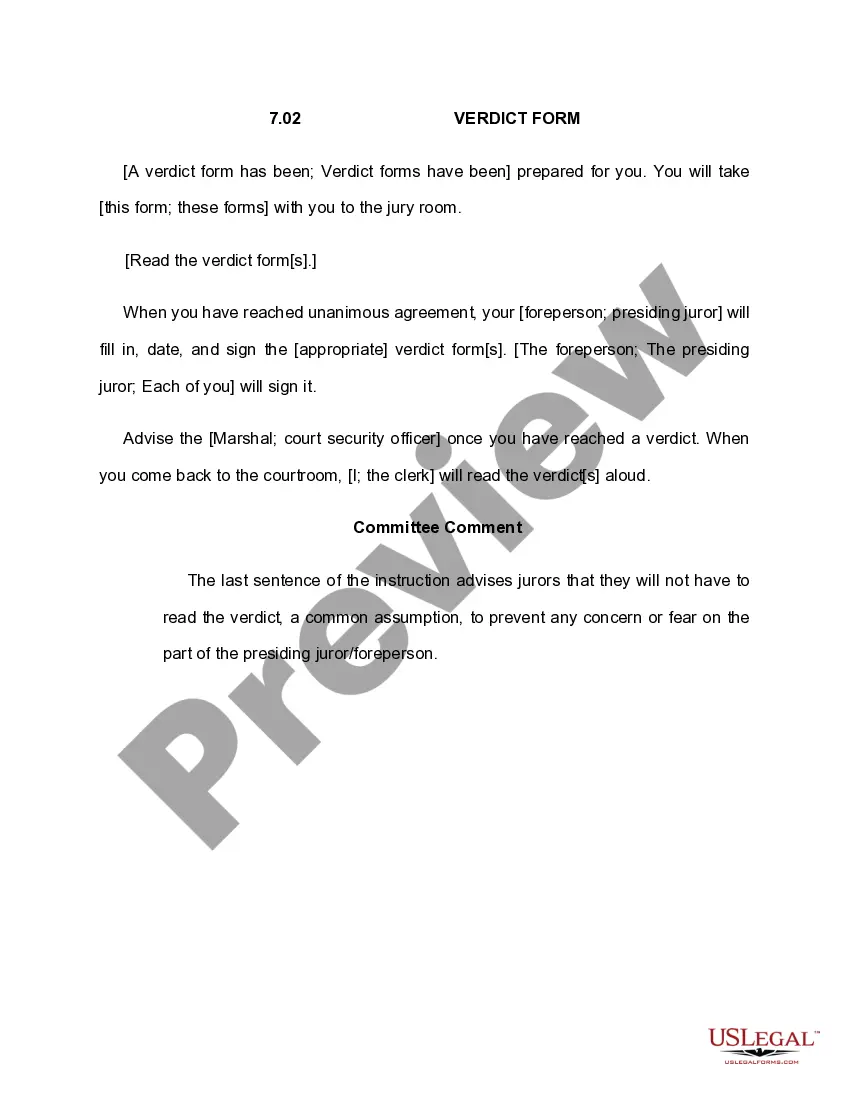
Verdict: The official decision or finding of the jury which is reported to the court.
Rule 49 identifies three kinds of jury verdicts: general, special, and general with interrogatories. The general verdict asks the jury one (or two) questions going to the ultimate issues ("do you find for the plaintiff or the defendant? or "do you find the defendant guilty or not guilty?").
Verdicts are of several kinds, namely, privy and public, general, partial, and special. 3.
In federal criminal trials, the jury must reach a unanimous decision in order to convict the defendant. After they reach an agreement on a verdict, they notify the judge, the lawyers, and the defendant in open court. Everyone is present in court for the reading of the verdict.
1 : the finding or decision of a jury on the matter submitted to it in trial. 2 : opinion, judgment.