Petition of Minor by Guardian Ad Litem to be Declared Free from Father's Custody Due to Cruel Treatment - Release of Parental Rights
What this document covers
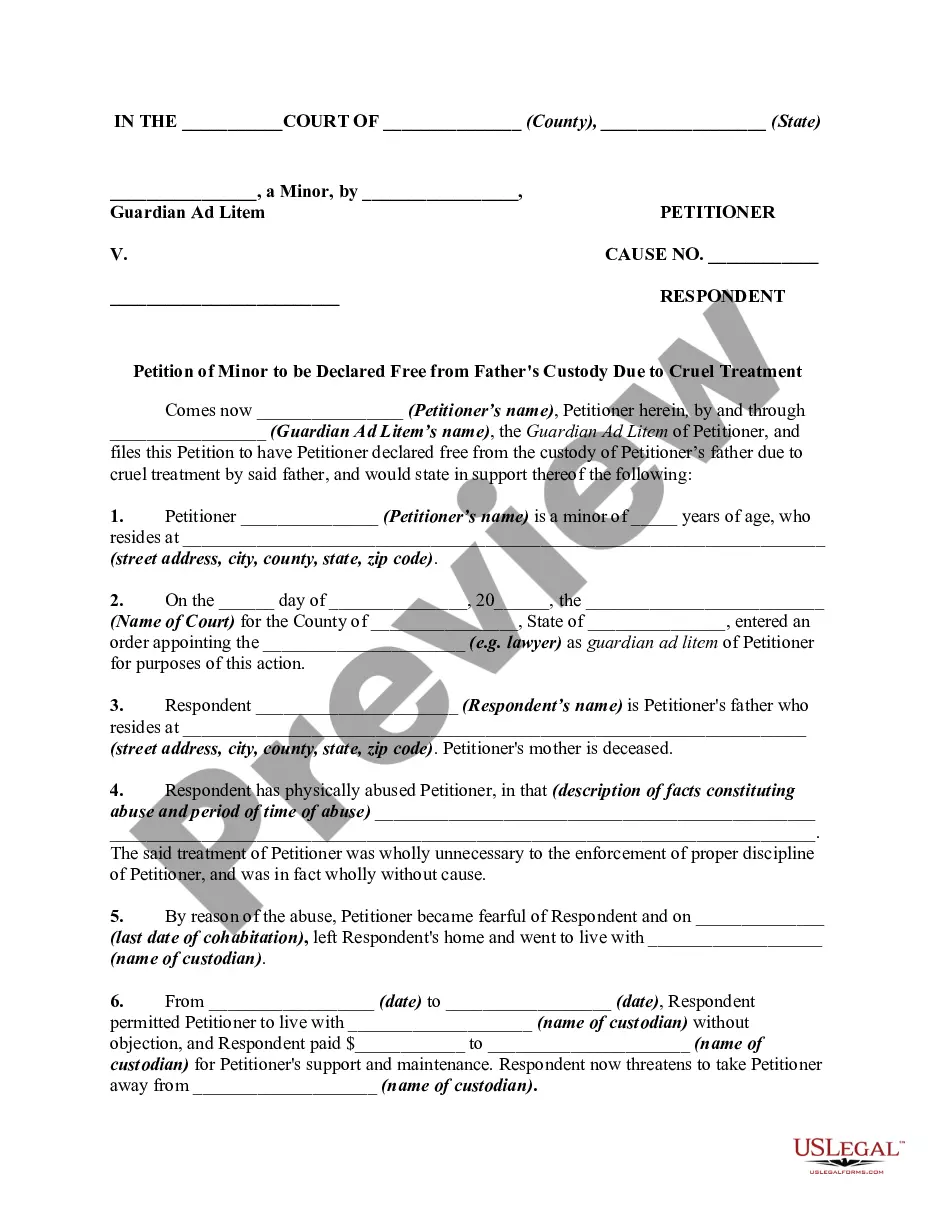
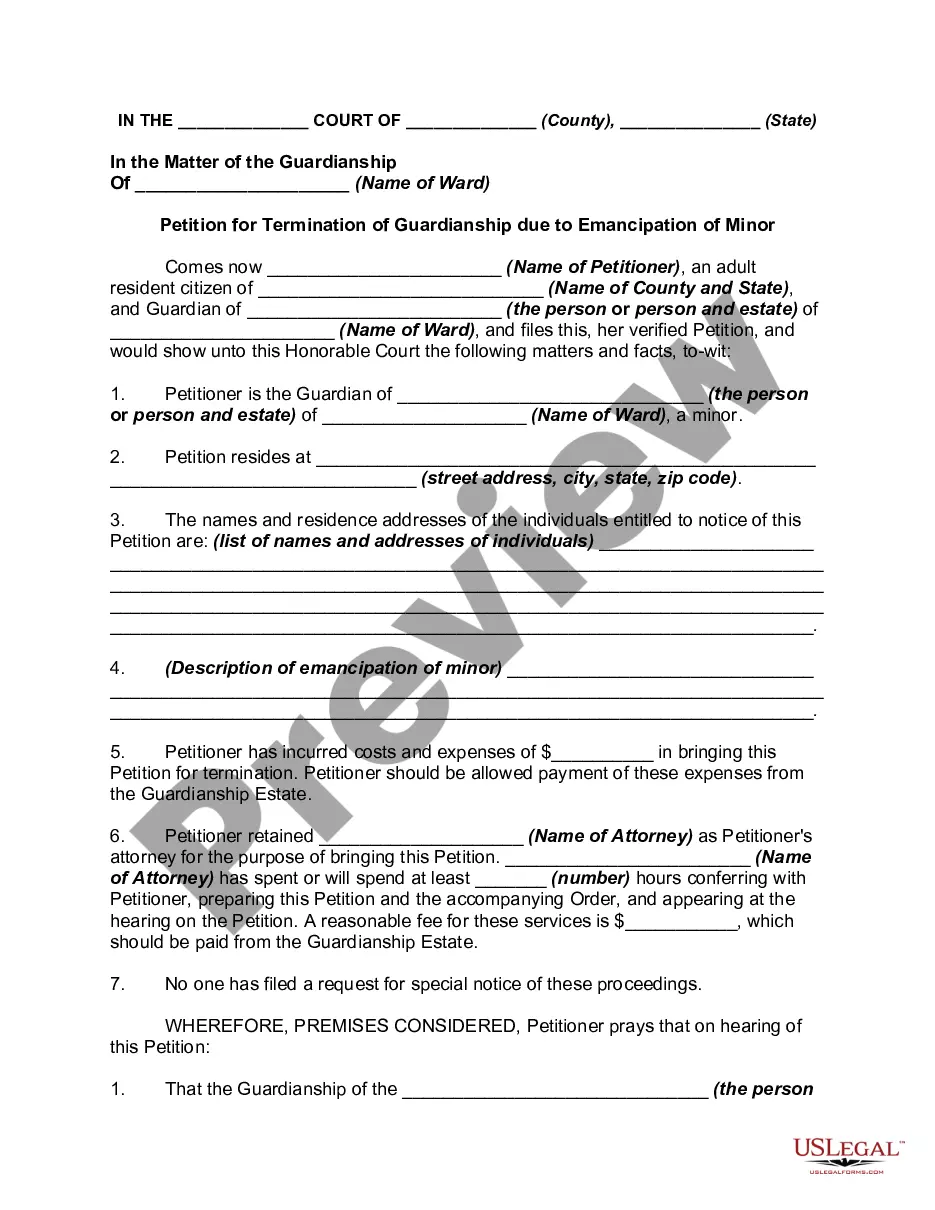
The Petition of Minor by Guardian Ad Litem to be Declared Free from Father's Custody Due to Cruel Treatment is a legal document that allows a minor, represented by a Guardian Ad Litem, to petition the court for the termination of their father's parental rights based on allegations of cruel treatment. This form is distinct from general custody forms as it specifically addresses situations involving abuse and seeks to permanently sever parental rights rather than merely modify custody arrangements.
Main sections of this form
- Name of the minor and Guardian Ad Litem.
- Details of the court and case number.
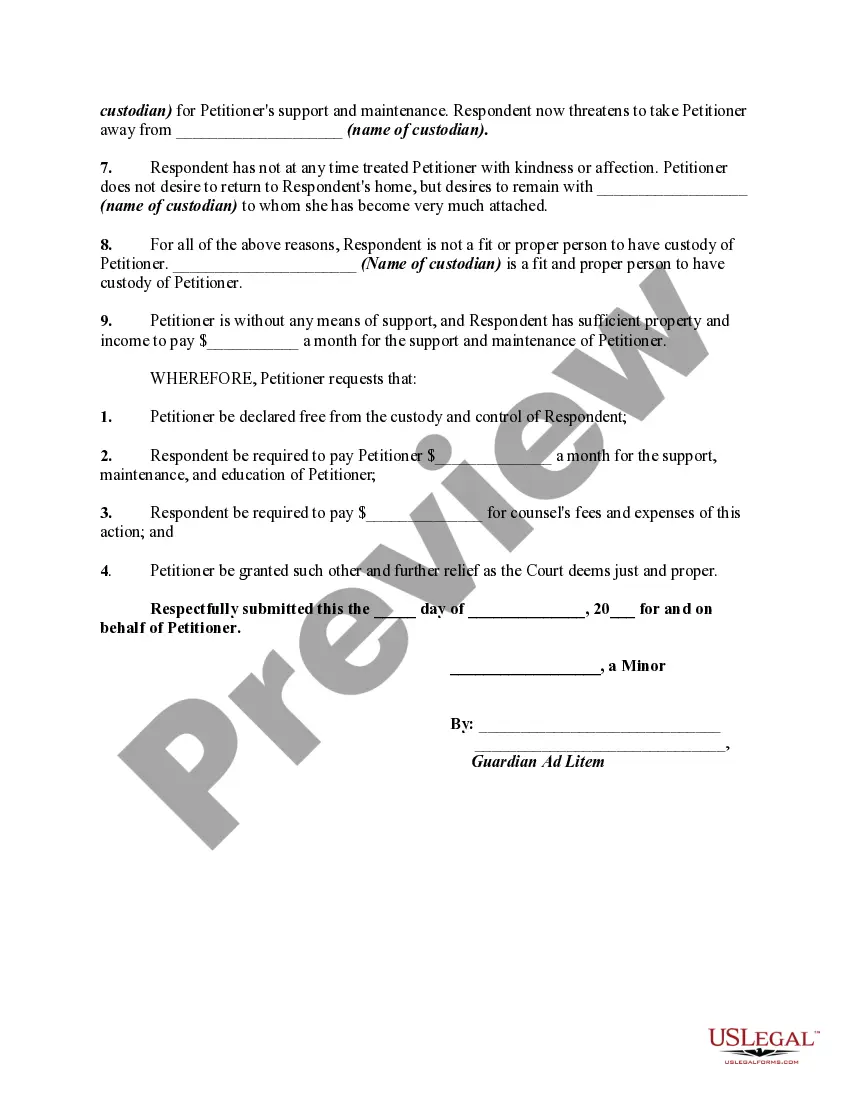
- Allegations of cruel treatment and their impact on the minor.
- Information about the current living situation and the custodian's suitability.
- Requests for court orders regarding custody and support.

Situations where this form applies
This petition should be used when a minor is subjected to cruel treatment by a parent and wishes to be declared free from that parent's custody. It is appropriate in situations where safety is a concern, and the minor has been placed with a different custodian who can provide a stable and nurturing environment.
Who should use this form
- Minors who have experienced abuse or neglect by a parent.
- Guardians Ad Litem representing minors in legal proceedings.
- Custodians seeking to protect the welfare of a minor from an unfit parent.
Steps to complete this form
- Identify and enter the names of the minor and the Guardian Ad Litem.
- Provide the court information and case number.
- Clearly outline the facts of the cruel treatment and the minor's current living situation.
- State the desired outcomes, including custody arrangements and financial support requests.
- Sign and date the petition, ensuring all parties have provided required information.
Notarization guidance
Notarization is required for this form to take effect. Our online notarization service, powered by Notarize, lets you verify and sign documents remotely through an encrypted video session, available 24/7.
Get your form ready online
Our built-in tools help you complete, sign, share, and store your documents in one place.
Make edits, fill in missing information, and update formatting in US Legal Forms—just like you would in MS Word.
Download a copy, print it, send it by email, or mail it via USPS—whatever works best for your next step.
Sign and collect signatures with our SignNow integration. Send to multiple recipients, set reminders, and more. Go Premium to unlock E-Sign.
If this form requires notarization, complete it online through a secure video call—no need to meet a notary in person or wait for an appointment.
We protect your documents and personal data by following strict security and privacy standards.

Make edits, fill in missing information, and update formatting in US Legal Forms—just like you would in MS Word.

Download a copy, print it, send it by email, or mail it via USPS—whatever works best for your next step.

Sign and collect signatures with our SignNow integration. Send to multiple recipients, set reminders, and more. Go Premium to unlock E-Sign.

If this form requires notarization, complete it online through a secure video call—no need to meet a notary in person or wait for an appointment.

We protect your documents and personal data by following strict security and privacy standards.
Common mistakes to avoid
- Failing to include specific details about the cruel treatment.
- Omitting the name and contact information of the custodian.
- Not following local court rules for formatting and submission.
Advantages of online completion
- Convenient access to the form anytime and anywhere.
- Editable fields to customize the petition according to the minor's situation.
- Reliable templates drafted by licensed attorneys to ensure legal compliance.
Looking for another form?





Form popularity
FAQ
First Impressions at the GAL Office. As the saying goes, You never get a second chance to make a first impression. This is definitely the case with a GAL. First Impressions at the Home Visit. Don't Put the Child in the Middle. Be Honest. Stay In Touch.
The Voluntary Termination of Parental Rights in CaliforniaThe parent voluntarily relinquishing his/her rights must be served with adequate notice before doing so. The parent will also be given the opportunity to consent or object in person during the court proceeding to relinquish rights.
If you can not pay the GAL fees, your pleadings will get dismissed.
The statutory grounds for termination of parental rights in the state of Florida include: Voluntary SurrenderShould a parent decide to voluntarily surrender his or her parental rights, properly filled out, written documentation must be submitted.
If a parent surrenders their parental rights they do not have to pay child support anymore. However, this also means that they no longer have any say in what the child does and they cannot request visitation rights.
An agreement between the parents: If both parents agree, child support payments can be waived or stopped. Give up your parental rights: A parent can decide to do this but they will have to follow specific state guidelines.
Family law judges take many other factors into consideration. Until a child is a legal adult at age 18, he or she cannot automatically choose which parent to live with. Cases in which one parent wishes to relocate can also be challenging.
Do Judges Listen to the Guardian Ad Litem? The judge doesn't always agree with the guardian ad litem, but they do recognize the importance of the GAL in proceedings.
A Guardian ad Litem, commonly referred to as a GAL, is a person appointed by the Court to investigate the facts of any proceeding pending in the court relating to or involving questions as to the care, custody or maintenance of minor children and as to any matter involving domestic relations.