Petition to Declare Child Free from Parent's Custody and Control for Abandonment - Release of Parental Rights
Understanding this form
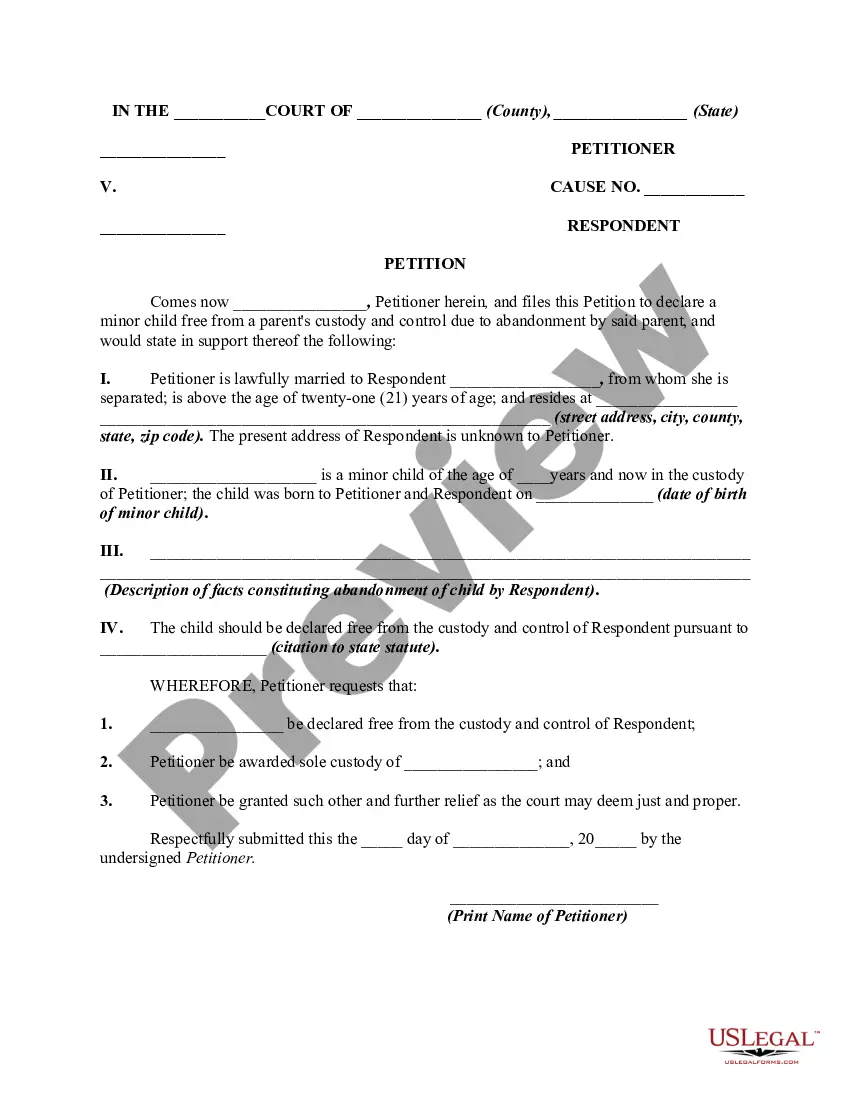
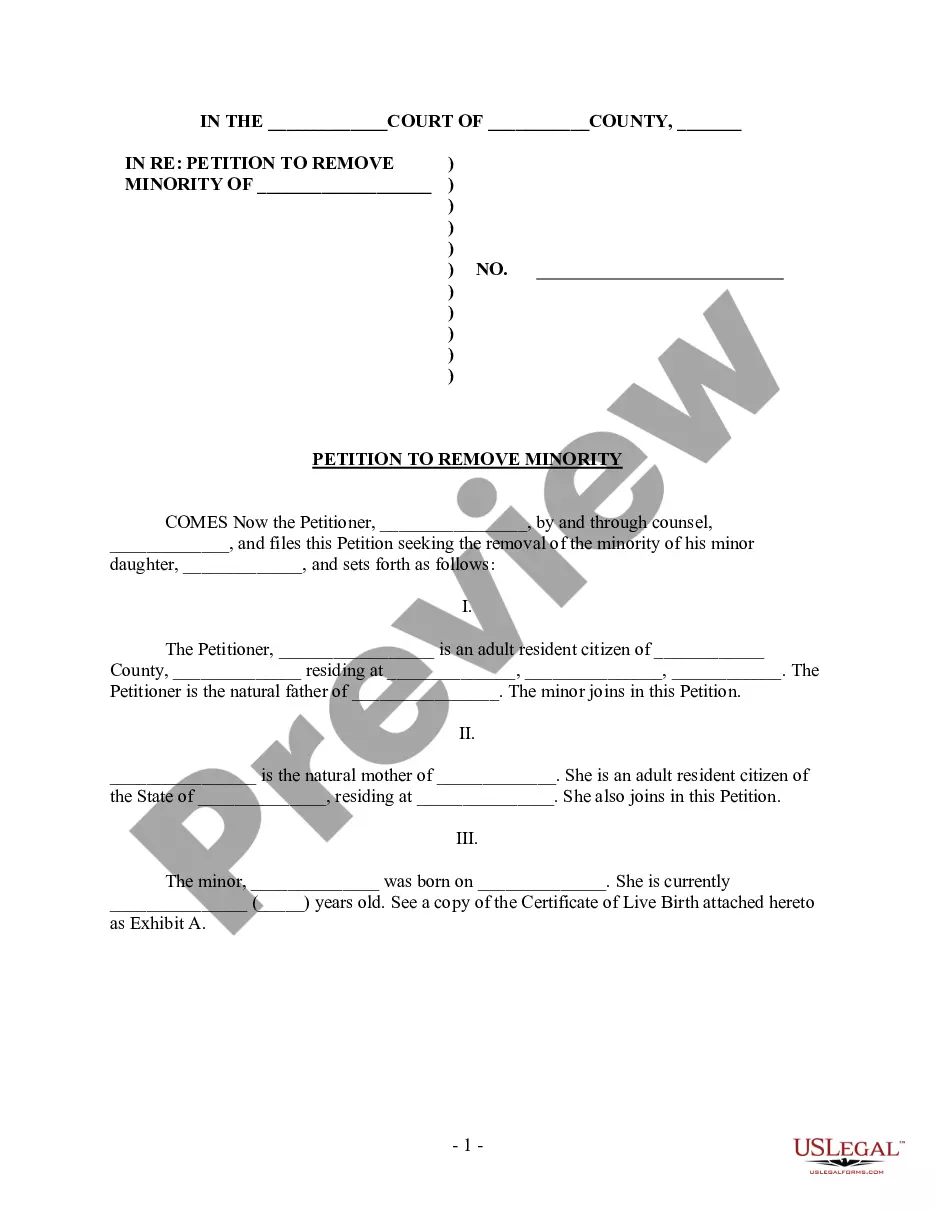
The Petition to Declare Child Free from Parent's Custody and Control for Abandonment is a legal document used to request that a court declare a child free from the custody of a parent due to abandonment. This form enables a petitioner to initiate proceedings that can ultimately terminate parental rights, differing from custody arrangements that may still allow parental involvement.
What’s included in this form
- Petitioner's information: Name and address of the person filing the petition.
- Respondent's information: Details about the parent whose custody is being contested.
- Child's details: Name and age of the child involved in the petition.
- Allegations of abandonment: Section for the petitioner to describe how the respondent has abandoned the child.
- Legal citation: Reference to the specific state statute supporting the petition.
- Relief requested: Specifies what the petitioner is asking the court to grant.
When this form is needed
This form is used in situations where a child has been abandoned by a parent, and the other parent or guardian is seeking to terminate the abandoning parent's rights. Valid scenarios include when the responding parent has been absent for an extended period or has failed to provide support or engagement in the child's life. This legal step is crucial for protecting the child's welfare and establishing clear guardianship.
Who this form is for
- Individuals who are the parent or legal guardian of the child.
- Persons seeking to terminate custody rights of an abandoning parent.
- Guardians in legal situations pertaining to child welfare and custody disputes.
Steps to complete this form
- Identify the parties involved by filling in the names and addresses of the petitioner and respondent.
- Provide the child's details, including their name and age.
- Clearly describe the facts that constitute abandonment in the designated section.
- Cite the relevant state statute that supports your petition in the prescribed area.
- Request specific relief regarding the custody status of the child at the end of the petition.
- Sign and date the form, ensuring to submit it according to local court rules.
Notarization guidance
This form usually doesn’t need to be notarized. However, local laws or specific transactions may require it. Our online notarization service, powered by Notarize, lets you complete it remotely through a secure video session, available 24/7.
Get your form ready online
Our built-in tools help you complete, sign, share, and store your documents in one place.
Make edits, fill in missing information, and update formatting in US Legal Forms—just like you would in MS Word.
Download a copy, print it, send it by email, or mail it via USPS—whatever works best for your next step.
Sign and collect signatures with our SignNow integration. Send to multiple recipients, set reminders, and more. Go Premium to unlock E-Sign.
If this form requires notarization, complete it online through a secure video call—no need to meet a notary in person or wait for an appointment.
We protect your documents and personal data by following strict security and privacy standards.

Make edits, fill in missing information, and update formatting in US Legal Forms—just like you would in MS Word.

Download a copy, print it, send it by email, or mail it via USPS—whatever works best for your next step.

Sign and collect signatures with our SignNow integration. Send to multiple recipients, set reminders, and more. Go Premium to unlock E-Sign.

If this form requires notarization, complete it online through a secure video call—no need to meet a notary in person or wait for an appointment.

We protect your documents and personal data by following strict security and privacy standards.
Common mistakes
- Failing to provide complete and accurate information about all parties involved.
- Not including a detailed description of the abandonment circumstances.
- Omitting the legal citation which supports the petition.
- Not signing or dating the form properly prior to submission.
Advantages of online completion
- Convenience of downloading the form at any time, from anywhere.
- Access to attorney-drafted templates ensuring legal compliance.
- Editability to customize the form according to specific case details.
Looking for another form?







Form popularity
FAQ
The abandoning of a child occurs when a child is left by their parent/guardian, without the intention of returning to the child to ensure they are safe and well.Under child abandonment law a parent can face a custodial sentence if convicted of abandoning their child.
The parent or parents have left the child and failed to provide identification for the child (An example of this is providing a birth certificate); The parent or parents have failed to provide support for the child for an extended period of time;
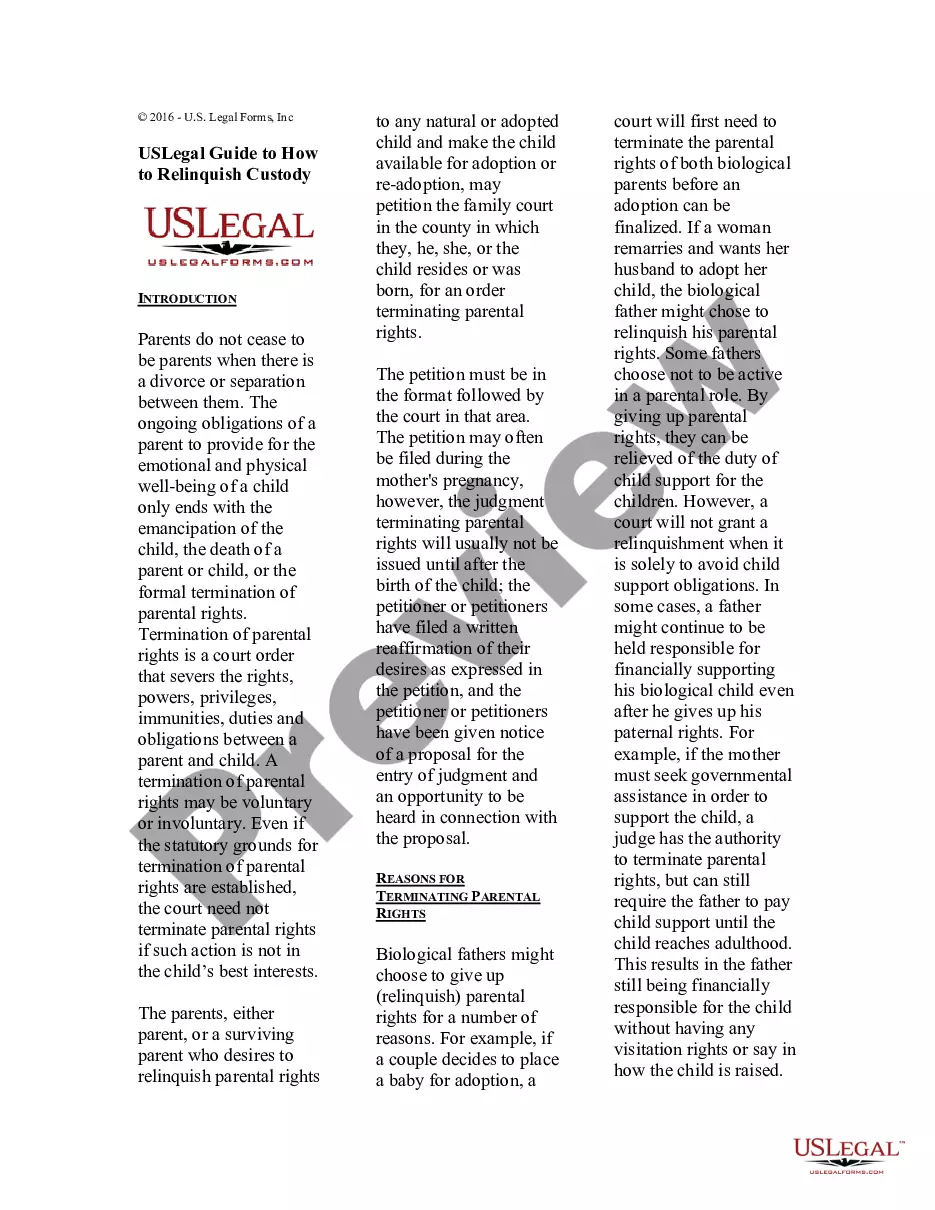
Once abandonment has been proven, the parental rights of the parent who abandoned the child can be terminated.Typically, these are scenarios in which the biological father is uninvolved in the child's life, and he may even be difficult or impossible to locate.
In order to prove abandonment, the abandoned spouse must use direct or constructive evidence to demonstrate their claim. The spouse claiming abandonment must prove that the couple kept separate residences and didn't engage in marital relations for a required period, usually a year.
Absent parent: If a parent has been absent for 6 months or more, the law allows the other, more responsible parent, to petition to terminate parental rights. Not just parents can terminate: in fact, anyone with an interest in the well-being of a child can attempt to terminate one or both parents' rights.
Parents will have to file a petition with their local court requesting a hearing to determine parental rights. Once a petition is filed, parents need to attend a hearing before the judge who will determine whether rights will be granted/terminated.
Child abandonment occurs when a parent, guardian, or person in charge of a child either deserts a child without any regard for the child's physical health, safety or welfare and with the intention of wholly abandoning the child, or in some instances, fails to provide necessary care for a child living under their roof.