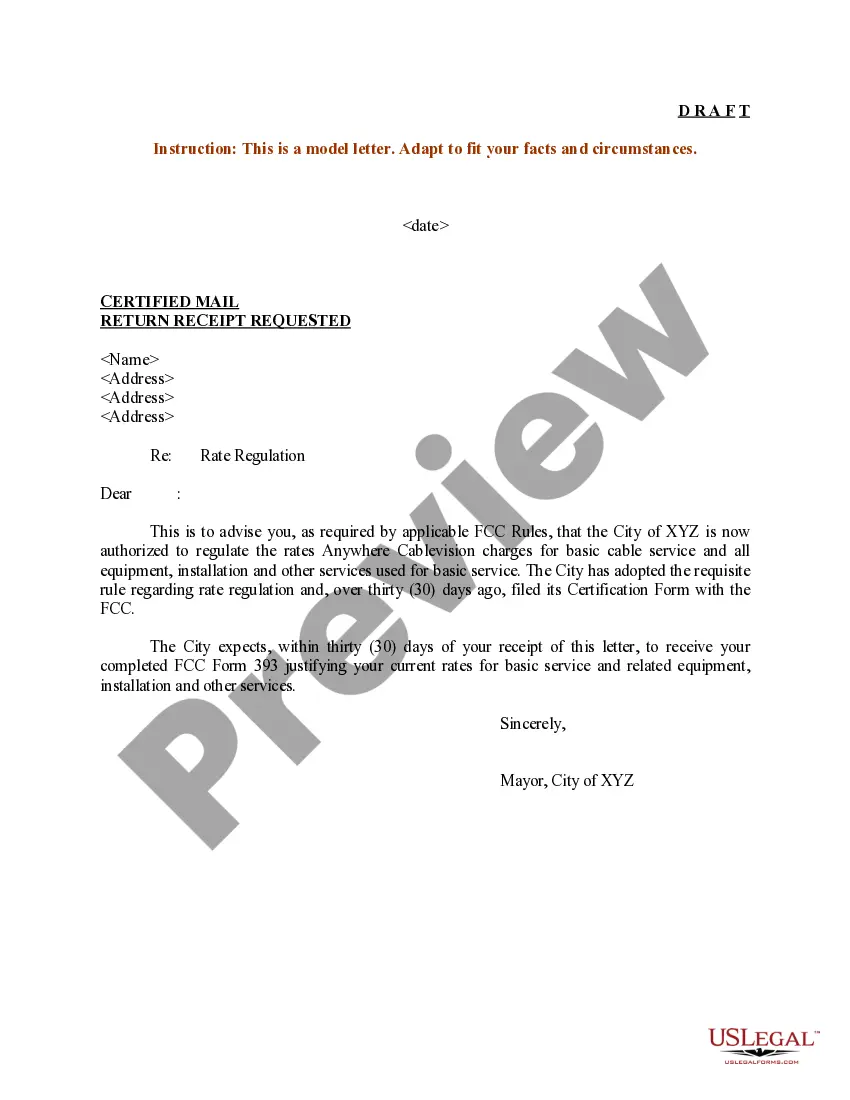
Sample Letter for Regulation of Cable Rates
Understanding this form
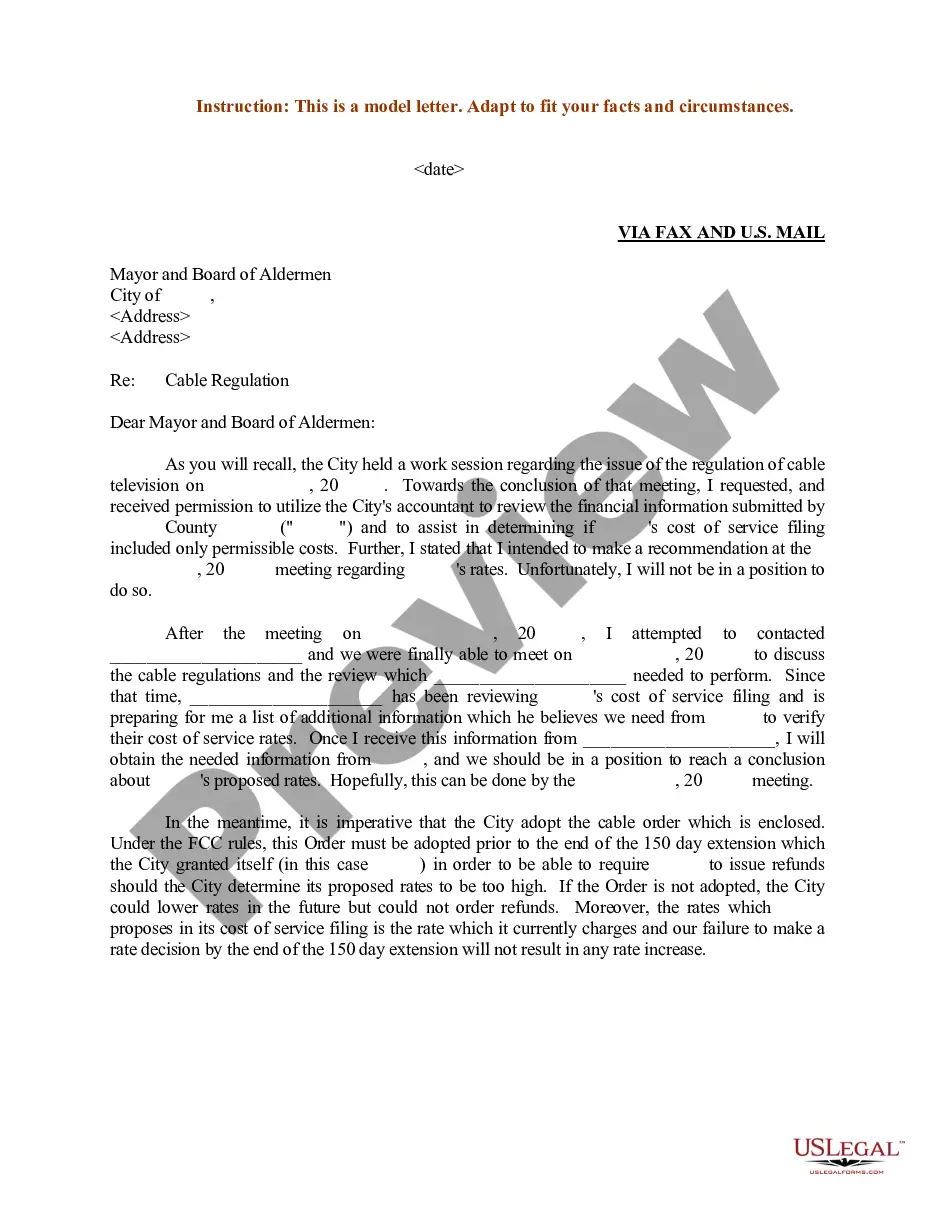
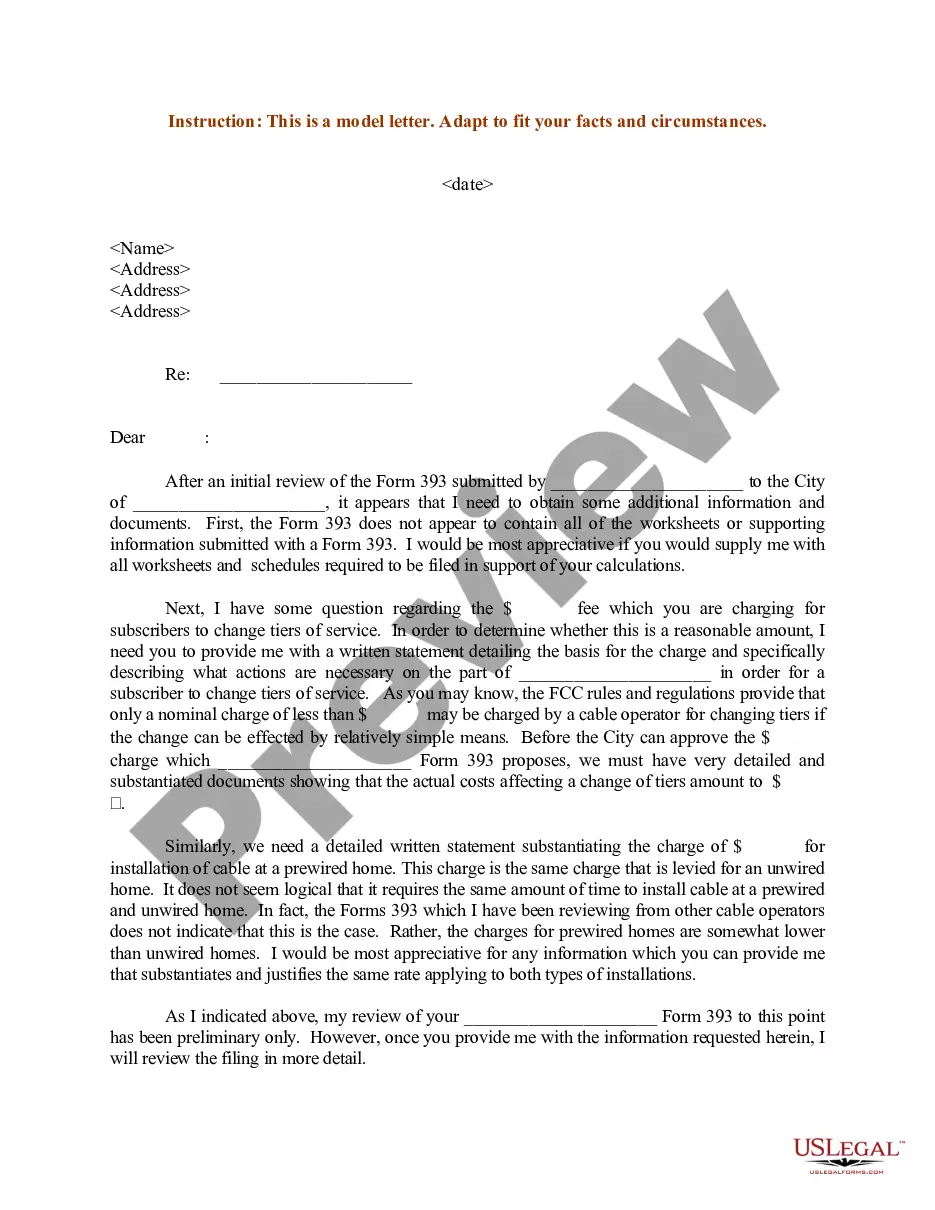
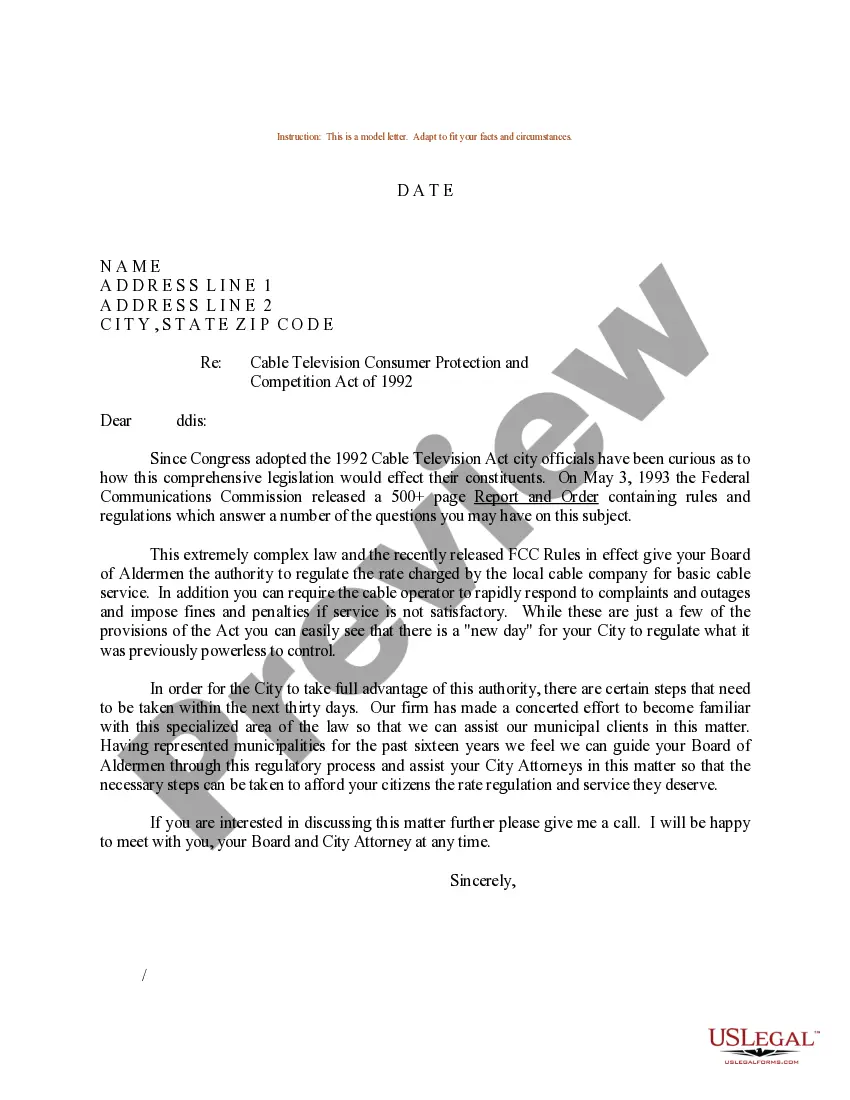
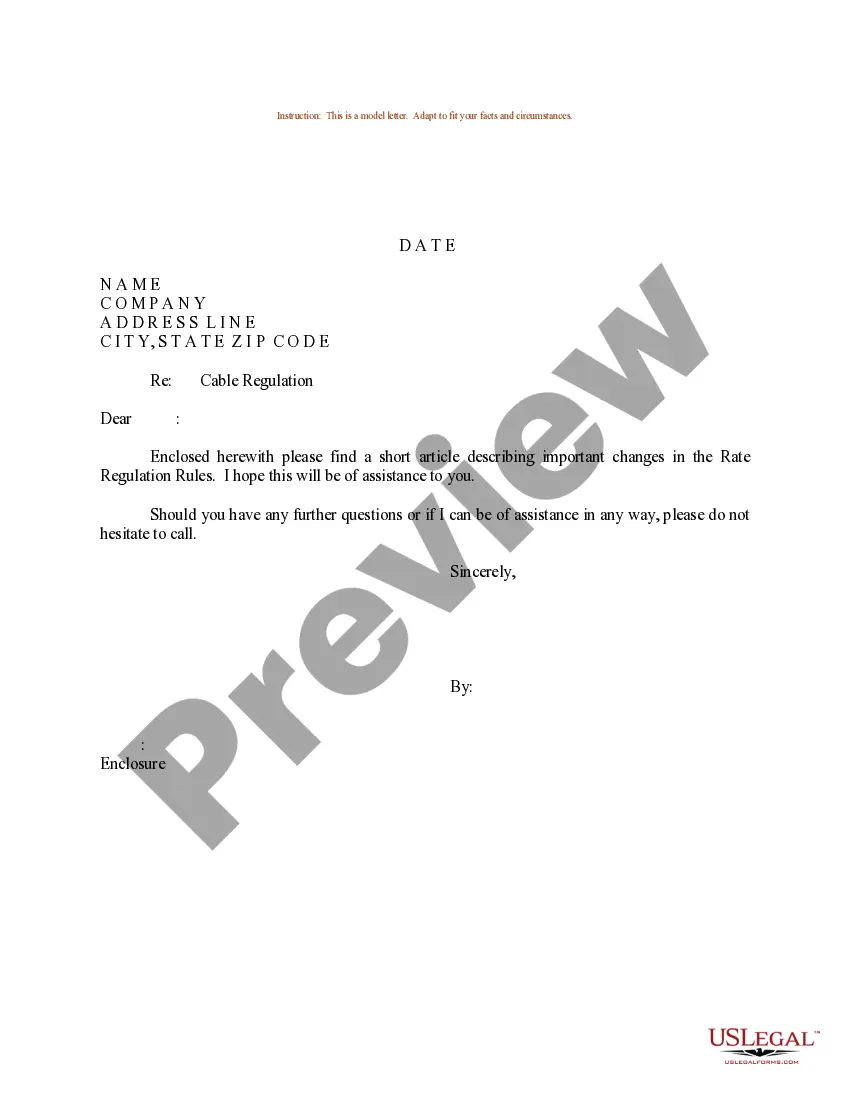
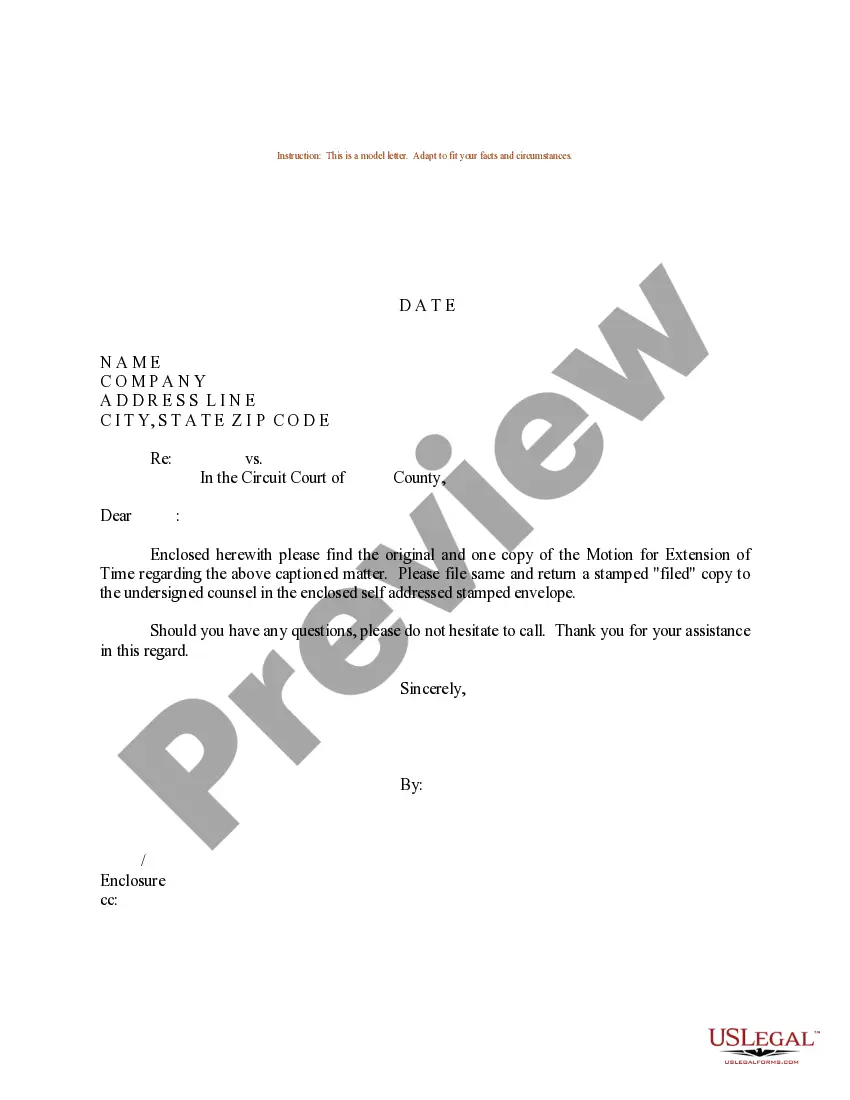
The Sample Letter for Regulation of Cable Rates is a model letter designed to help individuals or entities request the regulation of their cable rates. This form provides a structured format to communicate your concerns to the appropriate authorities. Unlike other legal forms, this letter specifically addresses cable rate issues, making it a unique tool for consumers looking to challenge or inquire about their rates effectively.
What’s included in this form
- Date: The date when the letter is sent.
- Recipient Information: The name and address of the authority or company receiving the letter.
- Subject Line: Clearly indicates that the letter concerns rate regulation.
- Body of the Letter: Contains the specific request or issue regarding cable rates.
- Sign-off: A professional closing along with the sender's name.
Situations where this form applies
This letter is used when you want to formally address concerns related to your cable service rates. You may need this form if you believe that your rates are unjust, if there have been service changes that affect pricing, or if you simply seek clarification on how rates are structured. Using this sample letter can facilitate your communication with regulators or service providers and help ensure your query is taken seriously.
Who should use this form
- Consumers unhappy with their current cable rates.
- Individuals seeking to understand billing practices from their cable service provider.
- Community organizations advocating for fair cable pricing.
- Legal representatives of consumers addressing rate issues with cable companies.
Instructions for completing this form
- Identify the date you are sending the letter.
- Enter the recipient's name and address, ensuring it is accurate and complete.
- Clearly state the subject of your letter regarding rate regulation.
- Detail your concerns or requests in the body of the letter, being concise and direct.
- Sign off with your name and any relevant contact information.
Does this form need to be notarized?
This form does not typically require notarization unless specified by local law. However, it is advisable to check local regulations to ensure compliance.
Get your form ready online
Our built-in tools help you complete, sign, share, and store your documents in one place.
Make edits, fill in missing information, and update formatting in US Legal Forms—just like you would in MS Word.
Download a copy, print it, send it by email, or mail it via USPS—whatever works best for your next step.
Sign and collect signatures with our SignNow integration. Send to multiple recipients, set reminders, and more. Go Premium to unlock E-Sign.
If this form requires notarization, complete it online through a secure video call—no need to meet a notary in person or wait for an appointment.
We protect your documents and personal data by following strict security and privacy standards.

Make edits, fill in missing information, and update formatting in US Legal Forms—just like you would in MS Word.

Download a copy, print it, send it by email, or mail it via USPS—whatever works best for your next step.

Sign and collect signatures with our SignNow integration. Send to multiple recipients, set reminders, and more. Go Premium to unlock E-Sign.

If this form requires notarization, complete it online through a secure video call—no need to meet a notary in person or wait for an appointment.

We protect your documents and personal data by following strict security and privacy standards.
Common mistakes to avoid
- Failing to include a clear subject line.
- Providing incorrect recipient information.
- Being vague about the concerns or requests in the letter.
- Not including a date, which can delay your request.
Advantages of online completion
- Convenient: Easily download and customize the letter to fit your needs.
- Editable: Modify the document quickly to reflect your specific circumstances.
- Reliable: Created by licensed attorneys, ensuring legal accuracy.
Legal use & context
- Using this letter may lead to a formal review of cable rates by a regulatory body.
- This template maintains a professional tone important for legal correspondence.
- The form serves as a record of the consumerâs request for transparency in pricing.
Summary of main points
- The form helps in addressing concerns about cable rates formally.
- Accurate details in the letter improve the likelihood of a response.
- Using the structured format makes communication easier for recipients.
Looking for another form?
Form popularity
FAQ
A diplomatic cable, also known as a diplomatic telegram (DipTel) or embassy cable, is a confidential text-based message exchanged between a diplomatic mission, like an embassy or a consulate, and the foreign ministry of its parent country.Other dispatches may be sent as physical documents in a diplomatic bag.
Letters, numbers, and wording on wiring labels tell you important information, such as the wire material, the size of the wire, and the type of insulation used on the conducting wires.Cables carry labels indicating the cable type or construction as well as the number of wires inside the cable.
Cable is the medium through which information usually moves from one network device to another. There are several types of cable which are commonly used with LANs.The type of cable chosen for a network is related to the network's topology, protocol, and size.
A communication cable is an electrical cable used to send information signals and is most commonly found as coaxial, fiber optic, data & ethernet, and twisted wire pairs.
D : a wire or wire rope by which force is exerted to control or operate a mechanism. 2 : cable length. 3a : an assembly of electrical conductors insulated from each other but laid up together (as by being twisted around a central core) b : cablegram also : a radio message or telegram.
Alternatively referred to as a cord, connector or plug, a cable is one or more wires covered in plastic that transmit power or data between devices or locations.There are two main types of computer cables, a data cable and a power cable. A data cable is a cable that provides communication between devices.
1a : a strong rope especially of 10 inches (25 centimeters) or more in circumference. b : a cable-laid rope. c : a wire rope or metal chain of great tensile strength. d : a wire or wire rope by which force is exerted to control or operate a mechanism. 2 : cable length.
A diplomatic cable is a diplomatic message. The etymology goes back to the mid-nineteenth century when the first diplomatic messages were sent via telegraph.But, in spite of changes in technology, the term 'cable' remains part of diplomatic lingo.
A cable is a thick wire, or a group of wires inside a rubber or plastic covering, which is used to carry electricity or electronic signals.Cable is used to refer to television systems in which the signals are sent along underground wires rather than by radio waves.