Consent of Employee to be Monitored and Recorded for Security Purposes Pursuant to Closed Circuit Video Surveillance - CCTV
Understanding this form
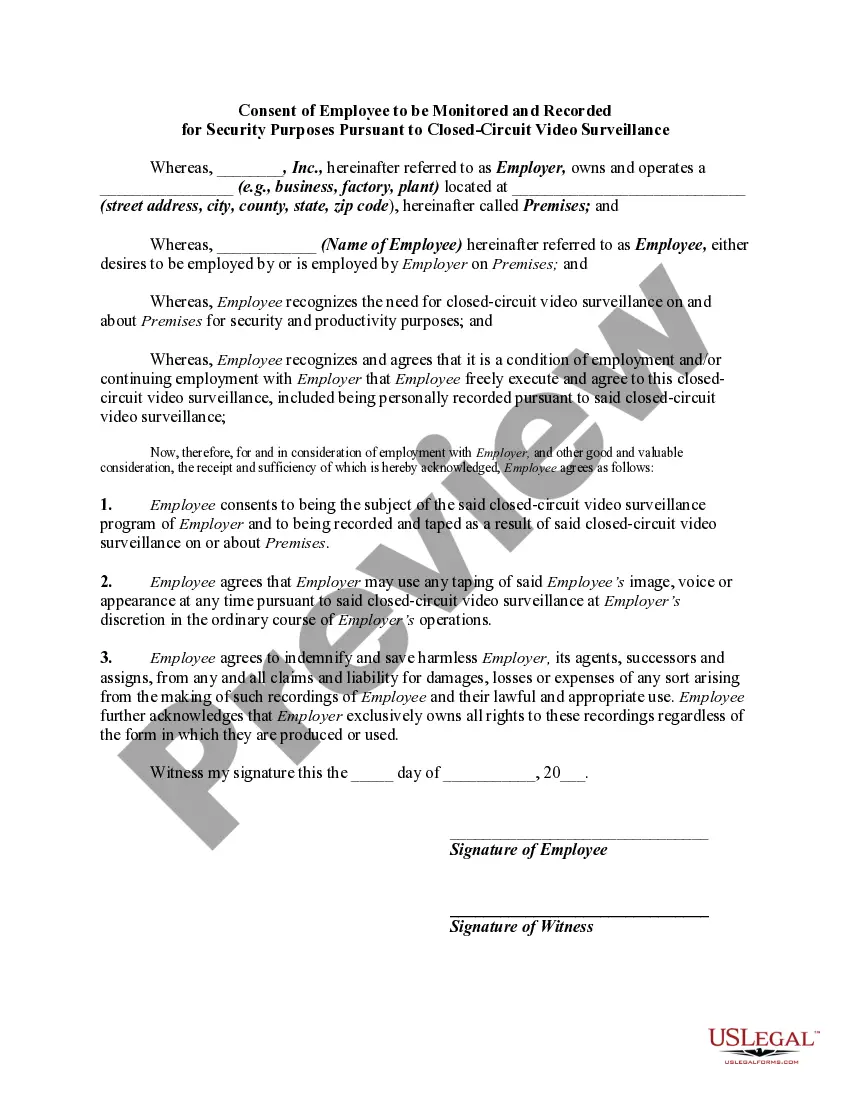
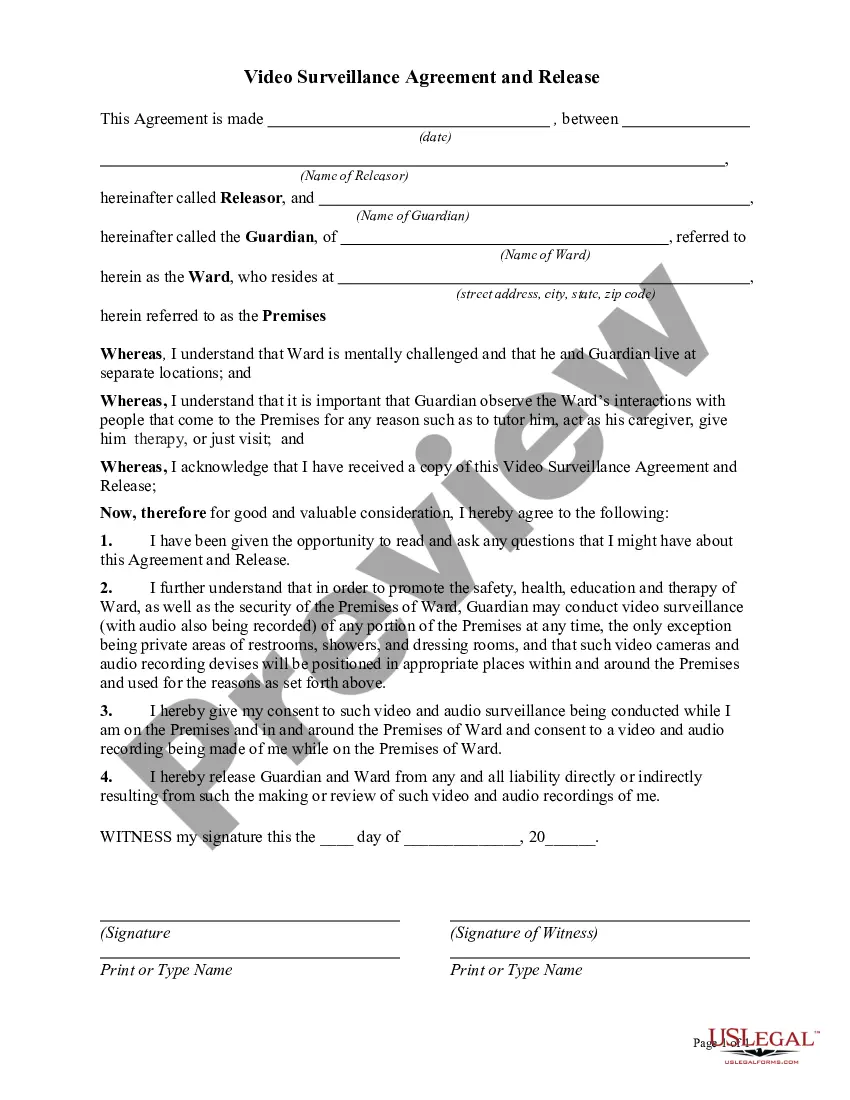
This form, known as the Consent of Employee to be Monitored and Recorded for Security Purposes Pursuant to Closed Circuit Video Surveillance - CCTV, is a legal document that allows employers to obtain consent from employees for video surveillance in the workplace. This consent is crucial for compliance with federal and state privacy laws, ensuring that employees are informed of their rights regarding monitoring and recording. Unlike public sector employees who have constitutional privacy protections, private sector employees rely on agreements like this one to establish their understanding and acceptance of surveillance practices.
Key parts of this document
- Identifies the employer and the premises where monitoring will occur.
- Specifies the employee's acknowledgment of being recorded for security and productivity purposes.
- Includes clauses detailing the employer's rights to use recordings as needed.
- Contains an indemnification provision protecting the employer from claims related to surveillance.
- Requires signatures from both the employee and a witness to validate the consent.
When to use this form
This form should be used when an employer intends to implement closed-circuit video surveillance in the workplace for security reasons. It is essential in scenarios where monitoring employee activities is deemed necessary to ensure safety, enhance productivity, or deter theft and misconduct. By securing written consent, employers can protect themselves from potential legal challenges regarding privacy violations.
Who this form is for
- Employers in the private sector planning to conduct video surveillance in their workplace.
- Human resources professionals responsible for employee onboarding and compliance with privacy laws.
- Managers seeking to implement monitoring policies that necessitate employee consent.
- Anyone involved in drafting workplace policies relating to surveillance and employee rights.
How to complete this form
- Identify the employer and provide the business name and address.
- State the name of the employee who will be monitored.
- Review the conditions outlined in the form regarding consent to surveillance.
- Ensure both the employee and a witness sign the document to validate consent.
- Keep a copy of the signed form for both the employer and the employee's records.
Does this document require notarization?
This form does not typically require notarization unless specified by local law. However, ensuring both parties sign it in the presence of a witness is recommended to strengthen its enforceability.
Get your form ready online
Our built-in tools help you complete, sign, share, and store your documents in one place.
Make edits, fill in missing information, and update formatting in US Legal Forms—just like you would in MS Word.
Download a copy, print it, send it by email, or mail it via USPS—whatever works best for your next step.
Sign and collect signatures with our SignNow integration. Send to multiple recipients, set reminders, and more. Go Premium to unlock E-Sign.
If this form requires notarization, complete it online through a secure video call—no need to meet a notary in person or wait for an appointment.
We protect your documents and personal data by following strict security and privacy standards.

Make edits, fill in missing information, and update formatting in US Legal Forms—just like you would in MS Word.

Download a copy, print it, send it by email, or mail it via USPS—whatever works best for your next step.

Sign and collect signatures with our SignNow integration. Send to multiple recipients, set reminders, and more. Go Premium to unlock E-Sign.

If this form requires notarization, complete it online through a secure video call—no need to meet a notary in person or wait for an appointment.

We protect your documents and personal data by following strict security and privacy standards.
Avoid these common issues
- Failing to secure a witness signature, which may invalidate the consent.
- Not clearly communicating the surveillance policy to employees prior to obtaining consent.
- Using outdated forms that do not reflect current laws and regulations.
Benefits of completing this form online
- Convenient download: Quickly access and customize the form to fit your specific needs.
- Editable templates: Ensure that all necessary information is included before printing and signing.
- Reliable legal standards: Use templates drafted by licensed attorneys to ensure compliance with current laws.
Legal use & context
- The form protects both the employer's right to monitor and the employee's right to privacy.
- Clear consent helps mitigate potential legal disputes over privacy invasions.
Main things to remember
- This form provides essential consent for employers to monitor employees via video surveillance.
- It ensures compliance with legal requirements regarding employee privacy in the workplace.
- Proper completion of the form can help protect employers from potential legal challenges.
Looking for another form?

Form popularity
FAQ
For the most part, you don't need to put a sign if you are going to be using a video camera in a public or private space.A camera in your backyard should also be okay. Still, you can always talk to a California state official to make sure, but it should be okay.
An employer can monitor their CCTV cameras from anywhere, but they must adhere to data protection law in doing so.If they installed cameras and started monitoring them from anywhere without letting employees know, they would almost certainly be breaking the law.
What is Considered Illegal Surveillance? Canadian privacy laws indicate that it is illegal to record a conversation with someone without their consent. This essentially means that you cannot go out of your way to intercept and record a private conversation.
It is Not Legal to Record Sound on Surveillance All thanks to the federal wiretap law. To sum up the law, it is a federal crime to record a conversation between two employees in places like a break room or the bathroom.
Installing video surveillance at work without the employees being in the know and use of hidden cameras is a violation of the employees' privacy. Due to that, employers are advised if not required to inform their employees of the existence of cameras within the premises.
Generally speaking, Canadian courts have not looked favourably on employers who install surveillance cameras to spy on employees without good reason. A licensed private investigator can provide advice and assistance in using surveillance in a workplace and other investigation services.
An employer can monitor their CCTV cameras from anywhere, but they must adhere to data protection law in doing so.If they installed cameras and started monitoring them from anywhere without letting employees know, they would almost certainly be breaking the law.
In Canada, surveillance cameras can only be used to record video, not audio communications. More information on privacy laws in the workplace can be found from both the Office of the Information and Privacy Commissioner of Ontario, and the Office of the Privacy Commissioner of Canada.
For the most part, you don't need to put a sign if you are going to be using a video camera in a public or private space. This means you can use a camera in front of your home without worrying about putting up a sign. A camera in your backyard should also be okay.For business security cameras the same is true.