Release and Waiver of Liability Given by Customer in Favor of Owner / Operator of Pony Rides including Assumption of all Risks of Personal Bodily Injury
Understanding this form
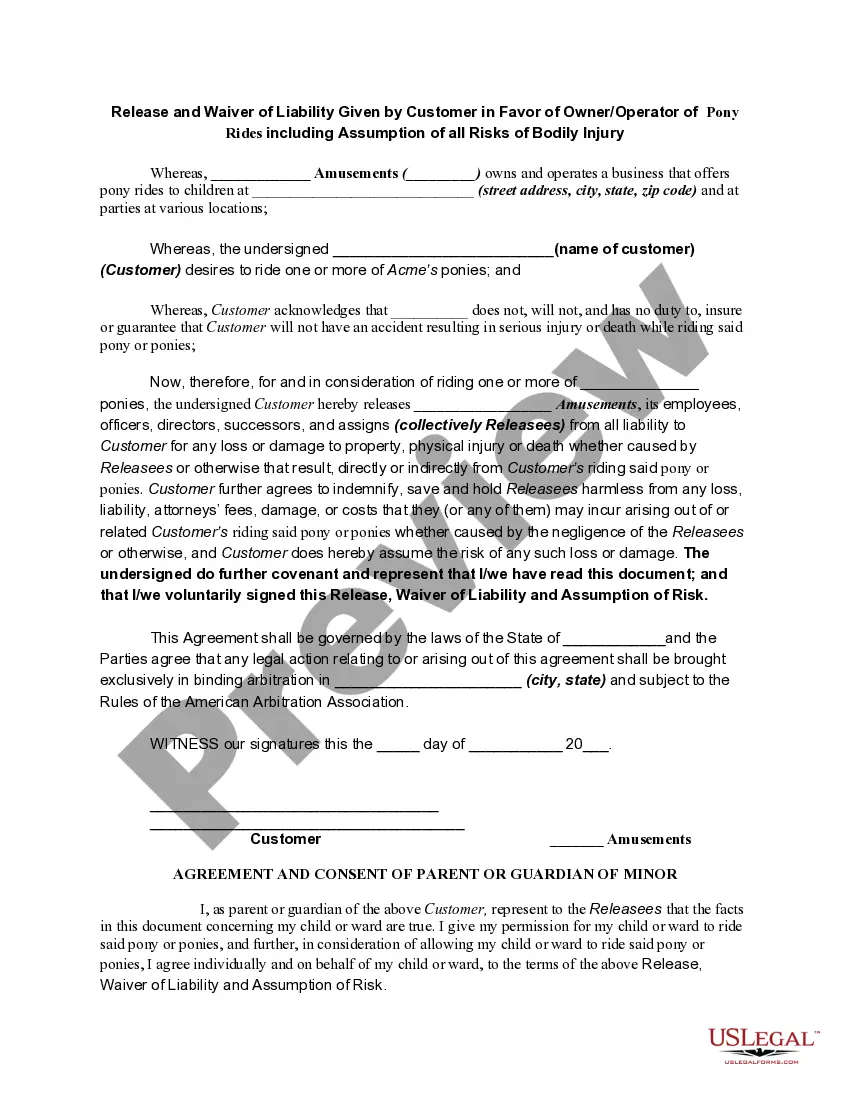
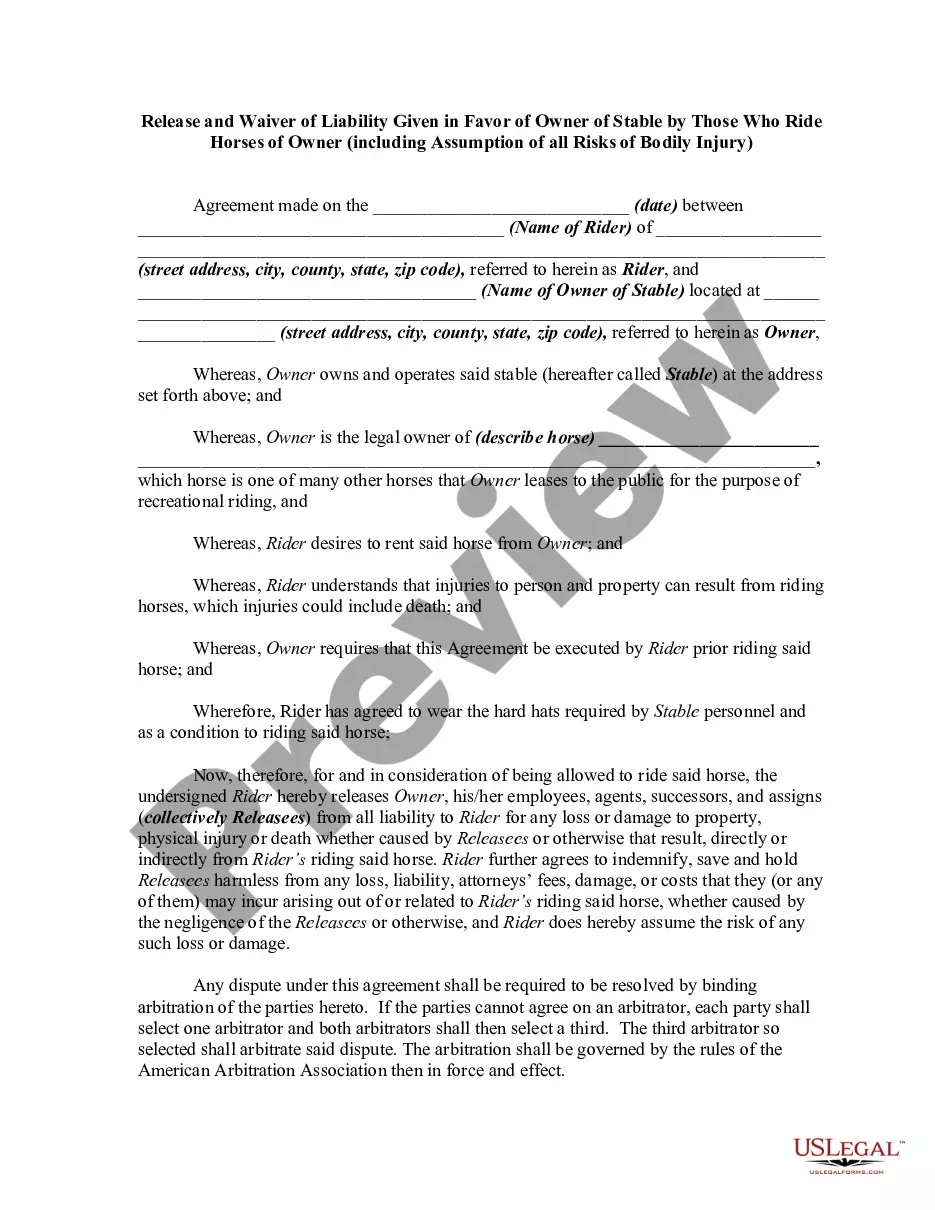
The Release and Waiver of Liability Given by Customer in Favor of Owner / Operator of Pony Rides is a legal document that helps amusement companies protect themselves from liability for injuries that might occur when a child rides one of their ponies. This form is essential for ensuring that customers understand the risks involved in pony rides and agree to release the business from legal claims related to those risks.
Key parts of this document
- Identification of the amusement company and location of the pony rides.
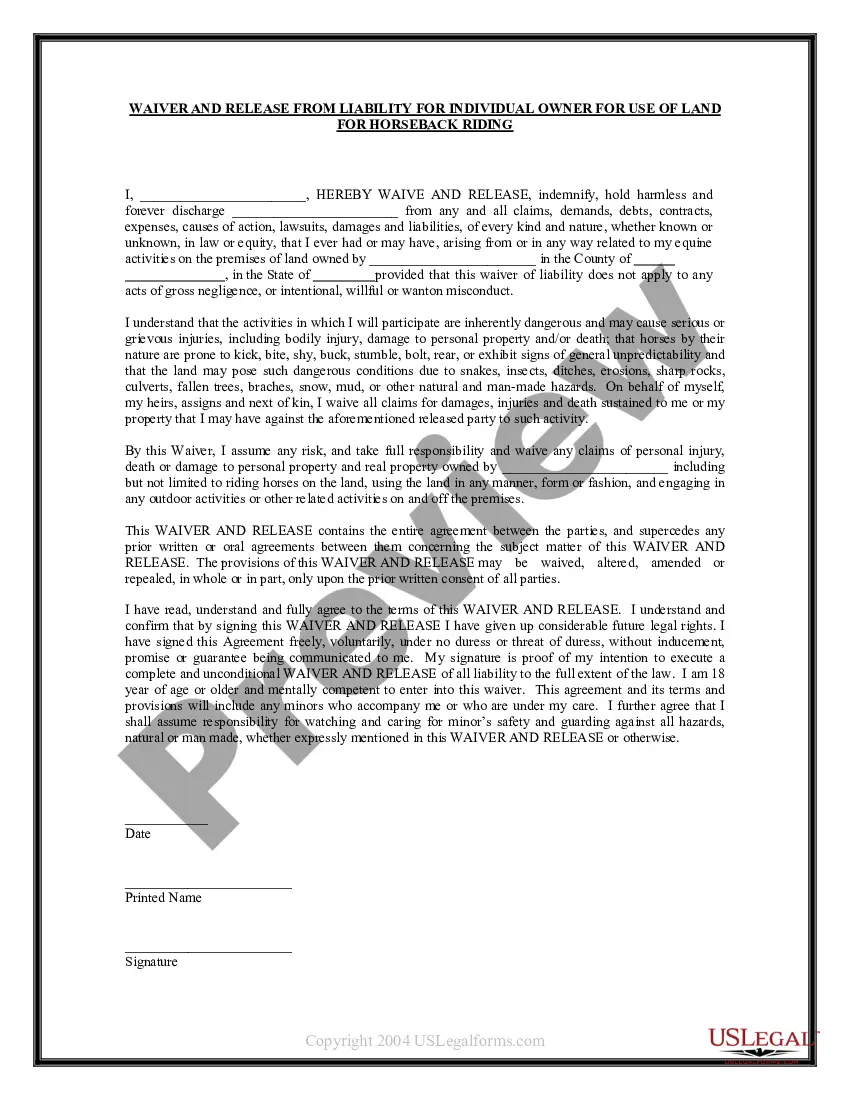
- Customer's acknowledgment of the inherent risks associated with pony rides.
- Release of liability clause protecting the amusement company from claims.
- Indemnification clause where the customer agrees to hold the company harmless.
- Consent section for the parent or guardian of a minor child.

Situations where this form applies
This form should be used whenever a customer wishes to allow a child to ride a pony at an amusement park, fair, or private event. It is crucial for parents or guardians to complete this waiver to ensure their understanding and acceptance of the risks involved in pony rides, thus protecting the service provider against potential legal claims stemming from accidents or injuries.
Who needs this form
- Parents or guardians who want their children to participate in pony rides.
- Owners and operators of pony ride services seeking to limit liability.
- Event organizers providing pony rides at gatherings such as birthday parties or community events.
How to complete this form
- Identify the amusement company and provide its address.
- Enter the name of the customer who wishes to have the pony ride.
- Read and understand the risks outlined in the document.
- Sign the form to acknowledge acceptance of terms.
- If applicable, have a parent or guardian also sign for minors.
Notarization requirements for this form
This form does not typically require notarization unless specified by local law. It is always advisable to check local regulations to confirm the validity of the waiver.
Get your form ready online
Our built-in tools help you complete, sign, share, and store your documents in one place.
Make edits, fill in missing information, and update formatting in US Legal Forms—just like you would in MS Word.
Download a copy, print it, send it by email, or mail it via USPS—whatever works best for your next step.
Sign and collect signatures with our SignNow integration. Send to multiple recipients, set reminders, and more. Go Premium to unlock E-Sign.
If this form requires notarization, complete it online through a secure video call—no need to meet a notary in person or wait for an appointment.
We protect your documents and personal data by following strict security and privacy standards.

Make edits, fill in missing information, and update formatting in US Legal Forms—just like you would in MS Word.

Download a copy, print it, send it by email, or mail it via USPS—whatever works best for your next step.

Sign and collect signatures with our SignNow integration. Send to multiple recipients, set reminders, and more. Go Premium to unlock E-Sign.

If this form requires notarization, complete it online through a secure video call—no need to meet a notary in person or wait for an appointment.

We protect your documents and personal data by following strict security and privacy standards.
Common mistakes to avoid
- Failing to read the entire form before signing.
- Not including the child's name if the rider is a minor.
- Incomplete signatures or missing dates.
Benefits of completing this form online
- Convenient access from anywhere, allowing quick and easy completion.
- Editability ensures that you can input specific details according to your needs.
- Reliability in legal standards, as forms are drafted by licensed attorneys.
Legal use & context
- The waiver must be clear and unambiguous in protecting the amusement company from liability.
- Ensure that the form complies with local laws regarding liability waivers.
- Be aware that a signed waiver may not be enforceable in instances of gross negligence.
Main things to remember
- This form helps protect amusement companies from liability for injuries during pony rides.
- Parents or guardians must complete the waiver for minors participating in pony rides.
- It's important to fully understand the terms before signing this waiver.
Looking for another form?

Form popularity
FAQ
Am I Liable If Someone is Injured on My Property? If a guest, customer, or trespasser is injured while on your property, they may be able to bring a personal injury lawsuit against you.If the landowner fails to do so, or breaches their duty of care to those entering their property, they may be liable for negligence.
Yes, you can be held liable if someone is injured on your propertyperiod. However, before you panic and refuse to ever let anyone enter your yard again, take advantage of homeowners insurance quotes online from CoverHound to help you get the coverage you need to restore your peace of mind.
Am I Liable If Someone is Injured on My Property? If a guest, customer, or trespasser is injured while on your property, they may be able to bring a personal injury lawsuit against you.If the landowner fails to do so, or breaches their duty of care to those entering their property, they may be liable for negligence.
When you've been injured on business property, you have a right to expect to be compensated by the at-fault business owner. Minor injury claims can often be settled out of court, but more serious injury cases may require suing the business to get fair compensation.
You can file a lawsuit for negligence against the manager of a real estate property in the same way you can sue the owner of any type of business. Generally speaking, with certain exceptions, filing a lawsuit for negligence against a property manager is a straightforward process.
If a guest, customer, or trespasser is injured while on your property, they may be able to bring a personal injury lawsuit against you.If the landowner fails to do so, or breaches their duty of care to those entering their property, they may be liable for negligence.
Personal Injury provides coverage for OTHER THAN bodily injury or property damage. This includes false arrest, detention, or imprisonment; malicious prosecution; wrongful eviction; slander; libel; and invasion of privacy. This is more of a mental or psychological based claim.
If someone is hurt at your house or on your property, as a result of an accident or any kind of unintentional mishap, the liability provision of your homeowners' insurance policy will typically kick in to cover any personal injury claim that is filed.
Homeowners insurance covers personal injuries as long as your policy includes personal liability coverage, and most policies do.Furthermore, your personal liability insurance only applies to others, meaning any of your own injuries will require health insurance.