Release and Waiver of Liability Regarding Repair Work in Home - Repairman or Handyman
Understanding this form
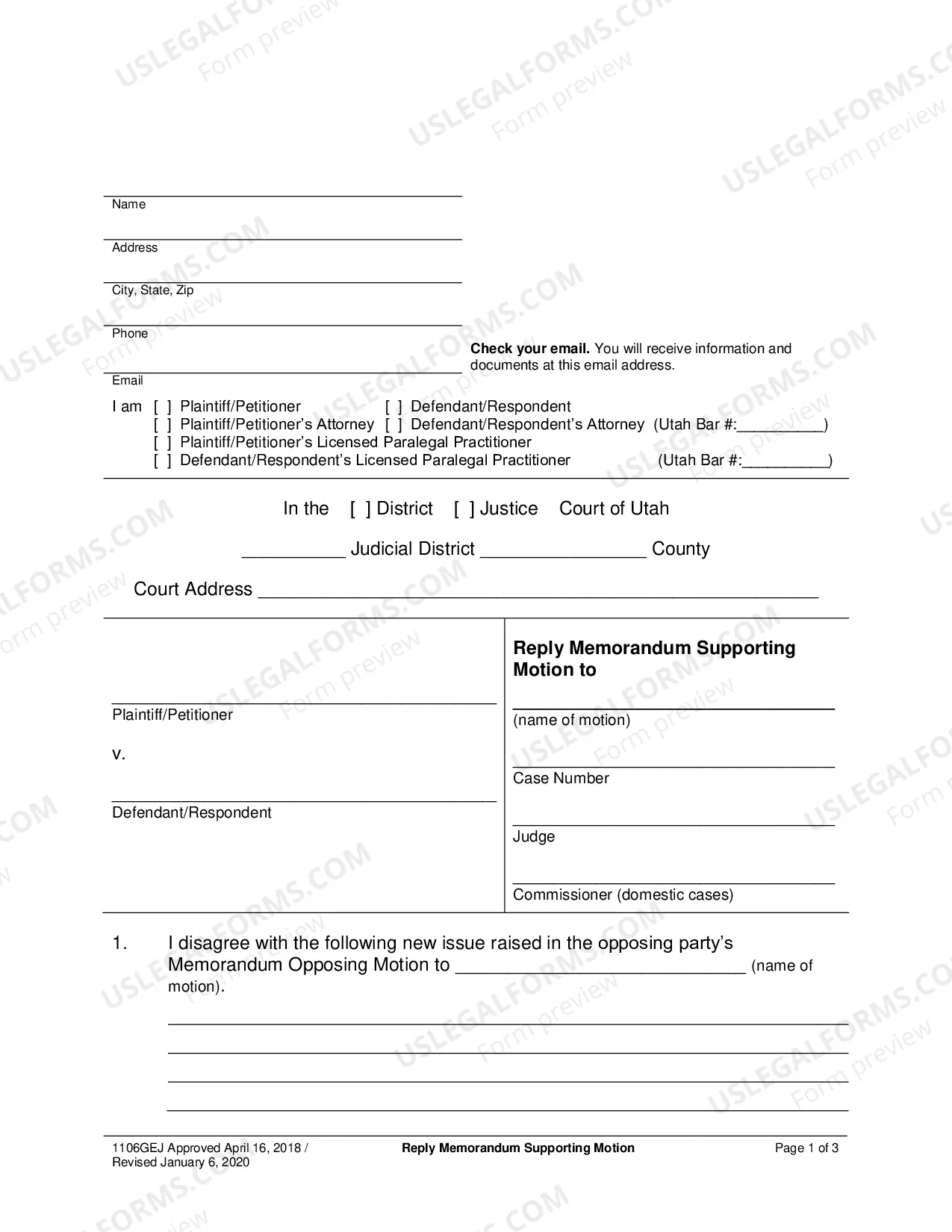
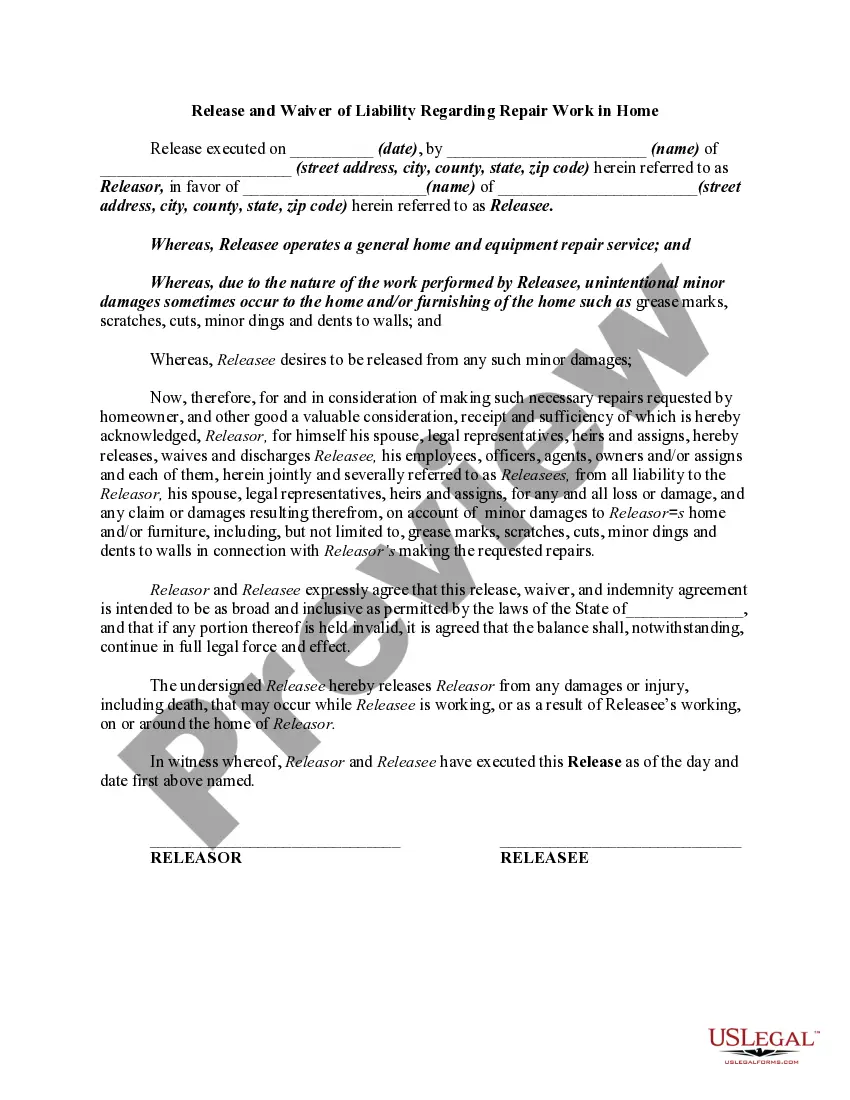
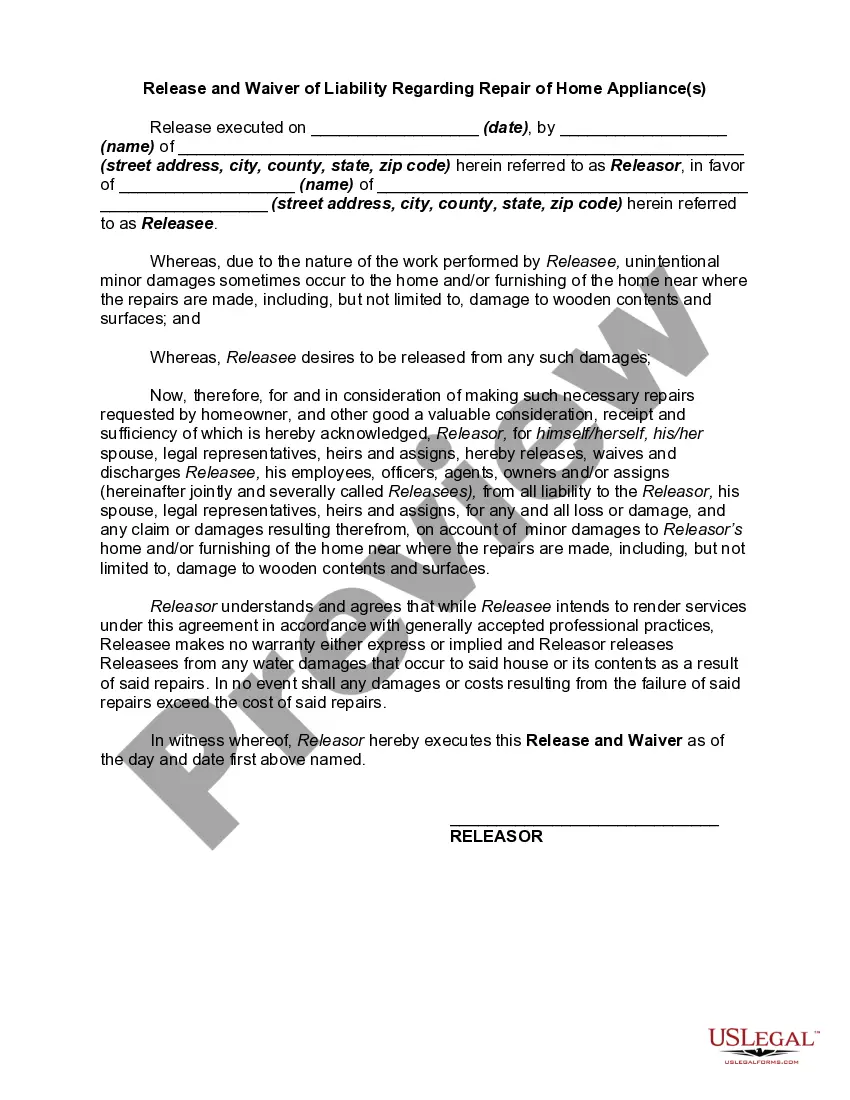
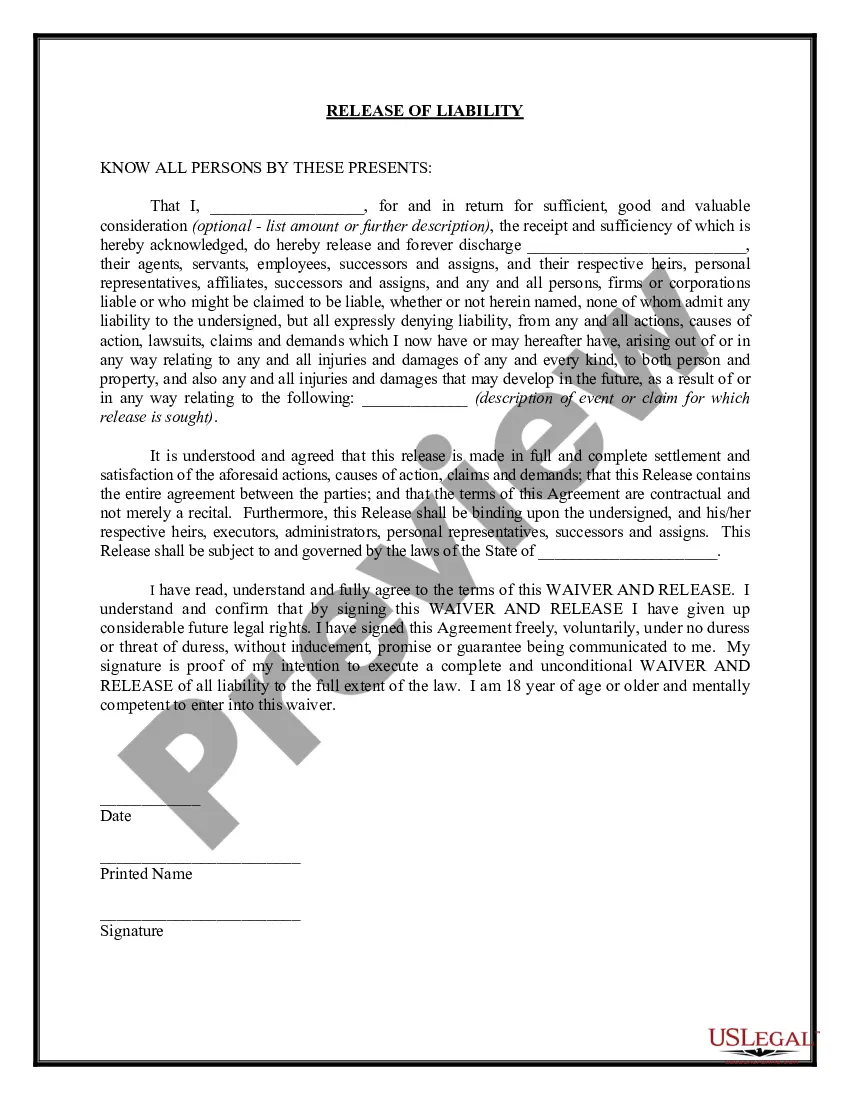
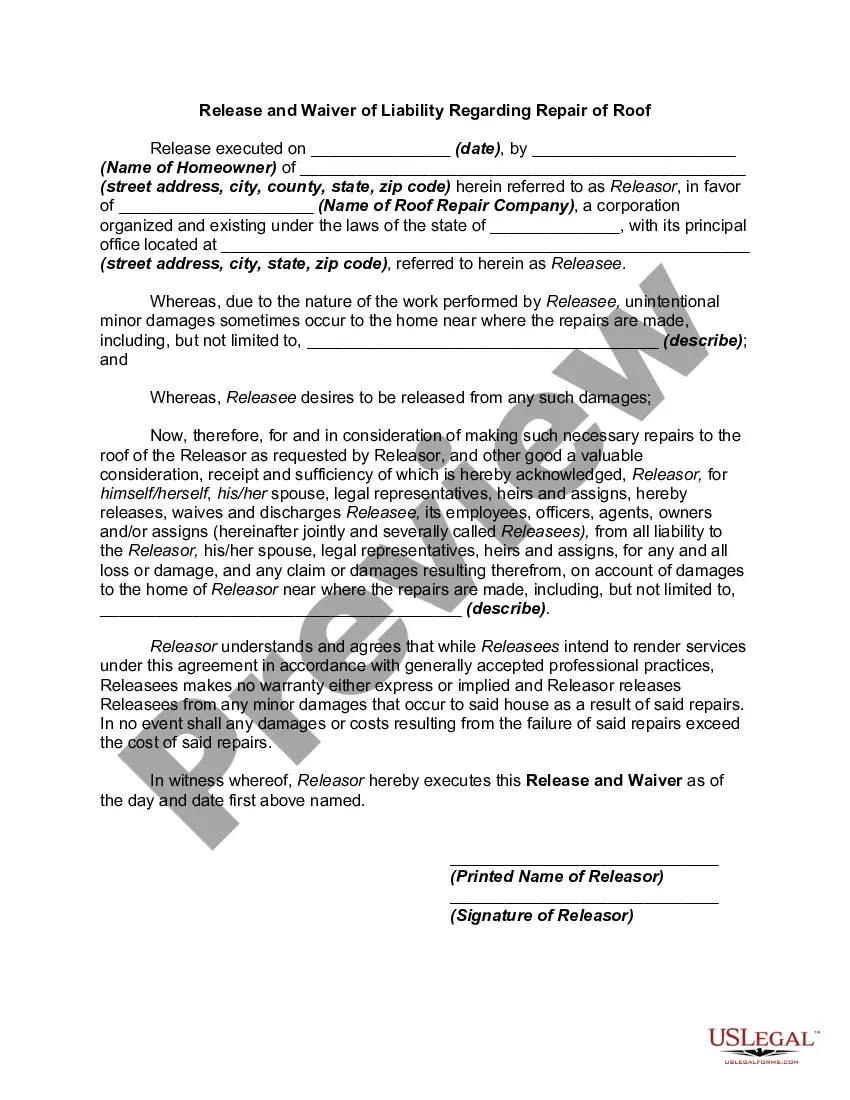
The Release and Waiver of Liability Regarding Repair Work in Home is a legal document that protects homeowners from potential claims related to minor damages caused during repair work. While homeowners typically welcome repair services, unintended minor damages like scratches or grease marks can occur. This form helps to clarify that the homeowner will not hold the repairman or handyman liable for these types of damages, differentiating it from general liability waivers that might cover more severe incidents. It provides peace of mind for both parties involved in the repair process.
Key parts of this document
- Date of release execution
- Full names and addresses of the Releasor (homeowner) and Releasee (repairman or handyman)
- Acknowledgment of the nature of repair work and potential for minor damages
- Legal release from liability for minor damages
- Indemnity agreement covering both parties
- Signatures of both Releasor and Releasee
When this form is needed
This form is ideal when homeowners are hiring a repairman or handyman for repairs within their home. It is particularly useful in situations where minor damages could occur but are not significant enough to warrant insurance claims or legal action. By using this release, homeowners can ensure that any minor scuffs, scratches, or dents that happen during the repair process do not lead to disputes or extra costs.
Who needs this form
This form is intended for:
- Homeowners who are hiring repair professionals
- Repairmen or handymen engaging in home repair work
- Individuals or companies providing handyman services
Instructions for completing this form
- Enter the date on which the release is being executed.
- Fill in the full name and address of the homeowner (Releasor).
- Provide the name and address of the repairman or handyman (Releasee).
- Read and acknowledge the terms regarding minor damages and the waiver of liability.
- Both parties should sign and date the document.
Notarization guidance
In most cases, this form does not require notarization. However, some jurisdictions or signing circumstances might. US Legal Forms offers online notarization powered by Notarize, accessible 24/7 for a quick, remote process.
Get your form ready online
Our built-in tools help you complete, sign, share, and store your documents in one place.
Make edits, fill in missing information, and update formatting in US Legal Forms—just like you would in MS Word.
Download a copy, print it, send it by email, or mail it via USPS—whatever works best for your next step.
Sign and collect signatures with our SignNow integration. Send to multiple recipients, set reminders, and more. Go Premium to unlock E-Sign.
If this form requires notarization, complete it online through a secure video call—no need to meet a notary in person or wait for an appointment.
We protect your documents and personal data by following strict security and privacy standards.

Make edits, fill in missing information, and update formatting in US Legal Forms—just like you would in MS Word.

Download a copy, print it, send it by email, or mail it via USPS—whatever works best for your next step.

Sign and collect signatures with our SignNow integration. Send to multiple recipients, set reminders, and more. Go Premium to unlock E-Sign.

If this form requires notarization, complete it online through a secure video call—no need to meet a notary in person or wait for an appointment.

We protect your documents and personal data by following strict security and privacy standards.
Avoid these common issues
- Failing to include the date of execution, which can invalidate the form.
- Not providing complete addresses for both parties.
- Overlooking the importance of signatures from both the Releasor and Releasee.
Why use this form online
- Convenient access to professionally drafted forms at any time.
- Easy to fill out and customize according to specific needs.
- Instant download for immediate use and record-keeping.
Legal use & context
- This waiver is legally binding as long as it complies with state laws.
- It protects professionals in case of minor damages during repair work.
- Be aware that this form does not cover gross negligence or willful misconduct.
Summary of main points
- The form is designed to protect homeowners and repair professionals from claims regarding minor damage during repair work.
- Clear agreements on liability help prevent future disputes.
- Complete all sections accurately, including signatures, to ensure the form is valid.
Looking for another form?
Form popularity
FAQ
NOTICE TO RESIDENTS: THE PROPERTY DAMAGE LIABILITY WAIVER ONLY WAIVES YOUR OBLIGATION TO INDEMNIFY THE OWNER FOR ACCIDENTAL DAMAGES CAUSED BY YOUR NEGLIGENT ACTS OR OMISSIONS AS DESCRIBED HEREIN.
If you've been injured due to negligent actions, you can sue even if you signed a waiver. Winning a lawsuit concerning negligence is not uncommon. Many celebrities have sued for negligence even though they signed documents stating they understood the risks.
Under California law, a liability waiver cannot excuse an injury caused by a defendant's gross negligence, recklessness or intentional wrongful act.Additionally, to be enforceable in California a waiver of liability must be clear, unambiguous, and explicit in expressing the parties' intent.
Waivers should only be signed before participating in an activity, not after you are hurt. If you are injured and given papers to sign, immediately call a personal injury attorney. You can find a personal injury lawyer by contacting your state or local bar association.
Get help. Writing a waiver should not be complicated. Use the correct structure. Proper formatting. Include a subject line. Include a caution! Talk about the activity risks. Do not forget an assumption of risk. Hold harmless.
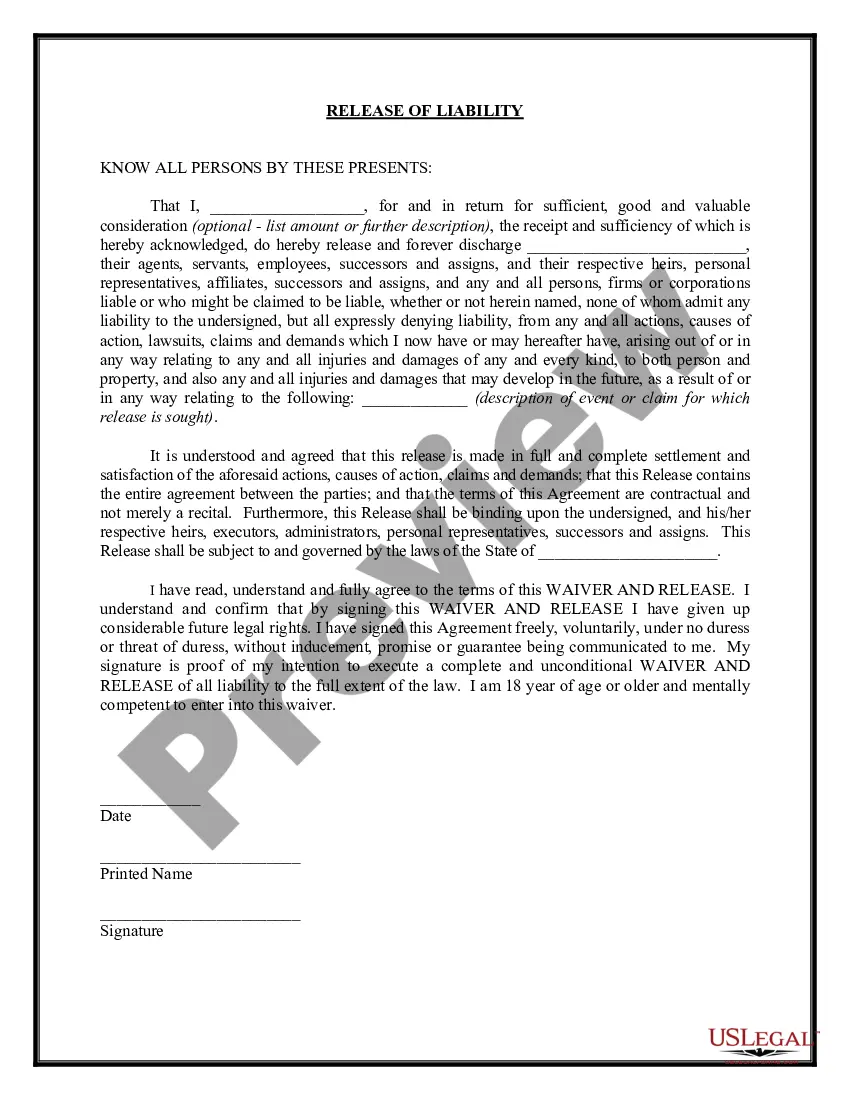
The General Release is a broad release from all possible civil claims resulting from a dispute. Since the Releasing Party is giving up all known and unknown claims against the other party, care should be taken to ensure that the Releasor is fully aware of their rights.
In California, a liability waiver must be clear, unambiguous, and explicit. In other words, waivers cannot be printed in faded ink, in small font, on the back of a paper, or in an otherwise ambiguous form. If the waiver that you sign is not represented clearly, it may not hold up in the event of a lawsuit.
200bStart the letter off with a clear explanation regarding your request. For instance, explain that you're requesting certain fees or charges to be waived or to be released from a previous engagement. Communicate any supporting or relative dates, names of parties, monetary figures, or venues as facts.
A liability waiver, or release waiver, is a legal document that a company or organization requires members of the public to sign in order to protect their organization from being sued if you sustain an injury.Depending on the facts of your case, you may still be able to file a lawsuit and recover damages.