Sample Letter to Report False Submission of Minor's Information
What is this form?
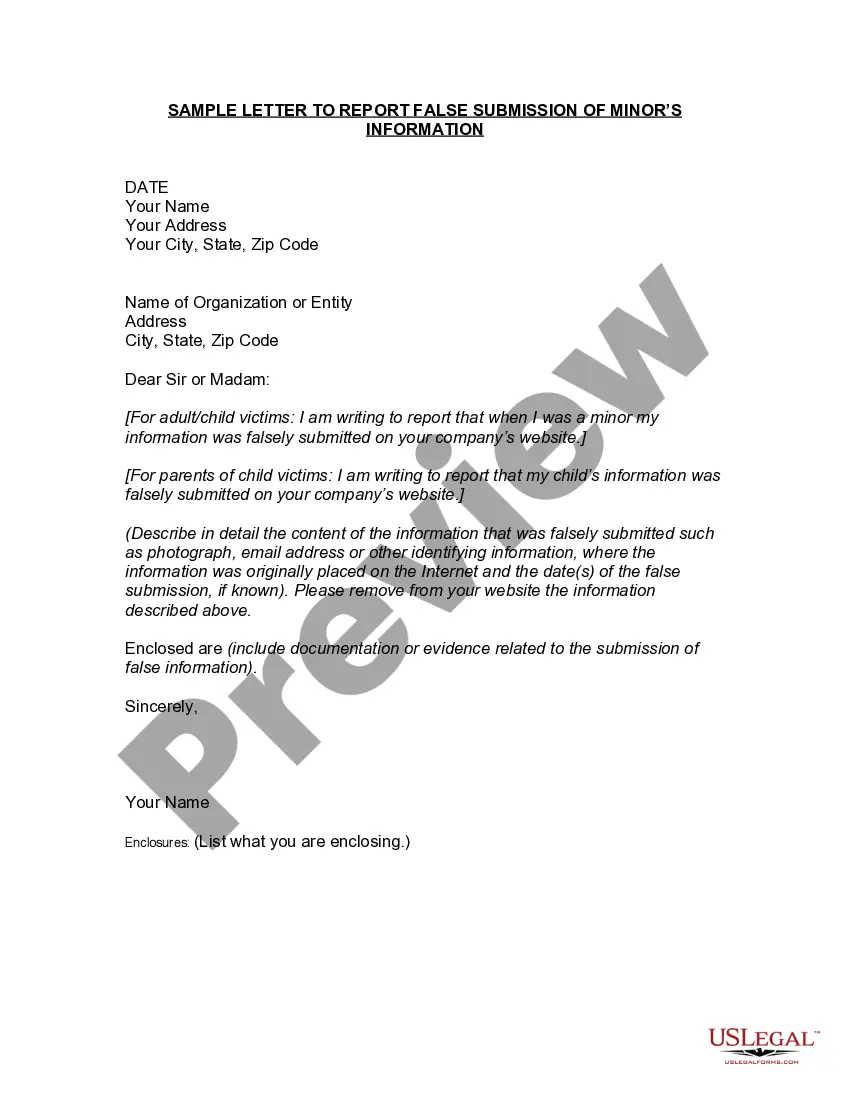
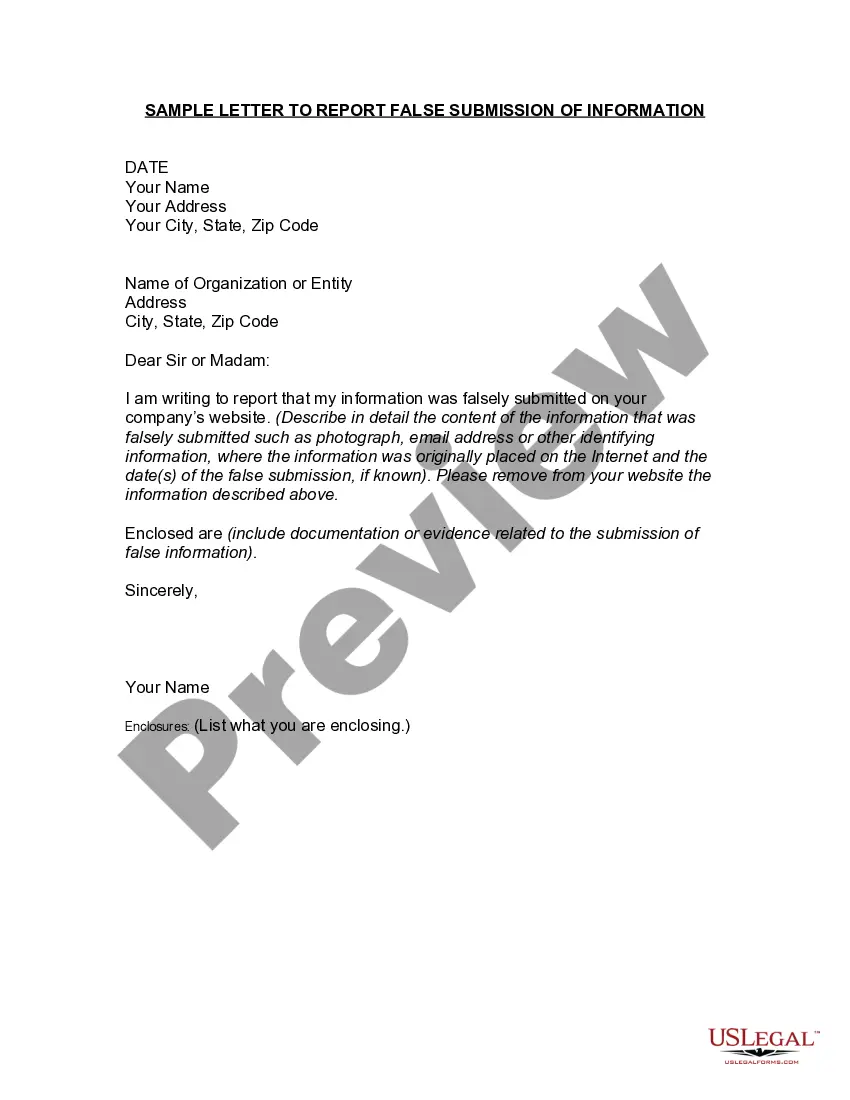
The Sample Letter to Report False Submission of Minor's Information is a legal document used to notify an organization that information about a minor has been submitted without consent. This letter is crucial for requesting the removal of such unauthorized information from the organizationâs website. Unlike other forms that may address broader privacy issues, this one specifically targets false submissions related to minors, making it essential for parents and guardians to take immediate action.
Key components of this form
- Date of the letter
- Your name and address
- Name and address of the organization
- Introduction stating the purpose of the letter
- Detailed description of the falsely submitted information
- Request for the removal of the information
- List of enclosed documentation related to the claim
When this form is needed
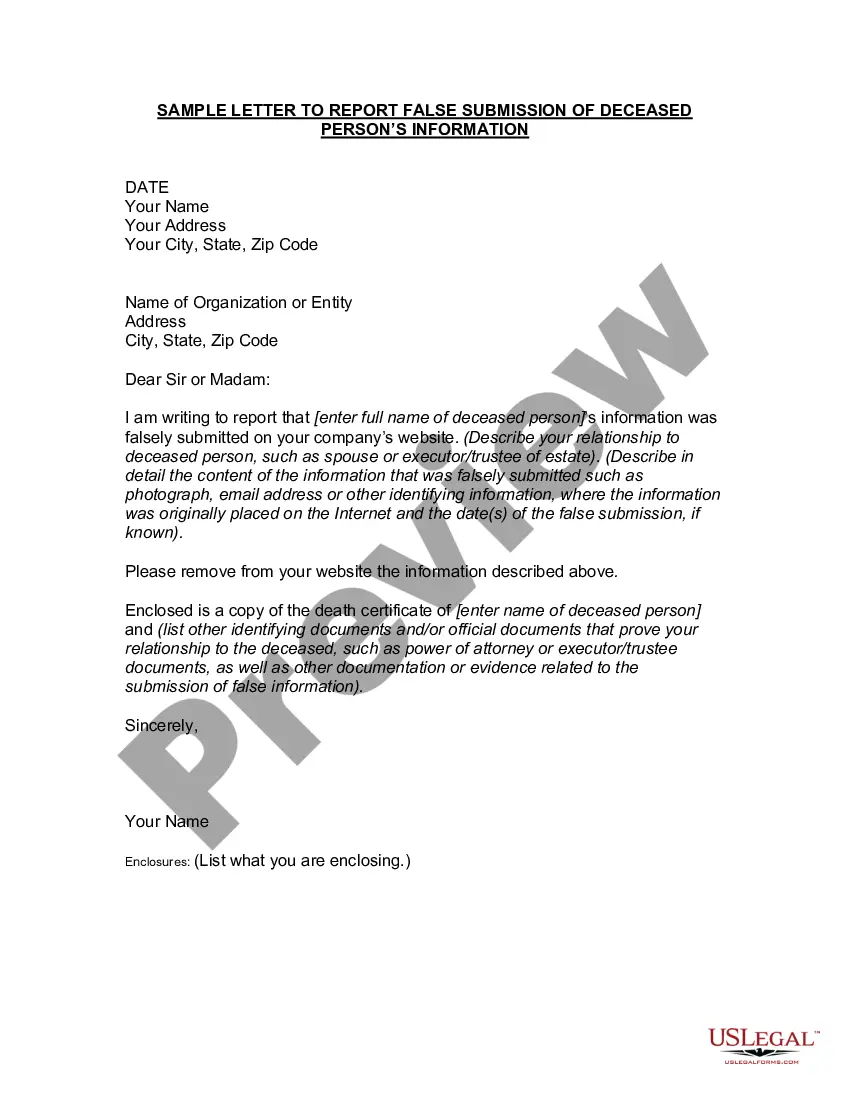
This form is used in various situations where there is a belief that someone's information, particularly that of a minor, has been submitted without permission. Common scenarios include instances where a minor's photograph, email address, or other personal details have been posted on a website, potentially for malicious reasons. Using this letter promptly can help mitigate any adverse effects caused by the unauthorized disclosure of personal information.
Who this form is for
This letter is intended for:
- Minors who are able to report false submissions of their personal information.
- Parents or guardians of minors who wish to advocate on their behalf.
- Individuals seeking to protect the privacy and safety of minors from unauthorized disclosures.
How to prepare this document
- Enter the date at the top of the letter.
- Provide your name and address to identify yourself.
- Fill in the name and address of the organization you are addressing.
- Clearly state your intention to report the false submission.
- Detail the specific information that was falsely submitted, including the type and location.
- Request the immediate removal of the unauthorized information and list any evidence you are enclosing.
Notarization guidance
This form does not typically require notarization unless specified by local law. However, consider checking with the organization to which you are submitting the letter, as some may have their own requirements.
Get your form ready online
Our built-in tools help you complete, sign, share, and store your documents in one place.
Make edits, fill in missing information, and update formatting in US Legal Forms—just like you would in MS Word.
Download a copy, print it, send it by email, or mail it via USPS—whatever works best for your next step.
Sign and collect signatures with our SignNow integration. Send to multiple recipients, set reminders, and more. Go Premium to unlock E-Sign.
If this form requires notarization, complete it online through a secure video call—no need to meet a notary in person or wait for an appointment.
We protect your documents and personal data by following strict security and privacy standards.

Make edits, fill in missing information, and update formatting in US Legal Forms—just like you would in MS Word.

Download a copy, print it, send it by email, or mail it via USPS—whatever works best for your next step.

Sign and collect signatures with our SignNow integration. Send to multiple recipients, set reminders, and more. Go Premium to unlock E-Sign.

If this form requires notarization, complete it online through a secure video call—no need to meet a notary in person or wait for an appointment.

We protect your documents and personal data by following strict security and privacy standards.
Avoid these common issues
- Failing to provide sufficient detail about the false submission.
- Not including the date of submission or relevant dates.
- Omitting contact information, making it difficult for the organization to respond.
- Neglecting to include supporting documentation or evidence.
Advantages of online completion
- Convenience of downloading the form at any time.
- Easy to edit to fit specific needs and circumstances.
- Provides a reliable way to formally notify organizations about privacy issues.
Key takeaways
- This letter is essential for reporting false submissions of a minor's information.
- It must include specific details and any supporting documentation.
- Using this form online provides numerous advantages, such as convenience and adaptability.
Looking for another form?
Form popularity
FAQ
Maintain Silence. Get The Best Lawyers. Don't Get In Contact With Your Accuser. Turning The Case Around Is One Way Of How To Prove Innocence When Falsely Accused. Gather As Much Evidence As Possible. Avoid Plea Deals. In A Nutshell.
In California, the crime of false accusations is a misdemeanor and you can be prosecuted for it.If you've been falsely accused of a crime you didn't commit, you should also talk to a lawyer. The person who made false accusations against you can go to jail for what they've done.
The first and most important tip to follow is to stay calm. No matter how angry or upset you are, you must try to not let these emotions get the best of you! You're a professional, so prove that you can handle difficult situations with grace and dignity. Don't retaliate, and don't throw accusations back at the accuser.
4.1. Hire a defense attorney. 4.2. Conduct a pre-file investigation. 4.3. Impeach the accuser. 4.4. File a civil suit for malicious prosecution. 4.5.
State the problem with clarity and do not blame or threaten in the first letter. State the exact reason for disagreement. Provide necessary proof to support your point of view. Mention the expected result of your plan of action. End the letter by mentioning the advantages of agreement of a solution.
Realize the seriousness of the accusations. Understand the cost of a defense. Intervene before charges. Take no action. Gather any physical evidence and documents. Obtain witness contact information. Investigation. Plea bargain.
The best tack to take when responding to false allegations is to write a serious, unemotional examination of the subjects raised. Repeat an allegation, then explain dispassionately the ways in which it is inaccurate. Then proceed to the next allegations. Keep responses objective, factual and succinct.
State the problem with clarity and do not blame or threaten in the first letter. State the exact reason for disagreement. Provide necessary proof to support your point of view. Mention the expected result of your plan of action. End the letter by mentioning the advantages of agreement of a solution.