Affidavit as to Time and Place of Taking Photograph
About this form
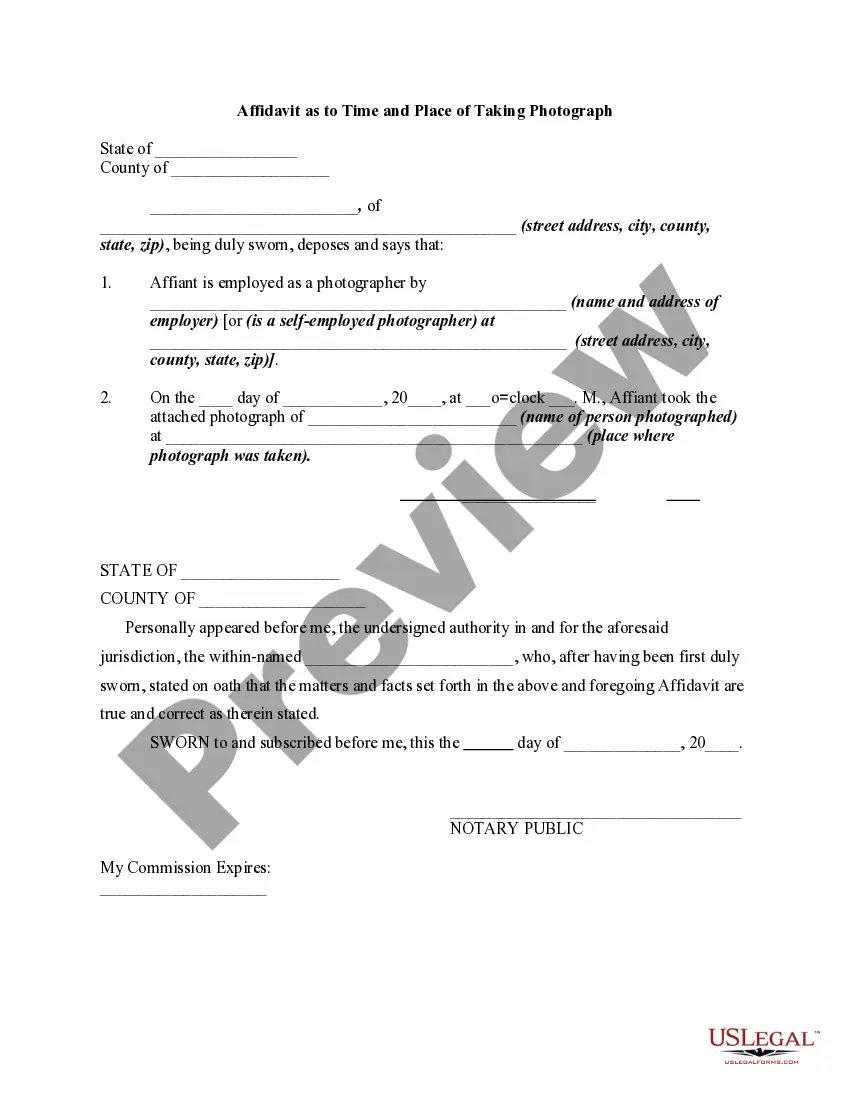
The Affidavit as to Time and Place of Taking Photograph is a legal document in which a photographer swears under oath about the specific time and location where a photograph was taken. This form serves to establish authenticity and credibility of photographic evidence, distinguishing it from ordinary photographs or informal statements. It is particularly useful in legal contexts where the timing and setting of a photo are crucial, such as in court cases or official records.
Form components explained
- Affiant's personal details including name, address, and employment status.
- Date and time of when the photograph was taken.
- Description of the subject in the photograph.
- Location where the photograph was taken, including full address.
- Notarization section for validating the affidavit.
When to use this document
This form should be used when a photographer needs to provide sworn testimony regarding the specifics of a photograph. It is useful in legal situations, such as evidence submissions in court, insurance claims, or when the authenticity of a photograph is disputed. Additionally, this affidavit can be required for documentation in various professional settings, including real estate transactions or event photography.
Who can use this document
- Professional photographers needing to verify their work in legal contexts.
- Individuals submitting photographs as evidence in legal proceedings.
- Businesses requiring documentation for promotional materials or claims.
- Real estate agents documenting properties through photographs.
Instructions for completing this form
- Enter the state and county where the affidavit is being executed.
- Provide your name and address, indicating if you are self-employed or employed by a company.
- Specify the exact date and time when the photograph was taken.
- Detail the subject of the photograph along with the location where it was captured.
- Sign the affidavit in front of a notary public and complete the notary section with the required details.
Does this form need to be notarized?
Yes, this form must be notarized to be legally valid. This ensures that the testimony provided in the affidavit is verified and trustworthy. US Legal Forms supports integrated online notarization, allowing you to complete the process through secure video calls at any time, ensuring convenience and compliance without needing to travel.
Get your form ready online
Our built-in tools help you complete, sign, share, and store your documents in one place.
Make edits, fill in missing information, and update formatting in US Legal Forms—just like you would in MS Word.
Download a copy, print it, send it by email, or mail it via USPS—whatever works best for your next step.
Sign and collect signatures with our SignNow integration. Send to multiple recipients, set reminders, and more. Go Premium to unlock E-Sign.
If this form requires notarization, complete it online through a secure video call—no need to meet a notary in person or wait for an appointment.
We protect your documents and personal data by following strict security and privacy standards.

Make edits, fill in missing information, and update formatting in US Legal Forms—just like you would in MS Word.

Download a copy, print it, send it by email, or mail it via USPS—whatever works best for your next step.

Sign and collect signatures with our SignNow integration. Send to multiple recipients, set reminders, and more. Go Premium to unlock E-Sign.

If this form requires notarization, complete it online through a secure video call—no need to meet a notary in person or wait for an appointment.

We protect your documents and personal data by following strict security and privacy standards.
Avoid these common issues
- Failing to provide complete address details for the location of the photograph.
- Not accurately stating the time and date, which can lead to disputes.
- Omitting the notarization step, which invalidates the affidavit.
- Using unclear or vague descriptions for the photograph's subject.
Benefits of using this form online
- Convenience of accessing and downloading the form from anywhere.
- Editability allows customization to fit specific needs.
- Reliability of forms drafted by licensed attorneys ensures legal compliance.
- Quick completion without the need for physical paperwork.
Main things to remember
- The Affidavit as to Time and Place of Taking Photograph helps verify the authenticity of images.
- It is crucial for legal contexts where proof of the timing and location of a photo is necessary.
- This form requires notarization for legal validity.
Looking for another form?
Form popularity
FAQ
Full name of the deponent and their signature. Statement indicating whether the affidavit has been sworn or not. Date and place where the affidavit is being signed. Designation and full name of the Notary or Magistrate (person attesting the affidavit)
I am _____ and my name _______, appearing on the enclosed ID proof, is single name.Both names denote one and the same person. I solemnly state that the contents of this affidavit are true to the best of my knowledge and belief and that it conceals nothing and that no part of it is false.
Title the affidavit. First, you'll need to title your affidavit. Craft a statement of identity. The very next section of your affidavit is what's known as a statement of identity. Write a statement of truth. State the facts. Reiterate your statement of truth. Sign and notarize.
In the sentence, the person writing the statement must state that he or she is stating that the information is accurate. (Example: I, Jane Doe, solemnly swear that the contents of this document are true and correct, and that I agree to abide by the terms in this affidavit.)
In the sentence, the person writing the statement must state that he or she is stating that the information is accurate. (Example: I, Jane Doe, solemnly swear that the contents of this document are true and correct, and that I agree to abide by the terms in this affidavit.)
In a nutshell, an affidavit is a sworn statement that is in writing. Affidavits are usually used in a court or in negotiations. They are common in family law cases and bankruptcy cases. They are also used in civil and criminal cases, though not as often as family or bankruptcy law cases.
Full name and address of affiant. Date and place of birth. Relationship to I-751 applicant and spouse. An account of your relationship explaining: How you met the couple. Details explaining how the person acquired this knowledge (i.e. friends) Date and signature.