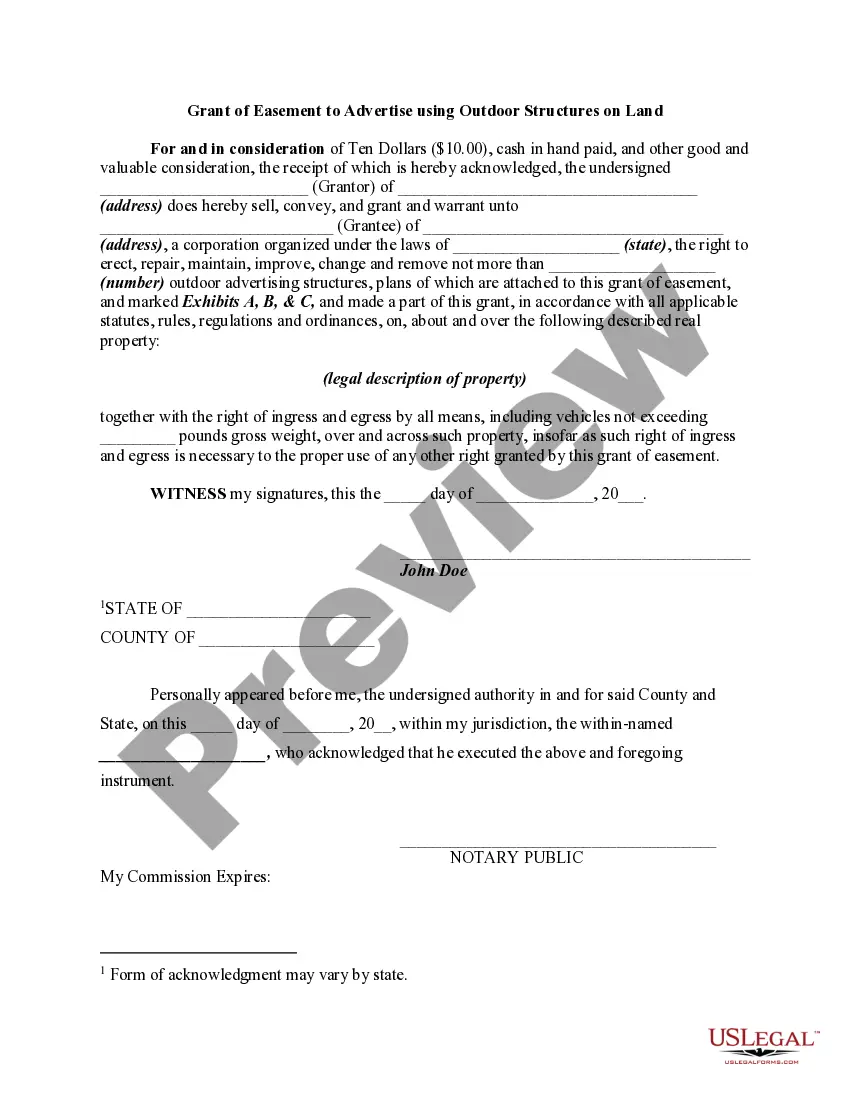
Grant of Easement to Advertise using Outdoor Structures on Land
Understanding this form
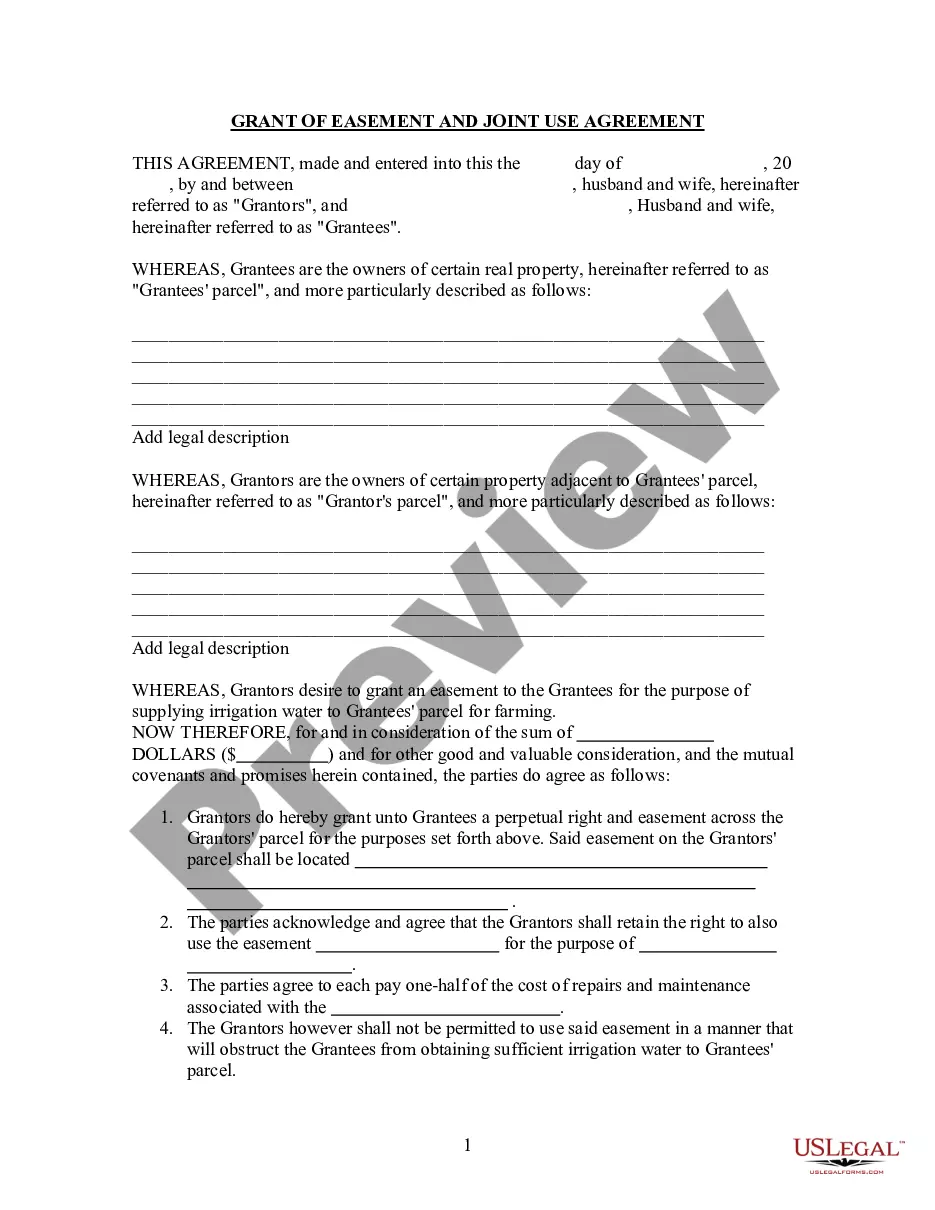
The Grant of Easement to Advertise using Outdoor Structures on Land is a legal document that allows a party (the grantee) to use someone else's property (the grantor) for the purpose of installing and maintaining outdoor advertising structures. This form is unique compared to other easement forms as it specifically caters to advertising needs, enabling property owners to receive compensation while allowing the grantee to promote their business or services through signs placed on the property.
What’s included in this form
- Grantor and Grantee Information: Names and addresses of both parties involved.
- Property Description: Legal description detailing the property location and boundaries.
- Number of Structures: Specifies how many outdoor advertising structures can be erected.
- Consideration: Acknowledgment of payment, which can include a nominal fee and other valuable considerations.
- Ingress and Egress Rights: Definition of the rights for the grantee to access the property to manage the structures.
- Notarization: Section for the notary public to validate the signing of the document.
When to use this form
This form is suitable in situations where a property owner wishes to grant permission for advertising on their land. It is often used by businesses seeking locations for outdoor advertisements, such as billboards or signs, especially when a property owner wants to monetize unused land by permitting others to advertise. This agreement protects both parties by clearly outlining the rights and obligations associated with the easement.
Intended users of this form
Individuals or entities that may find this form beneficial include:
- Property owners looking to lease space for outdoor advertising.
- Businesses seeking to promote their products or services via signs on private land.
- Real estate developers interested in maximizing the use of their properties.
Completing this form step by step
- Identify the parties involved by filling in the names and addresses of both the grantor and grantee.
- Provide a detailed legal description of the property where the advertising structures will be located.
- Specify the number of outdoor structures that can be erected for advertising.
- Include any payment information or other considerations agreed upon.
- Sign and date the form in the presence of a notary public.
Notarization requirements for this form
Yes, this form must be notarized to be legally valid. US Legal Forms provides integrated online notarization services that allow for secure video calls for notarization, available 24/7, saving you the need to travel while ensuring compliance with legal standards.
Get your form ready online
Our built-in tools help you complete, sign, share, and store your documents in one place.
Make edits, fill in missing information, and update formatting in US Legal Forms—just like you would in MS Word.
Download a copy, print it, send it by email, or mail it via USPS—whatever works best for your next step.
Sign and collect signatures with our SignNow integration. Send to multiple recipients, set reminders, and more. Go Premium to unlock E-Sign.
If this form requires notarization, complete it online through a secure video call—no need to meet a notary in person or wait for an appointment.
We protect your documents and personal data by following strict security and privacy standards.

Make edits, fill in missing information, and update formatting in US Legal Forms—just like you would in MS Word.

Download a copy, print it, send it by email, or mail it via USPS—whatever works best for your next step.

Sign and collect signatures with our SignNow integration. Send to multiple recipients, set reminders, and more. Go Premium to unlock E-Sign.

If this form requires notarization, complete it online through a secure video call—no need to meet a notary in person or wait for an appointment.

We protect your documents and personal data by following strict security and privacy standards.
Common mistakes to avoid
- Failing to provide a complete legal description of the property.
- Not specifying the exact number of structures permitted.
- Omitting signatures or notary requirements.
- Using vague language that could lead to disputes about the rights granted.
Benefits of completing this form online
- Convenience of downloading the form instantly from anywhere.
- The ability to customize the form according to specific needs.
- Access to legal templates reviewed by licensed attorneys for accuracy.
- Reduced costs compared to hiring a lawyer for simple easement arrangements.
Summary of main points
- The Grant of Easement to Advertise allows a third party to use land for advertising purposes.
- It requires proper identification of all parties and a legal description of the property.
- Notarization is necessary for the document to be enforceable in court.
Looking for another form?
Form popularity
FAQ
The Good Relationship. The person with the property often has a working or good relationship with neighbors.The easement is sometimes a necessity because of restrictions of the land the other person owns or is leasing such as a company or organizational situation.
An easement is a limited right to use another person's land for a stated purpose. Examples of easements include the use of private roads and paths, or the use of a landowner's property to lay railroad tracks or electrical wires.
An easement is a property right that provides its holder with a non-possessory interest on another person's land.If there are only personal individual benefits from an easement the term used is in gross. The majority of easements are affirmative, this means that they authorise the use of another person's land.
Ask him to grant you a formal easement by deed. Your neighbor the servient, or burdened landowner can give the easement of his own accord, but he is not obligated to do this. The chances are, you will have to negotiate a price; an easement is, after all, an interest in land, which has a value attached to it.
A property easement is a legal situation in which the title to a specific piece land remains with the landowner, but another person or organization is given the right to use that land for a distinct purpose.Or, you could have an easement on part of your property if it blocks access to a main road.
An easement in gross is personal to the party that receives the benefit of easement. An example of an easement in gross is an easement to a utility company to run a power line across a burdened piece of property. The utility company is the benefited party and there isn't necessarily a benefited parcel of land.
An easement can decrease the value of a real estate, increase the value of the real estate or it can have no impact on the value of the real estate at all. The most important fact is that each property and situation should be evaluated on individual basis, taking into account all the circumstances.
An easement is a "nonpossessory" property interest that allows the holder of the easement to have a right of way or use property that they do not own or possess.In contrast, the property owner may continue to use the easement and may exclude everyone except the easement holder from the land.
An easement is a nonpossessory right to use and/or enter onto the real property of another without possessing it. It is "best typified in the right of way which one landowner, A, may enjoy over the land of another, B".