Affidavit Attesting to the Mailing of Papers or Documents
About this form
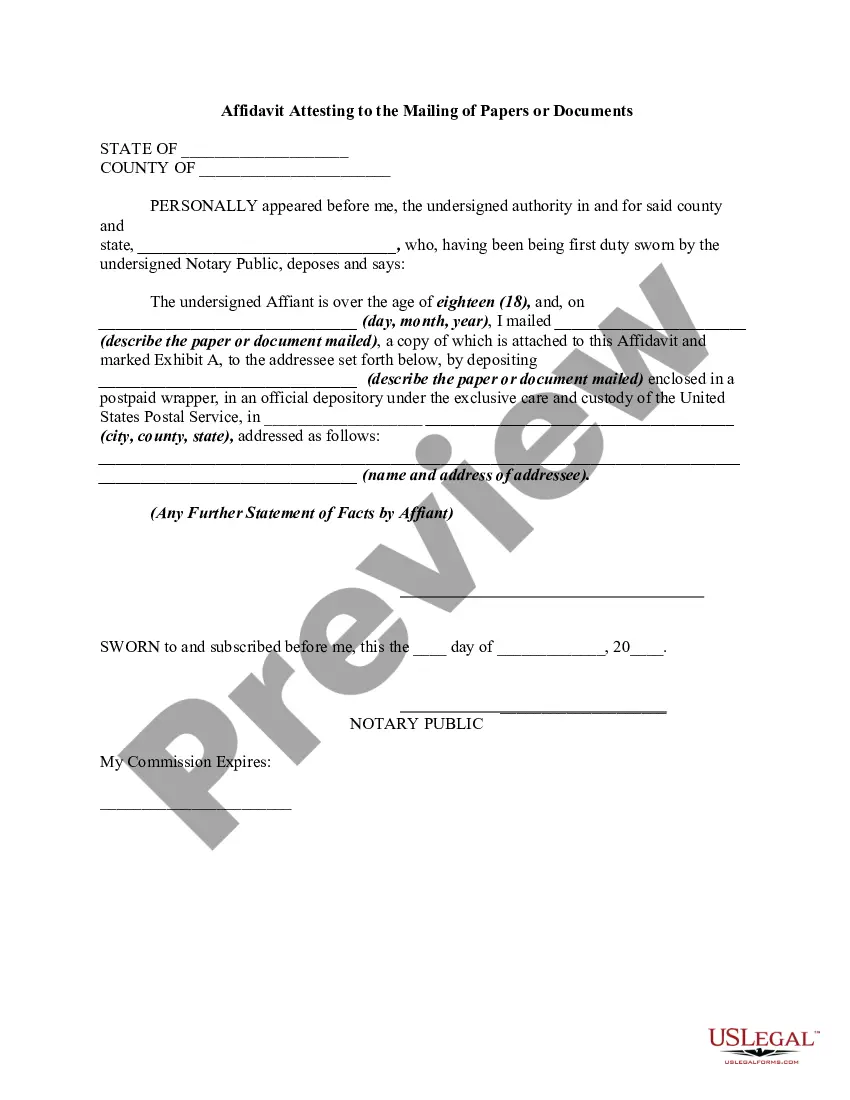
The Affidavit Attesting to the Mailing of Papers or Documents is a legal form used to confirm that specific documents have been mailed to a designated recipient at a specified address. This affidavit serves as a formal declaration, ensuring that the sending of documents is acknowledged, which can be critical for legal and administrative proceedings. Unlike other affidavit forms, this one specifically pertains to the mailing of documents, making it essential when proof of mailing is required.
Main sections of this form
- Affiant Information: Name and details of the person affirming the mailing.
- Date of Mailing: The specific date when the documents were sent.
- Description of Documents: A brief description of the mailed papers or documents.
- Addressee Information: Name and address of the person to whom the documents were mailed.
- Notary Public Section: A space for the notary to affirm the affidavit's validity.
Common use cases
This affidavit is typically used in scenarios where you need to provide evidence that certain papers or documents were sent to a specific individual. Common situations include court cases requiring proof of service, compliance with legal notices, or any situation where documentation of mailing is necessary for proper record-keeping or dispute resolution.
Who should use this form
- Individuals engaging in legal proceedings.
- Anyone who needs to establish proof of mailing documents.
- Attorneys preparing paperwork for their clients.
- Parties required to submit evidence of service to courts or other authorities.
How to complete this form
- Identify the affiant: Enter the name and details of the individual affirming the mail process.
- Specify the date of mailing: Fill in the exact day, month, and year the documents were mailed.
- Describe the documents: Clearly articulate what papers or documents were sent.
- Provide the addressee's information: Include the name and complete address of the recipient.
- Sign the affidavit: The affiant must sign the document in the presence of a notary public.
Notarization requirements for this form
To make this form legally binding, it must be notarized. Our online notarization service, powered by Notarize, lets you verify and sign documents remotely through an encrypted video session.
Get your form ready online
Our built-in tools help you complete, sign, share, and store your documents in one place.
Make edits, fill in missing information, and update formatting in US Legal Forms—just like you would in MS Word.
Download a copy, print it, send it by email, or mail it via USPS—whatever works best for your next step.
Sign and collect signatures with our SignNow integration. Send to multiple recipients, set reminders, and more. Go Premium to unlock E-Sign.
If this form requires notarization, complete it online through a secure video call—no need to meet a notary in person or wait for an appointment.
We protect your documents and personal data by following strict security and privacy standards.

Make edits, fill in missing information, and update formatting in US Legal Forms—just like you would in MS Word.

Download a copy, print it, send it by email, or mail it via USPS—whatever works best for your next step.

Sign and collect signatures with our SignNow integration. Send to multiple recipients, set reminders, and more. Go Premium to unlock E-Sign.

If this form requires notarization, complete it online through a secure video call—no need to meet a notary in person or wait for an appointment.

We protect your documents and personal data by following strict security and privacy standards.
Common mistakes
- Failing to include all necessary details about the recipient and documents.
- Not having the form notarized when required by state law.
- Using vague descriptions for the mailed documents.
- Missing the date of mailing, which is crucial for legal matters.
Why use this form online
- Convenience: Access and complete your affidavit from anywhere at any time.
- Editability: Easily make changes as needed before finalizing your affidavit.
- Reliability: Use templates created and reviewed by licensed attorneys to ensure accuracy.
Key takeaways
- The Affidavit Attesting to the Mailing of Papers or Documents serves as proof of mailing.
- It must be notarized to be valid.
- Ensures legal compliance in various situations requiring proof of document delivery.
Looking for another form?








Form popularity
FAQ
This form is a sworn statement used to confirm that specific papers were mailed to a designated recipient at a stated address. It is used when proof of mailing is required in legal or administrative proceedings. The document includes sections for the Affiant Information, Date of Mailing, Description of Documents, Addressee Information, and Notary Public Section.
To prove mailing, complete the Affidavit Attesting to the Mailing of Papers or Documents by supplying the Affiant Information, Date of Mailing, Description of Documents, and Addressee Information, then have it notarized in the Notary Public Section. This creates a sworn record that the mailing occurred on the stated date to the named recipient.
The purpose of the affidavit is to provide a sworn record that certain papers were mailed to a specific recipient. It supports proof of mailing for court filings or notices and creates a formal record of sending documents, which can be submitted with other case materials.
You may draft an affidavit yourself, but using this form provides a complete, structured template. To execute it properly, fill the five sections—Affiant Information, Date of Mailing, Description of Documents, Addressee Information, and Notary Public Section—and obtain notarization so the document is officially enforceable.
An affidavit of mailing is a sworn statement that particular papers were mailed to a named recipient on a given date. In this form, the Affiant confirms the mailing details and documents described, creating evidence for service, notices, or other official communications.
This form attests that mailing occurred and describes the documents and recipient; it does not assert that delivery or actual service occurred. An affidavit of service would address how and when the recipient was actually served.