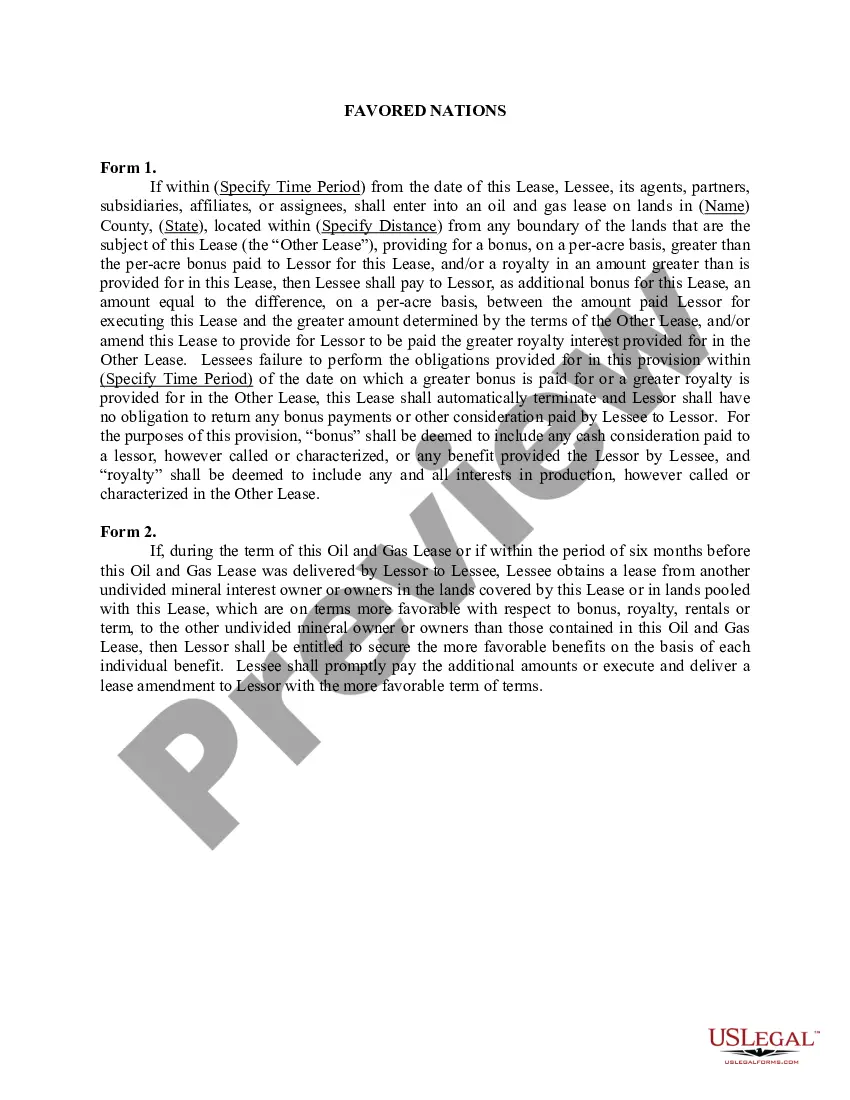
Exchange Addendum to Contract - Tax Free Exchange Section 1031
What is this form?
The Exchange Addendum to Contract - Tax Free Exchange Section 1031 is a legal document that modifies a standard real estate purchase agreement to facilitate a tax-free exchange of properties. This addendum is important for buyers and sellers seeking to defer capital gains taxes by exchanging one property for another under the provisions of Section 1031 of the Internal Revenue Code. This form sets forth the parties' intentions and obligations in the exchange process, differentiating it from other real estate contracts that do not accommodate such exchanges.
Key parts of this document
- Amendment to a Contract to Buy and Sell Real Estate
- Identification of the Exchanging Party and Cooperating Party
- Declaration of intent to structure the transaction as a Section 1031 exchange
- Limited assignability rights for the Exchanging Party
- Recommendation for obtaining legal and tax advice
- Conditions related to the qualifying exchange

Situations where this form applies
This form should be used when a buyer or seller intends to engage in a tax-free exchange of real estate under Section 1031 of the Internal Revenue Code. Scenarios may include selling an investment property while simultaneously purchasing another similar property, or when either party wants to defer taxes on capital gains from the sale of a property.
Intended users of this form
- Individuals or businesses selling commercial or investment properties
- Buyers looking to acquire replacement properties in a tax-deferred exchange
- Real estate agents or attorneys representing clients in property transactions
- Parties who are aware of the tax implications of property exchanges
How to prepare this document
- Identify the property being exchanged by filling in its details.
- Specify the names of the Buyer and Seller, denoting which is the Exchanging Party and which is the Cooperating Party.
- Indicate the intention to structure the transaction as a tax-free exchange under Section 1031.
- Complete the limited assignability clause, ensuring mutual agreement for cooperation in the exchange.
- Obtain necessary legal and tax advice as recommended within the form.
- Sign and date the document as required by both parties.
Is notarization required?
Notarization is required for this form to take effect. Our online notarization service, powered by Notarize, lets you verify and sign documents remotely through an encrypted video session, available 24/7.
Get your form ready online
Our built-in tools help you complete, sign, share, and store your documents in one place.
Make edits, fill in missing information, and update formatting in US Legal Forms—just like you would in MS Word.
Download a copy, print it, send it by email, or mail it via USPS—whatever works best for your next step.
Sign and collect signatures with our SignNow integration. Send to multiple recipients, set reminders, and more. Go Premium to unlock E-Sign.
If this form requires notarization, complete it online through a secure video call—no need to meet a notary in person or wait for an appointment.
We protect your documents and personal data by following strict security and privacy standards.

Make edits, fill in missing information, and update formatting in US Legal Forms—just like you would in MS Word.

Download a copy, print it, send it by email, or mail it via USPS—whatever works best for your next step.

Sign and collect signatures with our SignNow integration. Send to multiple recipients, set reminders, and more. Go Premium to unlock E-Sign.

If this form requires notarization, complete it online through a secure video call—no need to meet a notary in person or wait for an appointment.

We protect your documents and personal data by following strict security and privacy standards.
Typical mistakes to avoid
- Failing to accurately identify the properties involved in the exchange.
- Not consulting with legal or tax professionals, leading to potential compliance issues.
- Misunderstanding the limited assignability clause and its implications.
- Neglecting to sign and date the form, making it unenforceable.
Why use this form online
- Convenience of downloading and filling out the form at any time.
- Editability allows customization for specific transaction details.
- Access to forms drafted by licensed attorneys ensures reliability and legal soundness.
Looking for another form?






Form popularity
FAQ
A successful 1031 exchange isn't a do-it-yourself project. You must follow IRS rules to realize the tax deferral benefits, and you'll need a middle person, called a qualified intermediary (QI).
A 1031 exchange gets its name from Section 1031 of the U.S. Internal Revenue Code, which allows you to avoid paying capital gains taxes when you sell an investment property and reinvest the proceeds from the sale within certain time limits in a property or properties of like kind and equal or greater value.
The short answer. The direct cost to you in a 1031 exchange typically comes in the form of a fee paid to your QI. QI fees vary, but most reports indicate that a typical deferred 1031 exchange costs between $600 and $1,200.
Trade up in real estate value with one or more replacement properties. Reinvest all of your 1031 exchange proceeds from the relinquished property into the replacement property.
Gain deferred in a like-kind exchange under IRC Section 1031 is tax-deferred, but it is not tax-free. The exchange can include like-kind property exclusively or it can include like-kind property along with cash, liabilities and property that are not like-kind.
The exchange allows for the deference of any taxable gains on the property that is first sold.The replacement property must be secured, and the exchange finalized no later than 180 days after the sale of the original asset.
Your basis is equal to the amount you originally paid for the property, plus any improvements you made, minus depreciation deductions. For example, say you have a rental house located at 589 Santa Sophia Ave. You bought the property for $80,000 and paid a total of $40,000 for foundation and roof work.
When it comes to real estate investing, your cost basis is the price you pay to acquire a property, including any acquisition costs. For example, if you pay $200,000 for a property and pay $5,000 in legal expenses and lender fees, your cost basis is $205,000.