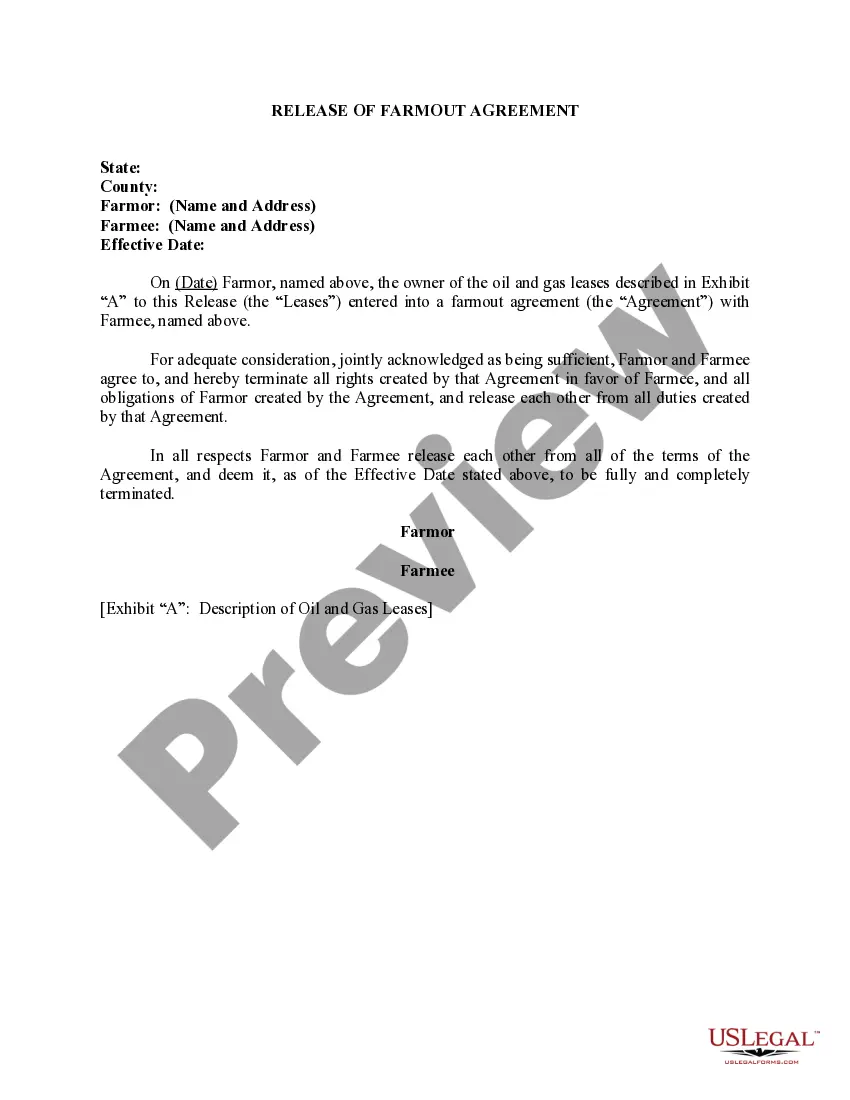
Educational Assistance Program for Employees
What is this form?
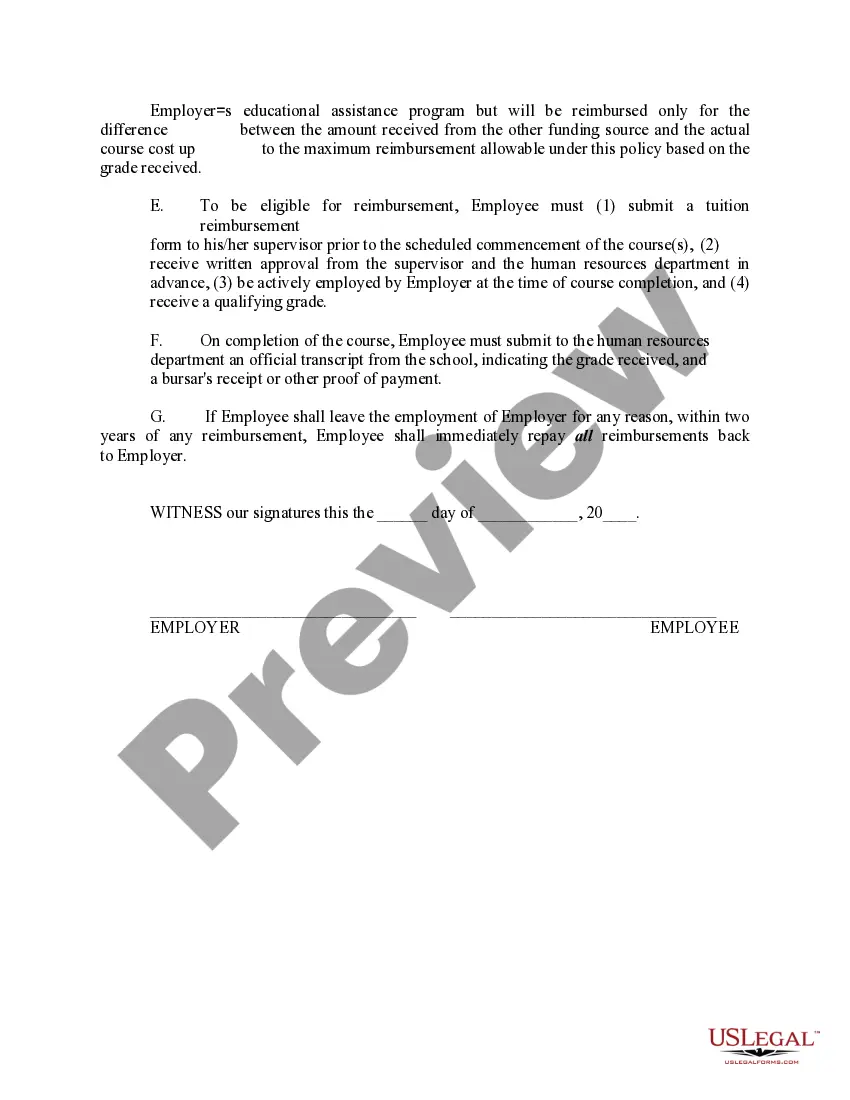
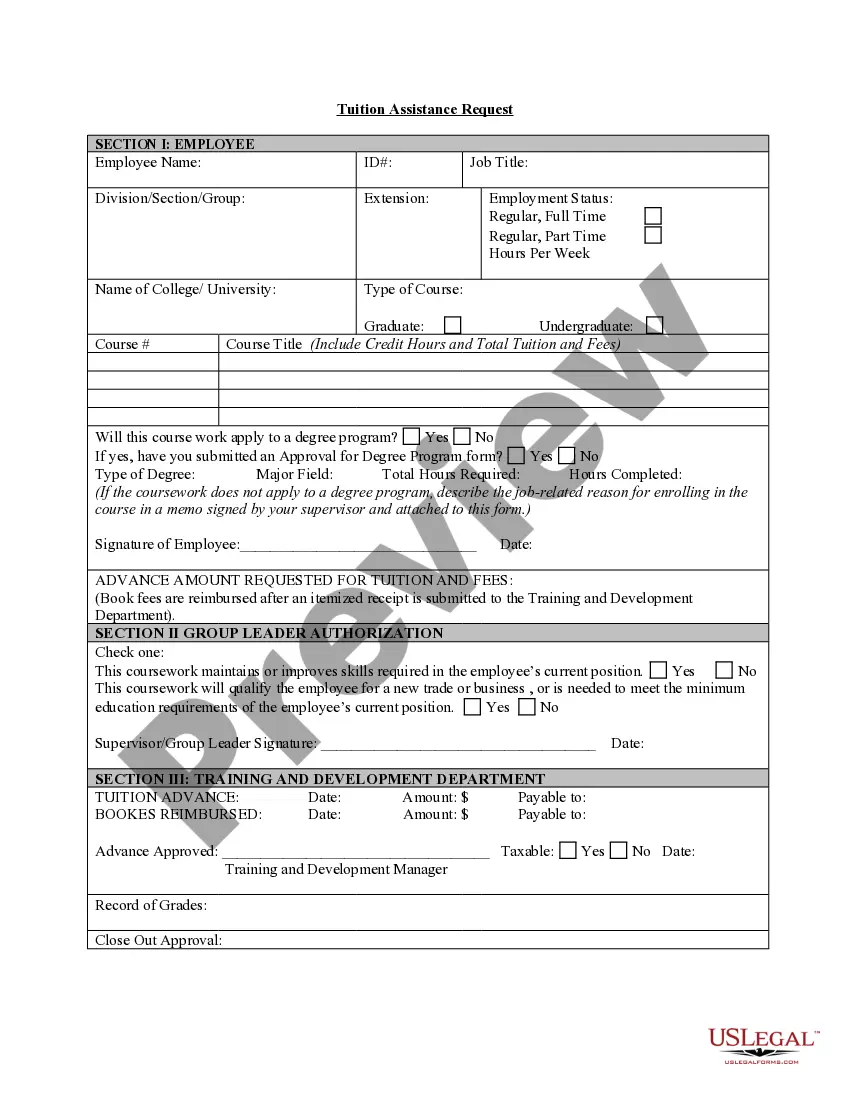
The Educational Assistance Program for Employees form is designed to formalize an employer's commitment to support eligible employees in their educational pursuits. This form outlines the employer's guidelines for providing financial assistance for courses that enhance employee skills related to their current job responsibilities or future career growth within the company. It establishes the criteria for eligibility, reimbursement amounts, and obligations employees must meet to qualify for the assistance.
Key components of this form
- Introduction stating the purpose of the educational assistance program.
- Eligibility criteria for employees to participate in the program.
- Details about the approved institutions and courses eligible for reimbursement.
- Reimbursement schedule based on the grade received in the course.
- Requirements for reimbursement submission and proof of completion.
- Clauses regarding repayment if the employee leaves the company within two years after receiving reimbursement.



When to use this document
This form should be used when an employer wants to establish a framework for providing educational assistance to employees. It is particularly useful when an employee wishes to pursue educational courses that will benefit their professional development. The program can be applied when seeking reimbursement for courses that are directly related to the employee's current role or future positions they may occupy within the organization.
Intended users of this form
- Employers seeking to implement or standardize an educational assistance program.
- Employees who are full-time and have completed at least one year of service, intending to enroll in educational courses that enhance their skills.
- Human resources professionals managing employee benefits and compensation.
Steps to complete this form
- Fill in the employer's name in the designated section at the beginning of the form.
- Specify the educational institution the employee intends to enroll in along with the course or degree being pursued.
- Confirm that pursuing the educational program will not interfere with the employee's job responsibilities.
- Attach the tuition reimbursement form and any other required documentation prior to the start of the course.
- Submit the completed form to the supervisor for approval and keep a copy for personal records.
Does this document require notarization?
This form usually doesn’t need to be notarized. However, local laws or specific transactions may require it. Our online notarization service, powered by Notarize, lets you complete it remotely through a secure video session, available 24/7.
Get your form ready online
Our built-in tools help you complete, sign, share, and store your documents in one place.
Make edits, fill in missing information, and update formatting in US Legal Forms—just like you would in MS Word.
Download a copy, print it, send it by email, or mail it via USPS—whatever works best for your next step.
Sign and collect signatures with our SignNow integration. Send to multiple recipients, set reminders, and more. Go Premium to unlock E-Sign.
If this form requires notarization, complete it online through a secure video call—no need to meet a notary in person or wait for an appointment.
We protect your documents and personal data by following strict security and privacy standards.

Make edits, fill in missing information, and update formatting in US Legal Forms—just like you would in MS Word.

Download a copy, print it, send it by email, or mail it via USPS—whatever works best for your next step.

Sign and collect signatures with our SignNow integration. Send to multiple recipients, set reminders, and more. Go Premium to unlock E-Sign.

If this form requires notarization, complete it online through a secure video call—no need to meet a notary in person or wait for an appointment.

We protect your documents and personal data by following strict security and privacy standards.
Typical mistakes to avoid
- Not obtaining supervisor and human resources approval before enrolling in courses.
- Failing to submit official transcripts and proof of payment after course completion.
- Ignoring the repayment clause if employment ends within two years of reimbursement.
Advantages of online completion
- Convenient access to the form eliminates the need for physical copies.
- Editable fields allow for quick adjustments to personal and educational information.
- Reliable storage of the completed form ensures that both employer and employee can reference it at any time.
Legal use & context
- This form serves as a binding agreement between the employer and employee, ensuring clarity in the educational assistance process.
- It protects both parties by outlining the expectations and responsibilities regarding financial reimbursement.
- Employers can enforce the repayment clause in accordance with company policy if the employee leaves the organization prematurely after reimbursement.
What to keep in mind
- Employers and employees benefit from a structured approach to educational assistance.
- Clear eligibility criteria and reimbursement schedules are crucial for program success.
- Both parties should maintain open communication throughout the educational assistance process.
Looking for another form?
Form popularity
FAQ
Company meetings. These meetings present many hurdles for employees. Email. Not every employee regularly checks their email, especially employees who don't work in front of a computer. Mail. Many people don't want to read long, complicated messages about health care.
Teach Why Before How. Too often it happens that companies cram a ton of information into the employee during training sessions. Practice Is The Best Training. Encourage employees to share their expertise. Expose employees to networking events. Training Videos.
Make Your Employees More Aware. Host Contests. Encourage Coworkers to Share. Encourage Management to Participate. Make It Easier to Find Benefits.
Employees can be reimbursed for up to $5,250 in educational assistance per year. That amount is not added to the employees wages and is deducted by small business owners on IRS Schedule C.
Employers get to deduct $5,250 from their FICA and FUCA payroll taxes for each participating employee.That said, all funding over the magic number are considered to be taxable income by the IRS. This means that tuition reimbursement in excess of this amount cannot be deducted and must be declared as income.
Many companies offer tuition reimbursement as part of their benefits package. Here's how it typically works: an employee pays up front for college, graduate, or continuing education classes. Then, once the class or semester is complete, the employer will refund a portion of the money spentor the full amount.
A qualified educational assistance program is a plan established and maintained by an employer under which the employer provides educational assistance to employees.The program must be a separate written plan of the employer.
Communicate with Employees to Help Them Understand Benefit Offerings. Make plans customizable to meet individual needs. Explore options to offer more voluntary benefits for financial security. Talk about benefits outside of open enrollment. Make it easy to sign up.
Consider using a variety of communication methods, including e-mail, broadcast voice mails, online outlets and in-person meetings with employees. Giving employees the opportunity to talk directly with benefits advisors or representatives from insurance carriers can be incredibly effective in terms of education.