Agreement and Personal Injury Release for Tanning Facility Use
Understanding this form
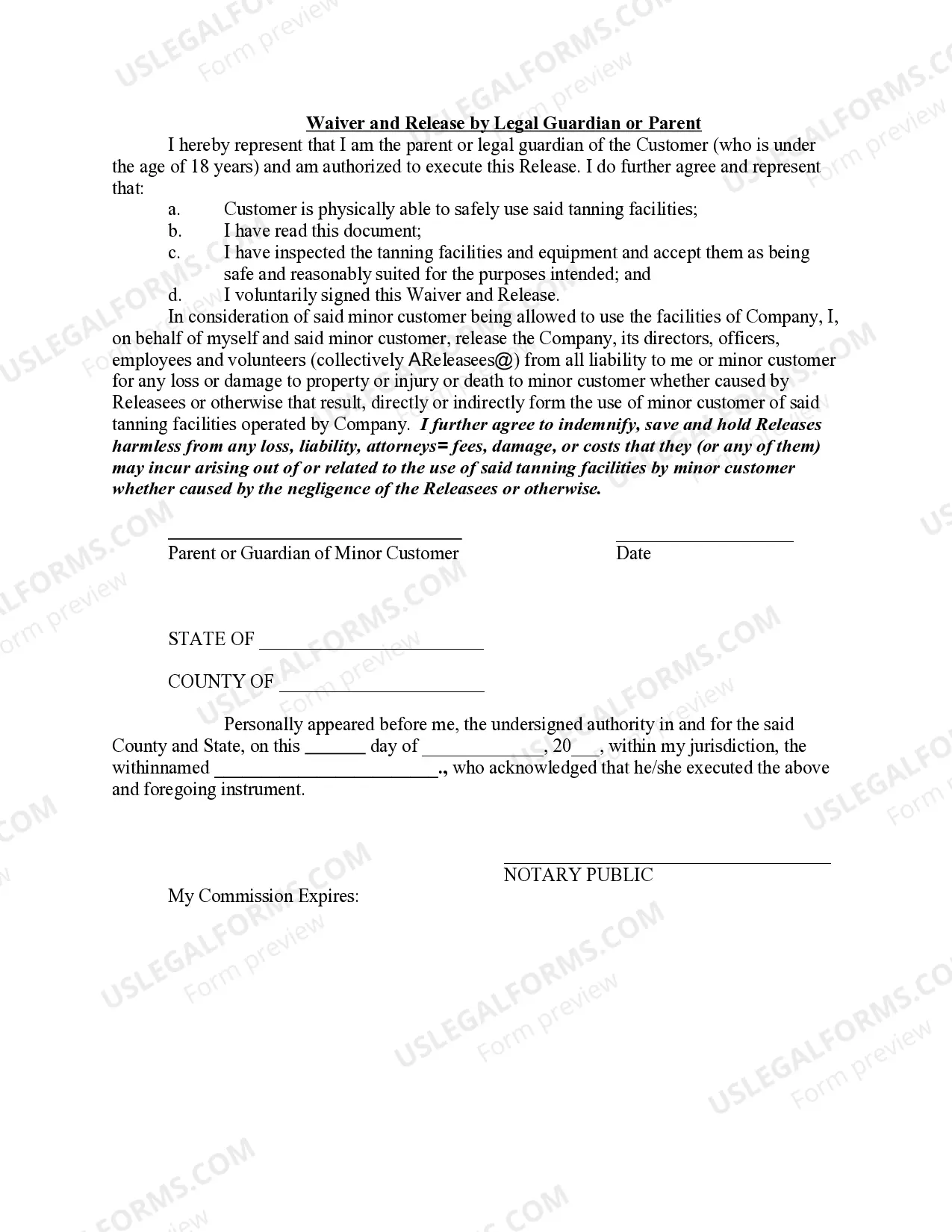
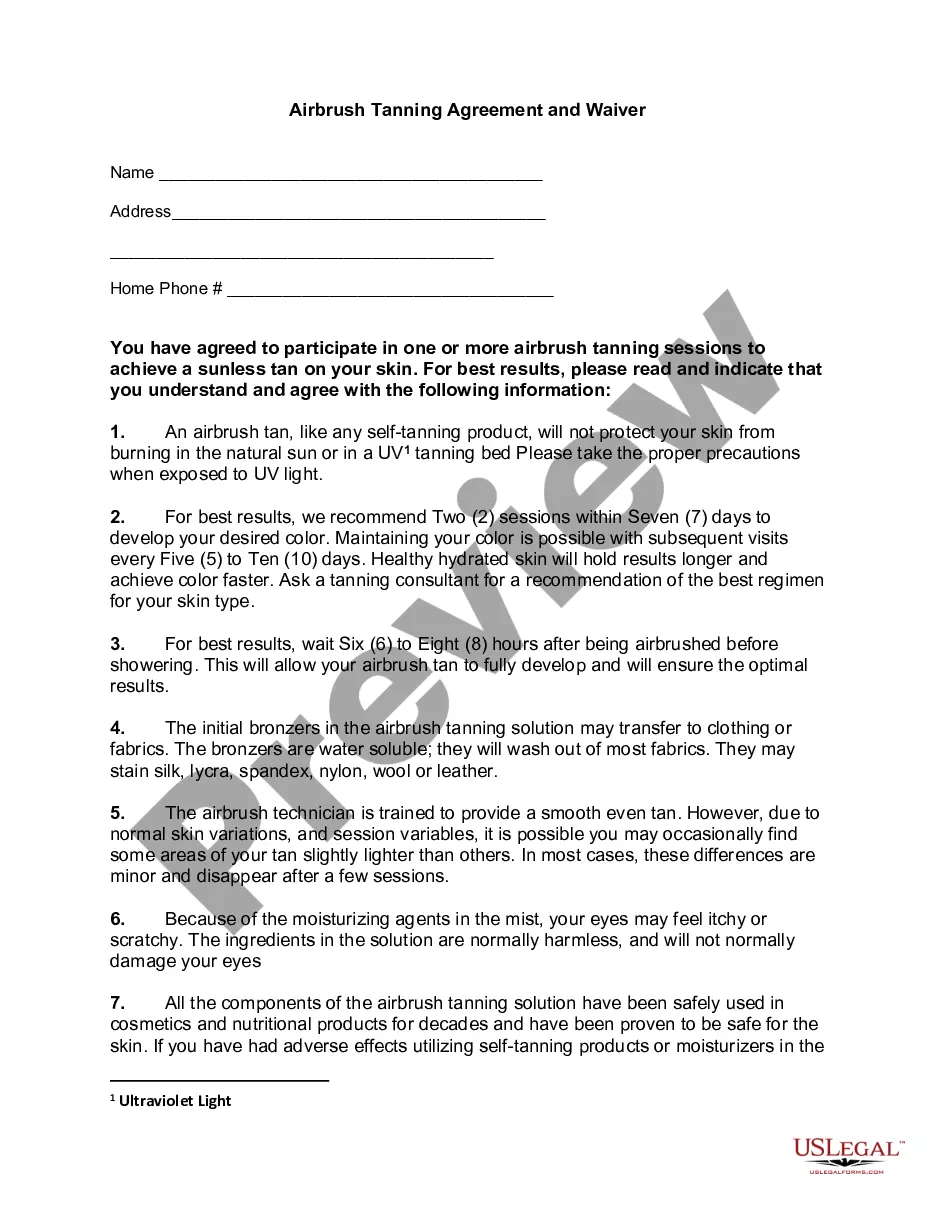
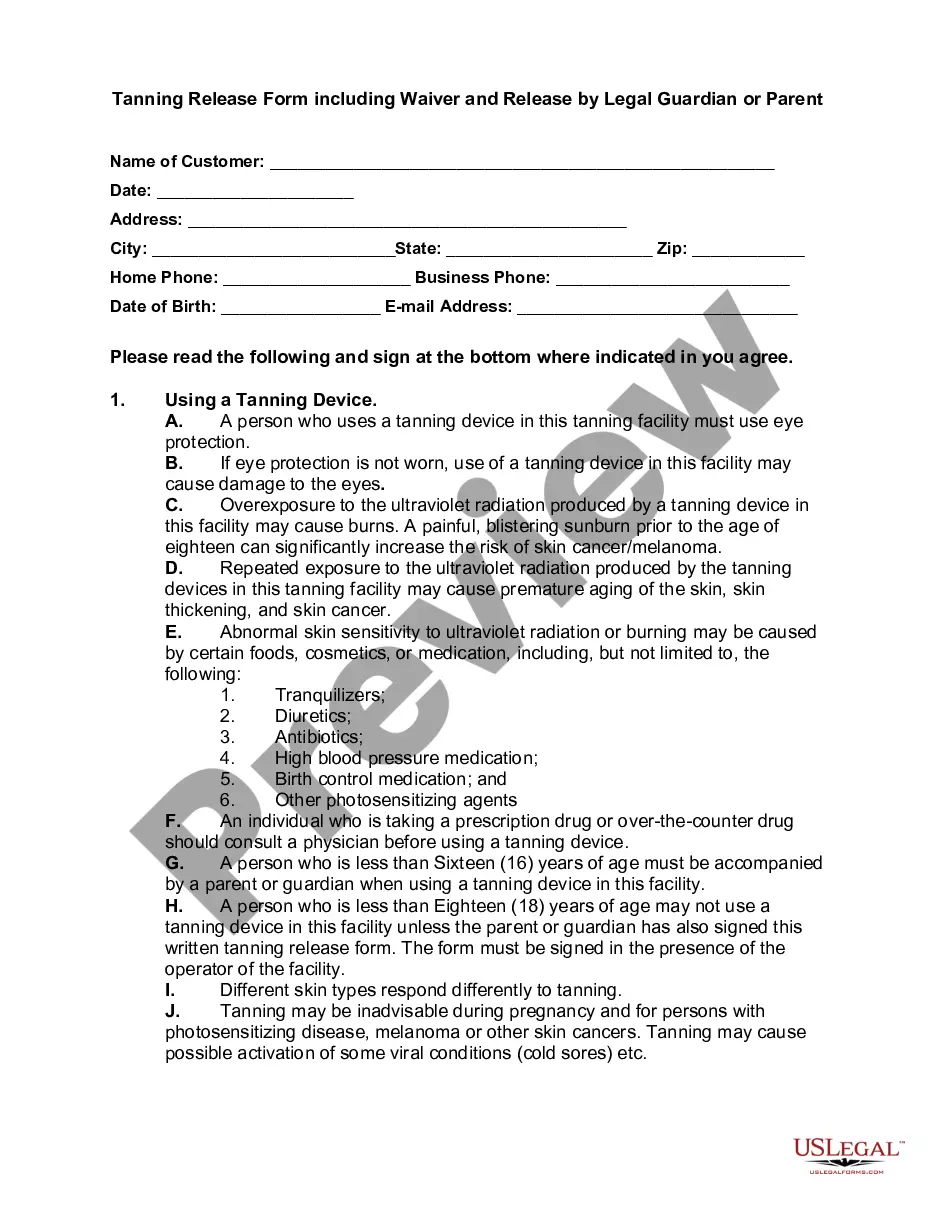
The Agreement and Personal Injury Release for Tanning Facility Use is a legal document designed to limit the liability of tanning facility owners when customers, especially minors, use their services. This form ensures that customers acknowledge the potential risks associated with tanning and enables facility owners to protect themselves from legal claims arising from injuries or health issues. Unlike other liability waivers, this form includes specific provisions for minors and requires parental consent, making it distinct in its protective measures for younger users.
Form components explained
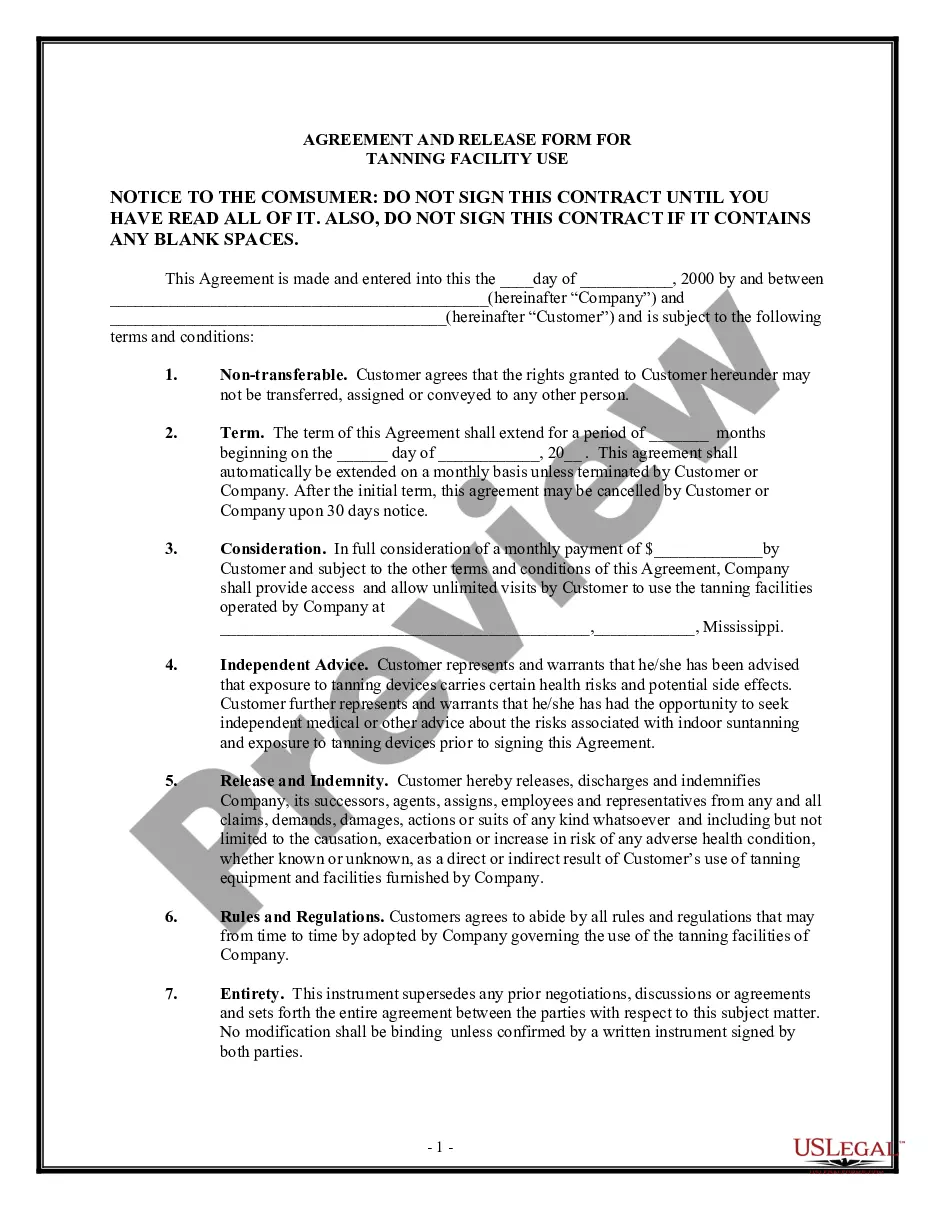
- Non-transferable clause: States that the rights granted are exclusive to the customer.
- Term of agreement: Outlines the duration of usage and automatic renewal conditions.
- Consideration: Details the payment terms for accessing tanning facilities.
- Independent advice: Affirms that customers understand the health risks associated with tanning.
- Release and indemnity clause: Releases the facility from liability for injuries or health issues arising from the use of tanning services.
- Rules and regulations: States that customers must comply with facility regulations.

When to use this document
This form should be used when a customer wishes to use tanning facilities, especially if that customer is a minor. It is essential when an individual or parent is seeking to establish an understanding of the risks involved and to limit the facility's legal exposure. This agreement is also useful in preparing for family or community tanning events where minors may participate.
Intended users of this form
- Tanning facility owners who want to protect themselves from liability.
- Customers, particularly minors, who intend to use tanning services.
- Parents or legal guardians seeking to agree to the terms on behalf of their children.
How to complete this form
- Identify the parties by entering the names of the tanning facility (Company) and the customer.
- Specify the agreement term by filling in the start date and duration of usage.
- Enter the amount of payment that the customer will provide for tanning services.
- Ensure the parent or legal guardian signs and acknowledges the waiver if the customer is a minor.
- Both parties should sign the document to make it legally binding.
Does this document require notarization?
Yes, this form must be notarized to be legally valid. This requirement ensures that the signatures, especially those of parents or guardians for minors, are verified. US Legal Forms offers integrated online notarization services, allowing you to complete this step securely via a video call without the need to travel.
Get your form ready online
Our built-in tools help you complete, sign, share, and store your documents in one place.
Make edits, fill in missing information, and update formatting in US Legal Forms—just like you would in MS Word.
Download a copy, print it, send it by email, or mail it via USPS—whatever works best for your next step.
Sign and collect signatures with our SignNow integration. Send to multiple recipients, set reminders, and more. Go Premium to unlock E-Sign.
If this form requires notarization, complete it online through a secure video call—no need to meet a notary in person or wait for an appointment.
We protect your documents and personal data by following strict security and privacy standards.

Make edits, fill in missing information, and update formatting in US Legal Forms—just like you would in MS Word.

Download a copy, print it, send it by email, or mail it via USPS—whatever works best for your next step.

Sign and collect signatures with our SignNow integration. Send to multiple recipients, set reminders, and more. Go Premium to unlock E-Sign.

If this form requires notarization, complete it online through a secure video call—no need to meet a notary in person or wait for an appointment.

We protect your documents and personal data by following strict security and privacy standards.
Typical mistakes to avoid
- Failing to have a parent or guardian sign for a minor customer.
- Not specifying the correct dates for the term of the agreement.
- Omitting payment details, leading to confusion about costs.
Why complete this form online
- Convenience of immediate access: download and fill out the form at your convenience.
- Editability: customize the form to fit specific situations and requirements.
- Legally vetted: ensures the form complies with legal standards set by licensed attorneys.
Main things to remember
- The form is essential for minimizing liability for tanning facility owners.
- Parental signatures are crucial when minors are involved to validate the agreement.
- Clear understanding of the terms can prevent future disputes regarding liability and usage.
Looking for another form?
Form popularity
FAQ
So, if an accident happens and injury occurs, is a Waiver effective in protecting the institution from liability and preventing a lawsuit from the injured party? The answer is that, if properly worded and signed, the Waiver is likely valid and will preclude legal claims for injuries.
Release Form Enforceability A minor usually cannot legally release his or her rights.So, a release signed only by the minor is not enforceable. In addition, the release must be signed before any injury has occurred.
The short answer is no. You don't have to accept what your employer offers, nor do you have to sign a release. A release is valid only if it's voluntary: If your employer requires or coerces you sign, it won't be upheld in court. This doesn't mean, however, that you are entitled to severance.
1, 1988) (liability waivers are enforceable in California if the release is clear, unambiguous and explicit in expressing the intent of the parties; the act of negligence that results in injury to the releasee is reasonably related to the object or purpose for which the release is given; and the release does not
In California, a liability waiver must be clear, unambiguous, and explicit. In other words, waivers cannot be printed in faded ink, in small font, on the back of a paper, or in an otherwise ambiguous form. If the waiver that you sign is not represented clearly, it may not hold up in the event of a lawsuit.
In many cases, the waiver is not enforceable.If you've been injured due to negligent actions, you can sue even if you signed a waiver. Winning a lawsuit concerning negligence is not uncommon. Many celebrities have sued for negligence even though they signed documents stating they understood the risks.
A release agreement is an enforceable promise not to proceed with a legal claim in exchange for money or other compensation. Essentially, a party (the releasee) gives money or other consideration to a second party (the releasor).Commonly, money is offered as consideration.
The main difference between releases and waivers is the transferring of ownership. When rights are released, they are transferred to another party. When rights are waived, they are gone altogether. If intellectual property rights are waived, the IP can be used by any other party that has access to it.
This includes releasing the Released Party from all claims for damages, costs, expenses, and compensation.This release and discharge shall be a fully binding and complete settlement among all Parties to this Agreement and their heirs, assigns, and successors.