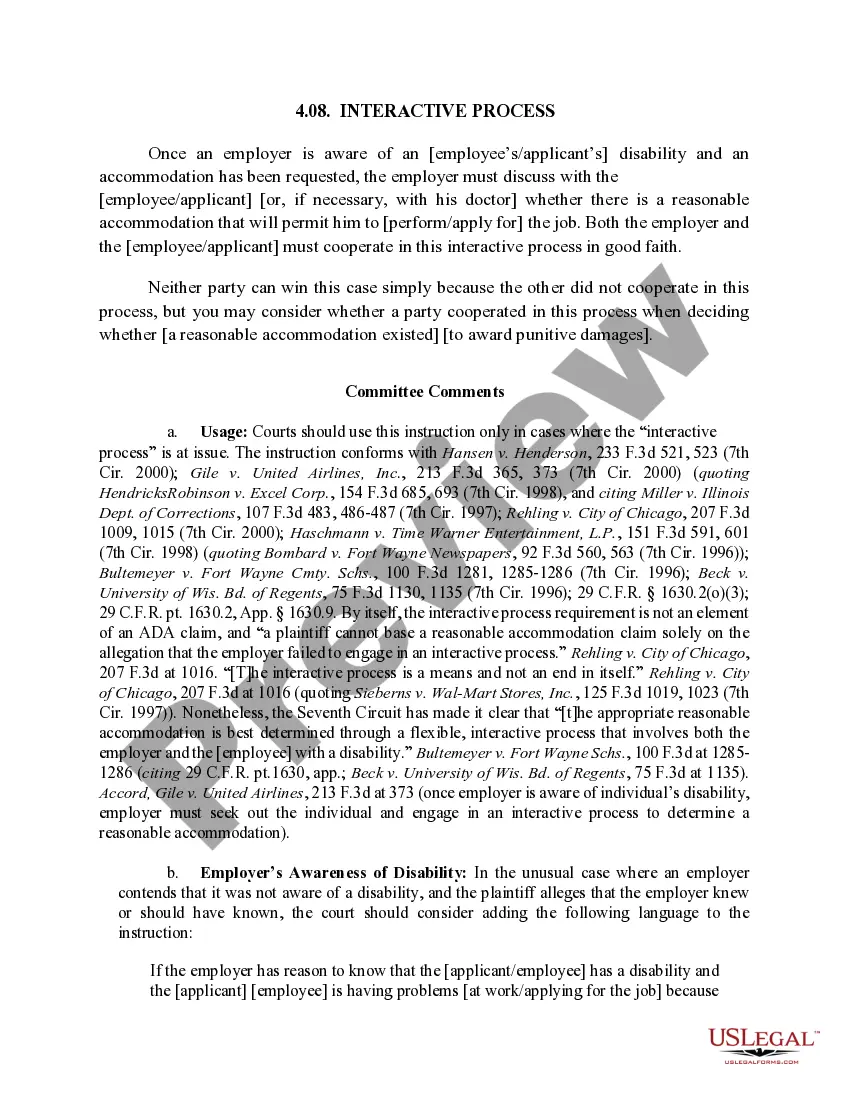
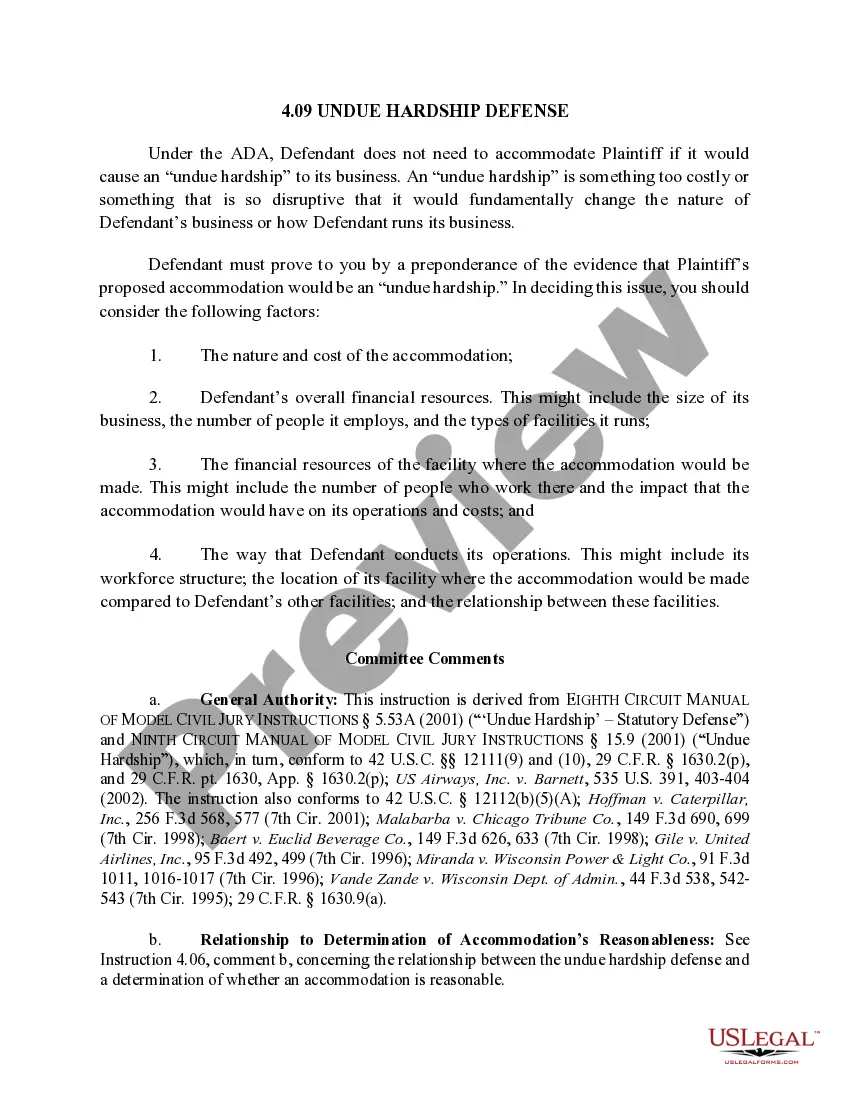
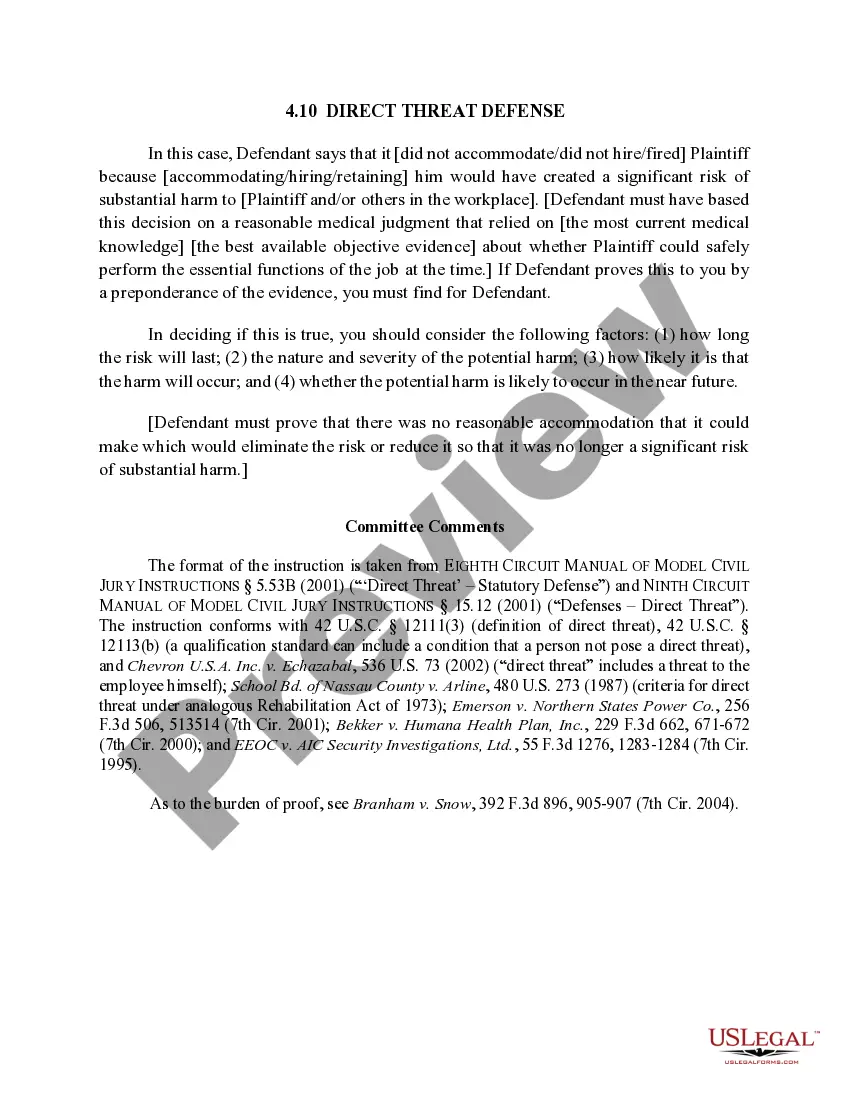
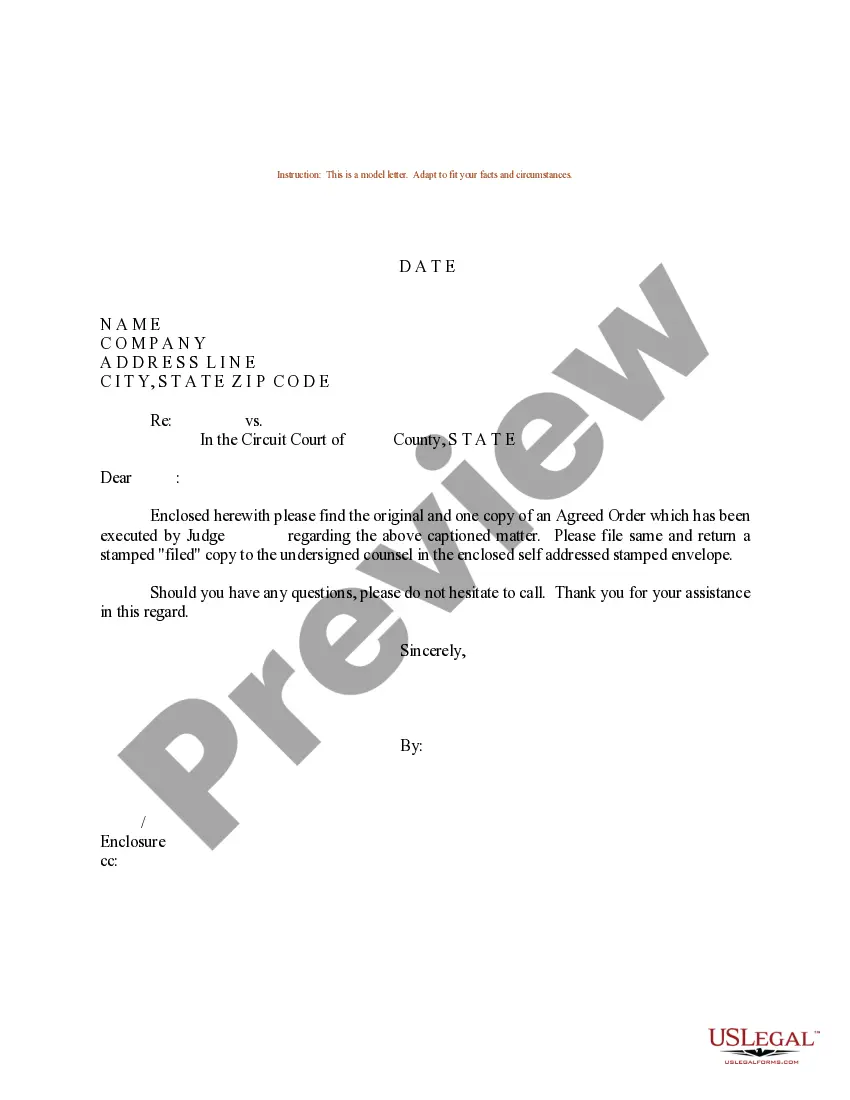
Sample Letter to Court Administrator transmitting Agreed Order of Possession
Overview of this form
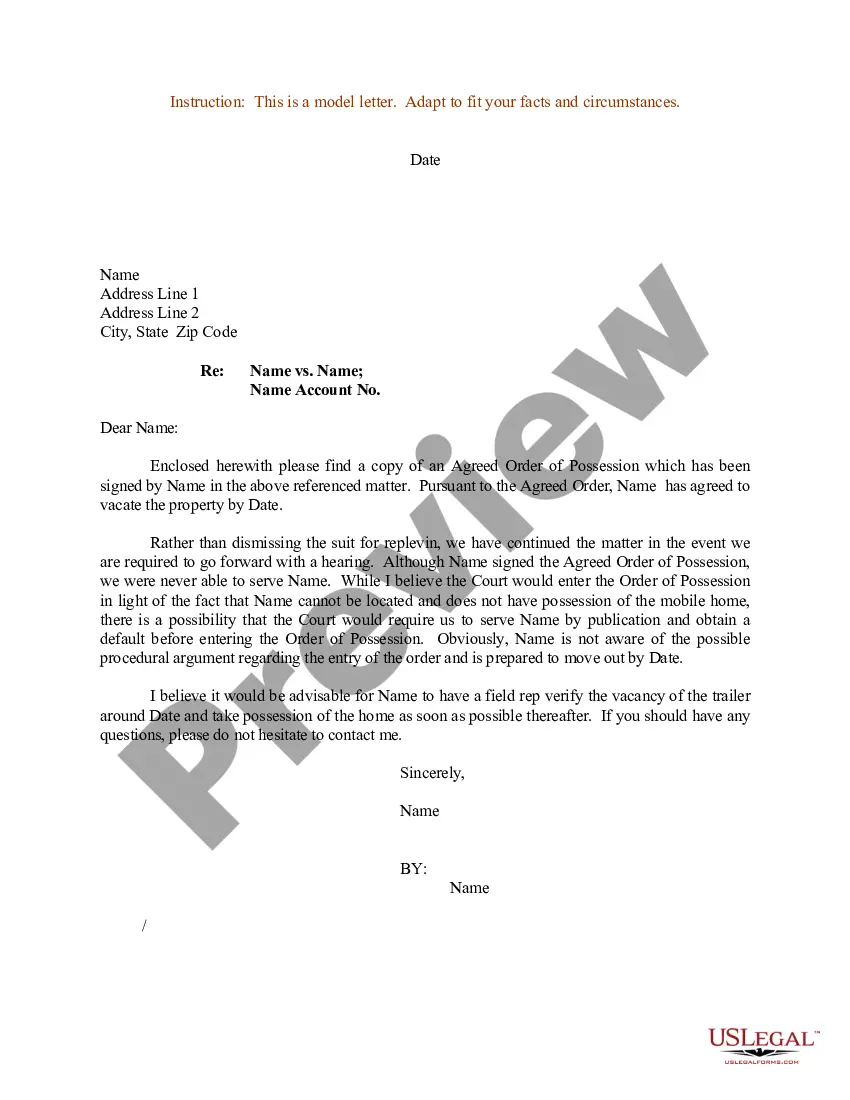
This Sample Letter to Court Administrator transmitting Agreed Order of Possession is a template designed to accompany an agreed order related to possession matters in court. This form serves as a professional correspondence to the court administrator, ensuring that the relevant documents are submitted formally and appropriately. Unlike other forms, this letter provides a structured way to communicate the specifics of the agreed order while maintaining legal decorum.
Main sections of this form
- Date: The date the letter is prepared.
- Name and Title: The name and title of the sender, typically the attorney or representative.
- Address: The complete address of the sender.
- Recipient: Identification of the court administrator and the relevant court address.
- Subject Line: A clear statement indicating the nature of the correspondence.
- Body Content: Space to explain the details of the agreed order of possession.



Common use cases
This form is appropriate when a legal party needs to communicate directly with a court administrator regarding an Agreed Order of Possession. It is typically used in scenarios such as landlord-tenant disputes where a property possession order has been mutually agreed upon by both parties and needs formal submission to the court for ratification.
Who can use this document
- Individuals or attorneys involved in landlord-tenant disputes.
- Landlords seeking to formalize possession agreements with tenants.
- Tenants who have reached an agreement with their landlords regarding possession and need to communicate this to the court.
- Legal representatives acting on behalf of one of the parties in a possession matter.
Completing this form step by step
- Identify the date and enter it at the top of the letter.
- Fill in your name and title, as well as your address for appropriate identification.
- Specify the name and address of the court administrator you are addressing.
- Clearly state the subject line to reflect the content of the letter.
- Compose the body, explaining the details of the Agreed Order of Possession and any pertinent information.
Does this document require notarization?
In most cases, this form does not require notarization. However, some jurisdictions or signing circumstances might. US Legal Forms offers online notarization powered by Notarize, accessible 24/7 for a quick, remote process.
Get your form ready online
Our built-in tools help you complete, sign, share, and store your documents in one place.
Make edits, fill in missing information, and update formatting in US Legal Forms—just like you would in MS Word.
Download a copy, print it, send it by email, or mail it via USPS—whatever works best for your next step.
Sign and collect signatures with our SignNow integration. Send to multiple recipients, set reminders, and more. Go Premium to unlock E-Sign.
If this form requires notarization, complete it online through a secure video call—no need to meet a notary in person or wait for an appointment.
We protect your documents and personal data by following strict security and privacy standards.

Make edits, fill in missing information, and update formatting in US Legal Forms—just like you would in MS Word.

Download a copy, print it, send it by email, or mail it via USPS—whatever works best for your next step.

Sign and collect signatures with our SignNow integration. Send to multiple recipients, set reminders, and more. Go Premium to unlock E-Sign.

If this form requires notarization, complete it online through a secure video call—no need to meet a notary in person or wait for an appointment.

We protect your documents and personal data by following strict security and privacy standards.
Common mistakes to avoid
- Failing to include the correct recipient's address.
- Omitting the subject line, leading to confusion about the letter's purpose.
- Not adapting the letter's content to fit the specific circumstances of the case.
- Submitting the letter without a signature if required by local rules.
Why use this form online
- Convenience of downloading and filling out the template from home.
- Editable format allows for easy customization to fit your specific case.
- Preserves legal standards and guidelines outlined by licensed attorneys during drafting.
What to keep in mind
- The Sample Letter to Court Administrator is a formal communication tool for submitting an Agreed Order of Possession.
- It is crucial for landlords, tenants, and their representatives to use this form accurately to reflect an agreed possession matter.
- Following the outlined steps will help ensure correct completion and submission to the court.
Looking for another form?



Form popularity
FAQ
Your Information (first thing that goes on the inside of the letter) Name. The Date. The Judge's Information. Honorable Judge First Name Last Name. What the Letter is Going to Address. Follow this format Re: Sentencing of First Name Last Name of Defendant, Case No. Salutation. Body. Signature.
Introduce yourself. State what your occupation is and any qualifications you hold. Outline your relationship with the person who is the subject of the legal proceedings. DO. Acknowledge the charges that have been brought against the person. DO. State your opinion of the person's general character. DO.
You put "p.p." in front of the name of the person for whom you are writing the letter -- p.p. stands for "per pro" (for and on behalf of).
Use "Re:" (an abbreviation for "regarding" or "with reference to"), followed by a brief identifying phrase. Begin with a salutation. Write "Dear Judge (last name)," to start the message of your letter. Note that you should use "the Honorable" when referring to the judge, but use "Judge" addressing him or her directly.
You can't write to the judge. You can hire your own attorney to make your case to the court.
Character letters should include your name, mailing address, phone number and email address so that the court can verify your information. They should be addressed either to the Honorable FIRST NAME LAST NAME or Judge FIRST NAME LAST NAME.
However, when a person is awaiting trial, writing a letter to the judge will not help. At best, the letter will go unread by the judge, and will be of no help. In a worst-case scenario, the letter will end up being used by the prosecution as evidence against that person.
You can address most judges at the start of a letter as "Dear Judge" (or "Dear Justice" if they serve in a U.S. state or federal Supreme Court, or in certain courts of other countries). When addressing the envelope, it is best to use the judge's full title, along with the full name of the court in which he/she serves.