Acceptance of Election - Corporate Resolutions
What this document covers
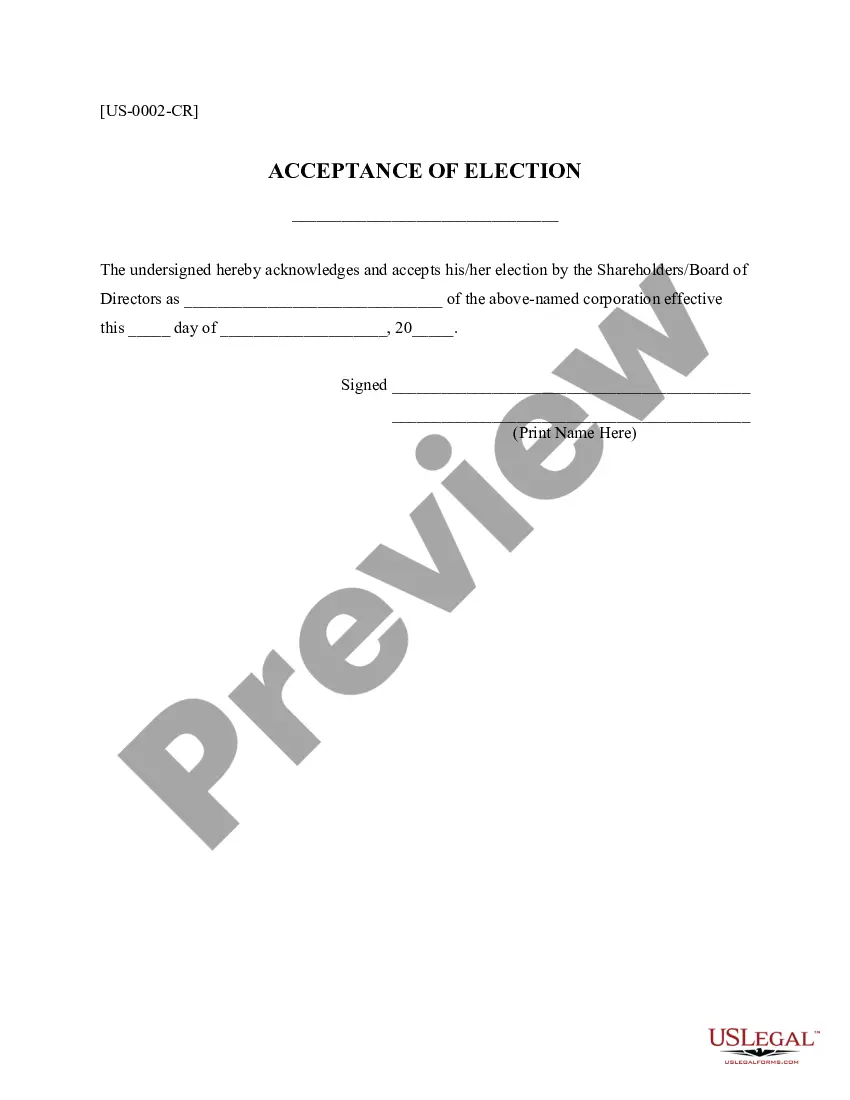
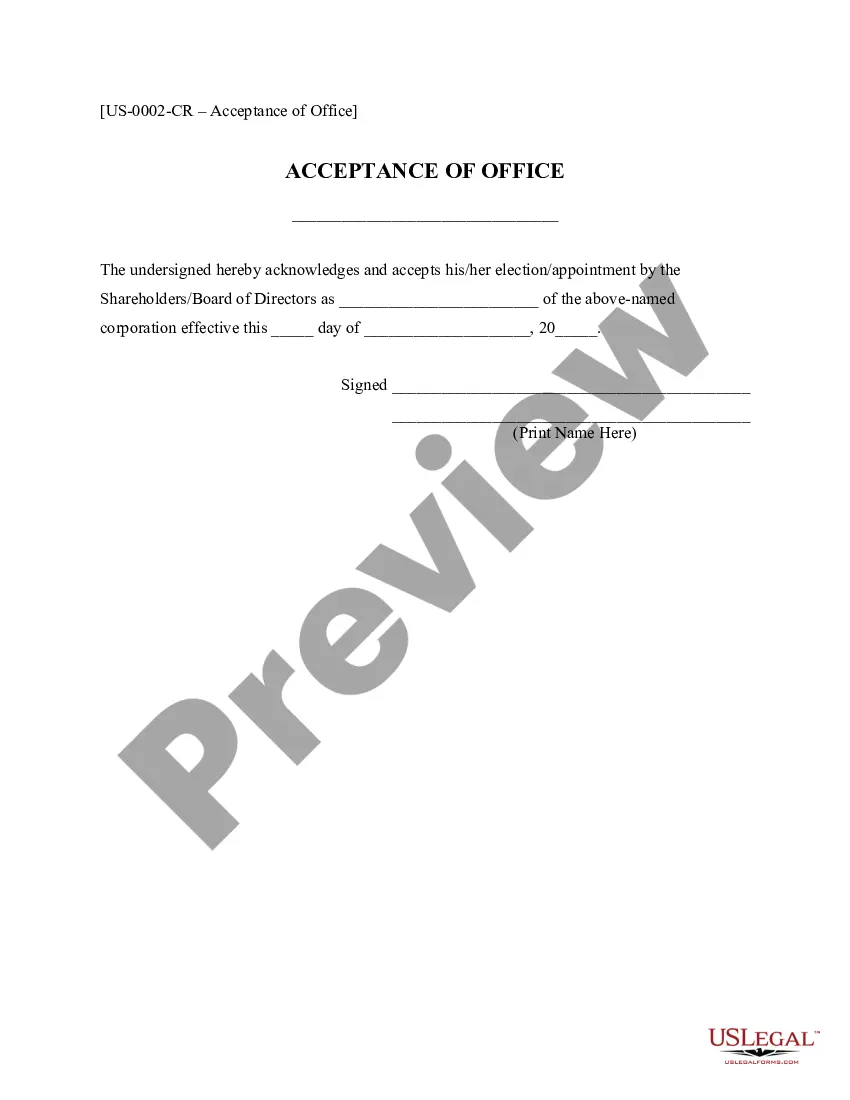
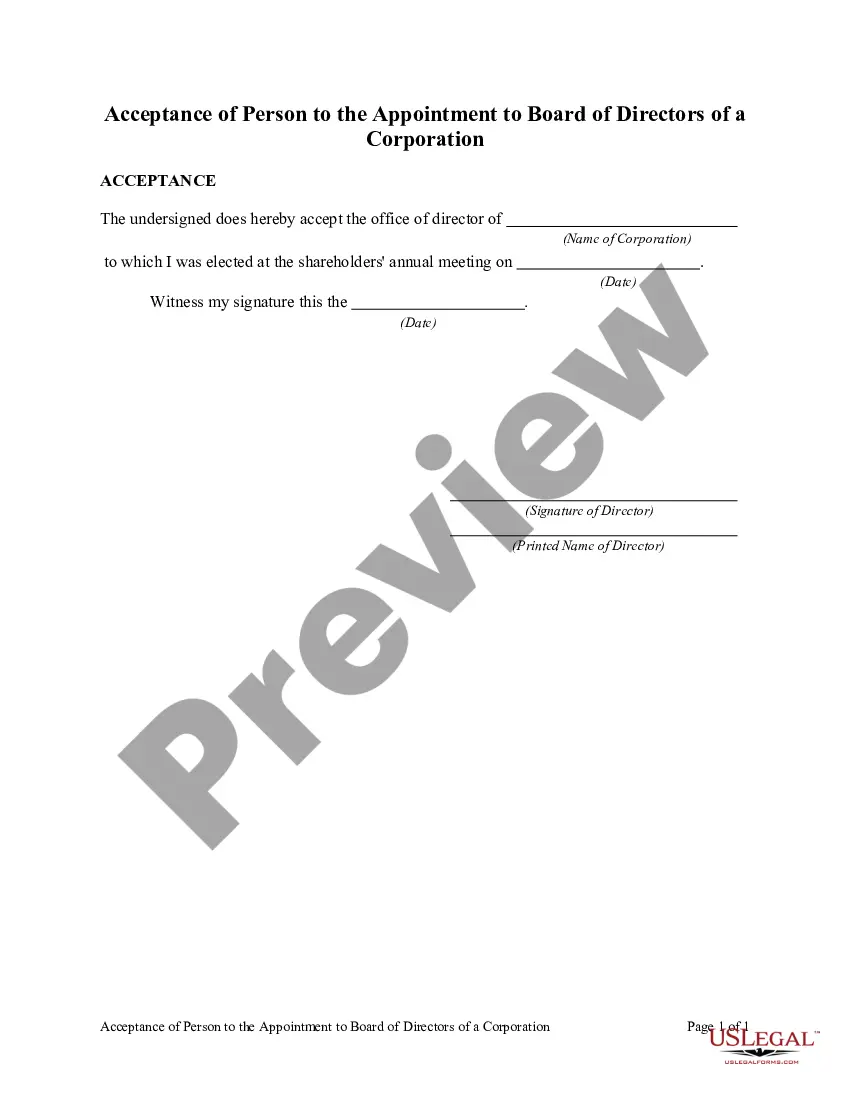
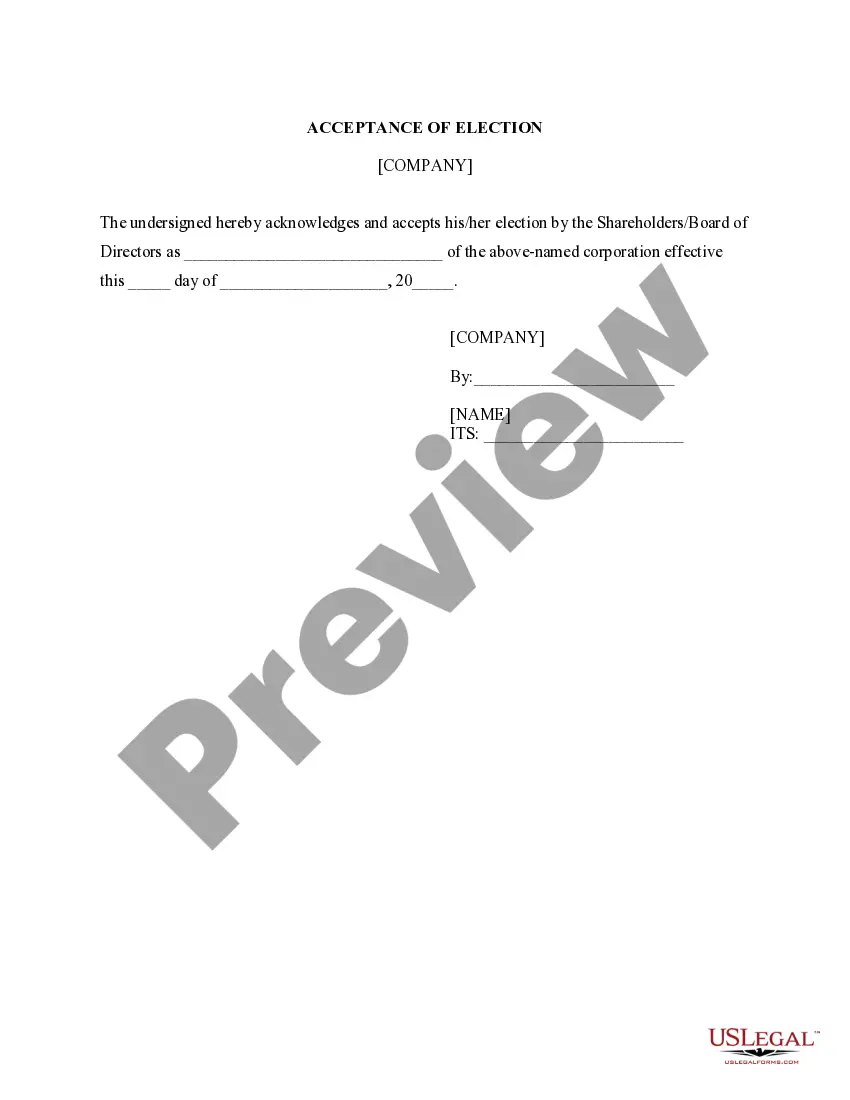
The Acceptance of Election - Corporate Resolutions is a legal document that enables an individual to formally accept their position as an officer or representative of a corporation. This form is essential for documenting the acceptance of an election made by the corporation's shareholders or board of directors and differs from other corporate forms as it specifically focuses on the acceptance of an election rather than the election process itself.
Key components of this form
- Signature line for the individual accepting the position.
- Space to indicate the title accepted by the individual.
- Effective date of the acceptance.
- Space to print the name of the accepting individual.

When to use this document
This form should be used when a corporation has elected an individual to a specific officer role or as a representative, and that individual wishes to officially accept the election. It is often required to maintain accurate corporate records and comply with corporate governance practices.
Intended users of this form
- Individuals elected as corporate officers or representatives.
- Members of the board of directors or shareholders involved in corporate governance.
- Corporations looking to maintain accurate documentation of officer elections.
Completing this form step by step
- Identify the name of the corporation in which the individual is being elected.
- Fill in the title the individual is accepting (e.g., President, Treasurer).
- Enter the effective date of the acceptance.
- Have the individual sign their name in the designated space.
- Print the name of the individual below the signature for clarity.
Does this document require notarization?
This form does not typically require notarization unless specified by local law. It is advisable to verify state-specific regulations that may apply to the acceptance of corporate elections.
Get your form ready online
Our built-in tools help you complete, sign, share, and store your documents in one place.
Make edits, fill in missing information, and update formatting in US Legal Forms—just like you would in MS Word.
Download a copy, print it, send it by email, or mail it via USPS—whatever works best for your next step.
Sign and collect signatures with our SignNow integration. Send to multiple recipients, set reminders, and more. Go Premium to unlock E-Sign.
If this form requires notarization, complete it online through a secure video call—no need to meet a notary in person or wait for an appointment.
We protect your documents and personal data by following strict security and privacy standards.

Make edits, fill in missing information, and update formatting in US Legal Forms—just like you would in MS Word.

Download a copy, print it, send it by email, or mail it via USPS—whatever works best for your next step.

Sign and collect signatures with our SignNow integration. Send to multiple recipients, set reminders, and more. Go Premium to unlock E-Sign.

If this form requires notarization, complete it online through a secure video call—no need to meet a notary in person or wait for an appointment.

We protect your documents and personal data by following strict security and privacy standards.
Common mistakes to avoid
- Failing to include the title being accepted.
- Not entering the effective date correctly.
- Omitting the printed name below the signature.
- Using an incorrect format for the corporation's name.
Benefits of using this form online
- Instant access to professionally drafted forms.
- Convenient downloadable format for easy use and storage.
- Editable fields that allow customization to fit specific needs.
- Reliable legal standards upheld by licensed attorneys.
What to keep in mind
- The Acceptance of Election - Corporate Resolutions form is crucial for formally accepting corporate positions.
- Proper completion ensures compliance with governance requirements.
- Using this form can help avoid common errors that may compromise its validity.
Looking for another form?

Form popularity
FAQ
When recording a resolution in the minutes, the exact wording of the resolution, the names of proposers and seconders, and the names of those voting in favor of or contrary to the resolution should be recorded.
Like every legal document, resolutions need to be signed and dated by the members of the board as they would do with minutes of meetings.
A corporate resolution is the legal document that provides the rules and framework as to how the board can act under various circumstances. Corporate resolutions provide a paper trail of the decisions made by the board and the executive management team.
Passing the resolution at a meeting where a quorum has been met. A quorum is the minimum number of members required for the meeting to be valid. Passing the resolution with necessary written consent. Passing the resolution with unanimous written consent.
When a board resolution is passed by a simple majority, it is called an ordinary resolution. Votes cast in favor are more than the ones against. A resolution with a majority of just over 50% of the quorum is considered passed. For example, 6 'yes' votes out of 10 are considered a majority.
Ratification is the official way to confirm something, usually by vote. It is the formal validation of a proposed law. We almost never use the word ratification except to talk about process by which proposed laws, treaties, and agreements are officially recognized.
Elements of a Certified Board Resolution A designation of the party for whom the resolution is being prepared for and its address. Explanation of the action being taken by the board of directors and the reason for doing so. Name of the secretary. Legal name of the corporation and state of incorporation.
This might be a member of the board of directors, the company owner, or someone else with authority, such as a chief executive officer or president. When an individual agrees to or confirms the action being taken by the business, this is referred to as "ratification" in law.