Affidavit of Defendant Spouse in Support of Motion to Amend or Strike Alimony Provisions of Divorce Decree on Remarriage of Plaintiff
Overview of this form
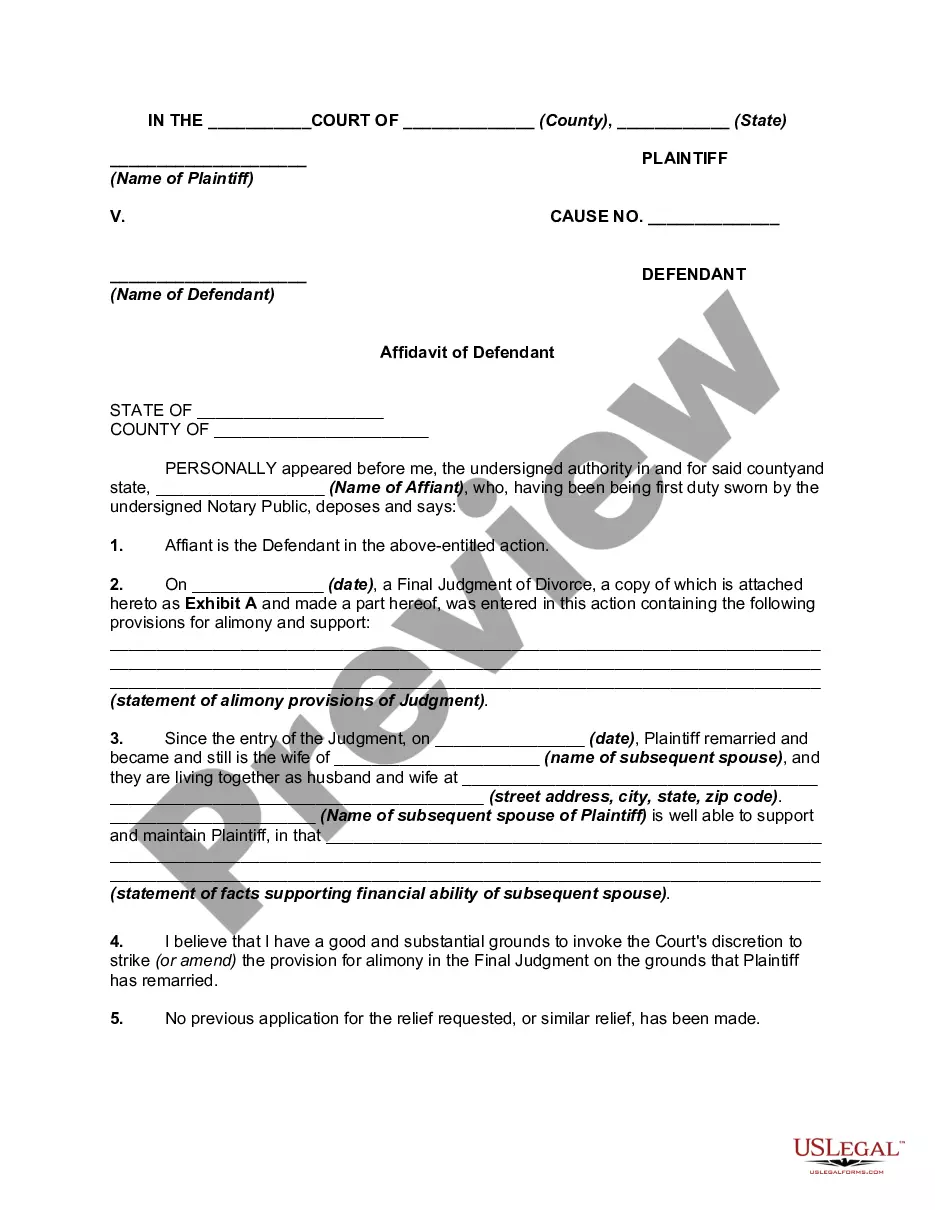
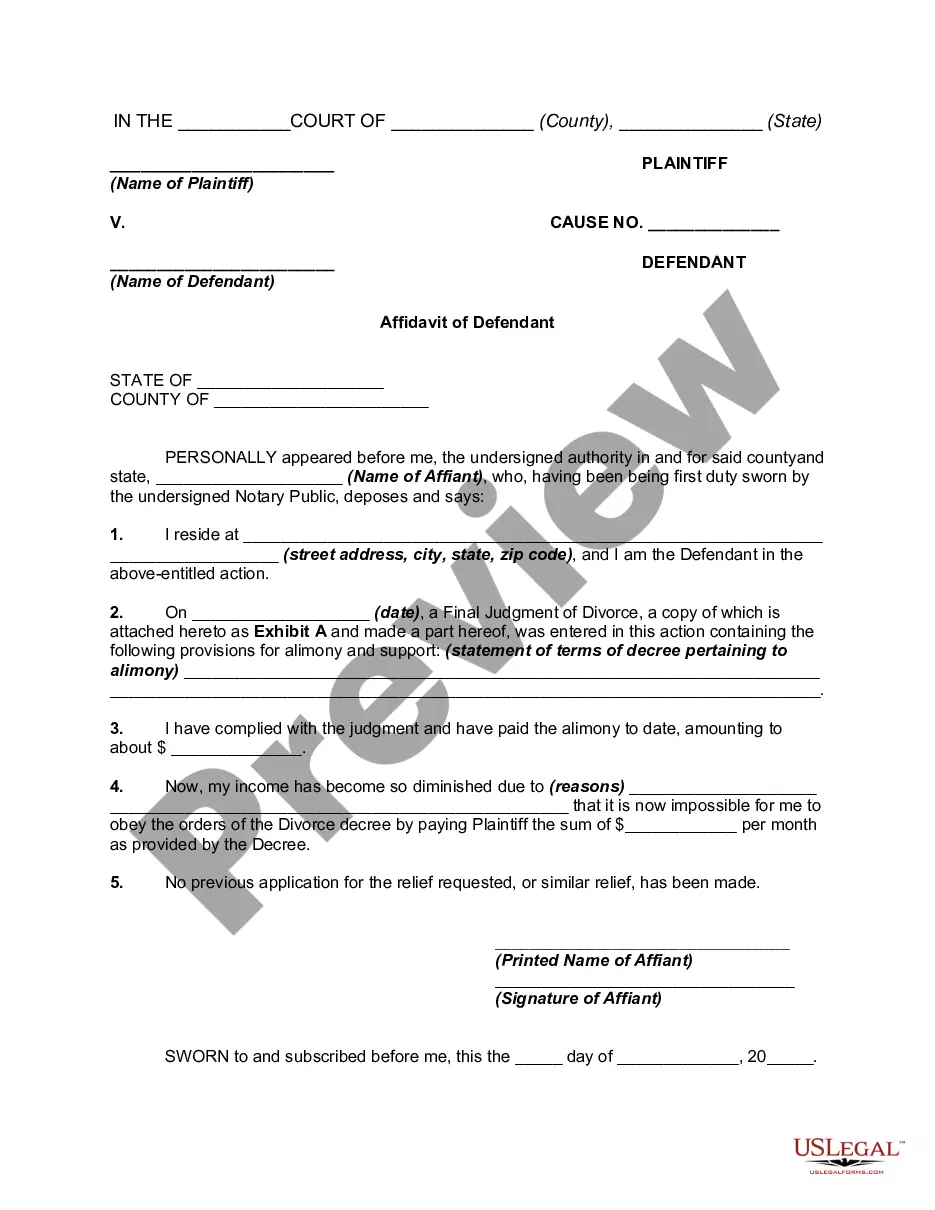
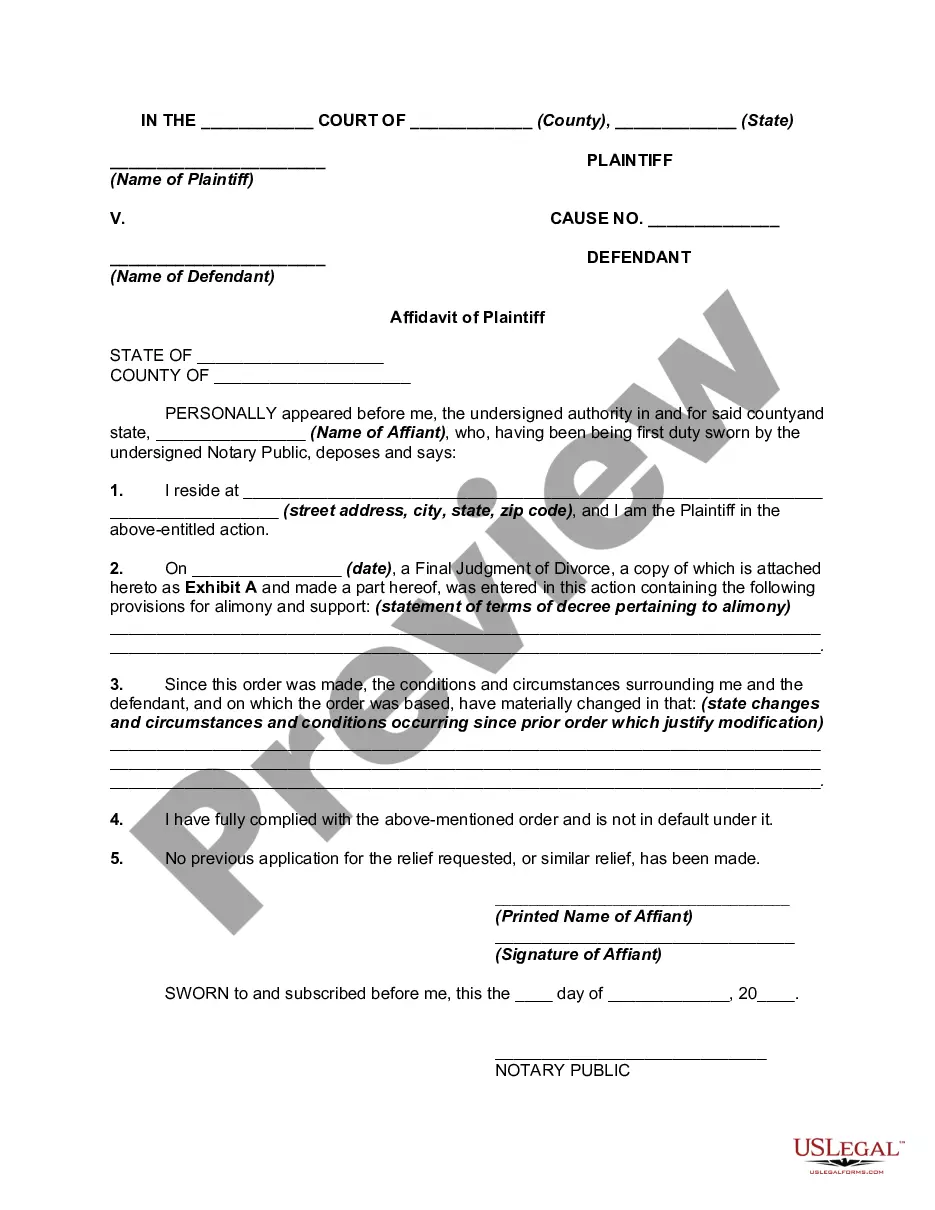
The Affidavit of Defendant Spouse in Support of Motion to Amend or Strike Alimony Provisions of Divorce Decree on Remarriage of Plaintiff is a legal document used when a defendant spouse seeks to modify or eliminate alimony payments following the remarriage of the former spouse (plaintiff). This form serves as an affidavit to support the motion filed in court, allowing the defendant to present evidence of the plaintiff's financial circumstances after remarriage. Unlike other forms related to divorce or alimony, this affidavit specifically addresses the change in financial status due to the remarriage of the plaintiff.
Key components of this form
- Name and case details of the parties involved.
- Affirmation of the defendant's identity and role in the case.
- Details of the final judgment of divorce, including alimony provisions.
- Information about the plaintiff's remarriage and their new spouse's ability to support them.
- Request for court discretion to amend or strike the alimony provisions based on new circumstances.
Common use cases
This affidavit should be used when the defendant spouse believes there is a valid reason to modify or eliminate alimony payments after the plaintiff has remarried. It is particularly relevant if the new spouse has the financial means to support the plaintiff, thereby reducing or negating the need for ongoing alimony. Situations may include the defendant being informed of the remarriage and seeking to formally address changes to the divorce decree in court.
Intended users of this form
- Defendant spouses who are subject to ongoing alimony payments.
- Individuals who are seeking to modify a divorce decree due to the remarriage of their former spouse.
- Those wishing to formally document and present changes in circumstances that may affect alimony obligations.
How to prepare this document
- Identify and write the names of the parties involved in the divorce case and the case number.
- State your identity and role as the defendant spouse in the case.
- Provide the details of the final judgment of divorce, including any alimony provisions.
- Document the remarriage date of the plaintiff and details of their new spouse's financial capabilities.
- Clearly state your request for the court to amend or strike the alimony provisions based on the remarriage.
- Submit the completed affidavit to the appropriate court, along with any required supporting documents.
Is notarization required?
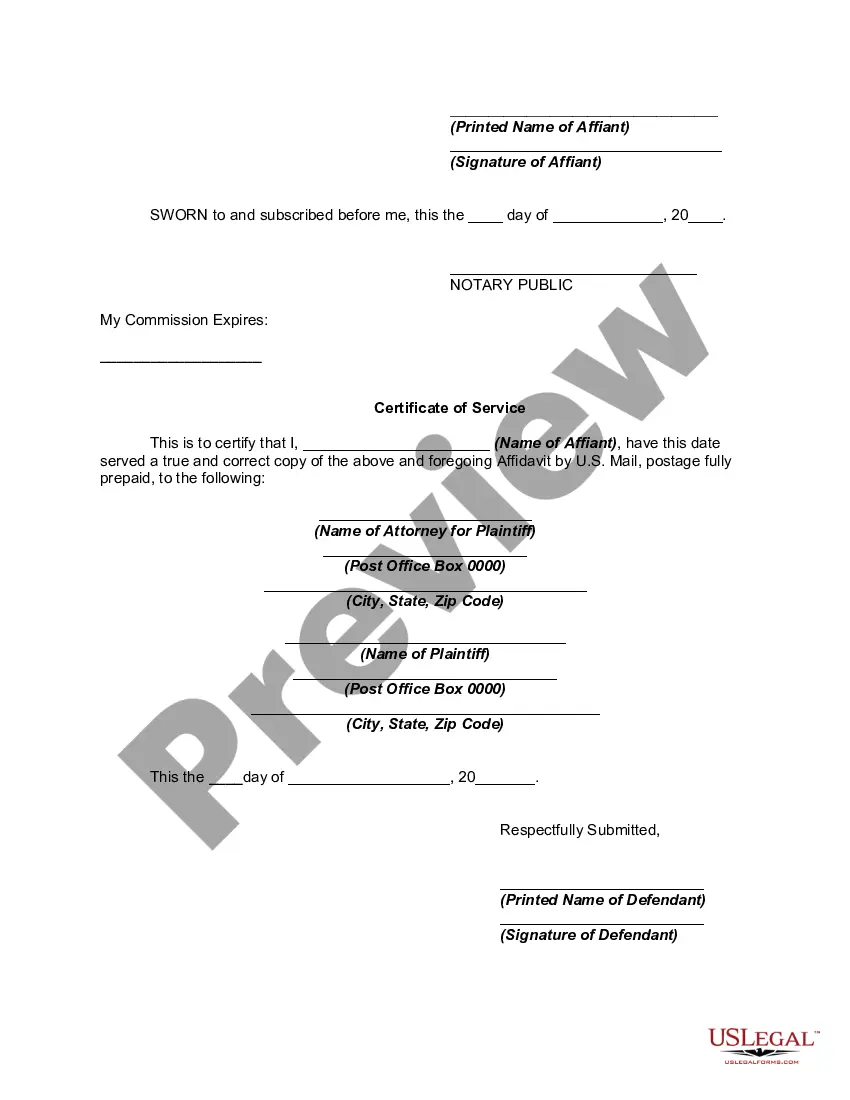
Yes, this form must be notarized to be legally valid. It should be signed in front of a notary public, who can verify your identity and witness your signature. US Legal Forms offers integrated online notarization with 24/7 availability, providing a secure video call option to ensure your affidavit meets legal standards without the need for travel.
Get your form ready online
Our built-in tools help you complete, sign, share, and store your documents in one place.
Make edits, fill in missing information, and update formatting in US Legal Forms—just like you would in MS Word.
Download a copy, print it, send it by email, or mail it via USPS—whatever works best for your next step.
Sign and collect signatures with our SignNow integration. Send to multiple recipients, set reminders, and more. Go Premium to unlock E-Sign.
If this form requires notarization, complete it online through a secure video call—no need to meet a notary in person or wait for an appointment.
We protect your documents and personal data by following strict security and privacy standards.

Make edits, fill in missing information, and update formatting in US Legal Forms—just like you would in MS Word.

Download a copy, print it, send it by email, or mail it via USPS—whatever works best for your next step.

Sign and collect signatures with our SignNow integration. Send to multiple recipients, set reminders, and more. Go Premium to unlock E-Sign.

If this form requires notarization, complete it online through a secure video call—no need to meet a notary in person or wait for an appointment.

We protect your documents and personal data by following strict security and privacy standards.
Mistakes to watch out for
- Failing to provide accurate case details and names.
- Neglecting to attach evidence of the final divorce judgment.
- Not including the financial details of the new spouse.
- Invalid signatures or lack of notarization if required.
Why complete this form online
- Convenience of downloading and completing the form at your own pace.
- Editable fields allow for customization to fit your specific circumstances.
- Access to forms drafted by licensed attorneys ensures legal validity.
- Instant availability reduces delays in initiating the modification process.
Summary of main points
- The affidavit is crucial for formal requests to amend alimony based on the plaintiff's remarriage.
- Providing detailed and accurate information is essential for the affidavit's effectiveness.
- Consult local laws for jurisdiction-specific requirements before submission.
- Notarization is necessary to validate the affidavit.
- Ensure service of process to all relevant parties to uphold fairness in legal proceedings.
Looking for another form?
Form popularity
FAQ
New York is a no-fault divorce state, which means that you don't need any grounds to file for divorce. The law only requires that your marriage be "irretrievably broken" in order for you to request a dissolution.
If you committed adultery yourself during the marriage, you cannot use adultery as your grounds for divorce. If you stayed with your spouse for five years or more after discovering the adultery, you cannot file for divorce using adultery as grounds.
The Uniform Marriage and Divorce Act, on which many states' spousal support statutes are based, recommends that courts consider the following factors in making decisions about alimony awards:The length of the marriage; and. The ability of the payer spouse to support the recipient and still support himself or herself.
New York is an equitable distribution state. This means, during a divorce, property division is handled in a way deemed most fair to both sides. It does not mean that all property will be split 50/50 between spouses. The court takes into account factors regarding the marriage and contributions of each party.
The parties to a divorce action are called a plaintiff and a defendant. The plaintiff is the spouse that commences the action for divorce and the defendant is the respondent spouse.
Adultery as a Legal Ground for Divorce in New York In a "no-fault" divorce, the filing spouse only needs to show that the marriage has been "irretrievably broken" for at least six months. This basically means that the couple can't get along anymore or remain married because of their differences.
There are no set rules as to what might constitute a changed circumstance, but examples include a reduction in salary or rental income, loss of property, increased earnings in certain circumstances, cohabitation by the recipient of spousal support with someone of the opposite sex (see Family Code 4323), loss of
O. The opposing party is the other party in your family law action, such as your spouse or the other parent of your child(ren).
New York courts must divide the marital property equitably. That means fairly, considering the circumstances of the case and of the parties involved, but it does not necessarily mean equally. There is no statutory requirement of a 50/50 split of marital property.