Texas Contract for Deed Seller's Annual Accounting Statement to Purchaser - Residential - Land Contract, Executory Contract
What is this form?
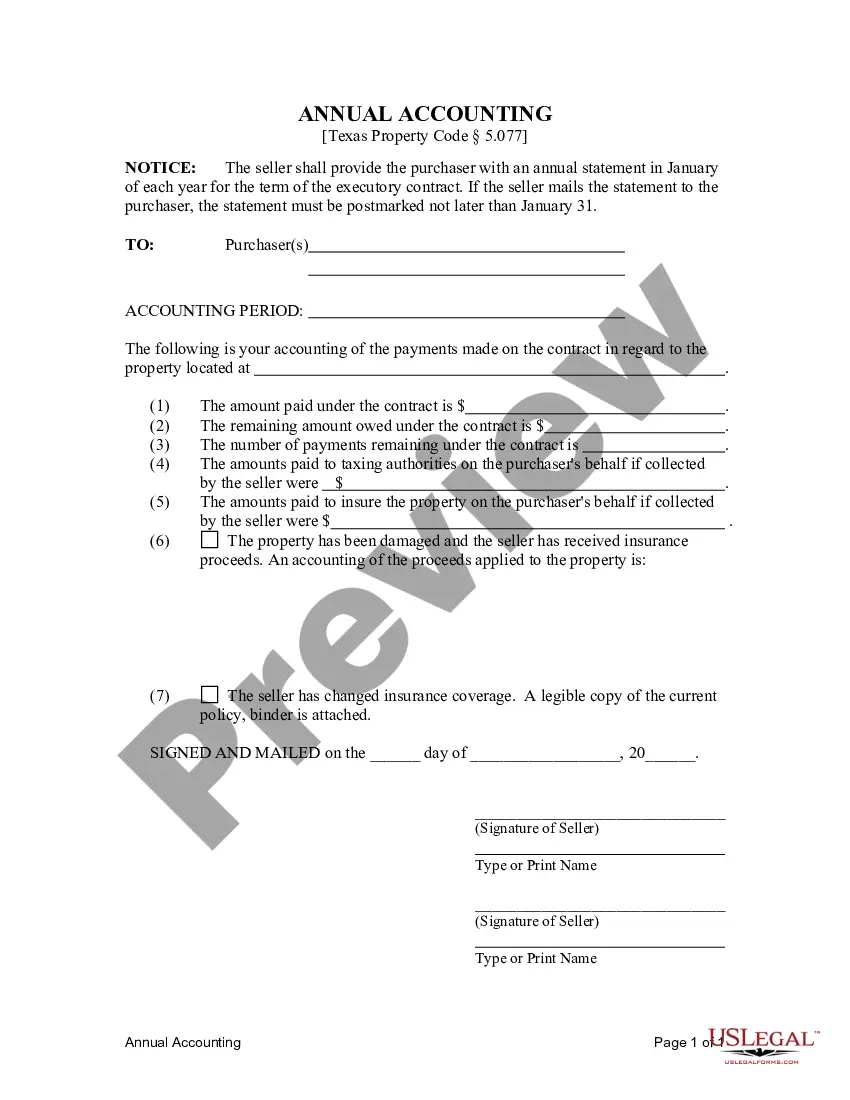
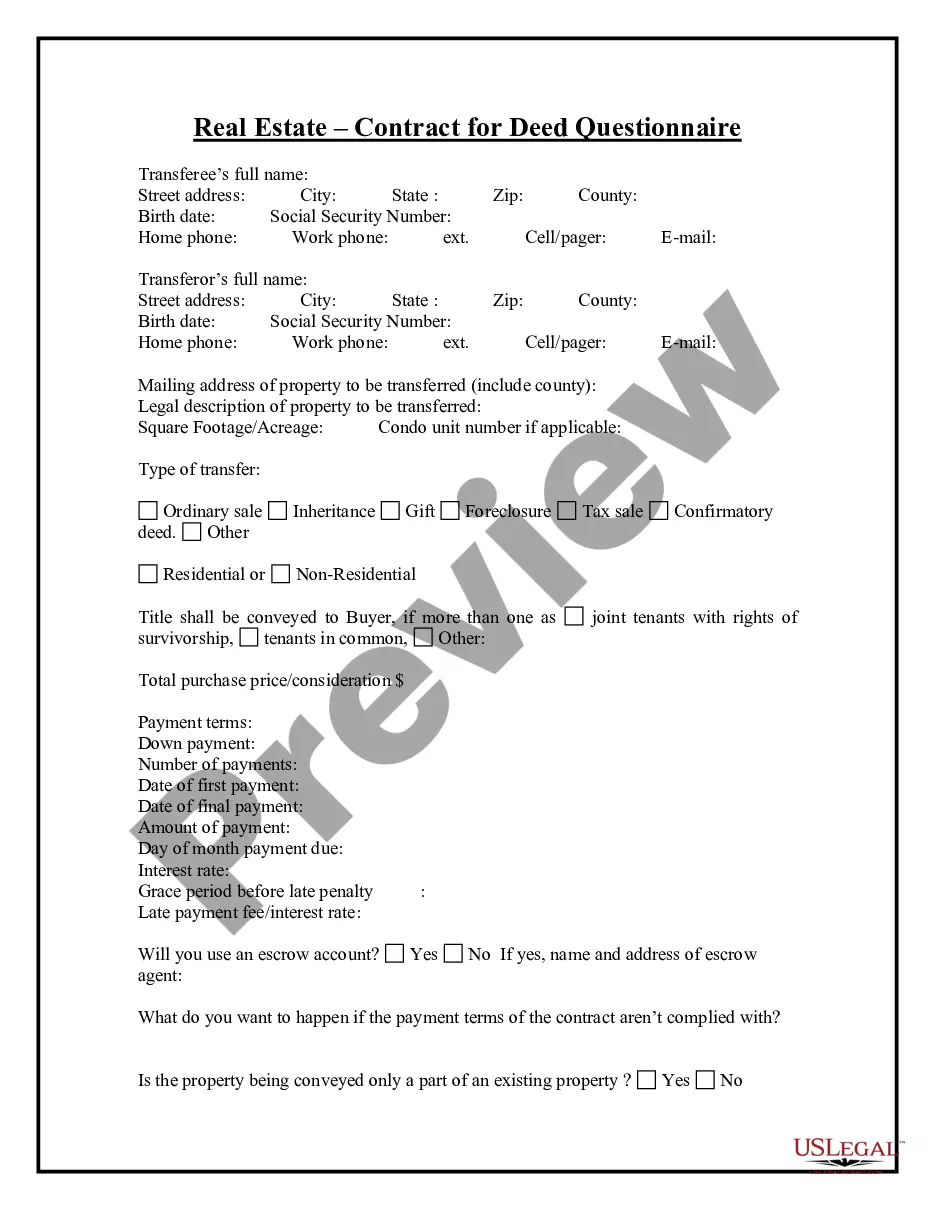
The Contract for Deed Seller's Annual Accounting Statement to Purchaser is a legal document that serves to inform the purchaser about the payments received towards the purchase price and interest under a contract for deed. This statement is a vital component of executing land contracts, which helps maintain transparency between the seller and purchaser. Unlike other financial statements, this form is specifically tailored for annual reporting in residential land contracts.
Key components of this form
- Contact information for the seller and purchaser
- Details of the contract for deed's purchase price
- Total number of payments received to date
- Breakdown of interest payments
- Annual statement date ensuring compliance with Texas Property Code 5.077

When this form is needed
This form should be used by sellers who have entered into a contract for deed with a purchaser. It is necessary to provide this annual accounting statement each January to comply with Texas law and to keep the purchaser informed of their payment progress and obligations under the agreement.
Who should use this form
The following parties should consider using this form:
- Sellers of residential properties under a land contract
- Purchasers who have an active contract for deed
- Real estate professionals managing land contracts
- Legal representatives involved in real estate transactions
Instructions for completing this form
- Gather the contact information for both the seller and the purchaser.
- Review the contract for deed to determine the total purchase price.
- Calculate the total number of payments received from the purchaser.
- Detail the amount of interest received during the reporting period.
- Ensure the document is dated accurately and sent to the purchaser by the legal deadline.
Notarization guidance
This form does not typically require notarization to be legally valid. However, some jurisdictions or document types may still require it. US Legal Forms provides secure online notarization powered by Notarize, available 24/7 for added convenience.
Get your form ready online
Our built-in tools help you complete, sign, share, and store your documents in one place.
Make edits, fill in missing information, and update formatting in US Legal Forms—just like you would in MS Word.
Download a copy, print it, send it by email, or mail it via USPS—whatever works best for your next step.
Sign and collect signatures with our SignNow integration. Send to multiple recipients, set reminders, and more. Go Premium to unlock E-Sign.
If this form requires notarization, complete it online through a secure video call—no need to meet a notary in person or wait for an appointment.
We protect your documents and personal data by following strict security and privacy standards.

Make edits, fill in missing information, and update formatting in US Legal Forms—just like you would in MS Word.

Download a copy, print it, send it by email, or mail it via USPS—whatever works best for your next step.

Sign and collect signatures with our SignNow integration. Send to multiple recipients, set reminders, and more. Go Premium to unlock E-Sign.

If this form requires notarization, complete it online through a secure video call—no need to meet a notary in person or wait for an appointment.

We protect your documents and personal data by following strict security and privacy standards.
Common mistakes to avoid
- Failing to submit the statement by the January 31 deadline
- Providing incorrect payment amounts or totals
- Not including contact information for both parties
- Neglecting to clarify whether any payments were late or missed
Advantages of online completion
- Convenient access to downloadable templates at any time
- Easy to edit and customize according to specific contract details
- Reliability of using forms created by licensed attorneys
- Immediate compliance with Texas legal requirements
Main things to remember
- The Seller's Annual Accounting Statement is important for transparency between seller and purchaser.
- Annual compliance with Texas Property Code ensures adherence to legal obligations.
- Accurate record-keeping helps maintain a positive business relationship.
Looking for another form?



Form popularity
FAQ
Contract execution is the process whereby the signing parties perform the duties mentioned in the contractual agreement. The terms mentioned in the contractual agreement contain certain guidelines to be kept in mind while executing the contract and in the performance of the contract.
Recording Requirement No longer. Section 5.076(a) states that the seller shall record the executory contract, including the attached disclosure statement . . . on or before the 30th day after the date the contract is executed. Additionally, any instrument that terminates the contract must be recorded.
An executory contract is a contract that has not yet been fully performed or fully executed. It is a contract in which both sides still have important performance remaining.
In order for any contract to be considered executory, it needs to be binding on the parties to the contract. And, per the statute of frauds, real estate sales contracts must be in writing to be valid, so any oral real estate agreement is considered a voluntary, non-binding understanding and NOT a binding contract.
An executed contract is one in which the parties have performed their duties under the contract. An executory contract is one in which the parties have not yet performed their obligations under the agreement. Example: I enter into a contract with you. Before I have fully performed the contract, it is executory.
If the executory contract is terminated for any reason, the Property Code also requires that the seller record the instrument that terminates the contract. A recorded executory contract is considered to be the same as a deed with a vendor's lien for the amount of the unpaid contract price, less any lawful deductions.
An executory contract is a contract that has not yet been fully performed or fully executed. It is a contract in which both sides still have important performance remaining. However, an obligation to pay money, even if such obligation is material, does not usually make a contract executory.
An executory contract is when one or both parties have obligations still to be performed. For example, a sales contract is an executory contract until the buyer has obtained financing-there are still obligations remaining to be performed before the contract can be considered executed.