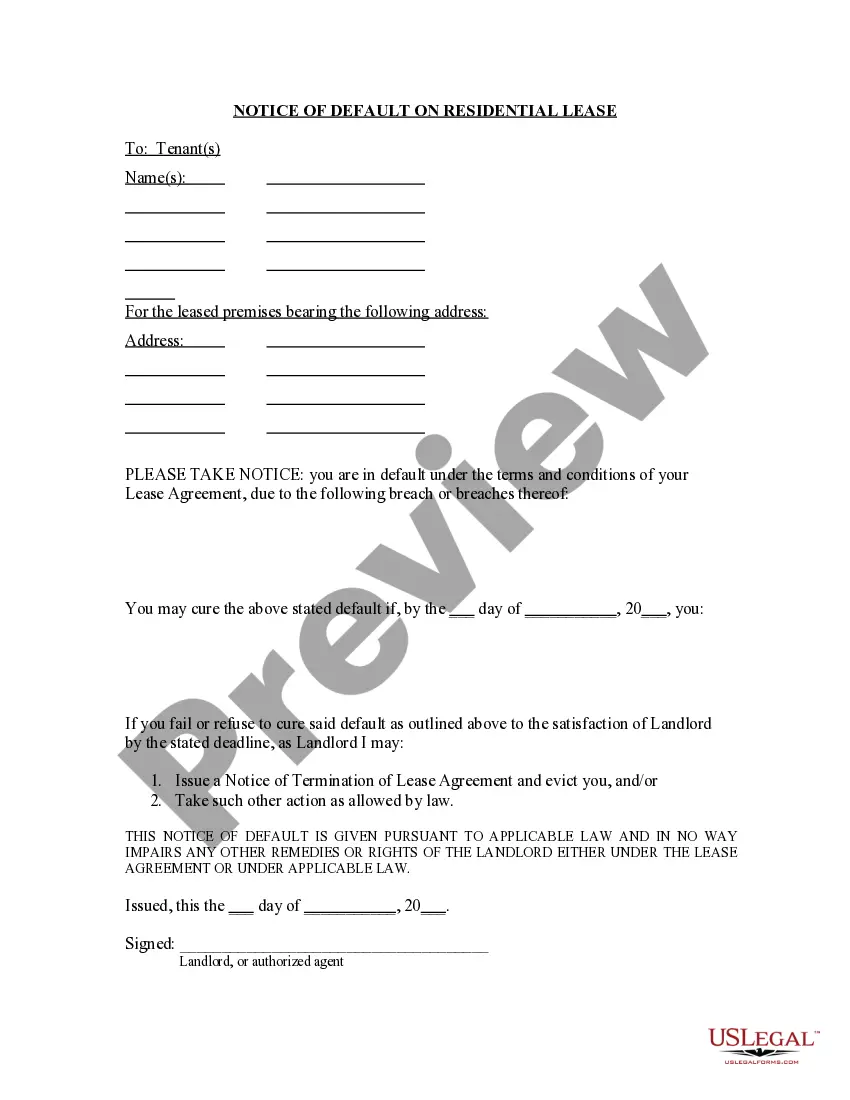
Tennessee Notice of Default on Residential Lease
About this form
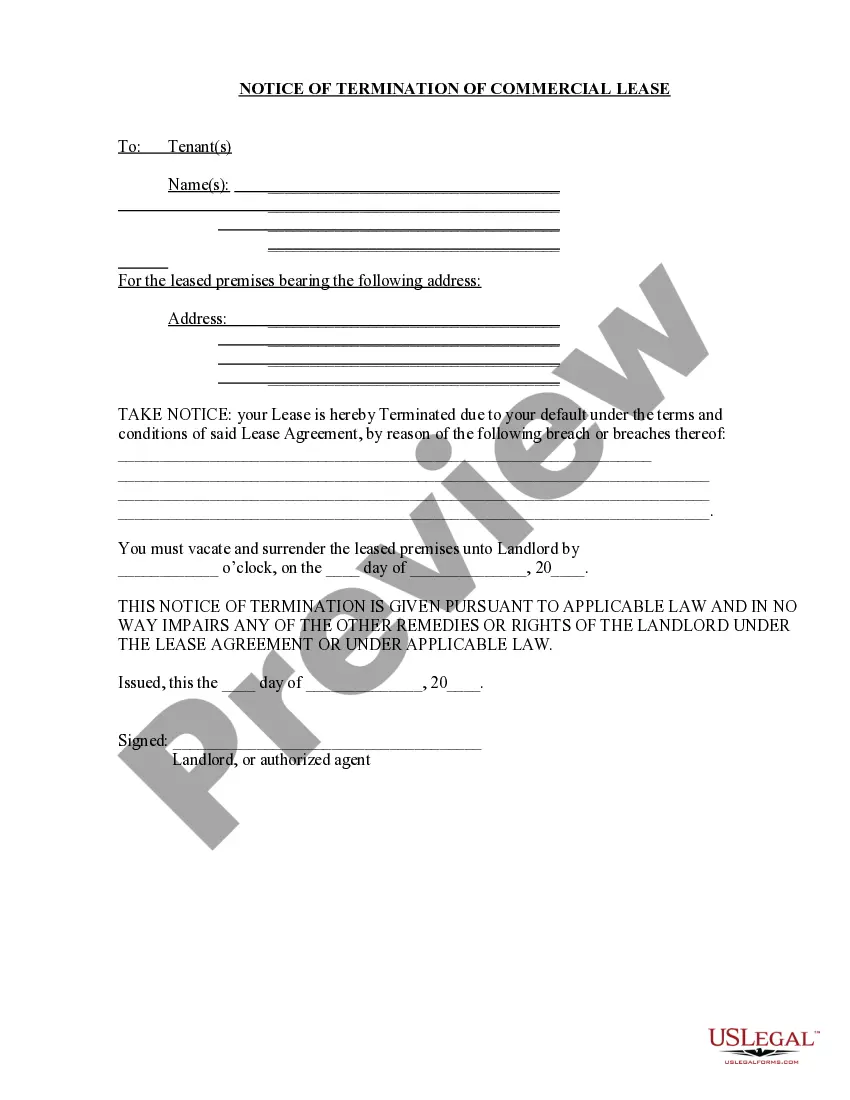
The Notice of Default on Residential Lease is a formal document used by landlords to inform tenants of their failure to meet specific obligations under a lease agreement, typically related to late or unpaid rent. This notice serves to specify the default, outline the necessary steps to remedy the situation, and establish a deadline for the tenant to address the default. It distinguishes itself from other forms of notice by explicitly detailing reasons for the default and providing a clear timeline for corrective action.
Key parts of this document
- Identification of the tenant and landlord's information.
- Specific reasons for the default, such as unpaid rent.
- Deadline date by which the tenant must cure the default.
- Consequences for failing to remedy the default, including eviction.
- Signature line for the landlord or their authorized agent.


When this form is needed
This form should be used when a tenant has not complied with the terms of the lease agreement, particularly in cases of late rent payments or other defaults. Landlords must provide this notice before pursuing eviction or other legal remedies, making it a crucial step in the landlord-tenant relationship. It helps ensure that tenants have a chance to address any issues before further actions are taken.
Who can use this document
- Landlords who need to formally notify tenants of a lease default.
- Property managers acting on behalf of landlords.
- Landlords considering eviction due to nonpayment or lease violations.
- Real estate professionals involved in tenant management.
How to complete this form
- Identify the parties by entering the names and addresses of the landlord and tenant.
- State the specific reasons for the default, such as late rent payment.
- Set a clear deadline date by which the tenant must cure the default.
- Outline the potential consequences if the tenant does not comply.
- Have the landlord or authorized agent sign and date the notice.
Notarization guidance
Notarization is not commonly needed for this form. However, certain documents or local rules may make it necessary. Our notarization service, powered by Notarize, allows you to finalize it securely online anytime, day or night.
Get your form ready online
Our built-in tools help you complete, sign, share, and store your documents in one place.
Make edits, fill in missing information, and update formatting in US Legal Forms—just like you would in MS Word.
Download a copy, print it, send it by email, or mail it via USPS—whatever works best for your next step.
Sign and collect signatures with our SignNow integration. Send to multiple recipients, set reminders, and more. Go Premium to unlock E-Sign.
If this form requires notarization, complete it online through a secure video call—no need to meet a notary in person or wait for an appointment.
We protect your documents and personal data by following strict security and privacy standards.

Make edits, fill in missing information, and update formatting in US Legal Forms—just like you would in MS Word.

Download a copy, print it, send it by email, or mail it via USPS—whatever works best for your next step.

Sign and collect signatures with our SignNow integration. Send to multiple recipients, set reminders, and more. Go Premium to unlock E-Sign.

If this form requires notarization, complete it online through a secure video call—no need to meet a notary in person or wait for an appointment.

We protect your documents and personal data by following strict security and privacy standards.
Mistakes to watch out for
- Failing to specify clear reasons for the default.
- Not providing an adequate deadline for the tenant to respond.
- Omitting required signatures from the notice.
- Neglecting to check local laws for specific regulations.
Benefits of using this form online
- Quick and easy access to legal documentation without the need for in-person consultations.
- Editable templates that allow for customization based on specific situations.
- Reliability from professionally drafted forms that comply with legal standards.
Looking for another form?
Form popularity
FAQ
Notice Requirements for Tennessee Landlords A landlord can simply give you a written notice to move, allowing you 30 days as required by Tennessee law and specifying the date on which your tenancy will end.
While some jurisdictions may have provisions that allow consumers to change their minds with no consequences, generally there is no cooling-off period for leasing real property. Once the landlord and tenant sign a lease and a copy is delivered to the both parties, it becomes a valid contract.
In landlord-tenant law, default refers to the failure of a tenant to timely pay rent due.In general, the landlord is required to give the tenant notice of the default before bringing eviction proceedings or applying security deposit proceeds to the payment in default.
Tenant default occurs when a Tenant breaches one of the tenant's covenants in its lease. Tenant default can arise in a number of different ways but will typically be for one of the following: Non-payment of rent or other sums reserved under the lease.
Your landlord can end the let at any time by serving a written 'notice to quit'. The notice period will depend on the tenancy or agreement, but is often at least 4 weeks.
The first thing a landlord must do is provide the tenant with a written notice that an eviction will occur in 30 days if the tenant does not comply with the terms of the lease within 14 days. This notice is required by T.C.A. Section 66-28-505.
If a tenant does not pay the outstanding rent by the fourteenth day, they have 16 days to vacate the property. If a tenant does not leave the property by the end of the 16-day period (30 days after the landlord delivered the notice to quit) the landlord can go to court to request a detainer warrant for the tenant.
Title 66 - Property. Chapter 28 - Uniform Residential Landlord and Tenant Act. (b) The landlord may enter the premises without consent of the tenant in case of emergency.
You are responsible for: paying your rent on time, paying any late fees, keeping the place clean and safe, not letting anyone else damage it, not breaking the law, disposing of your garbage, and following your landlord's rules. If you break your lease, then it may become a legal issue.