Colorado Quitclaim Deed - Three Individuals to Two Individuals as Joint Tenants with the Right of Survivorship

Overview of this form
This form is a Quitclaim Deed specifically designed for transferring property from three individuals (Grantors) to two individuals (Grantees), who will hold the property as joint tenants with the right of survivorship. Unlike other deeds, a Quitclaim Deed does not guarantee that the Grantors own the property free and clear of any encumbrances. This form ensures compliance with state statutory laws.
Key components of this form
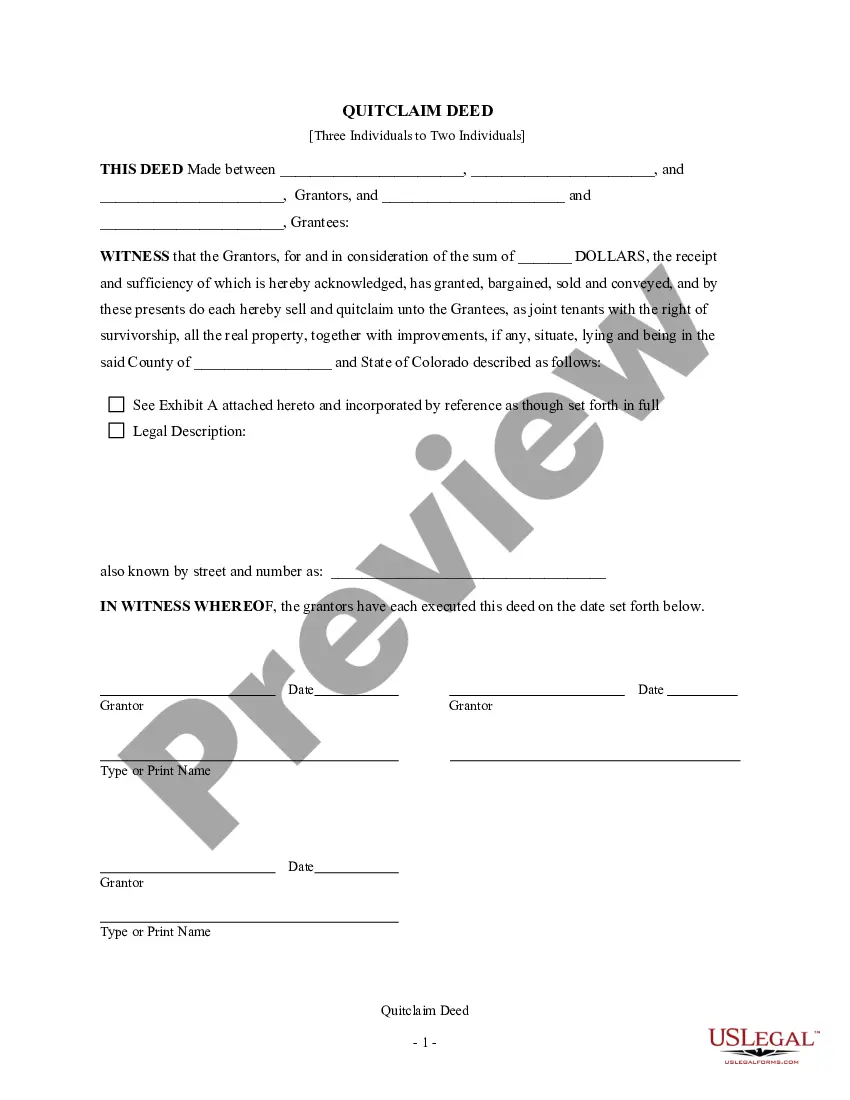
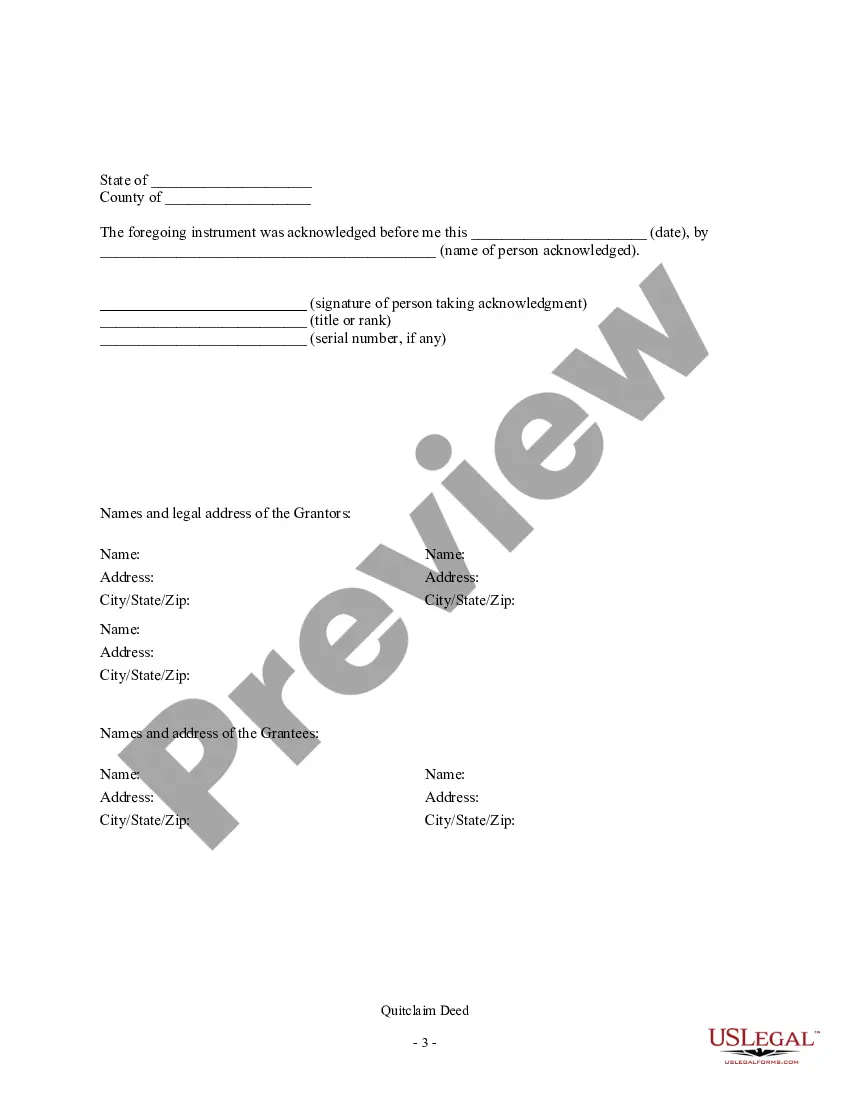
- Grantors: The three individuals transferring their interest in the property.
- Grantees: The two individuals receiving the property as joint tenants.
- Property Description: Specific details about the property being conveyed, including its legal description.
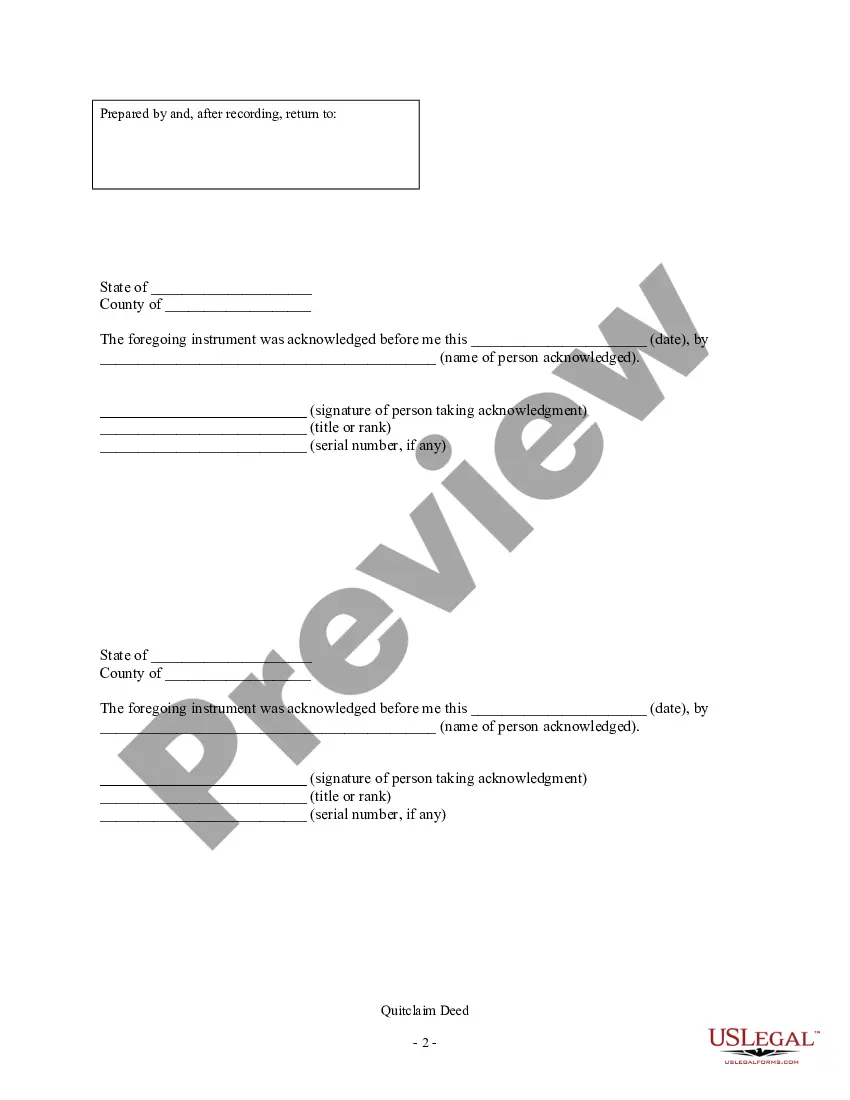
- Witness and Notary Section: Areas for signatures of witnesses and public notary to authenticate the deed.
- Consideration Amount: The monetary amount acknowledged as part of the transaction.





Situations where this form applies
This Quitclaim Deed should be used when three individuals wish to transfer ownership of a property to two individuals who intend to hold it as joint tenants with the right of survivorship. It is ideal for family members or friends who want to simplify property transfer without the complexities of a warranty deed.
Intended users of this form
- Individuals transferring property among family members.
- Friends or partners who want to hold property together.
- Anyone needing a simple and quick means of property transfer without warranties.
How to prepare this document
- Identify the parties involved: The three Grantors and the two Grantees.
- Specify the property to be transferred by filling in the legal description.
- Enter the consideration amount being exchanged.
- Obtain signatures from all Grantors and have them reviewed by a notary.
- Include any witness signatures as required in your jurisdiction.
Does this form need to be notarized?
This form must be notarized to be legally valid. US Legal Forms provides secure online notarization powered by Notarize, allowing you to complete the process through a verified video call.
Get your form ready online
Our built-in tools help you complete, sign, share, and store your documents in one place.
Make edits, fill in missing information, and update formatting in US Legal Forms—just like you would in MS Word.
Download a copy, print it, send it by email, or mail it via USPS—whatever works best for your next step.
Sign and collect signatures with our SignNow integration. Send to multiple recipients, set reminders, and more. Go Premium to unlock E-Sign.
If this form requires notarization, complete it online through a secure video call—no need to meet a notary in person or wait for an appointment.
We protect your documents and personal data by following strict security and privacy standards.

Make edits, fill in missing information, and update formatting in US Legal Forms—just like you would in MS Word.

Download a copy, print it, send it by email, or mail it via USPS—whatever works best for your next step.

Sign and collect signatures with our SignNow integration. Send to multiple recipients, set reminders, and more. Go Premium to unlock E-Sign.

If this form requires notarization, complete it online through a secure video call—no need to meet a notary in person or wait for an appointment.

We protect your documents and personal data by following strict security and privacy standards.
Typical mistakes to avoid
- Failing to accurately describe the property.
- Not including all Grantor's signatures.
- Neglecting witness or notary signatures where required.
- Forgetting to enter the consideration amount.
Benefits of using this form online
- Convenient access to forms anytime, allowing for quicker transactions.
- Editable fields for easy completion, which helps avoid errors.
- Guaranteed compliance with state-specific legal formatting.
Looking for another form?
Form popularity
FAQ
If one owner dies in Colorado, the jointly owned property automatically transfers to the surviving owners due to the right of survivorship. This transfer occurs outside of probate, which can save time and reduce legal costs for the remaining owners. It simplifies property management during an emotionally challenging time, allowing the surviving owners to retain full ownership. Using a Colorado Quitclaim Deed - Three Individuals to Two Individuals as Joint Tenants with the Right of Survivorship can be a smart choice for those looking to ensure a smooth transition.
Yes, joint tenancy with right of survivorship does override a will. This means that assets owned jointly will not be distributed according to the will, but will instead go directly to the surviving owners. This can create complications in estate planning, especially if your will designates a different distribution plan. It’s vital to consult resources like US Legal Forms for guidance on using a Colorado Quitclaim Deed - Three Individuals to Two Individuals as Joint Tenants with the Right of Survivorship effectively.
One disadvantage of joint tenancy with rights of survivorship is the complete control over the property by all owners, which can lead to conflicts. Additionally, if one owner encounters financial issues, creditors may claim the entire property. Also, this ownership structure does not allow for individual estate planning through wills, as assets bypass probate. Understanding the implications of a Colorado Quitclaim Deed - Three Individuals to Two Individuals as Joint Tenants with the Right of Survivorship can help you navigate these challenges.
Yes, Colorado recognizes joint tenancy with the right of survivorship. This means that co-owners can ensure that their share of the property securely passes to the surviving owners upon death. This legal framework is especially beneficial for couples or families looking to streamline property ownership. Utilizing a Colorado Quitclaim Deed - Three Individuals to Two Individuals as Joint Tenants with the Right of Survivorship can help you establish this ownership efficiently.
A form of co-ownership that includes the right of survivorship is known as joint tenancy. In this arrangement, if one individual passes away, their share automatically transfers to the surviving co-owners. This legal structure prevents delays in the transfer of property after death, simplifying estate management. When considering a Colorado Quitclaim Deed - Three Individuals to Two Individuals as Joint Tenants with the Right of Survivorship, it's crucial to understand how this arrangement can benefit all parties involved.
A Colorado Quitclaim Deed - Three Individuals to Two Individuals as Joint Tenants with the Right of Survivorship allows multiple owners to share property equally. In this arrangement, if one owner passes away, their share automatically transfers to the remaining owners. This feature ensures that the property stays within the group of surviving owners without going through probate. Using this type of quitclaim deed simplifies transferring ownership and provides peace of mind for families and co-owners.
You can put several individuals on a quitclaim deed in Colorado, making it a flexible option. A Colorado Quitclaim Deed - Three Individuals to Two Individuals as Joint Tenants with the Right of Survivorship allows you to designate ownership among multiple parties. This type of deed can effectively facilitate shared ownership while maintaining clear rights. Just ensure that all parties understand their roles and responsibilities regarding the property.
Quitclaim deeds are often looked down upon due to their lack of warranty and protection. When you choose a Colorado Quitclaim Deed - Three Individuals to Two Individuals as Joint Tenants with the Right of Survivorship, you take on the risk of any existing title issues. Many real estate professionals recommend warranty deeds instead, as they provide greater security for buyers. This lack of protection can lead to complications later, especially during property disputes.
In Colorado, a quitclaim deed can include multiple owners. You can utilize a Colorado Quitclaim Deed - Three Individuals to Two Individuals as Joint Tenants with the Right of Survivorship to add or remove individuals from ownership. There is no strict limit to how many people can be included as long as the deed is properly executed. Including multiple owners generally facilitates shared property management and unified decision-making.
Yes, Colorado recognizes joint tenancy with the right of survivorship. This means that when you execute a Colorado Quitclaim Deed - Three Individuals to Two Individuals as Joint Tenants with the Right of Survivorship, all co-owners legally own the property together. If one owner passes away, their share automatically transfers to the surviving co-owners without going through probate. This feature can simplify estate planning and provide peace of mind.