Tennessee Notice of Lien by Remote Contractor - Corporation
What is this form?
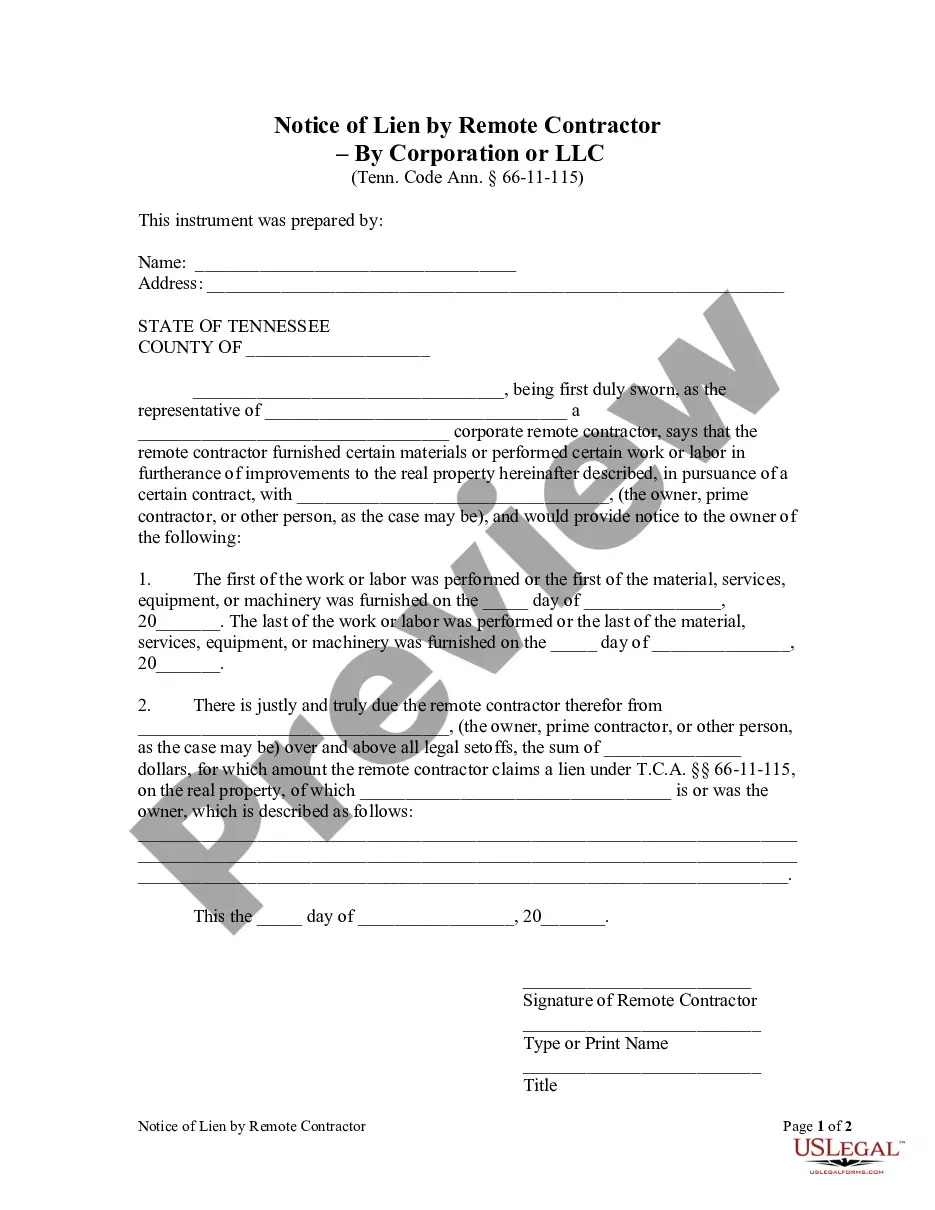
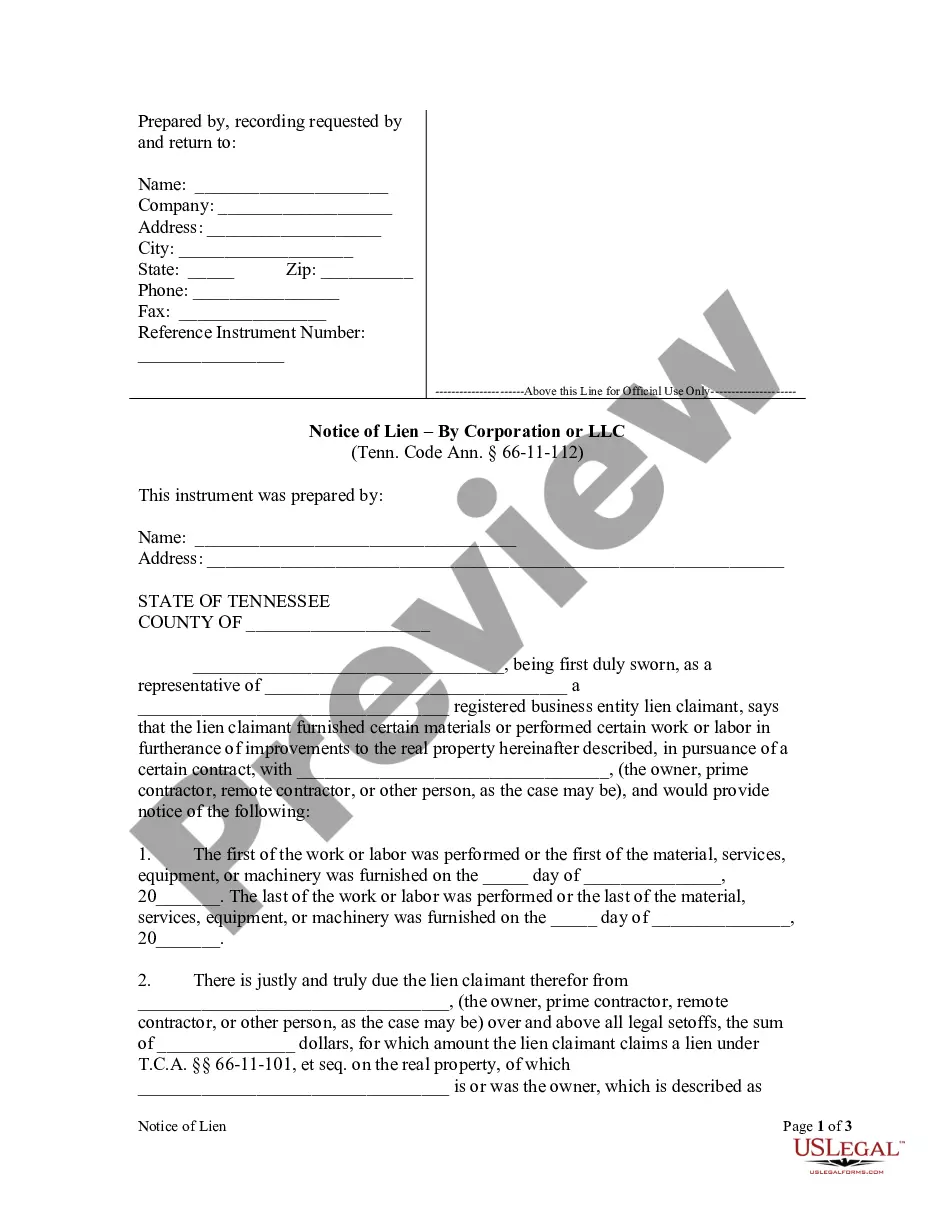
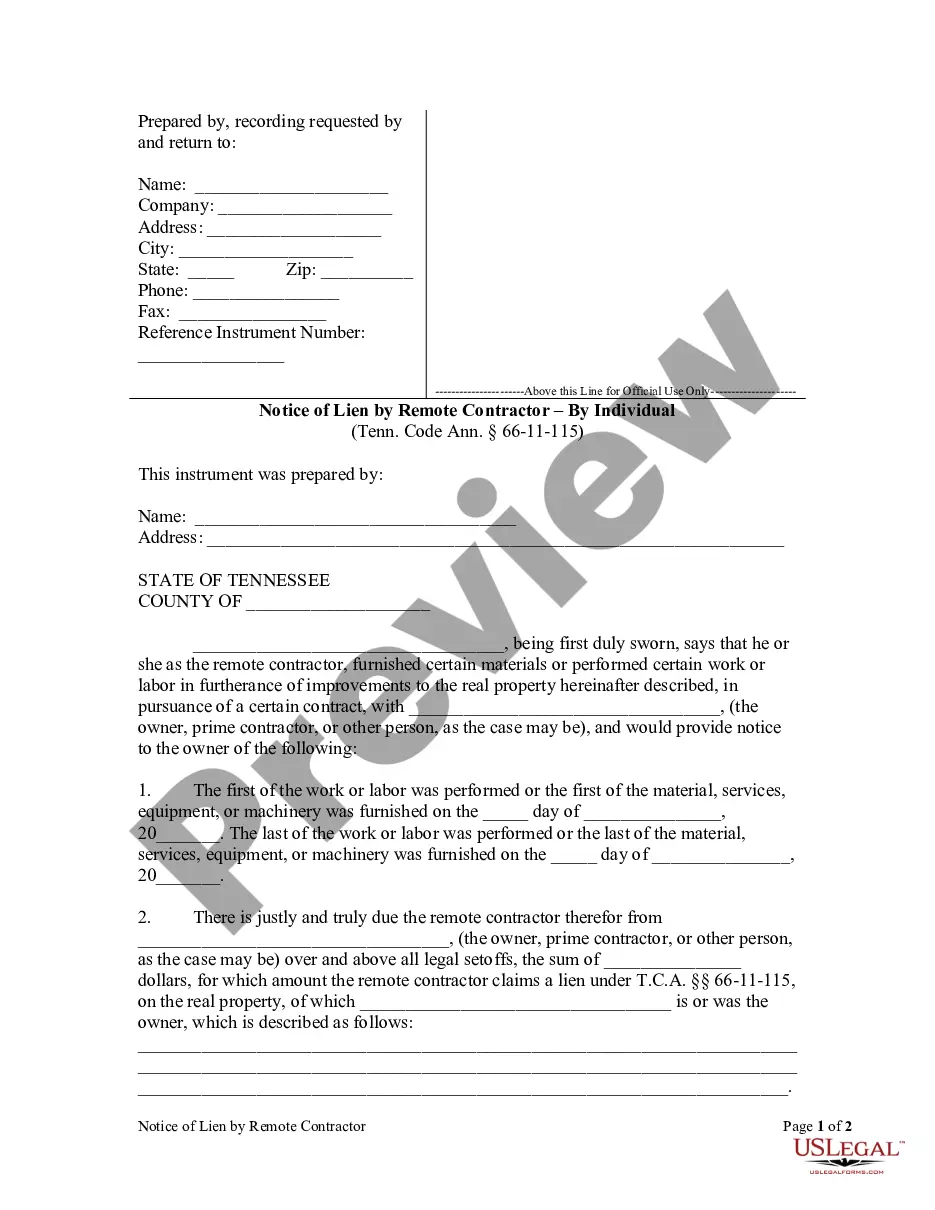
The Notice of Lien by Remote Contractor - Corporation is a legal document used to inform property owners that a lien is being claimed against their property. This form is specifically designed for remote contractorsâbusinesses that supply materials or labor for construction projects. By filing this notice, remote contractors protect their right to claim payment for their services and secure their interests in the property, distinguishing it from similar forms that may pertain to general contractors or suppliers.
Main sections of this form
- Description of the work done and materials supplied.
- Dates of when services or materials were first and last provided.
- Amount due for the claimed services or materials.
- Details regarding the property where the work was performed.
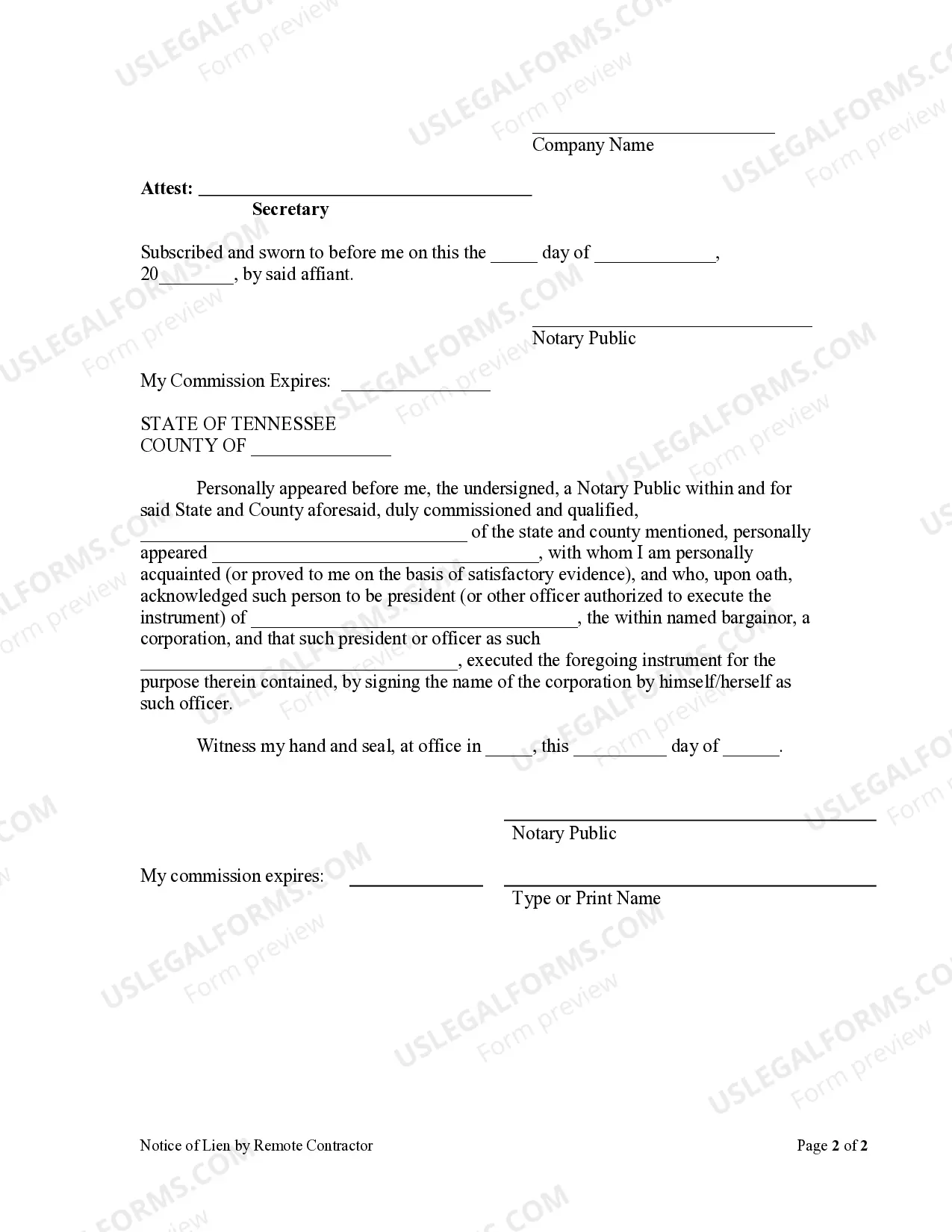
- Signature of the remote contractor and acknowledgment by a notary public.
Common use cases
This form should be used whenever a remote contractor has provided labor or materials for a construction project and needs to secure a lien against the property. It is particularly important if the contractor has not been paid or wishes to declare their financial interest in the real estate after completing their work. Filing this notice within ninety days after the completion of the work ensures compliance with state laws.
Who needs this form
- Remote contractors providing materials or labor to construction projects.
- Corporations or limited liability companies engaged in such contracts.
- Legal representatives acting on behalf of the remote contractor.
Steps to complete this form
- Identify the remote contractor by entering the name of the corporation or LLC.
- Specify the property owner and the location of the property in question.
- Provide the dates when the first and last work was performed.
- Enter the total amount owed for the services provided.
- Sign the form in the designated area, ensuring all required parties have knowledge of the document.
- Obtain notarization to validate the form, if necessary.
Is notarization required?
Yes, this form must be notarized to be legally valid. Notarization serves to verify the identity of the signer and ensures that the document is executed properly. US Legal Forms offers integrated online notarization services, allowing you to complete this process securely via a video call at any time without the need for travel.
Get your form ready online
Our built-in tools help you complete, sign, share, and store your documents in one place.
Make edits, fill in missing information, and update formatting in US Legal Forms—just like you would in MS Word.
Download a copy, print it, send it by email, or mail it via USPS—whatever works best for your next step.
Sign and collect signatures with our SignNow integration. Send to multiple recipients, set reminders, and more. Go Premium to unlock E-Sign.
If this form requires notarization, complete it online through a secure video call—no need to meet a notary in person or wait for an appointment.
We protect your documents and personal data by following strict security and privacy standards.

Make edits, fill in missing information, and update formatting in US Legal Forms—just like you would in MS Word.

Download a copy, print it, send it by email, or mail it via USPS—whatever works best for your next step.

Sign and collect signatures with our SignNow integration. Send to multiple recipients, set reminders, and more. Go Premium to unlock E-Sign.

If this form requires notarization, complete it online through a secure video call—no need to meet a notary in person or wait for an appointment.

We protect your documents and personal data by following strict security and privacy standards.
Mistakes to watch out for
- Failing to file the notice within the required ninety-day period.
- Not including correct details about the property or services.
- Omitting signatures or notarization when required.
- Using incorrect amounts for payment claimed.
Advantages of online completion
- Easy access to legally compliant templates developed by licensed attorneys.
- Efficient editing options to customize the form for individual needs.
- Immediate download available, saving time compared to traditional legal methods.
- Available for use at any time, streamlining the process of securing a lien.
Key takeaways
- The Notice of Lien by Remote Contractor - Corporation is essential for establishing a contractor's right to payment.
- Timely submission within ninety days of project completion is crucial.
- Accurate completion and notarization of the form are required for legal enforceability.
Looking for another form?
Form popularity
FAQ
A mortgage creates a lien on your property that gives the lender the right to foreclose and sell the home to satisfy the debt. A deed of trust (sometimes called a trust deed) is also a document that gives the lender the right to sell the property to satisfy the debt should you fail to pay back the loan.
The most common way to reduce or even eliminate mechanic's lien risk is through the use of lien waivers. A lien waiver is a private agreement in which a party surrenders the right to file a lien in exchange for payment.
How to Check for a Lien. There are a couple of ways you can request a lien search: Online through your AMA Account. By calling toll-free 1-866-989-6370 within Canada and the U.S.
To attach the lien, the creditor files a certified copy of the judgment with the register of deeds in any Tennessee county where the debtor owns property now or may own property in the future.
While it's unlikely that just anyone can put a lien on your home or land, it's not unheard of for a court decision or a settlement to result in a lien being placed against a property.
A Notice of Completion Is: Other parties higher up on the payment chain, like prime contractors or general contractors, can file a Notice of Completion too. Here's the bottom line. When an owner files a Notice of Completion, the mechanics lien deadline is shortened.
Request that the title company do a lien search; Visit the office of the county assessor; or. Search online.
Here's how this works: Tennessee statutes allow some assets to be absolutely exempt. These assets include: social security benefits; certain government pensions; certain health care aids; unemployment and veterans benefits; and certain insurance benefits. (See Tenn. Code Ann.
Creditors can collect a judgment in a number of ways, including garnishing your wages, levying your bank account, placing a lien on your property, and seizing your personal property like cars or jewelry.