South Dakota Warranty Deed to Separate Property of One Spouse to Both Spouses as Joint Tenants
What this document covers
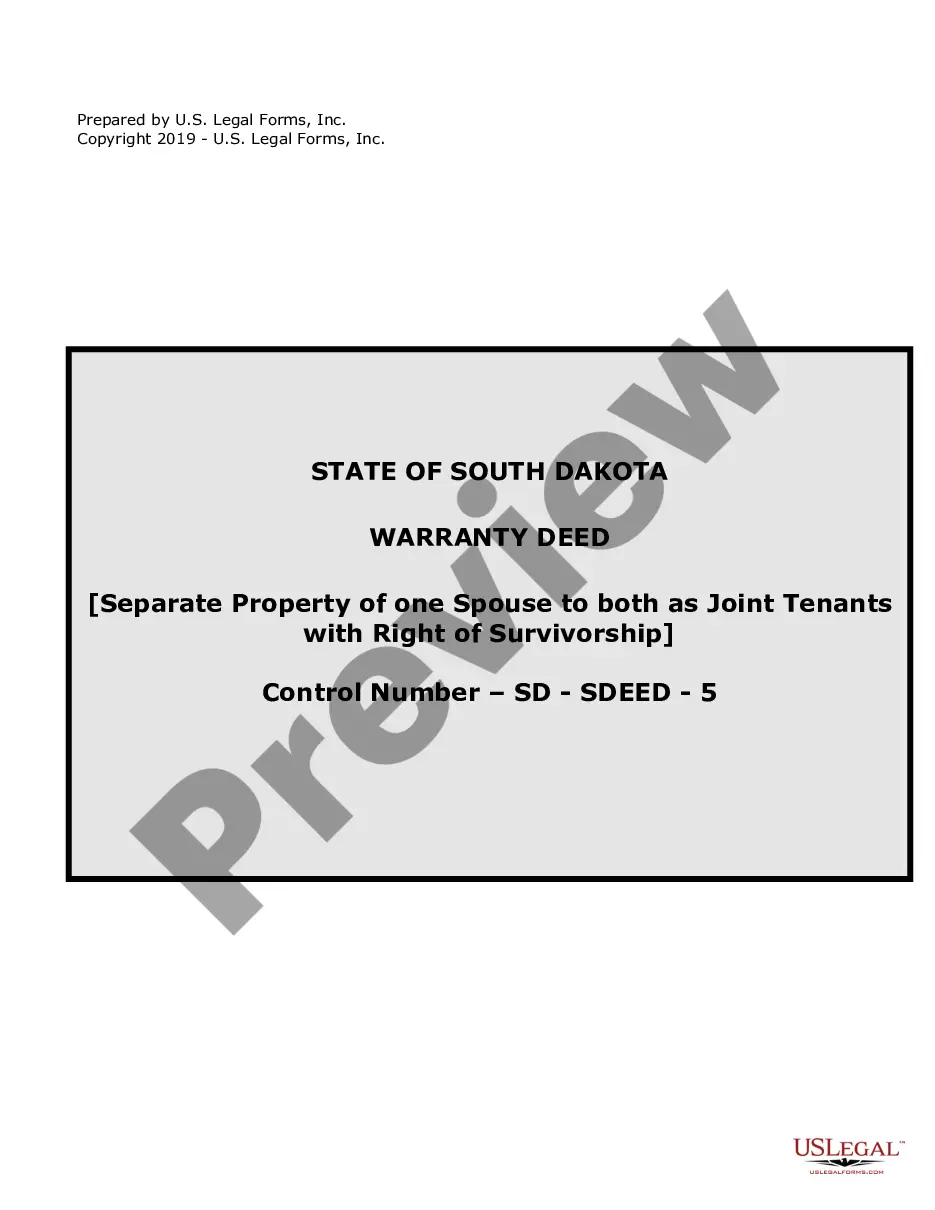
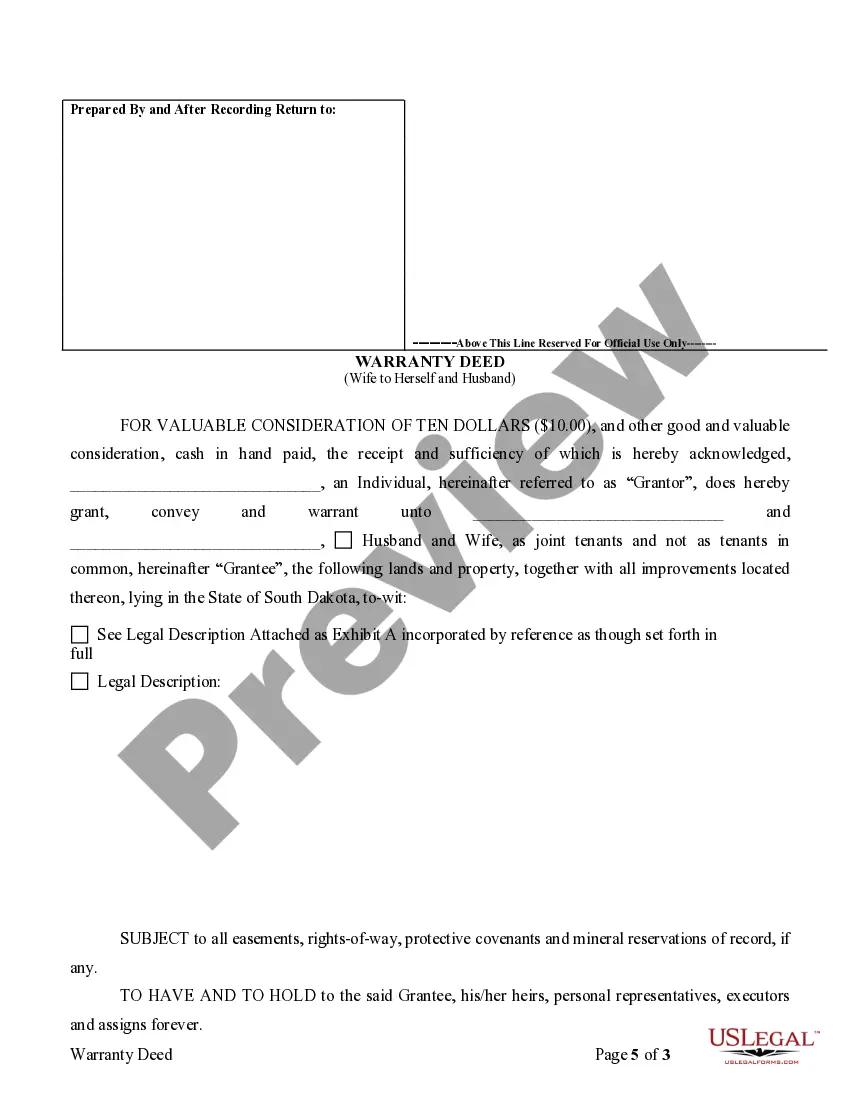
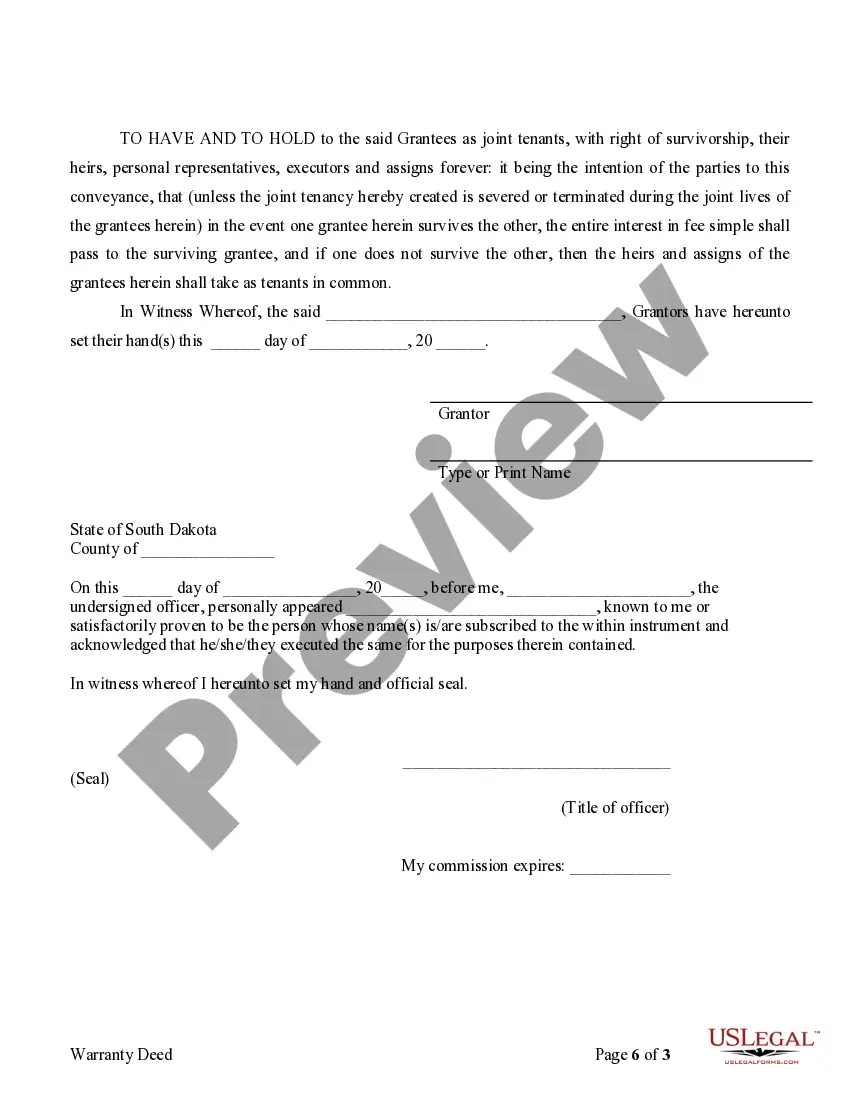
This Warranty Deed is a legal document through which one spouse transfers their separate property to both spouses as joint tenants with the right of survivorship. This form is crucial in establishing joint ownership of property, allowing both spouses to retain full rights to the property and ensuring that, upon the death of one spouse, the surviving spouse automatically inherits the entire property without the need for probate. Unlike a simple deed of transfer, this document specifically addresses joint tenancy, which is an important aspect of property ownership in marriage.
Key components of this form
- Grantor Information: Details about the spouse transferring the property.
- Grantee Information: Names of both spouses receiving the property as joint tenants.
- Property Description: A detailed description of the property being transferred.
- Consideration Statement: Acknowledgment that the grantor received valuable consideration (e.g., ten dollars) for the transfer.
- Execution and Notarization: Signatures of the grantor and the notary to validate the deed.



Common use cases
This form should be used when one spouse wishes to formally transfer their separate property into joint ownership with their spouse. This may occur during marriage when a spouse decides to share their individually owned property or during estate planning to simplify inheritance for the surviving spouse. Using this form can help avoid complications regarding property rights in the event of one spouse's death.
Who can use this document
- Married couples looking to change the ownership status of property from individual to joint.
- Spouses who want to ensure that the property passes directly to the surviving spouse upon death.
- Individuals preparing for estate planning and seeking to simplify future inheritance issues.
Instructions for completing this form
- Identify the grantor and grantee: Enter the names of the spouse transferring the property and the names of both spouses receiving it.
- Specify the property: Clearly describe the property being transferred, including its legal description.
- Enter the date of the transfer: Fill in the date on which the transfer is being executed.
- Obtain signatures: The grantor must sign the deed in the presence of a notary public.
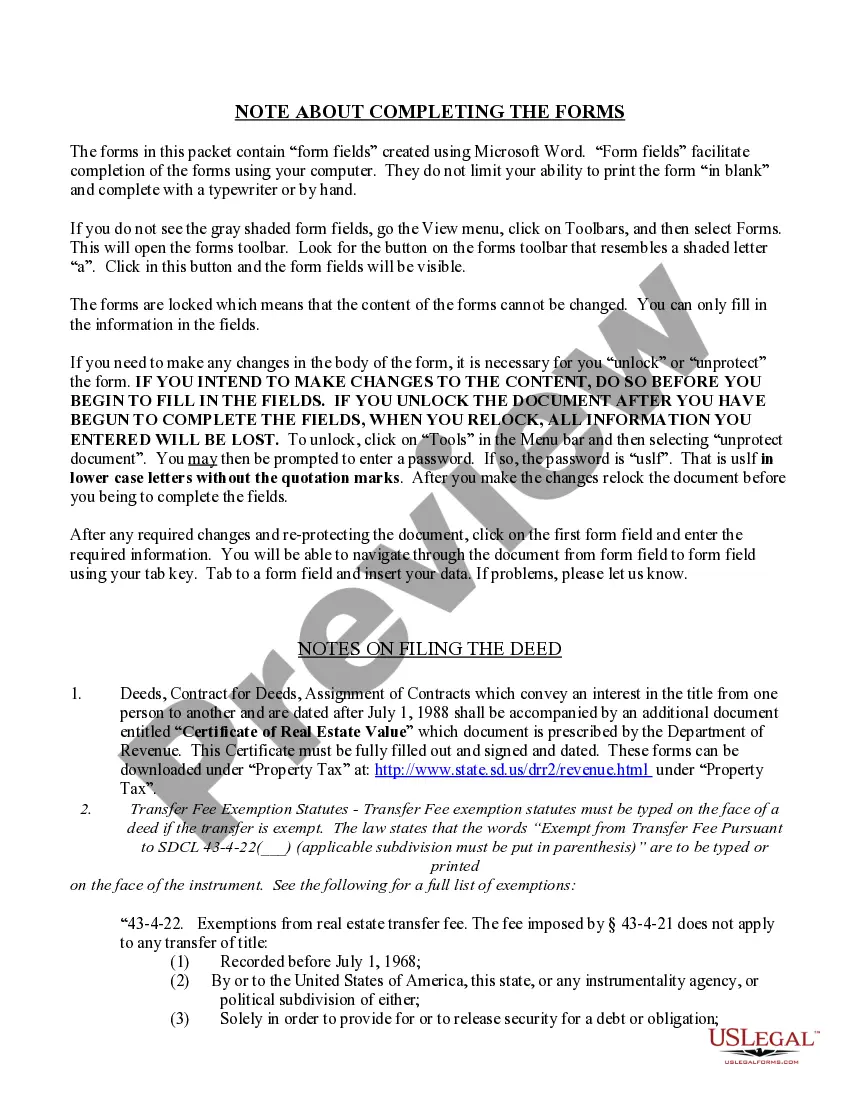
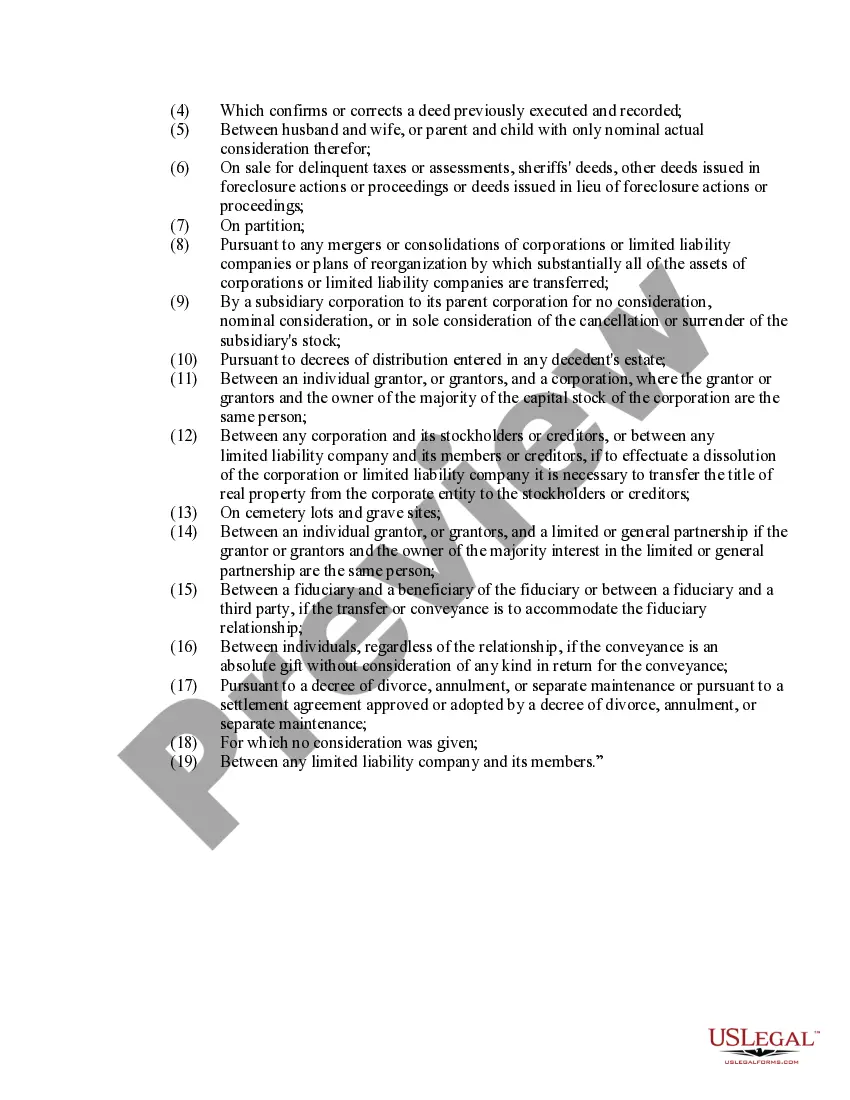
- Complete any additional required documents: Ensure that the Certificate of Real Estate Value is filled out and attached if applicable.
Is notarization required?
To make this form legally binding, it must be notarized. Our online notarization service, powered by Notarize, lets you verify and sign documents remotely through an encrypted video session.
Get your form ready online
Our built-in tools help you complete, sign, share, and store your documents in one place.
Make edits, fill in missing information, and update formatting in US Legal Forms—just like you would in MS Word.
Download a copy, print it, send it by email, or mail it via USPS—whatever works best for your next step.
Sign and collect signatures with our SignNow integration. Send to multiple recipients, set reminders, and more. Go Premium to unlock E-Sign.
If this form requires notarization, complete it online through a secure video call—no need to meet a notary in person or wait for an appointment.
We protect your documents and personal data by following strict security and privacy standards.

Make edits, fill in missing information, and update formatting in US Legal Forms—just like you would in MS Word.

Download a copy, print it, send it by email, or mail it via USPS—whatever works best for your next step.

Sign and collect signatures with our SignNow integration. Send to multiple recipients, set reminders, and more. Go Premium to unlock E-Sign.

If this form requires notarization, complete it online through a secure video call—no need to meet a notary in person or wait for an appointment.

We protect your documents and personal data by following strict security and privacy standards.
Common mistakes
- Failing to provide a complete description of the property.
- Not including necessary supporting documents during filing.
- Missing signatures or notarization of the document.
- Not specifying the joint tenancy relationship correctly.
Why use this form online
- Convenience: Easily download and complete the form from home.
- Editability: Modify the form as needed before finalizing it.
- Reliability: Access up-to-date legal forms drafted by licensed attorneys.
Looking for another form?

Form popularity
FAQ
In California, all property bought during the marriage with income that was earned during the marriage is deemed "community property." The law implies that both spouses own this property equally, regardless of which name is on the title deed.
The names on the mortgage show who's responsible for paying back the loan, while the title shows who owns the property. You can put your spouse on the title without putting them on the mortgage; this would mean that they share ownership of the home but aren't legally responsible for making mortgage payments.
In estate law, joint tenancy is a special form of ownership by two or more persons of the same property. The individuals, who are called joint tenants, share equal ownership of the property and have the equal, undivided right to keep or dispose of the property. Joint tenancy creates a Right of Survivorship.
In cases where a couple shares a home but only one spouse's name is on it, the home will not automatically pass to the surviving pass, if his or her name is not on the title.
California married couples generally have three options to take title to their community (vs separate) property real estate: community property, joint tenancy or Community Property with Right of Survivorship. The latter coming into play in California July of 2001.
It's often easier to qualify for a joint mortgage, because both spouses can contribute income and assets to the application. However, if one spouse can qualify for a mortgage based on his own income and credit, the mortgage does not need to be in both spouses' names unless you live in a community property state.
Separate property can become marital property if it is mixed with marital property. For example, if one of the spouses uses money they had before the marriage to buy a house for the couple, that money might become marital property.
In California, most married couples hold real property (such as land and buildings) as joint tenants with right of survivorship.For instance, many married couples share real property as joint tenants. This way, upon the death of a spouse, the surviving spouse will own 100% share of the property.
An unmarried couple may each own a home that qualifies as their principal residence but a married couple may only nominate one property and must elect jointly. It is possible to cut capital gains bills by living in the second property for a period of time.