South Carolina Final Notice of Forfeiture and Request to Vacate Property under Contract for Deed
What this document covers
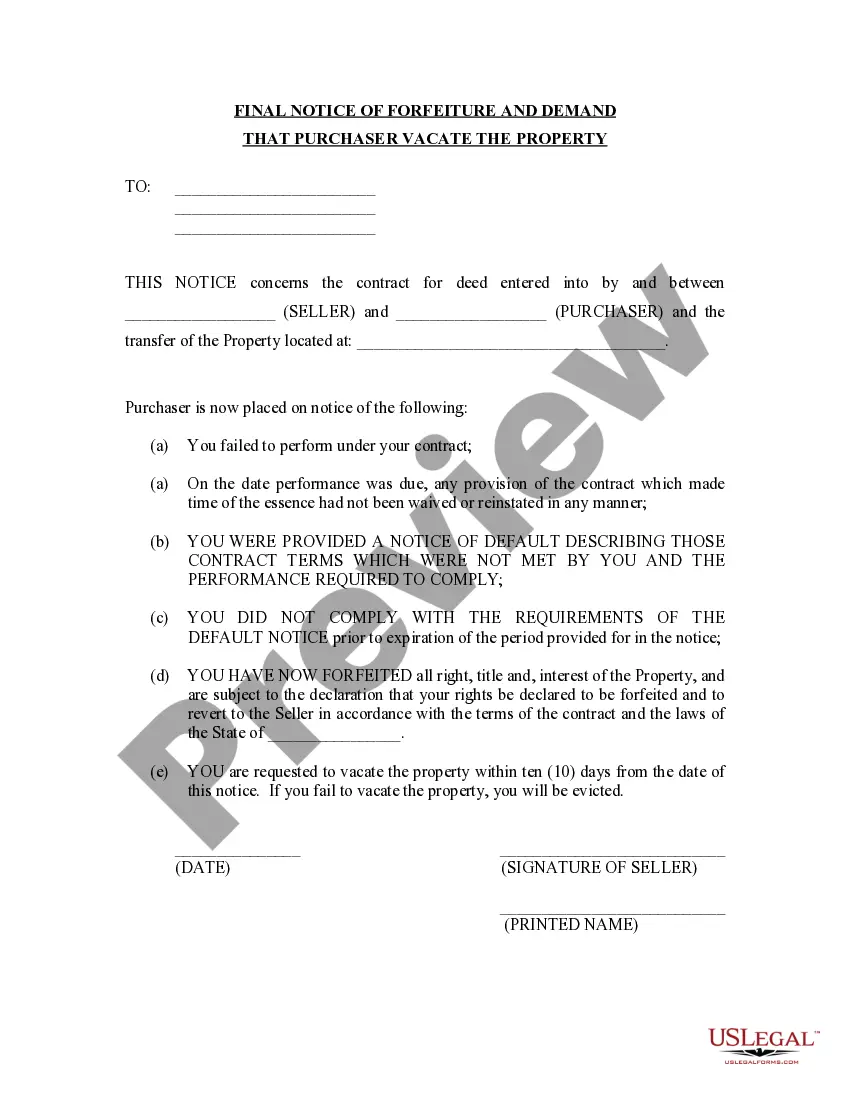
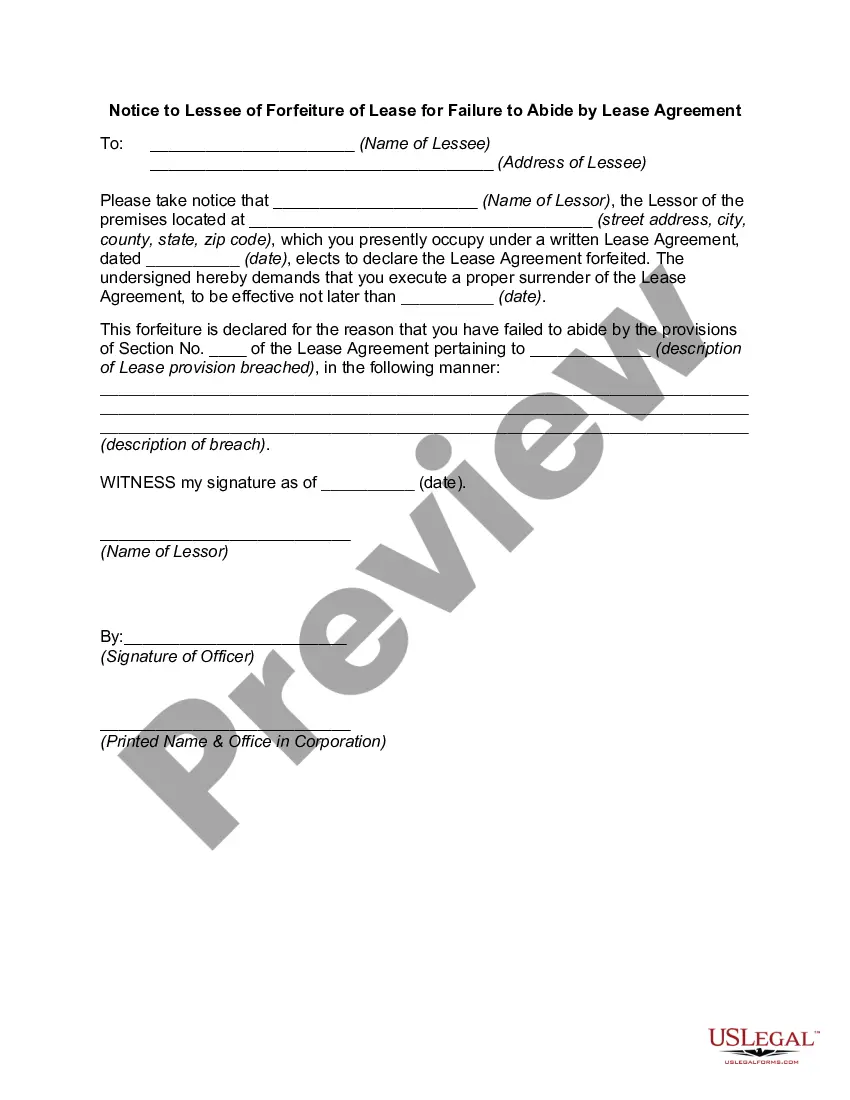
The Final Notice of Forfeiture and Request to Vacate Property under Contract for Deed is a legal document used by sellers to inform purchasers of the cancellation of a contract for deed. This form is crucial after previous notifications of breach have lapsed, asserting that any payments made by the buyer are forfeited. This form effectively requires the buyer to vacate the property to avoid further legal action, distinguishing it from other notices related to property defaults.
Key components of this form
- Identification of the parties involved (seller and buyer).
- Details of prior notices sent regarding the breach of contract.
- Statement of the seller's election to cancel the contract for deed.
- Forfeiture of prior payments made by the buyer.
- A demand for the buyer to vacate the property.
- Potential consequences of continued occupancy, including legal action.
Situations where this form applies
This form should be used when a seller has previously notified a buyer of a breach in the terms of their contract for deed and the stipulated time for remedying the breach has expired. It is an essential step before initiating any further legal proceedings to reclaim the property and ensures that the seller has met all legal notification requirements.
Intended users of this form
- Sellers who have entered a contract for deed with a buyer.
- Sellers who have followed the required procedures to notify buyers of breaches.
- Sellers seeking to reclaim their property after a buyer has defaulted on terms.
Steps to complete this form
- Identify the seller and buyer by providing their legal names and addresses.
- Include details regarding prior default notices sent to the buyer.
- State the seller's decision to cancel the contract clearly.
- Specify that all past payments made by the buyer are forfeited.
- Provide a deadline for the buyer to vacate the property.
- Sign and date the form appropriately.
Does this document require notarization?
To make this form legally binding, it must be notarized. Our online notarization service, powered by Notarize, lets you verify and sign documents remotely through an encrypted video session.
Get your form ready online
Our built-in tools help you complete, sign, share, and store your documents in one place.
Make edits, fill in missing information, and update formatting in US Legal Forms—just like you would in MS Word.
Download a copy, print it, send it by email, or mail it via USPS—whatever works best for your next step.
Sign and collect signatures with our SignNow integration. Send to multiple recipients, set reminders, and more. Go Premium to unlock E-Sign.
If this form requires notarization, complete it online through a secure video call—no need to meet a notary in person or wait for an appointment.
We protect your documents and personal data by following strict security and privacy standards.

Make edits, fill in missing information, and update formatting in US Legal Forms—just like you would in MS Word.

Download a copy, print it, send it by email, or mail it via USPS—whatever works best for your next step.

Sign and collect signatures with our SignNow integration. Send to multiple recipients, set reminders, and more. Go Premium to unlock E-Sign.

If this form requires notarization, complete it online through a secure video call—no need to meet a notary in person or wait for an appointment.

We protect your documents and personal data by following strict security and privacy standards.
Mistakes to watch out for
- Failing to include all prior notices of default.
- Not clearly stating the cancellation of the contract for deed.
- Omitting the deadline for vacating the premises.
- Not signing or dating the form properly.
Benefits of completing this form online
- Immediate access to a legally vetted document drafted by attorneys.
- Conveniently downloadable and customizable to specific needs.
- Low-cost option compared to traditional legal services.
- Secure storage of your completed form on your device.
Main things to remember
- The Final Notice of Forfeiture is essential for sellers wanting to cancel a contract for deed.
- Properly completing the form can help ensure legal compliance and facilitate eviction if necessary.
- Understanding local laws is critical before using this form.
Looking for another form?

Form popularity
FAQ
Criminal forfeiture is an action brought as a part of the criminal prosecution of a defendant.Civil judicial forfeiture is an in rem (against the property) action brought in court against the property. The property is the defendant and no criminal charge against the owner is necessary.
Forfeiture. A foreclosure action extinguishes any claim the mortgagor may have to the real property securing a defaulted loan, whereas a forfeiture refers generally to the loss of a right to something as a result of nonperformance of an obligation or condition.
Forfeiture is the loss of any property without compensation as a result of defaulting on contractual obligations, or as a penalty for illegal conduct.The process of forfeiture often involves proceedings in a court of law.
Forfeiture is the loss of any property without compensation as a result of defaulting on contractual obligations, or as a penalty for illegal conduct.
The name of the notice that is given to property owners to appear in court to say why the property shouldn't be forfeited.
401(k) plan forfeitures occur when a participant terminates employment (voluntarily or involuntarily) prior to satisfying the required service years to become fully vested in his/her account.Participants are generally always 100% vested in the contributions made by the participant.
If the buyer defaults on the land contract, or fails to make the monthly payments to the seller as required, the seller can file a court action called land contract forfeiture.In other words, if the buyer fails to pay, the seller keeps all money received, plus the seller keeps the real estate.
Forfeiture refers to a loss of any property, money, or assets without consideration or compensation in return. A forfeiture generally occurs due to default in complying with repayment obligations under a contract. It can also be used as a penalty for an illegal way of conducting business.