Pennsylvania Notice of Dishonored Check - Criminal - Keywords: bad check, bounced check
What is this form?
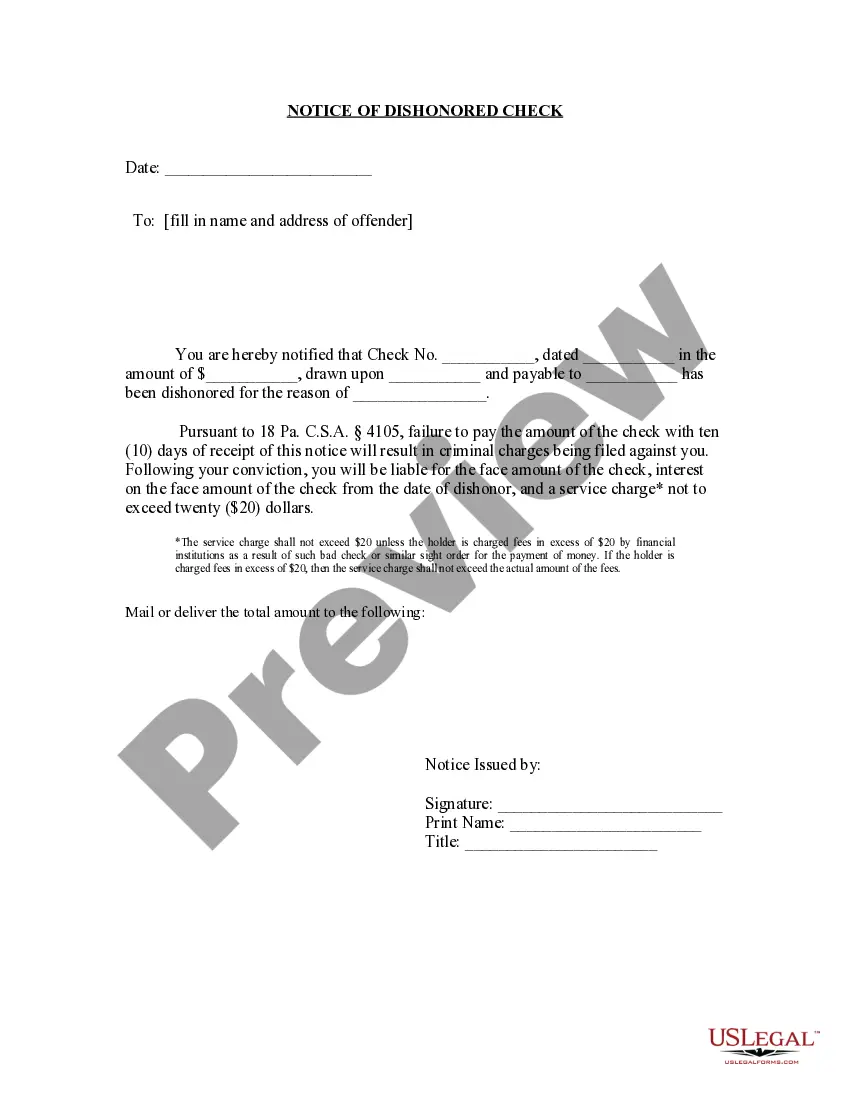
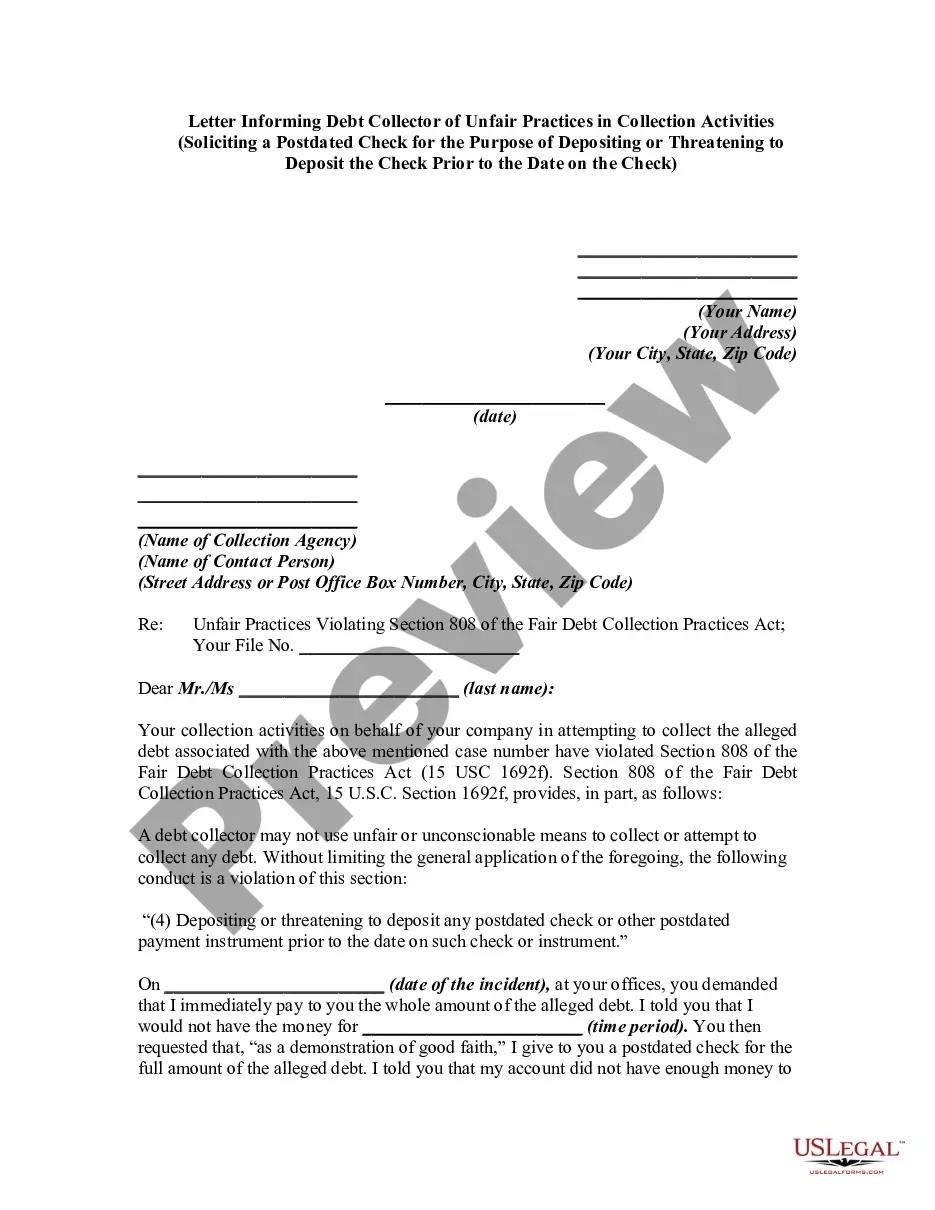
The Notice of Dishonored Check - Criminal is a legal document that notifies a debtor that their check has bounced or been dishonored due to insufficient funds or a closed account. This form is essential for initiating the legal process that may lead to criminal charges if the debtor does not rectify the situation within a specified timeframe. This form differs from other notices as it outlines potential criminal implications under state law.
Form components explained
- Identification of the debtor and check details.
- Notification of the dishonor and the required action.
- Consequences of failing to pay the amount specified in the notice.
- Specific service charges that may apply based on bank fees.

When to use this form
This form should be used when you receive a check that has bounced, indicating that there are insufficient funds in the debtor's account or that the account is closed. It is important to notify the debtor formally and allow them a grace period to resolve the issue before taking further legal actions. Using this form is a step towards recovering the owed amount while ensuring compliance with state laws regarding dishonored checks.
Who should use this form
- Business owners who have received a dishonored check from a customer.
- Individuals who accept checks as payment and face issues with payment processing.
- Anyone seeking to initiate legal action against a debtor for a bounced check.
Steps to complete this form
- Identify the debtor by entering their full name and address.
- Specify the details of the dishonored check, including the check number and amount.
- Include the date the check was presented and the date it was returned unpaid.
- Provide instructions for payment and notify the debtor of the consequences of non-payment.
- Sign and date the notice to make it legally valid.
Does this document require notarization?
Notarization is generally not required for this form. However, certain states or situations might demand it. You can complete notarization online through US Legal Forms, powered by Notarize, using a verified video call available anytime.
Get your form ready online
Our built-in tools help you complete, sign, share, and store your documents in one place.
Make edits, fill in missing information, and update formatting in US Legal Forms—just like you would in MS Word.
Download a copy, print it, send it by email, or mail it via USPS—whatever works best for your next step.
Sign and collect signatures with our SignNow integration. Send to multiple recipients, set reminders, and more. Go Premium to unlock E-Sign.
If this form requires notarization, complete it online through a secure video call—no need to meet a notary in person or wait for an appointment.
We protect your documents and personal data by following strict security and privacy standards.

Make edits, fill in missing information, and update formatting in US Legal Forms—just like you would in MS Word.

Download a copy, print it, send it by email, or mail it via USPS—whatever works best for your next step.

Sign and collect signatures with our SignNow integration. Send to multiple recipients, set reminders, and more. Go Premium to unlock E-Sign.

If this form requires notarization, complete it online through a secure video call—no need to meet a notary in person or wait for an appointment.

We protect your documents and personal data by following strict security and privacy standards.
Mistakes to watch out for
- Failing to properly identify the debtor, leading to confusion or disputes.
- Not adhering to state timelines for notification.
- Neglecting to include all necessary details of the dishonored check.
Benefits of using this form online
- Convenience of accessing the form anytime and anywhere.
- Editable format allowing for easy customization to fit your needs.
- Reliability of professionally drafted content that complies with legal standards.
Looking for another form?

Form popularity
FAQ
Knowingly writing a bad check is an act of fraud, and is punishable by law. Writing bad checks is a crime. Penalties for people who tender checks knowing there are insufficient funds in their accounts vary by state.If the check amount exceeds certain thresholds, the crime may be treated as a felony.
Send the letter certified mail. Visit your local district attorney's office if you do not hear back from the debtor. Bring your correspondence with you and a copy of the bad check. He will take the case over, and likely prosecute the check writer.
Bouncing a check can happen to anyone. If you receive and deposit a check that bounces, you'll owe a fee to your bank for returning the check, in addition to having the headache of recovering the money you're due.
Writing a bad check can land you in prison. In Pennsylvania, bad checks under $200 constitute a summary offense. Bad checks between $200 and $500 are a third degree misdemeanor. Bad checks between $500 and $1,000 are a second degree misdemeanor.
As defined under California Penal Code Section 476a, writing a check while knowing that funds are insufficient can be charged as a misdemeanor offense that can result in sentence of up to one year in county jail.
If the tellers at the checks bank tell you there ARE sufficient funds you have three options: cash the check immediately (actually get cash - probably not recommended if it's several thousand dollars), take the check to YOUR bank and deposit the funds (this will take 2-3 days for the check to clear - not recommended),
It's possible to cash a check without a bank account by cashing it at the issuing bank or a check cashing store. It's also possible to cash a check if you've lost your ID by using an ATM or signing it over to someone else.
To do this, you must send a demand letter by registered or certified mail, to the address printed on the check, or if none, to the issuer's last known address. If the money owed is not received by you within the ten days, you may bring a Complaint at the district justice's office.