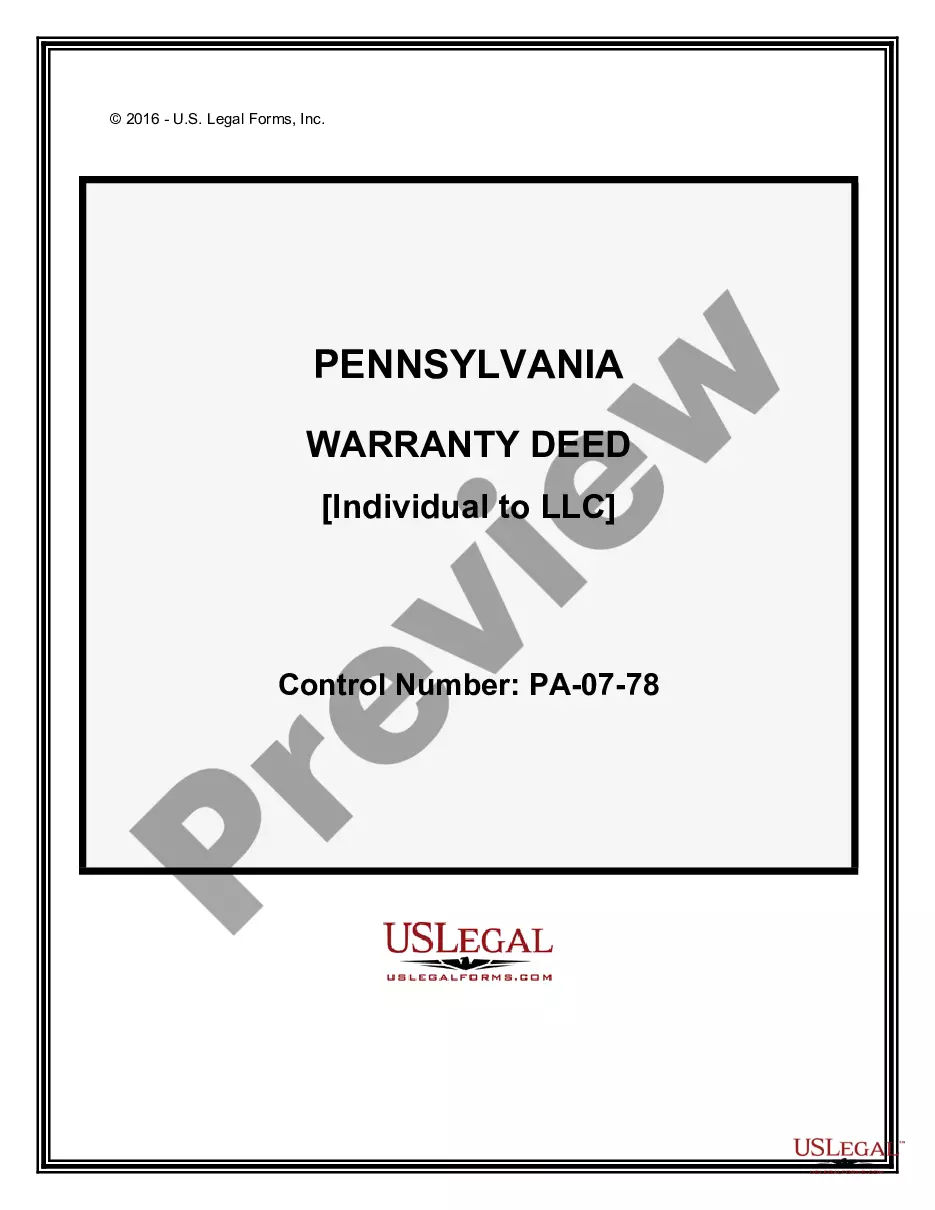
Pennsylvania Warranty Deed from Individual to LLC
Understanding this form
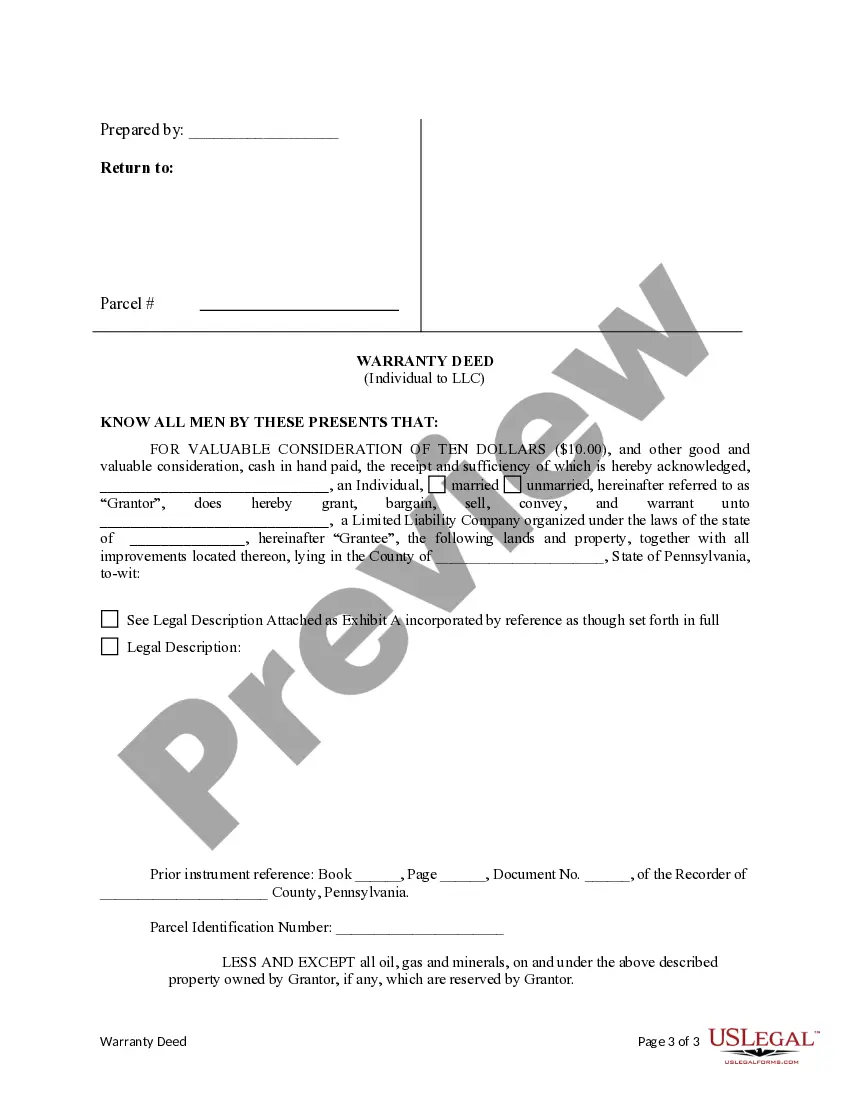
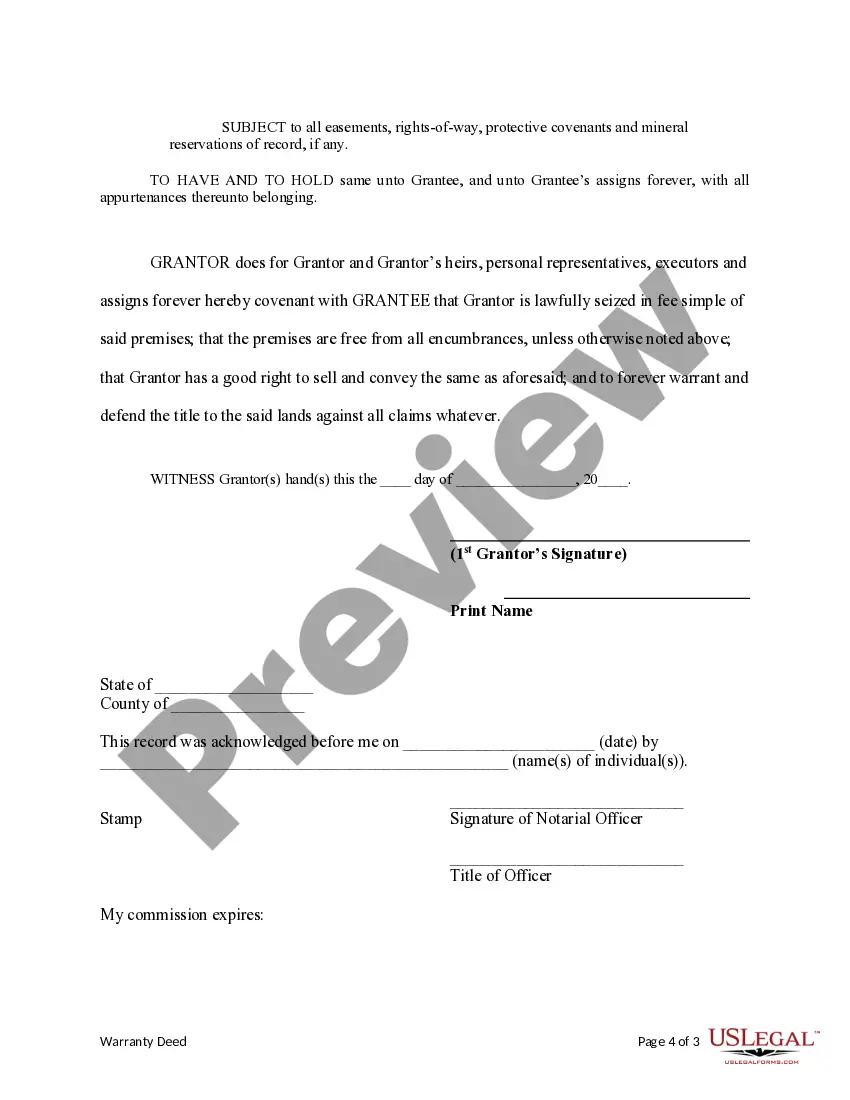
This Warranty Deed from Individual to LLC is a legal document designed to transfer property ownership from an individual (the grantor) to a limited liability company (the grantee). This form ensures that the grantor conveys the described property while reserving rights to any oil, gas, and minerals beneath the land. It is essential for formalizing real estate transactions specifically when moving property into an LLC, distinguishing it from standard deeds and offering specific legal protections related to that transfer.
Form components explained
- Grantor and Grantee details: Names and addresses of the individual and the LLC.
- Legal description of the property: Precise details identifying the property being transferred.
- Reservation clause: Specifies that the grantor retains rights to oil, gas, and minerals.
- Warranties of title: Assurances from the grantor about the legal status of the property.
- Signatures: Required signatures from the grantor and witnesses for validity.




Common use cases
This form is used in situations where an individual wishes to transfer ownership of a piece of real estate to a limited liability company they own or are a part of. Common scenarios include asset protection, business structuring, or estate planning where the property is to be held by a business entity rather than an individual.
Who should use this form
- Individuals transferring personal property to an LLC.
- Business owners seeking to consolidate real estate assets under a corporate structure.
- Investors looking to manage real estate holdings in a limited liability framework.
How to complete this form
- Identify the parties: Enter the full names and addresses of the grantor and grantee.
- Specify the property: Provide a detailed legal description of the property being transferred.
- Complete the reservation clause: Indicate any oil, gas, or mineral rights being reserved by the grantor.
- Verify warranties: Ensure all statements regarding title and encumbrances are accurate.
- Sign and date: The grantor must sign the document in the presence of witnesses and date it accordingly.
Notarization guidance
This form needs to be notarized to ensure legal validity. US Legal Forms provides secure online notarization powered by Notarize, allowing you to complete the process through a verified video call, available anytime.
Get your form ready online
Our built-in tools help you complete, sign, share, and store your documents in one place.
Make edits, fill in missing information, and update formatting in US Legal Forms—just like you would in MS Word.
Download a copy, print it, send it by email, or mail it via USPS—whatever works best for your next step.
Sign and collect signatures with our SignNow integration. Send to multiple recipients, set reminders, and more. Go Premium to unlock E-Sign.
If this form requires notarization, complete it online through a secure video call—no need to meet a notary in person or wait for an appointment.
We protect your documents and personal data by following strict security and privacy standards.

Make edits, fill in missing information, and update formatting in US Legal Forms—just like you would in MS Word.

Download a copy, print it, send it by email, or mail it via USPS—whatever works best for your next step.

Sign and collect signatures with our SignNow integration. Send to multiple recipients, set reminders, and more. Go Premium to unlock E-Sign.

If this form requires notarization, complete it online through a secure video call—no need to meet a notary in person or wait for an appointment.

We protect your documents and personal data by following strict security and privacy standards.
Common mistakes
- Failing to include the complete legal description of the property.
- Not reserving rights to oil, gas, and minerals if applicable.
- Inadequate signatures or not having witnesses present at signing.
- Providing incorrect information about the status of property ownership.
Why use this form online
- Convenience of completing forms from anywhere, at any time.
- Editable fields that facilitate accurate and efficient completion.
- Access to professionally drafted templates ensuring legal compliance.
Looking for another form?
Form popularity
FAQ
To transfer property in Pennsylvania, you'll need to prepare and execute a deed and record it in the county where the property is located. If the transfer was in exchange for money, you'll have to pay transfer tax.
If you give your house to your children, the tax basis will be $150,000.PA INHERITANCE TAX ISSUES: In Pennsylvania, there is no gift tax. However, to avoid PA Inheritance Taxes (the rate is 4.5% for assets passed to children or grandchildren), you must live at least one year from the time the gift was made.
Retrieve your original deed. Get the appropriate deed form. Draft the deed. Sign the deed before a notary. Record the deed with the county recorder. Obtain the new original deed.
A: A "special warranty" deed is the type of deed used most frequently in Pennsylvania real estate sales. It essentially represents that the seller did nothing to weaken the status of title from the time that he/she received it.A "quit-claim" deed is a deed that contains no warranties at all.
The only way to forcibly change the ownership status is through a legal action and the resultant court order. However, if an owner chooses to be removed from the deed, it is simply a matter of preparing a new deed transferring that owner's interest in the property.
The State of Pennsylvania charges 1% of the sales price and the municipality and school district USUALLY charge 1% between them for a total of 2% (i.e. 2% X 100,000 = $2,000). By custom, the buyer and seller split the cost. 1% to buyer, 1% to seller; however payment is dictated by the sales contract.
However, there are substantial downsides associated with transferring your primary home into an LLC.If you are using your personal residence for estate planning purposes, a qualified personal residence trust (QPRT) may be more effective than transferring your property to a limited liability company.
Does LLC ownership count as time used as a primary residence? For a single-member LLC, the answer is typically yes. For example, if the house is owned by an LLC. The Treasury Regulations allow for the capital gains exclusion when title is held by a single-member disregarded entity.