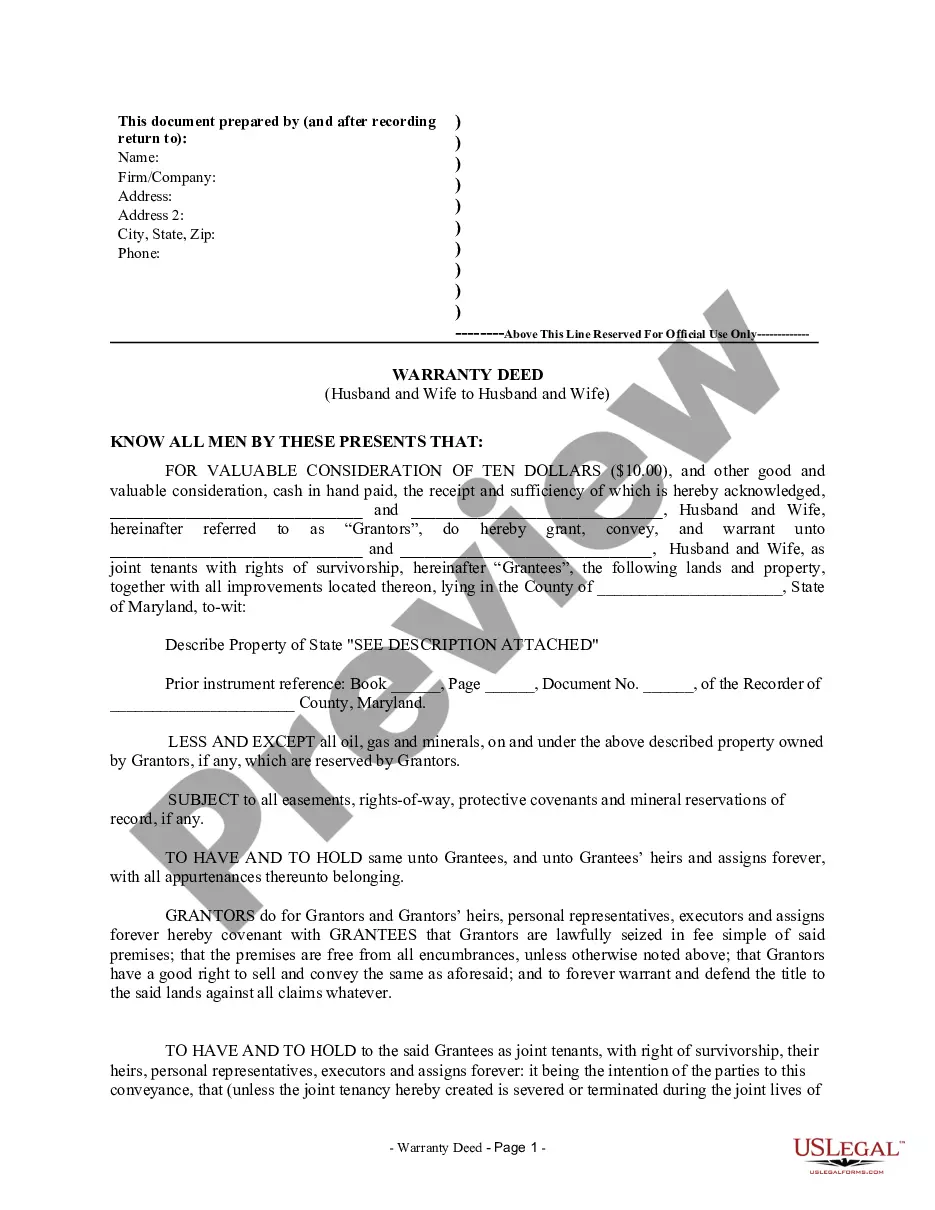
Maryland Warranty Deed from Husband and Wife to Husband and Wife
Description



How to fill out Maryland Warranty Deed From Husband And Wife To Husband And Wife?
Welcome to the greatest legal files library, US Legal Forms. Right here you can find any example including Maryland Warranty Deed from Husband and Wife to Husband and Wife templates and download them (as many of them as you want/need). Get ready official documents with a several hours, rather than days or weeks, without having to spend an arm and a leg on an lawyer or attorney. Get your state-specific example in a few clicks and be assured understanding that it was drafted by our qualified attorneys.
If you’re already a subscribed customer, just log in to your account and click Download near the Maryland Warranty Deed from Husband and Wife to Husband and Wife you want. Due to the fact US Legal Forms is web-based, you’ll generally get access to your saved templates, no matter the device you’re utilizing. Find them within the My Forms tab.
If you don't have an account yet, what exactly are you waiting for? Check out our guidelines below to get started:
- If this is a state-specific sample, check out its validity in your state.
- Look at the description (if accessible) to learn if it’s the right example.
- See more content with the Preview feature.
- If the example fulfills all your requirements, click Buy Now.
- To make an account, pick a pricing plan.
- Use a card or PayPal account to subscribe.
- Download the template in the format you require (Word or PDF).
- Print out the document and complete it with your/your business’s info.
When you’ve filled out the Maryland Warranty Deed from Husband and Wife to Husband and Wife, send it to your attorney for verification. It’s an additional step but an essential one for being sure you’re entirely covered. Become a member of US Legal Forms now and access a large number of reusable samples.
Form popularity
FAQ
In California, all property bought during the marriage with income that was earned during the marriage is deemed "community property." The law implies that both spouses own this property equally, regardless of which name is on the title deed.
In cases where a couple shares a home but only one spouse's name is on it, the home will not automatically pass to the surviving pass, if his or her name is not on the title.
Two of the most common ways to transfer property in a divorce are through an interspousal transfer deed or quitclaim deed. When spouses own property together, but then one spouse executes an interspousal transfer or a quitclaim deed, this is known as transmutation.
In states like California and Florida, the spouses may use a quitclaim deed to transfer the property without warranting title. Other stateslike Texasrecognize a similar type of deed called a deed without warranty.
If you live in a common-law state, you can keep your spouse's name off the title the document that says who owns the property.You can put your spouse on the title without putting them on the mortgage; this would mean that they share ownership of the home but aren't legally responsible for making mortgage payments.
The names on the mortgage show who's responsible for paying back the loan, while the title shows who owns the property. You can put your spouse on the title without putting them on the mortgage; this would mean that they share ownership of the home but aren't legally responsible for making mortgage payments.
Before adding your spouse to the deed, speak with your attorney. The easiest way to grant your spouse title to your home is via a quitclaim deed (Californians generally use an interspousal grant deed). With a quitclaim deed, you can name your spouse as the property's joint owner.
It's often easier to qualify for a joint mortgage, because both spouses can contribute income and assets to the application. However, if one spouse can qualify for a mortgage based on his own income and credit, the mortgage does not need to be in both spouses' names unless you live in a community property state.
California married couples generally have three options to take title to their community (vs separate) property real estate: community property, joint tenancy or Community Property with Right of Survivorship. The latter coming into play in California July of 2001.