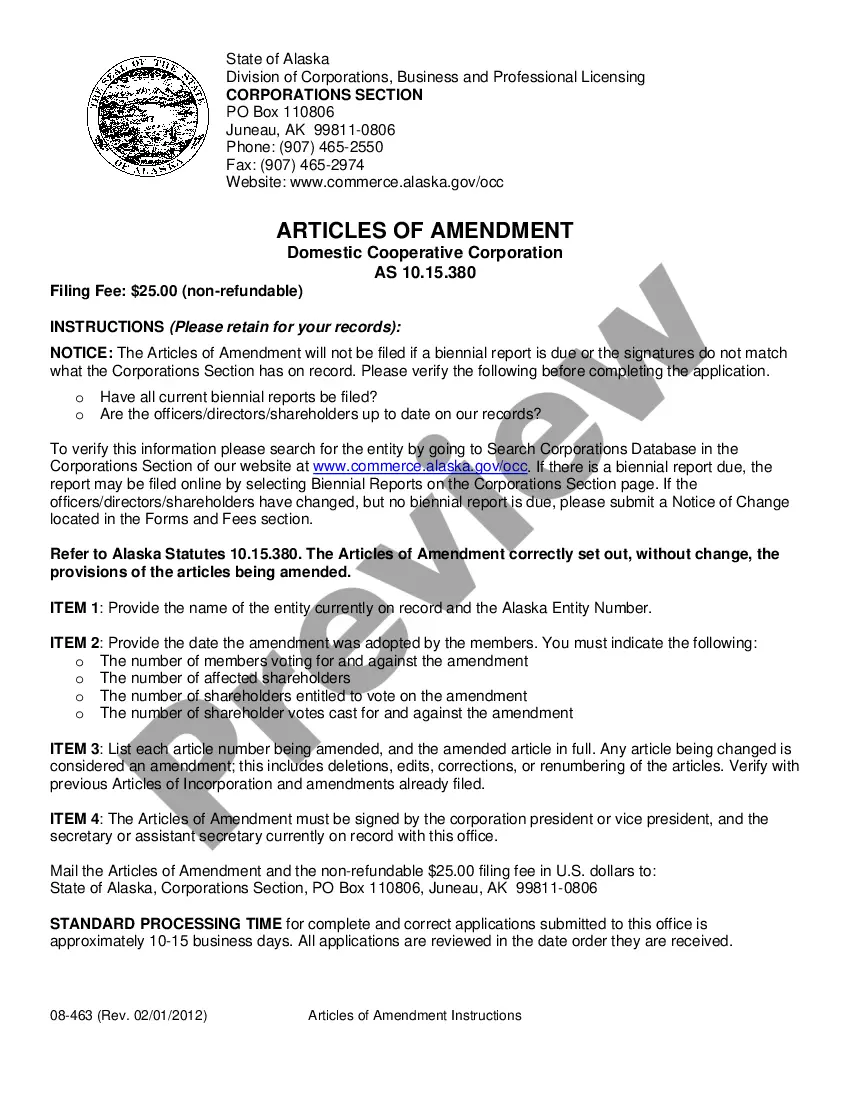
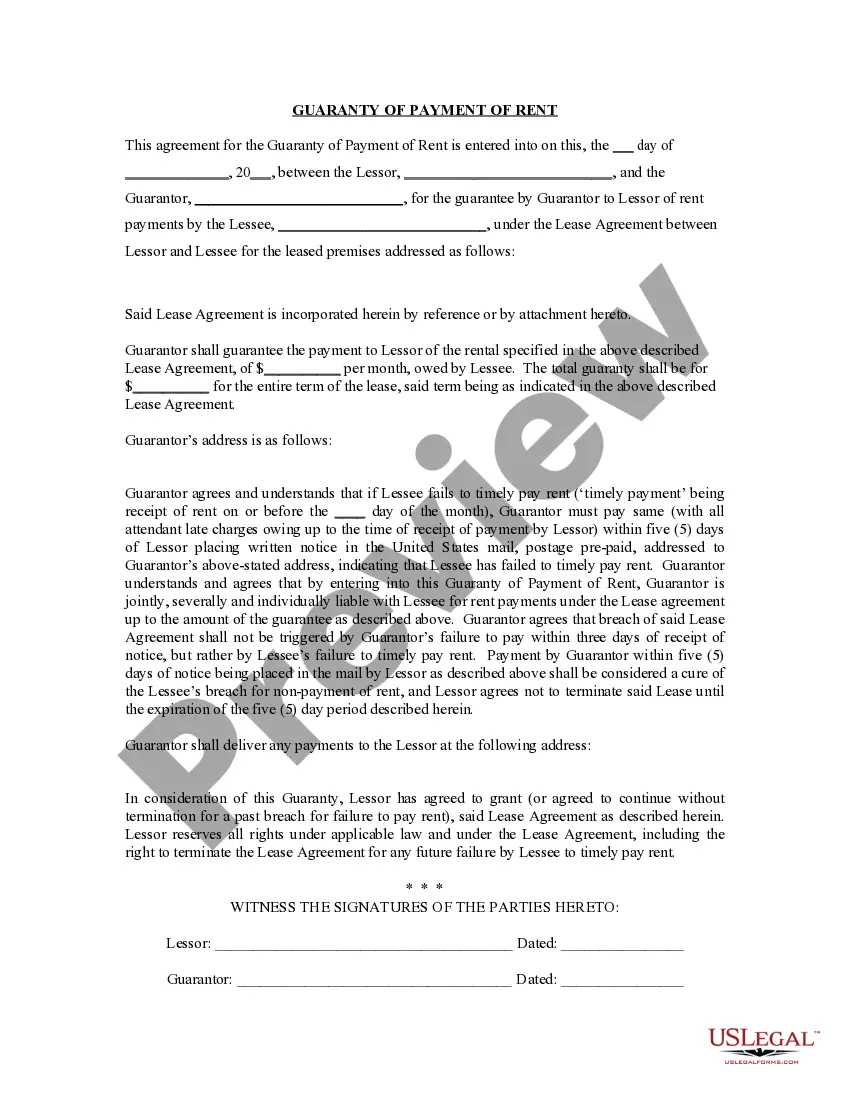
Ohio Guaranty or Guarantee of Payment of Rent
What this document covers
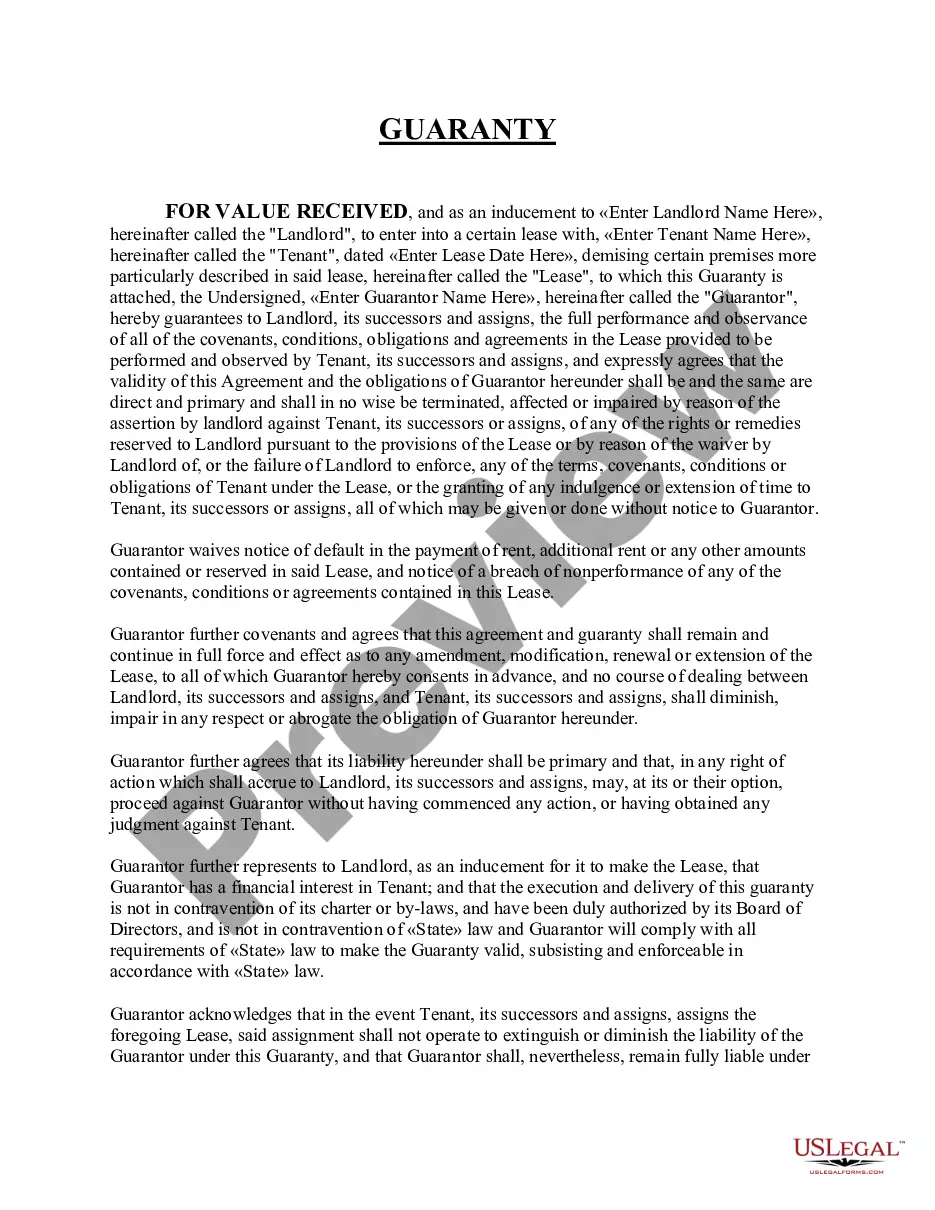
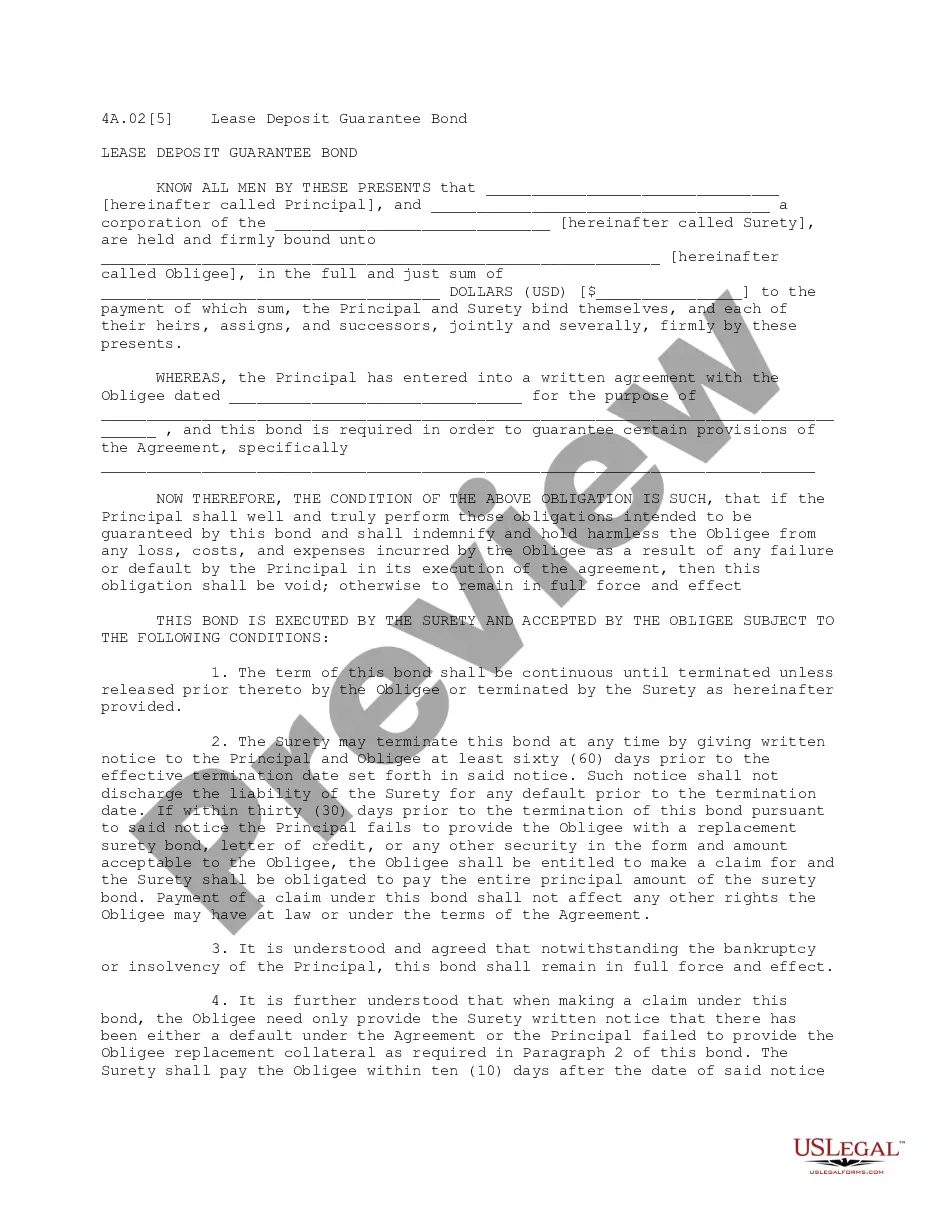
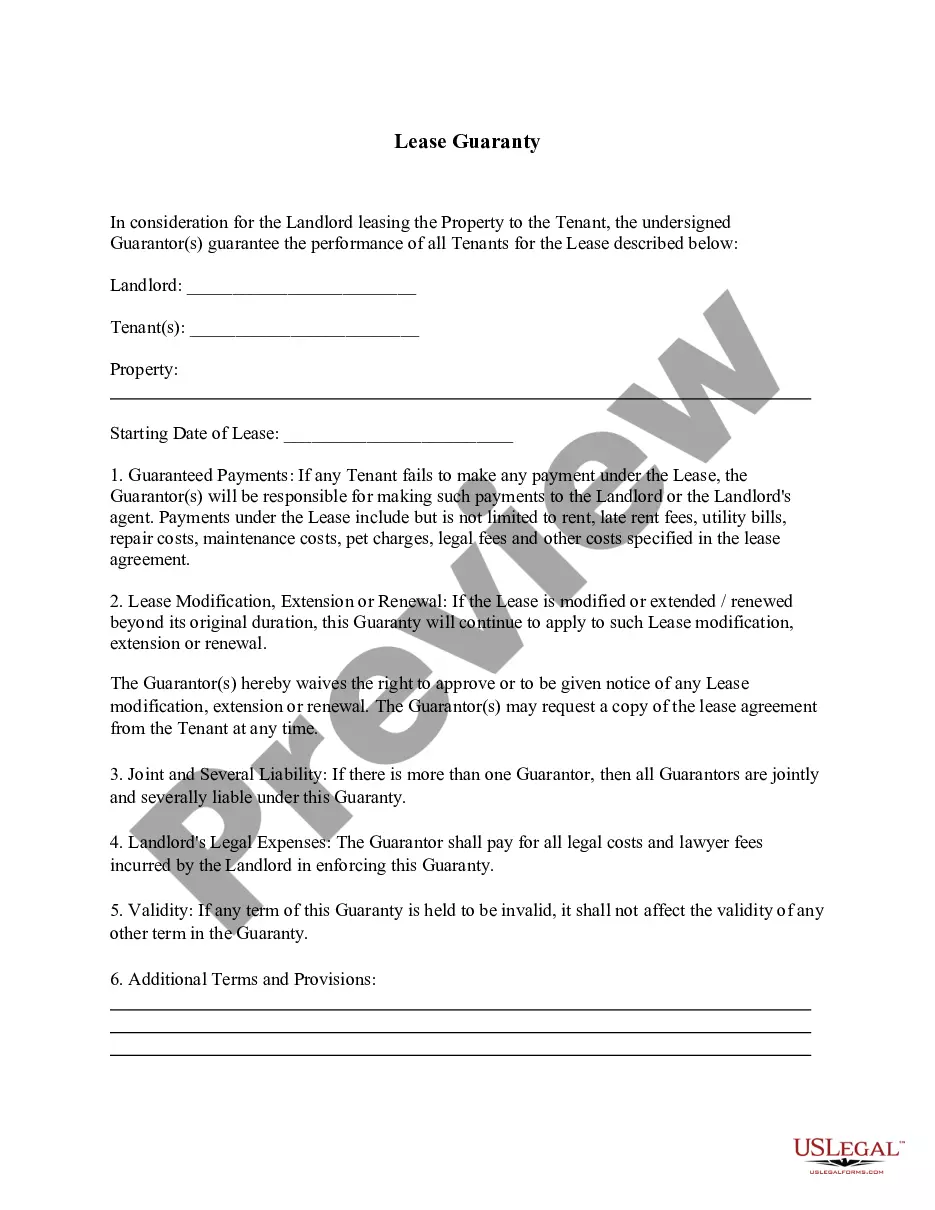
The Guaranty or Guarantee of Payment of Rent is a legal contract in which a guarantor agrees to pay rent on behalf of a tenant if the tenant is unable to do so. This form clarifies the responsibilities of both the guarantor and the landlord, ensuring that rent obligations are met. Unlike other rental agreements, this contract specifically addresses the role of the guarantor in relation to rent payments, providing a layer of security for landlords.
Main sections of this form
- Identification of the parties involved: tenant, guarantor, and landlord.
- Details regarding the property being rented.
- Clear statement of the guarantor's obligations in the event of tenant default.
- Signature and date lines for both the landlord and the guarantor.
When to use this document
This form should be used when a landlord requires additional assurance of rent payment from a tenant. It is particularly useful in situations where the tenant may not have a strong credit history or enough income proof. This agreement helps landlords mitigate risk by ensuring that they have a designated party responsible for payments if the tenant fails to meet their obligations.
Intended users of this form
- Landlords seeking a guarantee for rent payments.
- Tenants who may need a guarantor to lease a property.
- Guarantors who want to understand their responsibilities before signing.
Completing this form step by step
- Identify the parties by entering the names and addresses of the tenant, guarantor, and landlord.
- Specify the property address where the rental agreement applies.
- Clearly outline any specific conditions under which the guarantor will be required to pay.
- Sign and date the document in the designated areas.
- Ensure all parties retain a copy of the signed agreement for their records.
Notarization requirements for this form
This form does not typically require notarization to be legally valid. However, some jurisdictions or document types may still require it. US Legal Forms provides secure online notarization powered by Notarize, available 24/7 for added convenience.
Get your form ready online
Our built-in tools help you complete, sign, share, and store your documents in one place.
Make edits, fill in missing information, and update formatting in US Legal Forms—just like you would in MS Word.
Download a copy, print it, send it by email, or mail it via USPS—whatever works best for your next step.
Sign and collect signatures with our SignNow integration. Send to multiple recipients, set reminders, and more. Go Premium to unlock E-Sign.
If this form requires notarization, complete it online through a secure video call—no need to meet a notary in person or wait for an appointment.
We protect your documents and personal data by following strict security and privacy standards.

Make edits, fill in missing information, and update formatting in US Legal Forms—just like you would in MS Word.

Download a copy, print it, send it by email, or mail it via USPS—whatever works best for your next step.

Sign and collect signatures with our SignNow integration. Send to multiple recipients, set reminders, and more. Go Premium to unlock E-Sign.

If this form requires notarization, complete it online through a secure video call—no need to meet a notary in person or wait for an appointment.

We protect your documents and personal data by following strict security and privacy standards.
Common mistakes to avoid
- Failing to correctly identify all parties involved, leading to confusion about responsibilities.
- Not specifying the terms under which the guarantor is liable to pay the rent.
- Neglecting to have all parties sign the form, which can invalidate the agreement.
Advantages of online completion
- Immediate access to downloadable templates, saving time compared to traditional methods.
- Editability allows users to customize the form to fit their specific needs.
- Reliability of forms drafted by licensed attorneys, ensuring legal compliance.
Legal use & context
- Guaranties are legally binding contracts and enforceable in court as long as they meet state law requirements.
- The guarantor may be held liable for unpaid rent only after the landlord has attempted to collect from the tenant.
What to keep in mind
- The Guaranty or Guarantee of Payment of Rent provides financial security for landlords.
- Both tenants and guarantors need to understand their obligations under this form.
- Always check state-specific laws to ensure compliance and proper execution.
Looking for another form?

Form popularity
FAQ
It's very common for a guarantee to last as long as the tenancy lasts. So, if the tenant remains in the property for four years, you will continue to be responsible for any arrears or damages during that entire period. Most tenancies will run for a fixed term and will then continue on a month-by-month basis.
If you're renting in London, you'll need to go through credit checks and referencing as part of the rental application process. If you're new to renting or you can't provide a reference from a previous landlord, you might be asked to provide a guarantor.
A guarantor is an individual who takes on your financial obligations on a lease if you cannot pay. They essentially co-signs the rental lease with you, taking on your debt under the terms of the lease if necessary.
If you are a guarantor and no longer wish to be, you must obtain the consent or agreement from the landlord before you will be released from your liabilities, which, if the rent is in arrears, the landlord is unlikely to agree to.
At law, the giver of a guarantee is called the surety or the "guarantor". The person to whom the guarantee is given is the creditor or the "obligee"; while the person whose payment or performance is secured thereby is termed "the obligor", "the principal debtor", or simply "the principal".
Your guarantor needs to be more financial stable than you are. The landlord will request them to agree on credit checks and any other checks that have been made to you. In turn, the guarantor must satisfy the landlord's standards to be eligible.
A guarantor is a third party who 'guarantees' a loan, mortgage or rental agreement. This means they agree to repay the total amount owed if the borrower or renter can't pay what they owe. By guaranteeing the agreement, you become responsible for any arrears that occur.
Essentially, in the event of a tenant being unable to meet their obligations under the Tenancy Agreement contract, whether it is for overdue rent, damage to the property or whatever, the Guarantor is legally bound to accept the liabilities on behalf of the tenant.
Lenders have their own rules and guidelines, but usually guarantors will: be over 21 years old. have a good credit history. have a separate bank account to the borrower you may be able to guarantee a loan for a spouse or partner, but only if you have separate bank accounts.