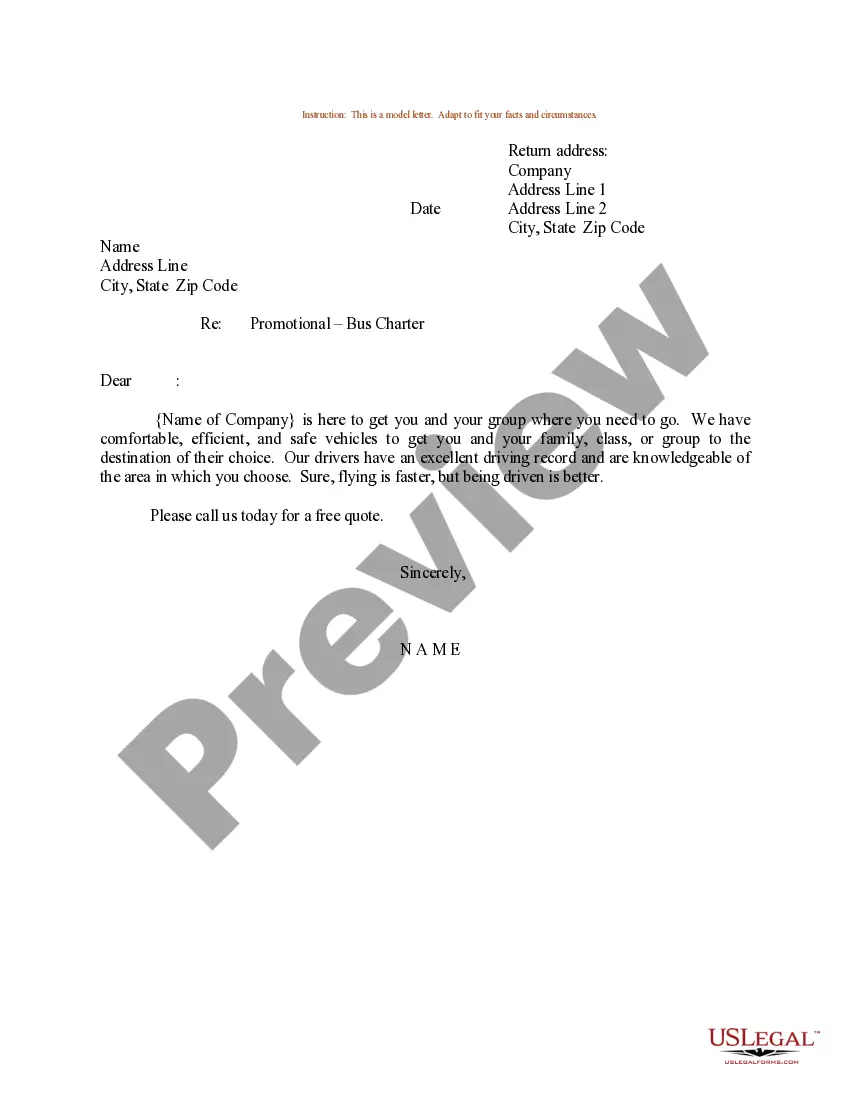
New York Quitclaim Deed from Corporation to Corporation
About this form
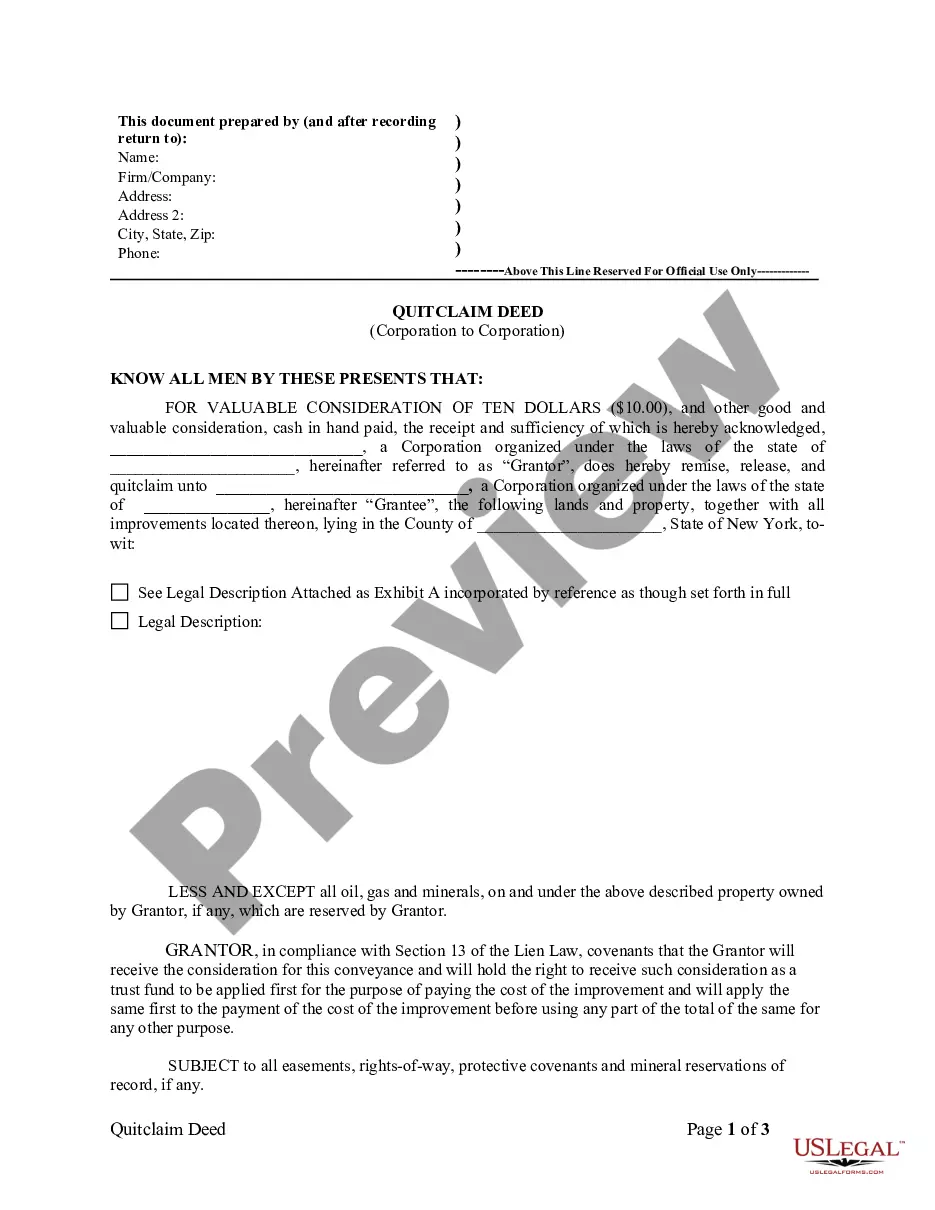
The Quitclaim Deed from Corporation to Corporation is a legal document that transfers ownership of real property from one corporation (the Grantor) to another corporation (the Grantee). This type of deed is distinct because it conveys any ownership interest the Grantor may have without any warranties or guarantees on the title. It is essential for situations where corporations wish to quickly transfer property without the complexities of a warranty deed.
Main sections of this form
- Legal description of the property provided in Exhibit A.
- Statement of conveyance from the Grantor to the Grantee.
- Reservation of oil, gas, and mineral rights by the Grantor, if applicable.
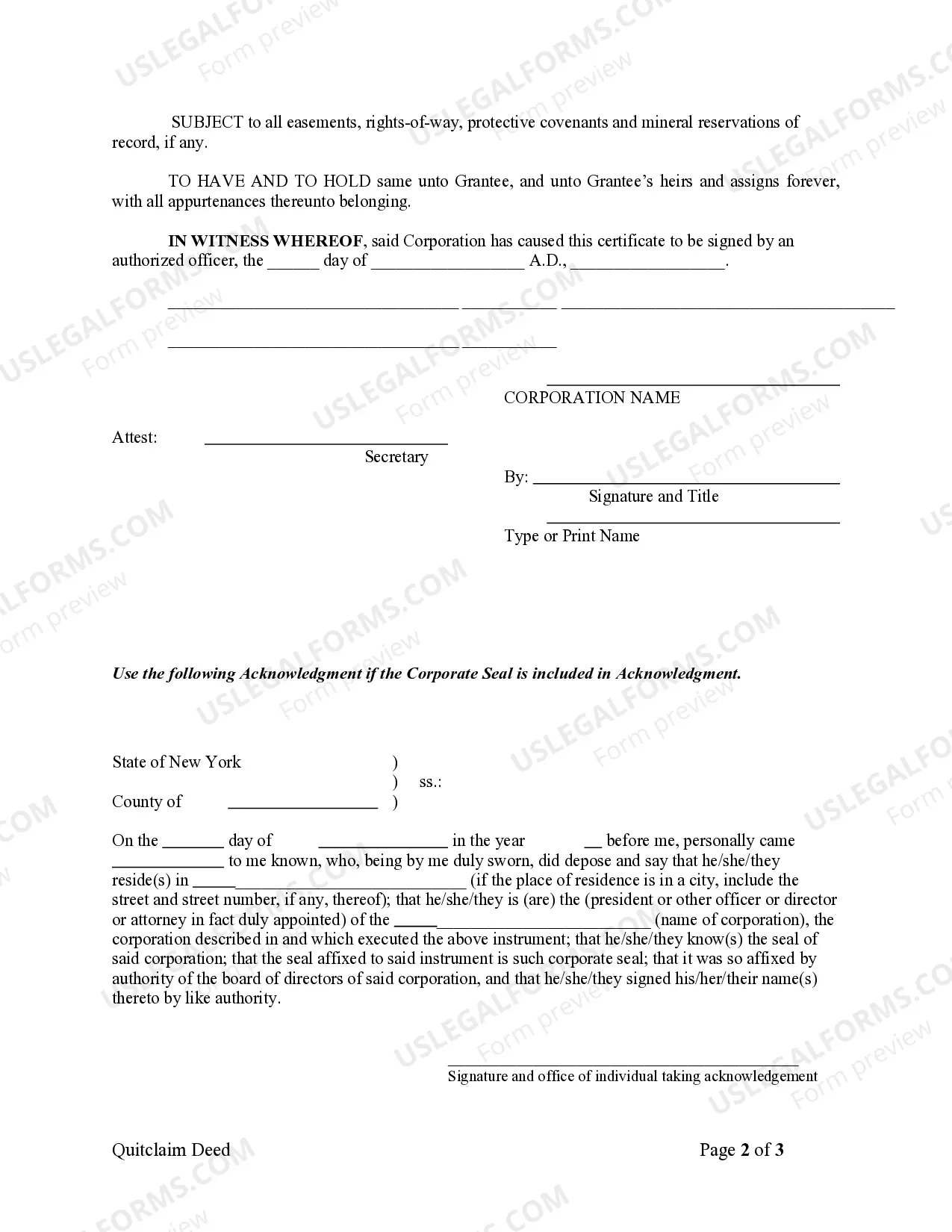
- Signature by an authorized officer of the Grantor corporation.
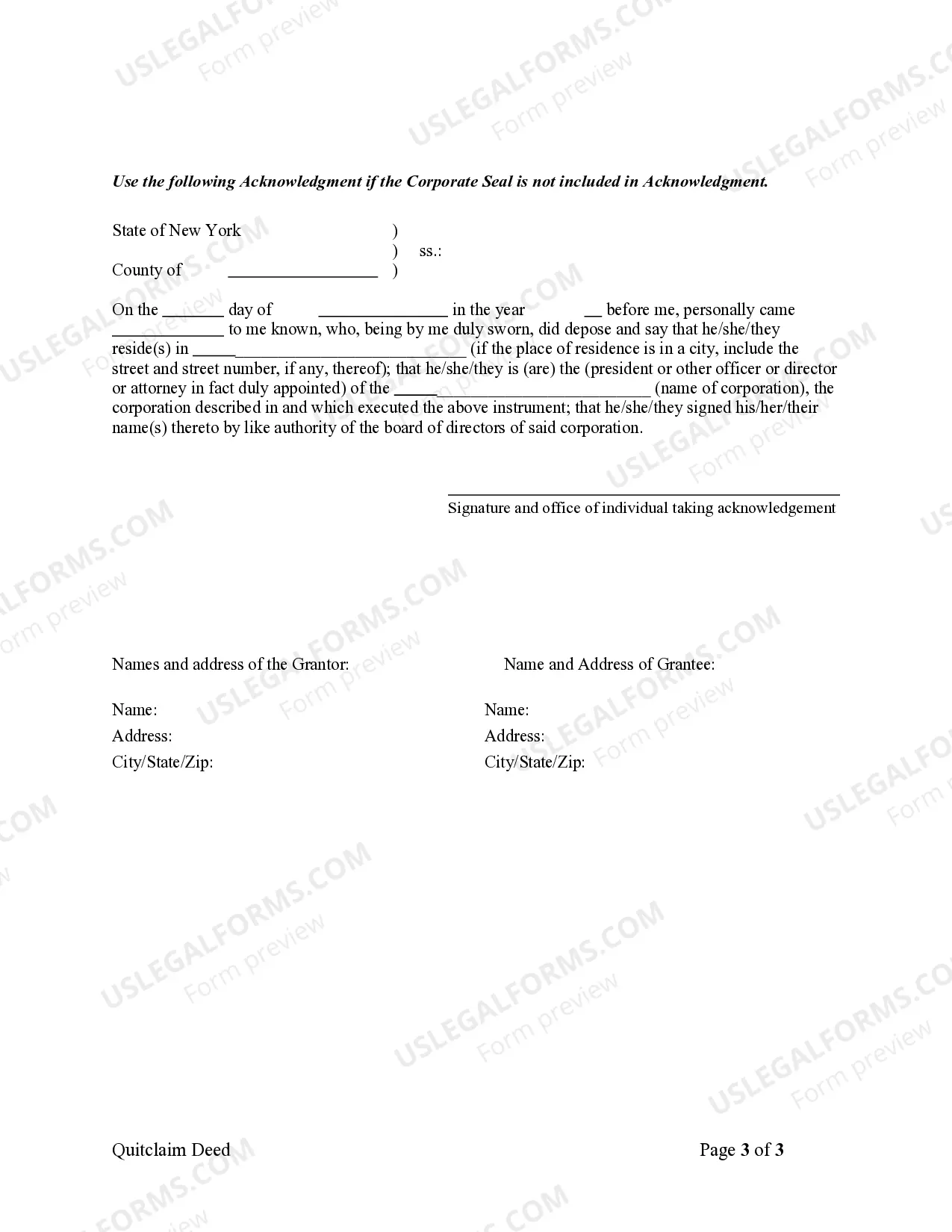
- Notary acknowledgment to validate the signatures.
- Details of the Grantor and Grantee, including their addresses.



When to use this document
This form is typically used when one corporation needs to transfer property interest to another corporation. Common scenarios include mergers or acquisitions, property reallocations between subsidiaries, or settling ownership disputes. It is useful in situations where the transfer does not necessitate a full title search or guarantees of title quality.
Who should use this form
- Corporations involved in property transactions.
- Corporate attorneys or legal representatives handling property transfer.
- Corporations looking to simplify the process of transferring property ownership without title warranties.
Completing this form step by step
- Identify the parties: Clearly state the names and addresses of both the Grantor and the Grantee corporations.
- Specify the property: Fill in the complete legal description of the property as referenced in Exhibit A.
- Indicate the reservation: Include any reservations related to oil, gas, and mineral rights, if applicable.
- Sign the form: Have an authorized officer of the Grantor corporation sign and date the deed.
- Obtain notarization: Have the signatures notarized by a qualified notary public to validate the document.
Does this form need to be notarized?
Notarization is required for this form to take effect. Our online notarization service, powered by Notarize, lets you verify and sign documents remotely through an encrypted video session, available 24/7.
Get your form ready online
Our built-in tools help you complete, sign, share, and store your documents in one place.
Make edits, fill in missing information, and update formatting in US Legal Forms—just like you would in MS Word.
Download a copy, print it, send it by email, or mail it via USPS—whatever works best for your next step.
Sign and collect signatures with our SignNow integration. Send to multiple recipients, set reminders, and more. Go Premium to unlock E-Sign.
If this form requires notarization, complete it online through a secure video call—no need to meet a notary in person or wait for an appointment.
We protect your documents and personal data by following strict security and privacy standards.

Make edits, fill in missing information, and update formatting in US Legal Forms—just like you would in MS Word.

Download a copy, print it, send it by email, or mail it via USPS—whatever works best for your next step.

Sign and collect signatures with our SignNow integration. Send to multiple recipients, set reminders, and more. Go Premium to unlock E-Sign.

If this form requires notarization, complete it online through a secure video call—no need to meet a notary in person or wait for an appointment.

We protect your documents and personal data by following strict security and privacy standards.
Avoid these common issues
- Failing to include a complete legal description of the property.
- Not obtaining notarization, which is required for the deed to be valid.
- Incorrectly identifying the authorized officer signing the deed.
- Overlooking the reservation of rights, leading to potential disputes over mineral rights.
Why use this form online
- Convenient access to the legal form from anywhere, without the need for in-person visits.
- Editable templates allow for easy customization to fit specific circumstances.
- Reliable, attorney-drafted content ensures the form complies with legal standards.
- Instant downloads provide quick turnaround when time-sensitive property transfers are required.
Looking for another form?








Form popularity
FAQ
A quitclaim deed is dangerous if you don't know anything about the person giving you the property. You should be sure that a person actually has rights to a property before signing it over with a quitclaim deed.
A quitclaim deed is quick and easy because it transfers all of one person's interest in the property to another.The deed transfers all claims the seller has to the property, if any. If the seller has no interest in the real estate, no interest is transferred.
A quitclaim deed transfers real estate interests from one party to another. It is a special type of deed in which the grantee takes ownership of the interests the grantor has at the time of the deed's execution whether or not the grantor is the actual property owner. A quitclaim deed offers zero protection to buyers.
Quitclaim deeds are most often used to transfer property between family members. Examples include when an owner gets married and wants to add a spouse's name to the title or deed, or when the owners get divorced and one spouse's name is removed from the title or deed.
Quitclaim Does Not Release Debts Signing a quitclaim deed and giving up all rights to the property doesn't release you from any financial obligations you may have. It only removes you from the title, not from the mortgage, and you are still responsible for making payments.
Fill in the deed form. Print it out. Have the grantor(s) sign and get the signature(s) notarized. Complete a transfer tax form, Form TP-584. Complete and print out Form RP-5217 (or, if you are in New York City, Form RP-5217NYC).
Fees to File a Quitclaim Deed in New York As of 2018, the basic fee for filing a quitclaim deed of residential or farm property is $125, while the fee for all other property is $250. These fees are for the RP-5217 form.