New Mexico Quitclaim Deed from Husband and Wife to Husband and Wife
Understanding this form
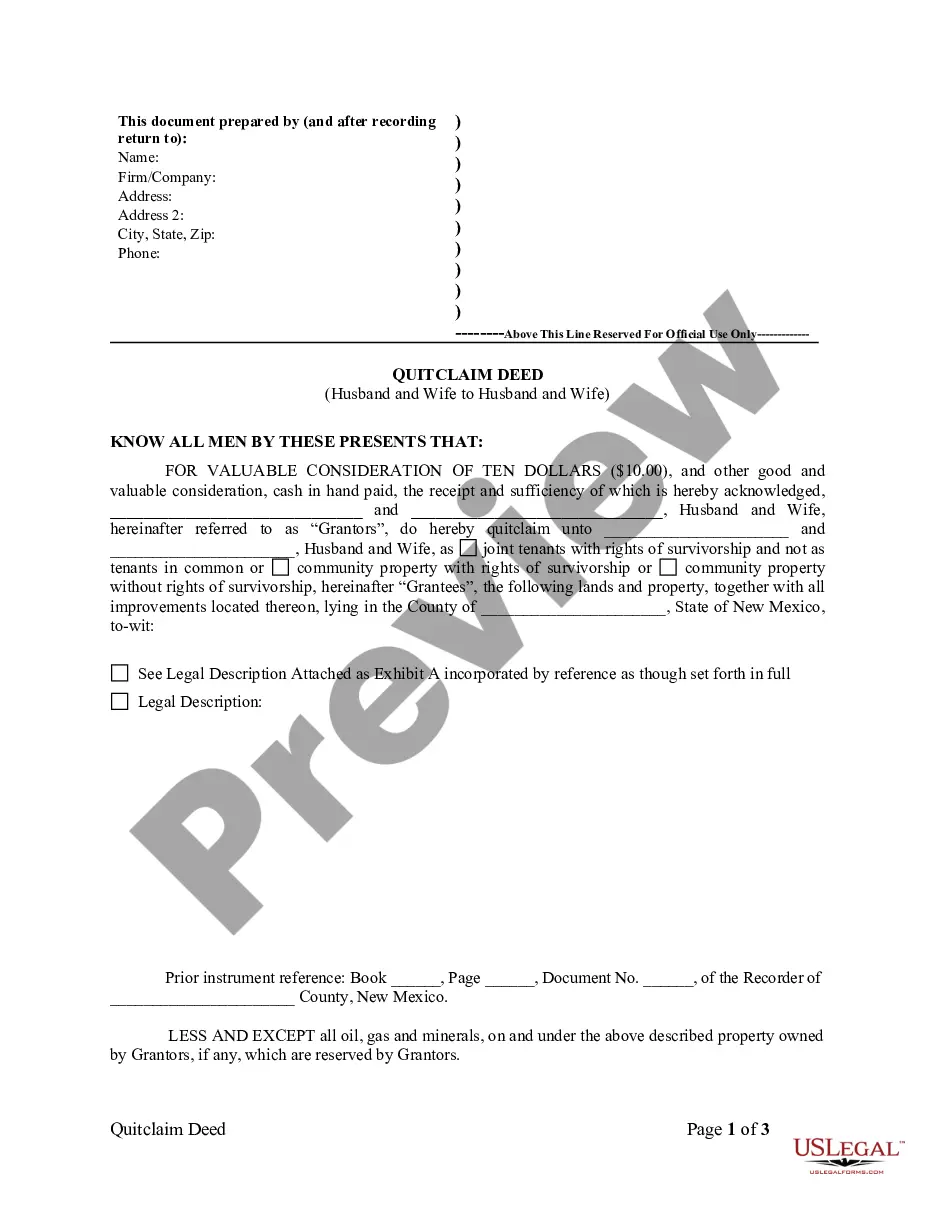
This form is a Quitclaim Deed specifically designed for the transfer of property between spouses. In this deed, both the husband and wife as grantors convey their interests in the property to each other as grantees. This form is important in situations where spouses wish to clarify property ownership without a sale and includes essential legal provisions and reservations concerning oil, gas, and minerals beneath the property.
Key components of this form
- Identification of the grantors (husband and wife) and grantees (husband and wife).
- Legal description of the property being conveyed, attached as Exhibit A.
- Provisions that reserve rights to any oil, gas, and minerals beneath the property.
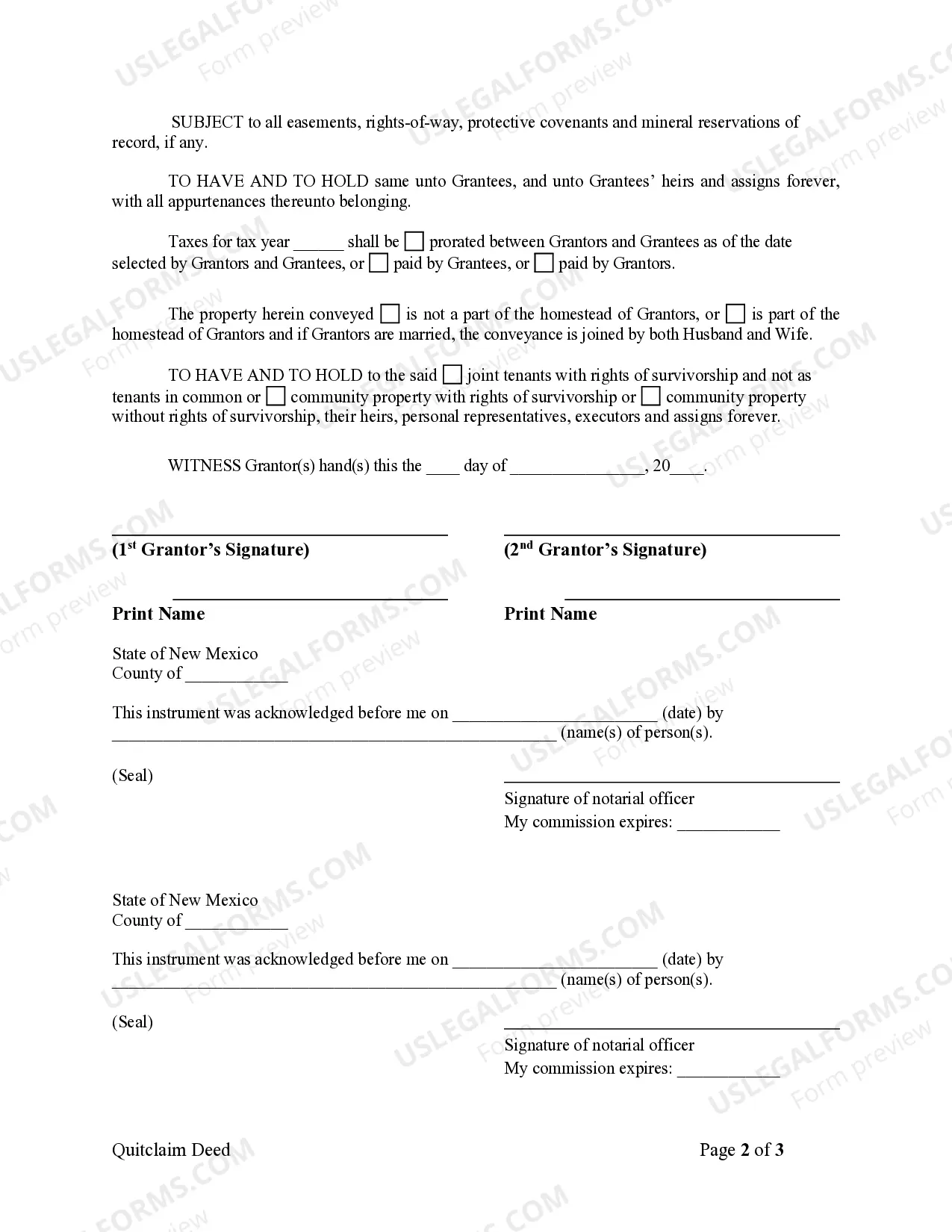
- Clauses for the prorating of taxes applicable at the time of transfer.
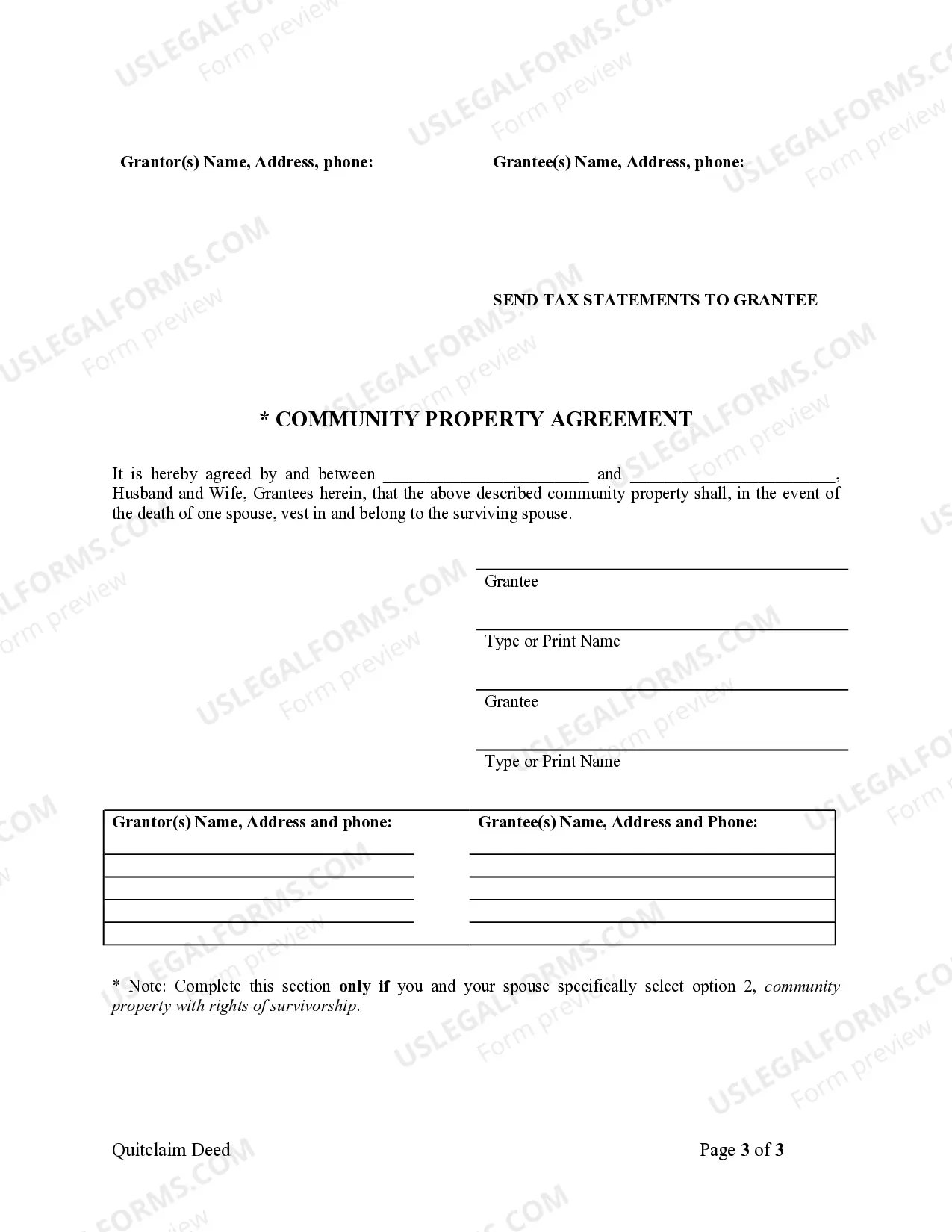
- Specifications regarding homestead status and survivorship rights.
- Signatures of both grantors and space for grantee names.






Common use cases
This Quitclaim Deed should be used when a husband and wife want to transfer property rights solely between themselves, such as when establishing joint ownership or clarifying title after a marriage. It is also useful when one spouse seeks to remove their name from a title or when couples wish to define their property ownership structure.
Intended users of this form
This form is intended for:
- Married couples looking to transfer property rights without a sale.
- Homeowners who wish to clarify property ownership between spouses.
- Individuals involved in divorce proceedings who need to divide property.
How to complete this form
- Identify the grantors by entering the names of both the husband and wife.
- Specify the property being conveyed by referring to the legal description attached as Exhibit A.
- Indicate the prorating of taxes for the tax year, selecting the appropriate option.
- Confirm the homestead status of the property and include any relevant details about survivorship.
- Both grantors should sign the document, including dates and printed names for clarity.
Notarization guidance
This form does not typically require notarization unless specified by local law. However, notarization can strengthen the validity of the deed and is recommended in certain circumstances.
Get your form ready online
Our built-in tools help you complete, sign, share, and store your documents in one place.
Make edits, fill in missing information, and update formatting in US Legal Forms—just like you would in MS Word.
Download a copy, print it, send it by email, or mail it via USPS—whatever works best for your next step.
Sign and collect signatures with our SignNow integration. Send to multiple recipients, set reminders, and more. Go Premium to unlock E-Sign.
If this form requires notarization, complete it online through a secure video call—no need to meet a notary in person or wait for an appointment.
We protect your documents and personal data by following strict security and privacy standards.

Make edits, fill in missing information, and update formatting in US Legal Forms—just like you would in MS Word.

Download a copy, print it, send it by email, or mail it via USPS—whatever works best for your next step.

Sign and collect signatures with our SignNow integration. Send to multiple recipients, set reminders, and more. Go Premium to unlock E-Sign.

If this form requires notarization, complete it online through a secure video call—no need to meet a notary in person or wait for an appointment.

We protect your documents and personal data by following strict security and privacy standards.
Common mistakes
- Failing to include the legal description of the property accurately.
- Not specifying the status of property as part of the homestead, which can affect rights.
- Omitting signatures or dates from the form before submission.
Benefits of using this form online
- Convenience of immediate download without the need for in-person consultations.
- Editability, allowing personalized information to be easily added.
- Reliability, as forms are drafted by licensed attorneys ensuring compliance with legal standards.
Looking for another form?


Form popularity
FAQ
If the lender accepts your offer of a Quit Claim, you sign a document called a Transfer of title to your lender. You and the lender both sign the Quit Claim. The Quit Claim states that you agree to transfer the ownership of your property to the lender and the lender agrees to release you from any debt owed.
Notary Public (Section 47-1-44) In New Mexico it must be signed with a Notary Public viewing the Grantor(s) signature(s). Recording A quit claim deed is required to be filed at the County Clerk's Office where the property is located along with the required recording fee(s).
To use a Quitclaim Deed to add someone to a property deed or title, you would need to create a Quitclaim Deed and list all of the current owners in the grantor section. In the grantee section, you would list all of the current owners as well as the person you would like to add.
But you might be wondering if an owner can transfer a deed to another person without a real estate lawyer. The answer is yes. Parties to a transaction are always free to prepare their own deeds.A quitclaim deed, for example, is far simpler than a warranty deed.
A quitclaim deed is dangerous if you don't know anything about the person giving you the property. You should be sure that a person actually has rights to a property before signing it over with a quitclaim deed.
The drawback, quite simply, is that quitclaim deeds offer the grantee/recipient no protection or guarantees whatsoever about the property or their ownership of it. Maybe the grantor did not own the property at all, or maybe they only had partial ownership.
They are commonly used to add/remove someone to/from real estate title or deed (divorce, name changes, family and trust transfers). The quitclaim deed is a legal document (deed) used to transfer interest in real estate from one person or entity (grantor) to another (grantee).
A New Mexico quitclaim deed transfers property without any guarantees, including title guarantees or a guarantee that the seller (grantor) has the right to transfer the property. Because of the risk of a quitclaim deed in New Mexico, it is best done when both parties trust each other. An alternative is a warranty deed.