New Jersey Quitclaim Deed from Corporation to Individual
What is this form?
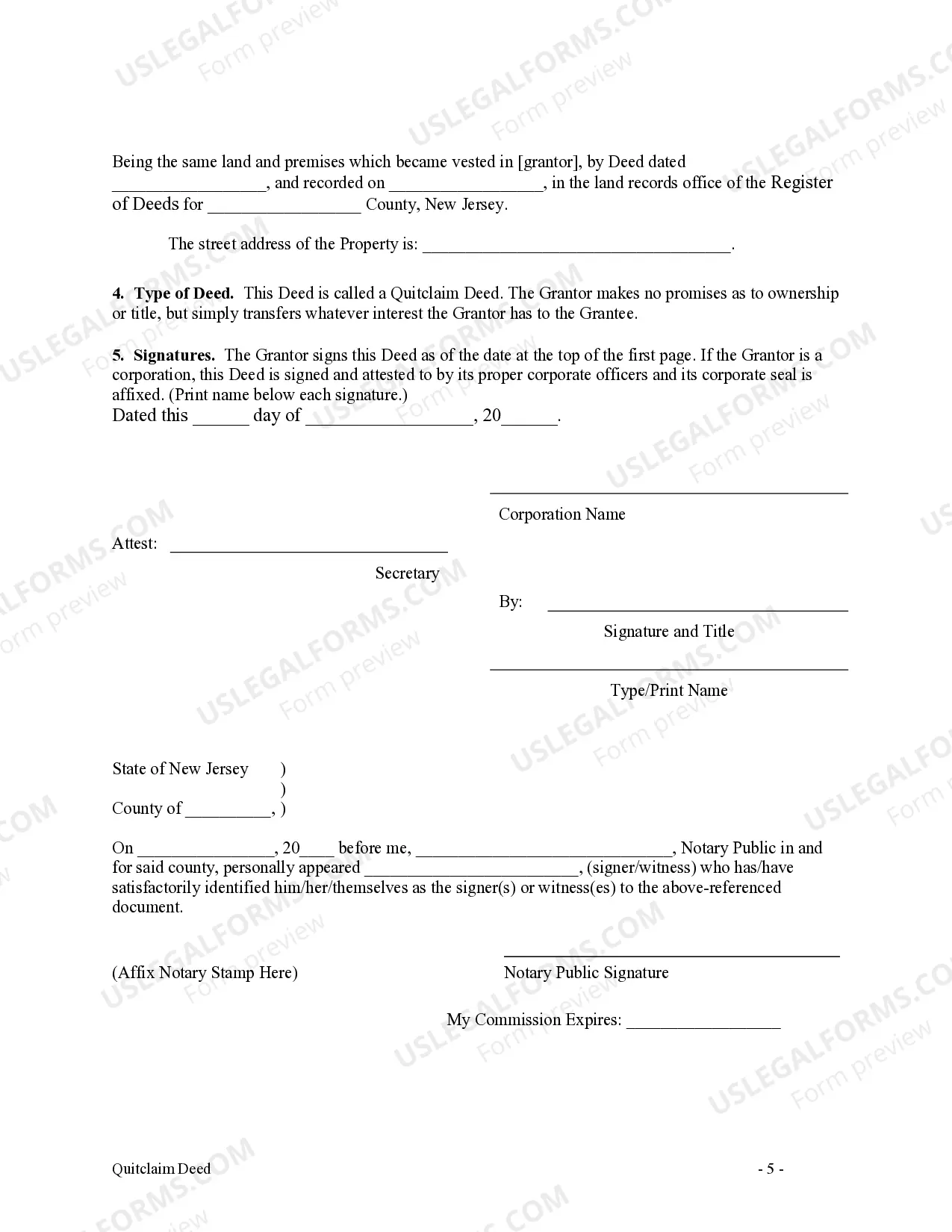
The Quitclaim Deed from Corporation to Individual is a legal document that transfers property ownership from a corporation (the Grantor) to an individual (the Grantee). This type of deed offers no guarantees regarding the title of the property, meaning that the Grantor is only conveying whatever interest they have. Unlike warranty deeds, quitclaim deeds do not assure the Grantee of clear ownership or protection against future claims. This deed is essential when a corporation needs to transfer property to a private individual without affirming the status of the title.
What’s included in this form
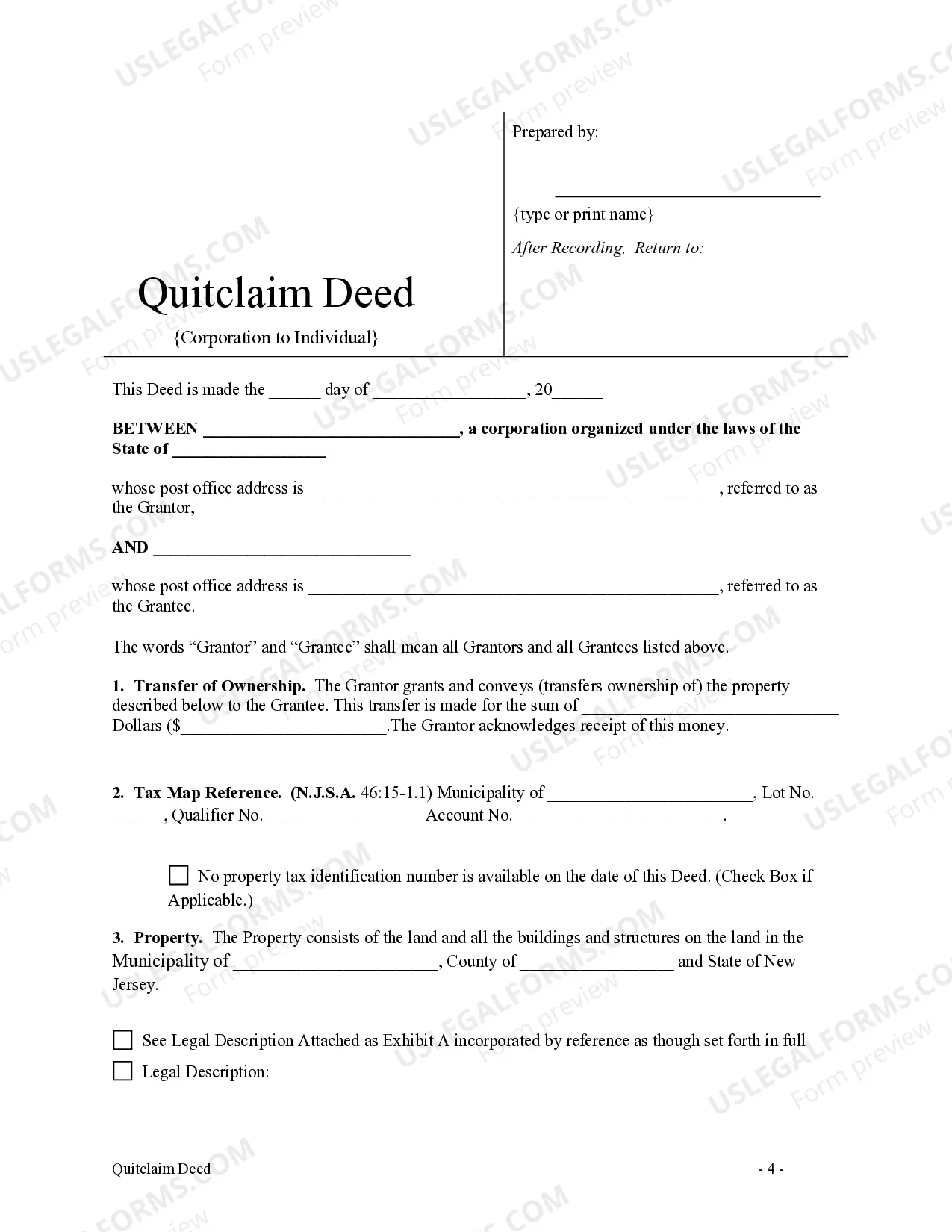
- Identification of the Grantor (Corporation) and Grantee (Individual).
- Transfer of ownership details, including the property description.
- Consideration amount, i.e., the monetary value for the property transfer.
- Legal description of the property, often attached as an exhibit.
- Notations regarding tax map references and account numbers, if applicable.



Situations where this form applies
This form is used when a corporation wishes to transfer property ownership to an individual. Common scenarios include property gifting, business restructurings, or asset transfers where the corporation no longer requires ownership of the property. It is crucial to utilize a quitclaim deed in these situations to ensure proper documentation and clear recording of the transaction.
Who this form is for
- Corporations involved in real estate management or selling assets.
- Individuals receiving property from a corporation.
- Real estate professionals handling corporate property transactions.
How to prepare this document
- Identify the parties involved by filling in the names and addresses of both the Grantor (corporation) and the Grantee (individual).
- Specify the property being transferred by entering the description, tax map information, and street address.
- Enter the consideration amount, or the payment for the property transfer.
- Refer to the legal description attached as Exhibit A to ensure accuracy.
- Sign and date the deed to validate the transfer, ensuring all requisite corporate authority is documented.
Does this document require notarization?
This form must be notarized to be legally valid. US Legal Forms provides secure online notarization powered by Notarize, allowing you to complete the process through a verified video call.
Get your form ready online
Our built-in tools help you complete, sign, share, and store your documents in one place.
Make edits, fill in missing information, and update formatting in US Legal Forms—just like you would in MS Word.
Download a copy, print it, send it by email, or mail it via USPS—whatever works best for your next step.
Sign and collect signatures with our SignNow integration. Send to multiple recipients, set reminders, and more. Go Premium to unlock E-Sign.
If this form requires notarization, complete it online through a secure video call—no need to meet a notary in person or wait for an appointment.
We protect your documents and personal data by following strict security and privacy standards.

Make edits, fill in missing information, and update formatting in US Legal Forms—just like you would in MS Word.

Download a copy, print it, send it by email, or mail it via USPS—whatever works best for your next step.

Sign and collect signatures with our SignNow integration. Send to multiple recipients, set reminders, and more. Go Premium to unlock E-Sign.

If this form requires notarization, complete it online through a secure video call—no need to meet a notary in person or wait for an appointment.

We protect your documents and personal data by following strict security and privacy standards.
Avoid these common issues
- Failing to attach the legal description of the property.
- Not completing the consideration amount or leaving it blank.
- Incorrectly identifying the Grantor or Grantee with inaccurate names.
Why complete this form online
- Convenient access to downloadable forms that save time and reduce paperwork.
- Easily editable fields make it simple to complete accurately.
- Access to forms drafted by licensed attorneys ensures compliance with legal standards.
Summary of main points
- The Quitclaim Deed from Corporation to Individual transfers property ownership without title guarantees.
- It is a useful tool for facilitating uncomplicated property transfers from a corporation to an individual.
- Careful attention must be paid to fill out the details accurately to avoid any legal issues.
Looking for another form?


Form popularity
FAQ
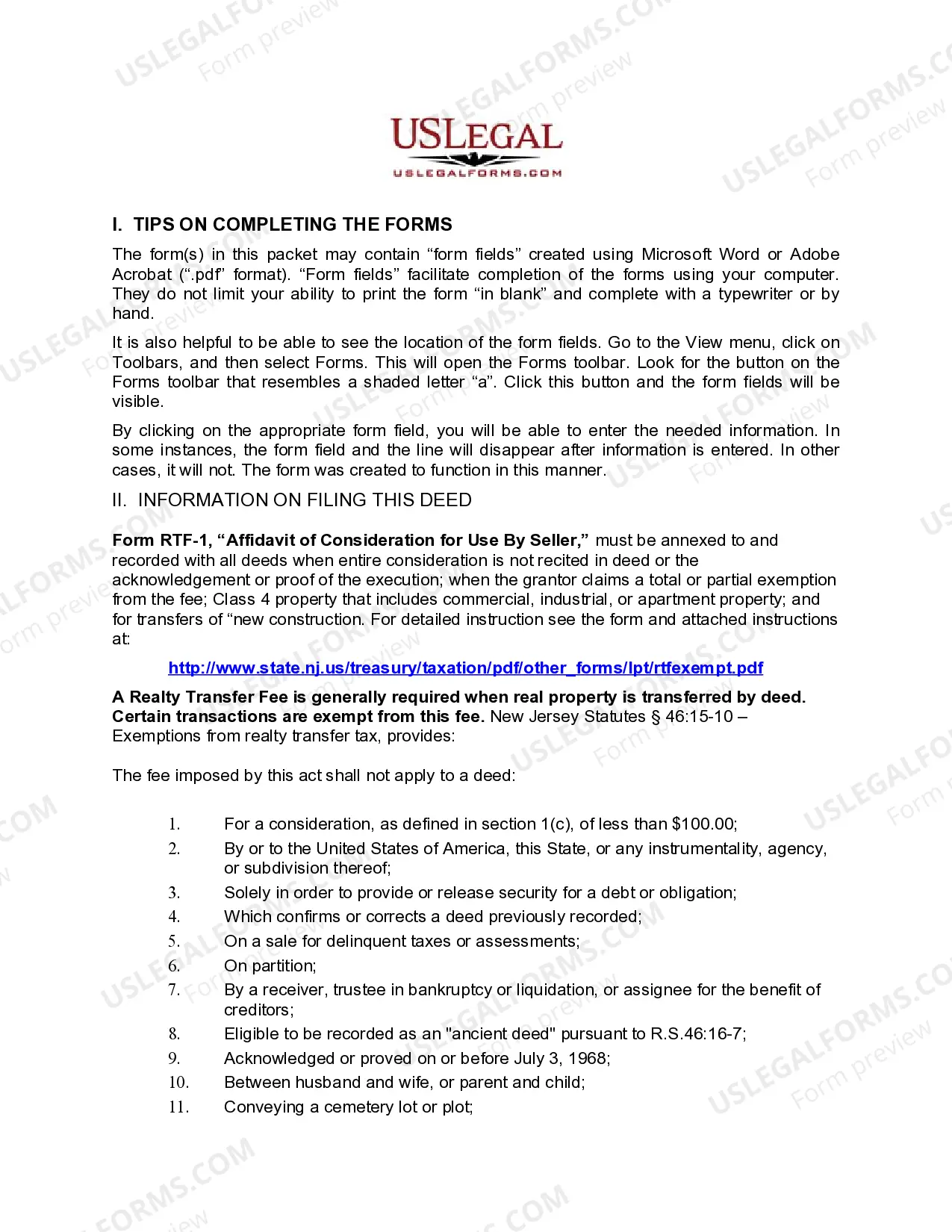
Signing - According to New Jersey law, the quit claim deed must be signed by the seller of the property in the presence of a Notary Public. Recording - All quit claim deeds that have been notarized should be filed with the County Clerk's Office within the jurisdiction that the property falls under.
A New Jersey (NJ) quitclaim deed allows a property owner (or grantor) to release their ownership rights to a purchaser (or grantee).A quitclaim deed is different from a warranty deed, which warrants to the purchaser that the property owner has (and is conveying) legal title to the property.
They are commonly used to add/remove someone to/from real estate title or deed (divorce, name changes, family and trust transfers). The quitclaim deed is a legal document (deed) used to transfer interest in real estate from one person or entity (grantor) to another (grantee).
A Quitclaim Deed must be notarized by a notary public or attorney in order to be valid.Consideration in a Quitclaim Deed is what the Grantee will pay to the Grantor for the interest in the property.
Quitclaim deeds are most often used to transfer property between family members.Examples include when an owner gets married and wants to add a spouse's name to the title or deed, or when the owners divorce and one spouse's name is removed from the title or deed.
But you might be wondering if an owner can transfer a deed to another person without a real estate lawyer. The answer is yes. Parties to a transaction are always free to prepare their own deeds.A quitclaim deed, for example, is far simpler than a warranty deed.
Quitclaim deeds are most often used to transfer property between family members. Examples include when an owner gets married and wants to add a spouse's name to the title or deed, or when the owners get divorced and one spouse's name is removed from the title or deed.
Yes, you can use a Quitclaim Deed to transfer a gift of property to someone. You must still include consideration when filing your Quitclaim Deed with the County Recorder's Office to show that title has been transferred, so you would use $10.00 as the consideration for the property.