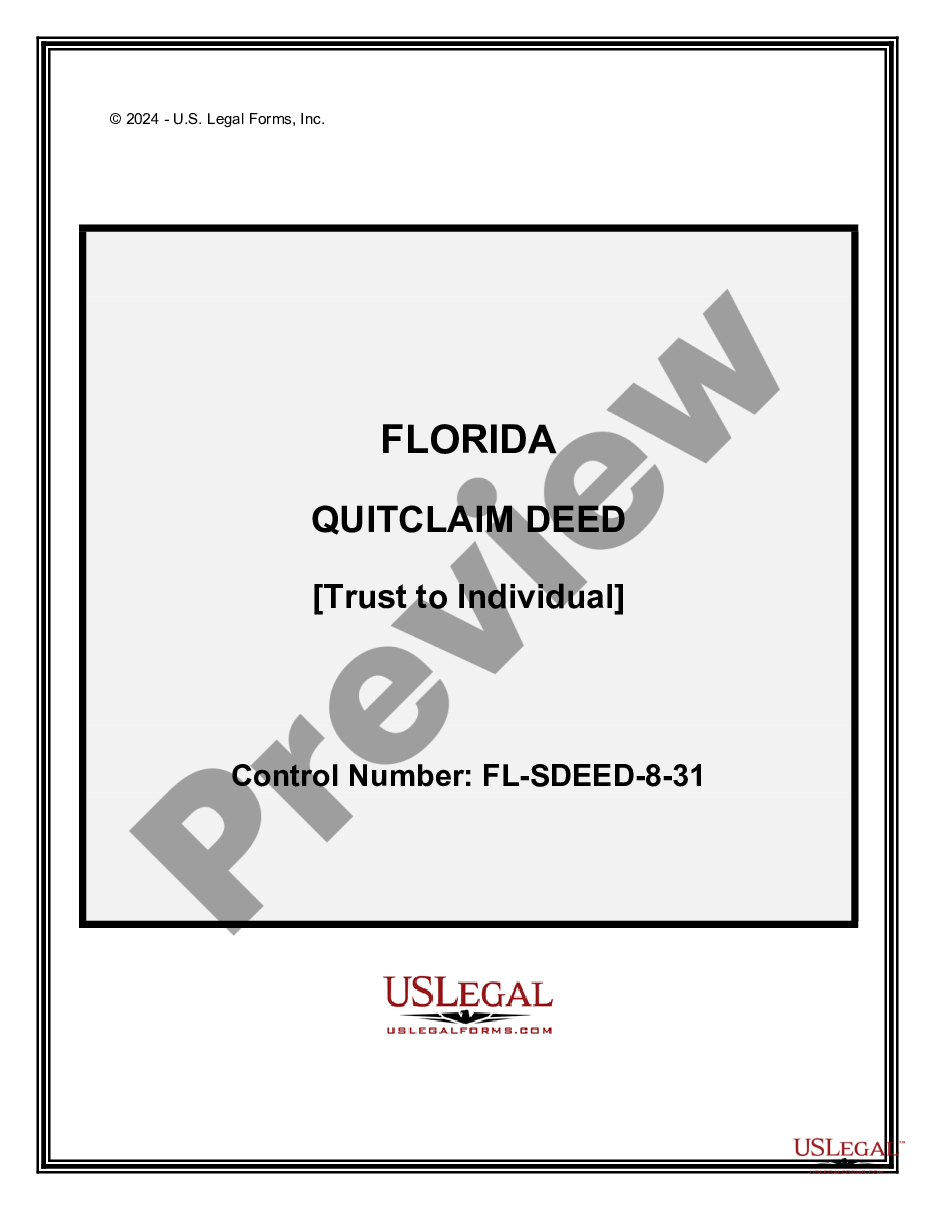
Florida Quitclaim Deed - Trust to Individual
About this form
A Quitclaim Deed - Trust to Individual is a legal document used to transfer property ownership from a trust to a specific individual. Unlike warranty deeds, which provide guarantees regarding the property title, a quitclaim deed simply conveys whatever interest the grantor (the trust) has in the property, if any. This form is particularly useful for changing property ownership while simplifying the legal process involved.
What’s included in this form
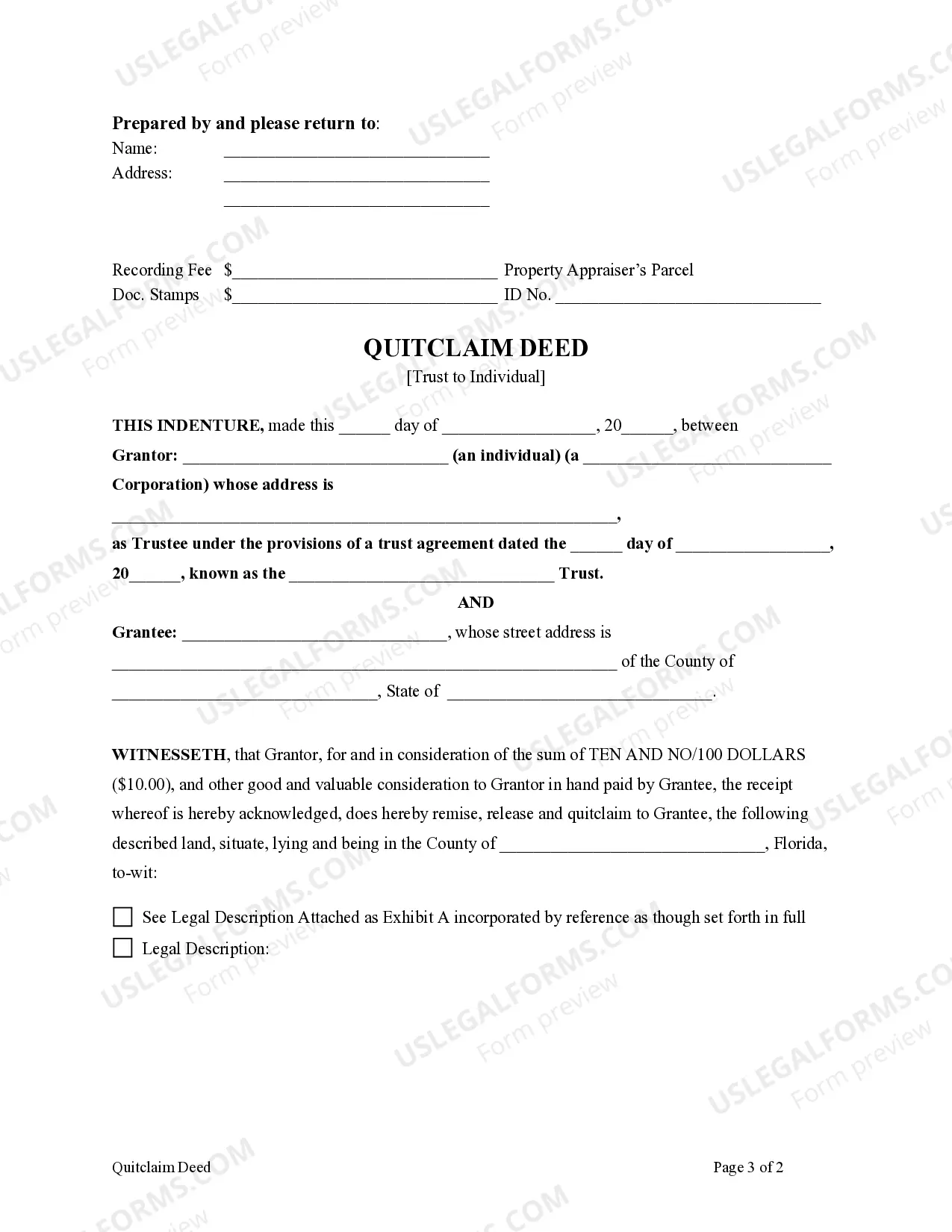
- Grantor's details: Information about the trust transferring the property.
- Grantee's details: Information about the individual receiving the property.
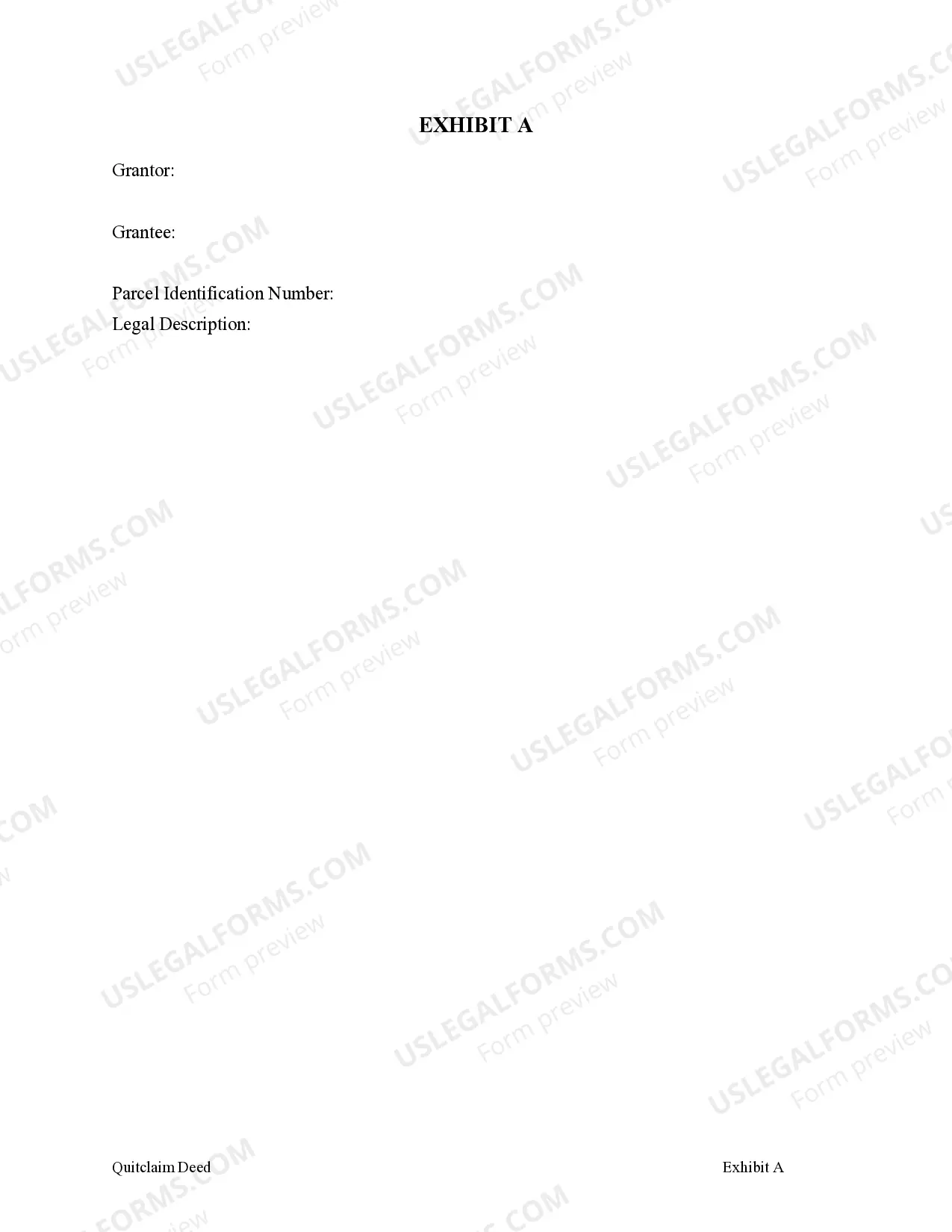
- Legal description: Specific details about the property being transferred.
- Consideration: A statement of the amount paid for the property transfer.
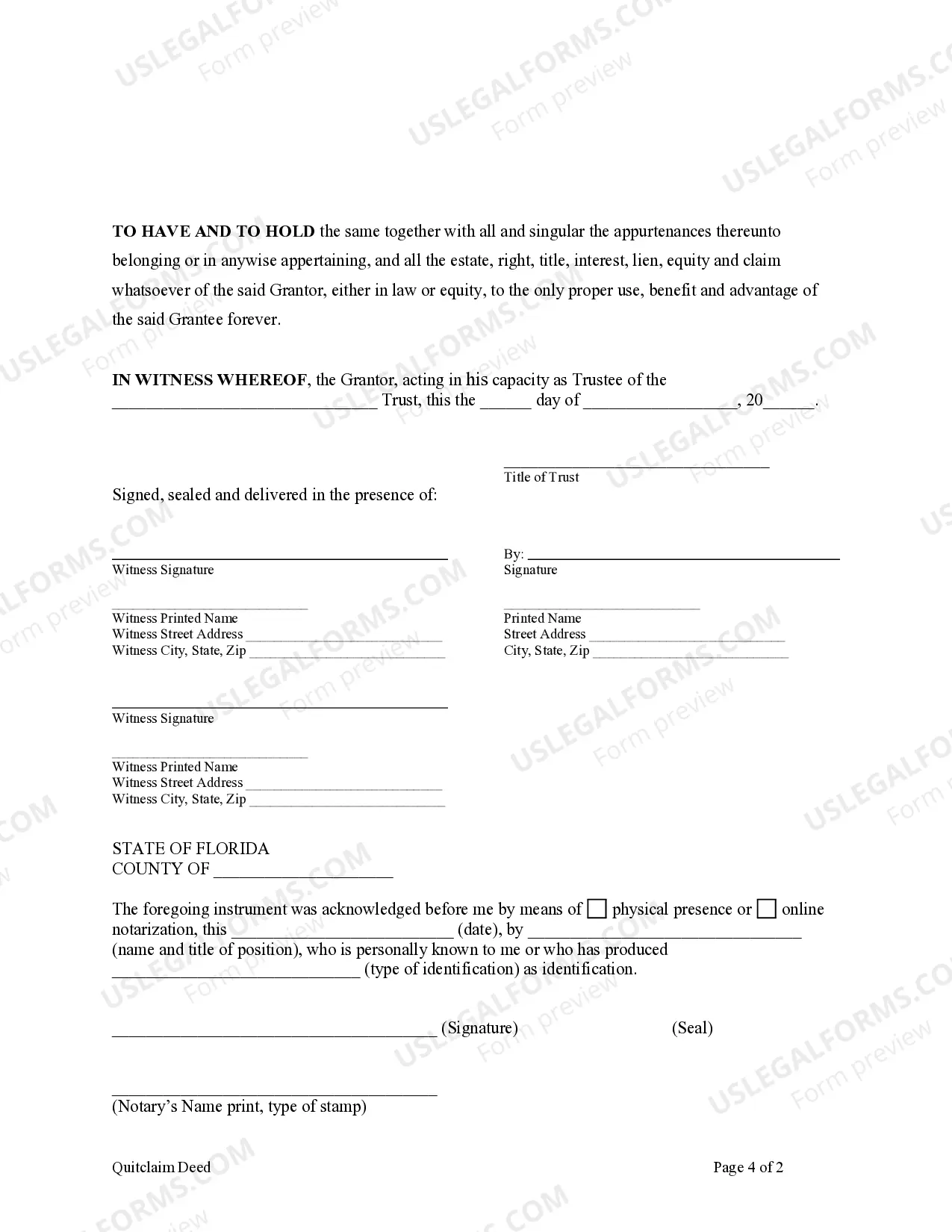
- Signatures: Required signatures of the grantor and witnesses for validation.





When to use this document
This form is typically used when a property owner wishes to transfer ownership from a trust to an individual without the need for a more complex conveyance process. This may occur during estate planning, after the death of the trust's creator, or as part of a property settlement. Using a quitclaim deed simplifies the transfer process and is ideal for situations where there are no disputes regarding ownership.
Intended users of this form
- Individuals involved in transferring property from a trust to themselves or others.
- Trustees acting on behalf of a trust looking to convey property ownership.
- Estate planners seeking to simplify property transitions after a death.
- Legal professionals assisting clients with property transfer matters.
How to complete this form
- Identify the parties: Enter the names and details of both the grantor (the trust) and the grantee (the individual receiving the property).
- Specify the property: Include a legal description of the property being transferred.
- Enter the effective date: Fill in the date on which the transfer is to take effect.
- Include consideration: Write in the amount being exchanged (typically a nominal fee).
- Sign and witness: Both the grantor and witnesses must sign the document to validate the transfer.
- Notarize the document: Ensure the deed is notarized to meet legal requirements in Florida.
Does this document require notarization?
Yes, this form must be notarized to be legally valid. Notarization ensures that the identities of the parties involved are confirmed, and it adds an extra layer of authenticity to the document. US Legal Forms provides an integrated online notarization option, allowing you to securely notarize the document via a video call, 24/7, without the need to travel.
Get your form ready online
Our built-in tools help you complete, sign, share, and store your documents in one place.
Make edits, fill in missing information, and update formatting in US Legal Forms—just like you would in MS Word.
Download a copy, print it, send it by email, or mail it via USPS—whatever works best for your next step.
Sign and collect signatures with our SignNow integration. Send to multiple recipients, set reminders, and more. Go Premium to unlock E-Sign.
If this form requires notarization, complete it online through a secure video call—no need to meet a notary in person or wait for an appointment.
We protect your documents and personal data by following strict security and privacy standards.

Make edits, fill in missing information, and update formatting in US Legal Forms—just like you would in MS Word.

Download a copy, print it, send it by email, or mail it via USPS—whatever works best for your next step.

Sign and collect signatures with our SignNow integration. Send to multiple recipients, set reminders, and more. Go Premium to unlock E-Sign.

If this form requires notarization, complete it online through a secure video call—no need to meet a notary in person or wait for an appointment.

We protect your documents and personal data by following strict security and privacy standards.
Typical mistakes to avoid
- Failing to provide a complete legal description of the property.
- Not including the required signatures from all parties and witnesses.
- Omitting the notarization step, which may invalidate the deed.
- Incorrectly filling in the consideration amount.
Advantages of online completion
- Easy access: Download and fill out the form anytime, without the need for in-person meetings.
- Editability: Customize the form fields on your computer, ensuring all information is accurately captured.
- Reliability: Forms are drafted by licensed attorneys, assuring you of their legality and correctness.
What to keep in mind
- A Quitclaim Deed allows for the transfer of property from a trust to an individual with minimal guarantees.
- It is particularly useful in informal transfers, such as family situations.
- Accuracy in filling out the form is critical to avoid legal complications.
- Notarization is required to ensure the deed's legal validity in Florida.
Looking for another form?
Form popularity
FAQ
Transferring a deed to a trust in Florida involves creating a new deed that names the trust as the owner. You can use a Florida Quitclaim Deed for this purpose, clearly stating that the property is being held in trust. After drafting the deed, make sure to sign it and record it with the appropriate county office to make the transfer legally effective.
In Florida, quitclaim deeds must meet specific legal requirements to be valid. The deed should include the full names of both the grantor and the grantee, describe the property being transferred, and be signed by the grantor. Additionally, it must be notarized and recorded in the county where the property resides to ensure proper legal recording and protection.
To transfer your property to a trust in Florida, you typically need to create a deed that reflects the change in ownership. This process usually involves drafting a new deed, such as a Florida Quitclaim Deed, that specifies the trust as the new owner. It is essential to record the deed with the county clerk's office to make the transfer official and legally binding.
A Florida Quitclaim Deed - Trust to Individual is a legal document that allows a trust to transfer property ownership directly to an individual. This type of deed conveys whatever interest the trust has in the property without making guarantees about clear title. By using a quitclaim deed, the trust can simplify the process of transferring property, making it easier for the individual to take full ownership.
You do not necessarily need a lawyer to complete a quitclaim deed in Florida; however, consulting one can be beneficial if you have questions about the process or your specific situation. Many individuals successfully prepare their own Florida Quitclaim Deed - Trust to Individual using templates and resources like uslegalforms. If you're confident in your understanding of the process, you can proceed without legal assistance.
Filling out the quitclaim deed form requires careful attention to detail. First, ensure it includes the names of the trust and the individual, a detailed legal description of the property, and the signatures of all parties involved. By using uslegalforms, you can access straightforward instructions and templates that guide you through the process step-by-step, ensuring your Florida Quitclaim Deed - Trust to Individual is completed correctly.
Yes, you can prepare your own quitclaim deed in Florida, provided you follow the state's guidelines. Using an online platform like uslegalforms can simplify this process, as it offers templates and instructions tailored for the Florida Quitclaim Deed - Trust to Individual. By preparing your own deed, you save on legal fees, but ensure you understand the requirements to avoid issues later.
An example of a quitclaim deed would be a situation where a parent transfers their ownership interest in a family home to their child. In this case, the parent signs a Florida Quitclaim Deed - Trust to Individual, relinquishing their rights to the property without making any guarantees about its title. This type of deed is often used for informal transactions, making it essential for parties to trust each other.
To fill out a Florida quitclaim deed, start by obtaining the correct form, which is available online or at your local county office. You will need to include the names of both the trust and the individual receiving the property, along with a description of the property. After filling out the necessary details, ensure it is signed and notarized to make it legally binding. Properly completing the Florida Quitclaim Deed - Trust to Individual is essential for a smooth transfer.
A Florida Quitclaim Deed - Trust to Individual cannot be used to settle disputes over ownership or to encumber property. It also should not be used when there are existing liens on the property or when transferring property rights in complicated arrangements, such as during divorce. If you’re uncertain about whether a quitclaim deed is appropriate for your situation, consulting legal resources or the US Legal Forms platform can provide clarity.