New Hampshire Warranty Deed from Husband and Wife to Corporation
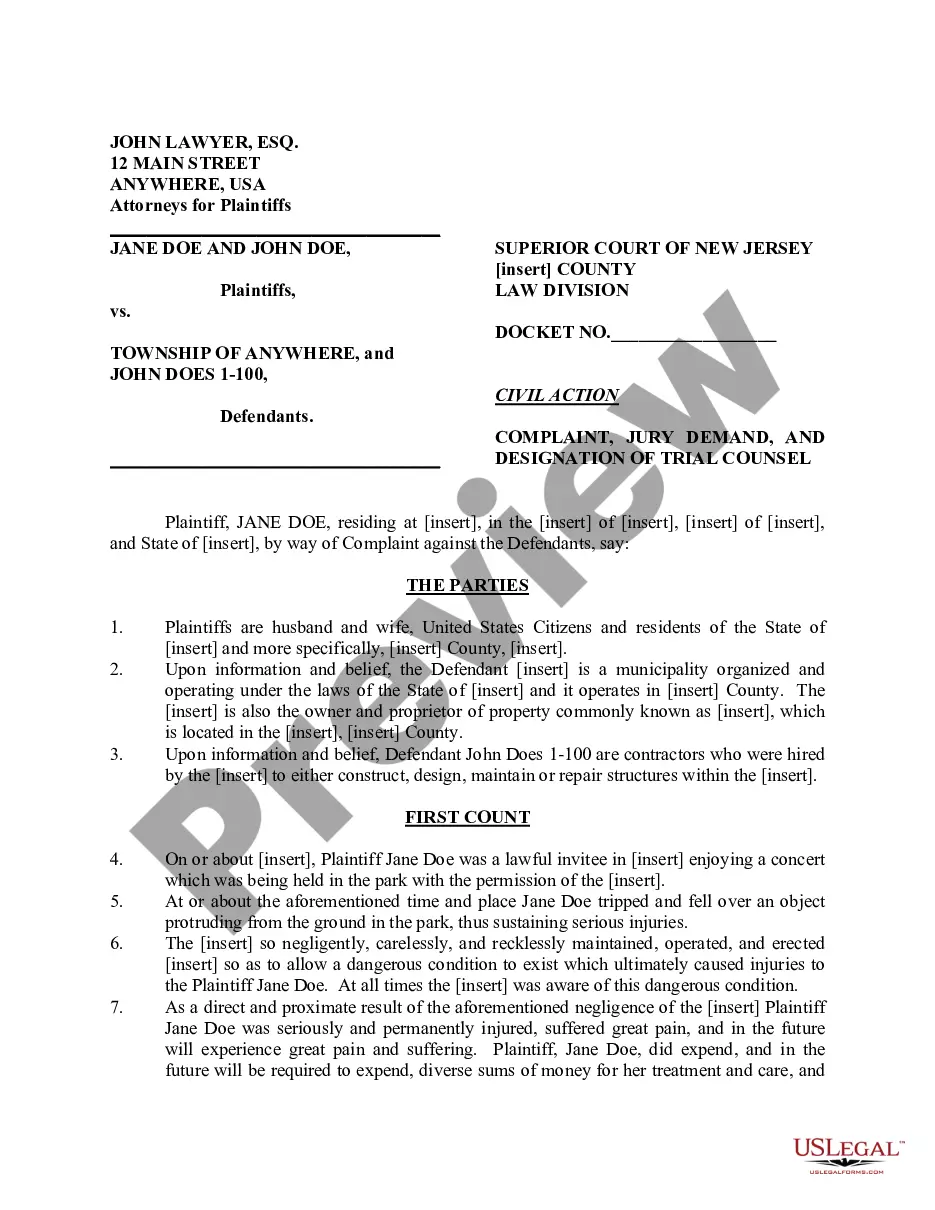
About this form
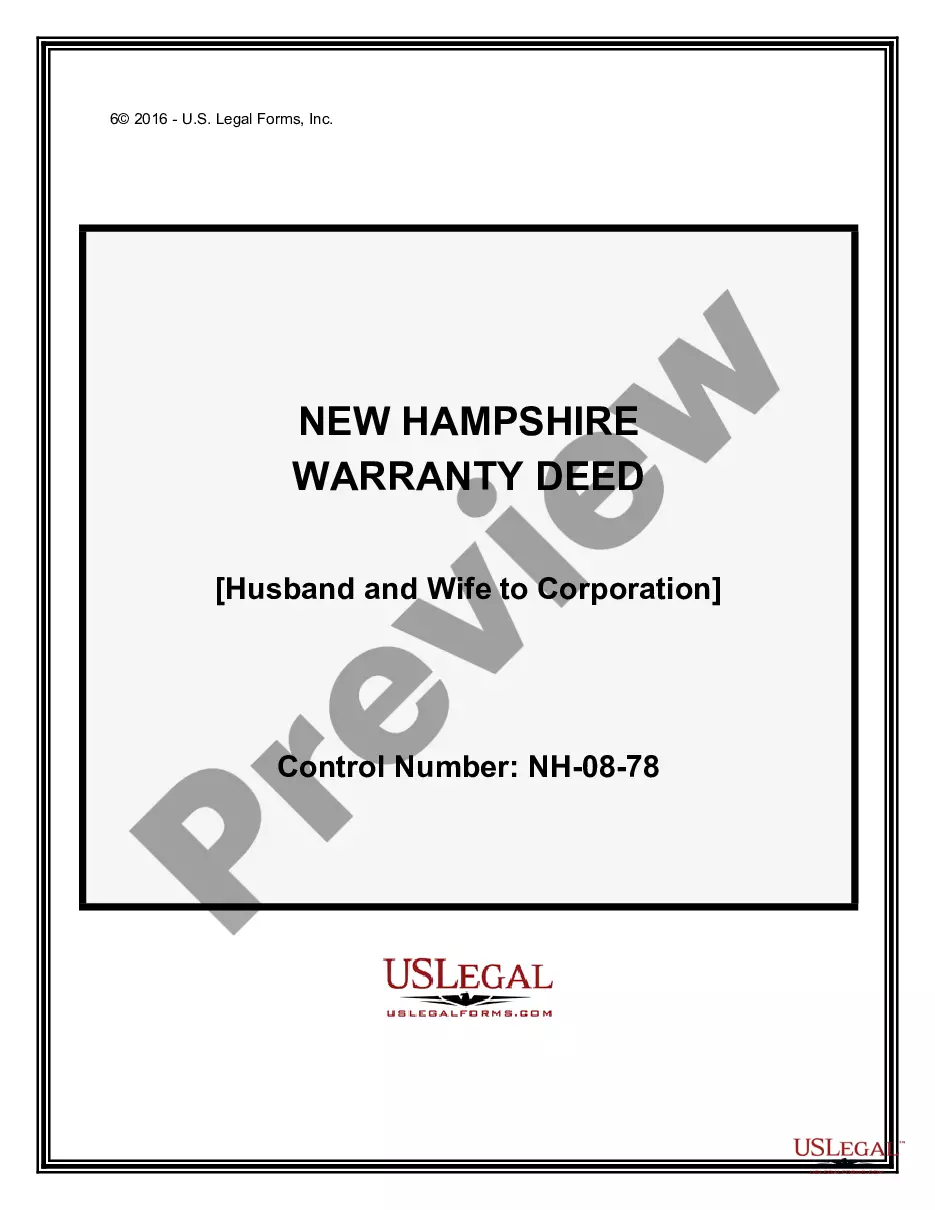
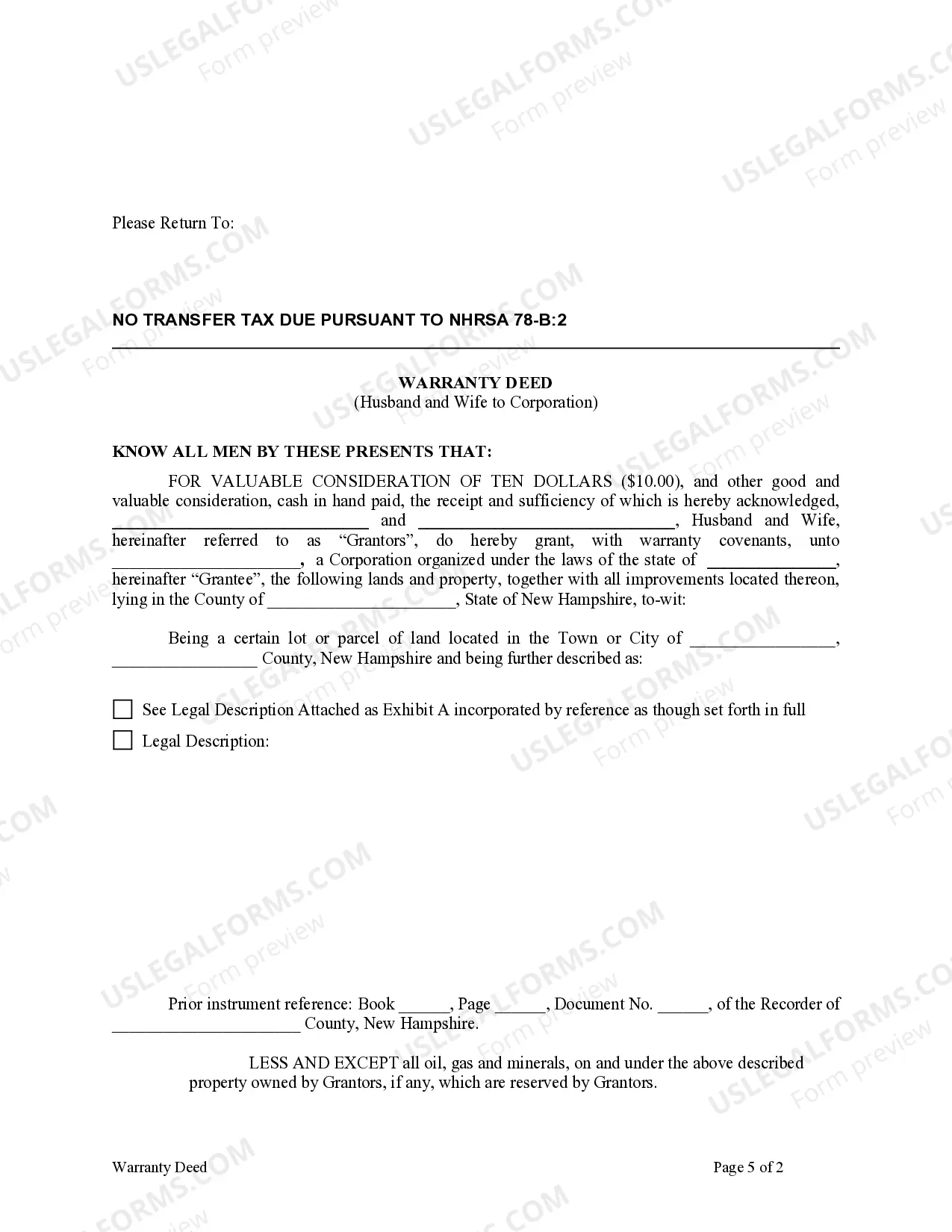
The Warranty Deed from Husband and Wife to Corporation is a legal document used to transfer ownership of property from a married couple to a corporation. This form legally conveys the title of the property while reserving rights to any oil, gas, and minerals beneath the land. This deed differs from other types of deeds in that it specifically involves both spouses as grantors and a corporate entity as the grantee.
Key parts of this document
- Identification of the grantors (husband and wife) and the grantee (corporation).
- Legal description of the property being transferred.
- Clauses outlining the reservation of oil, gas, and mineral rights.
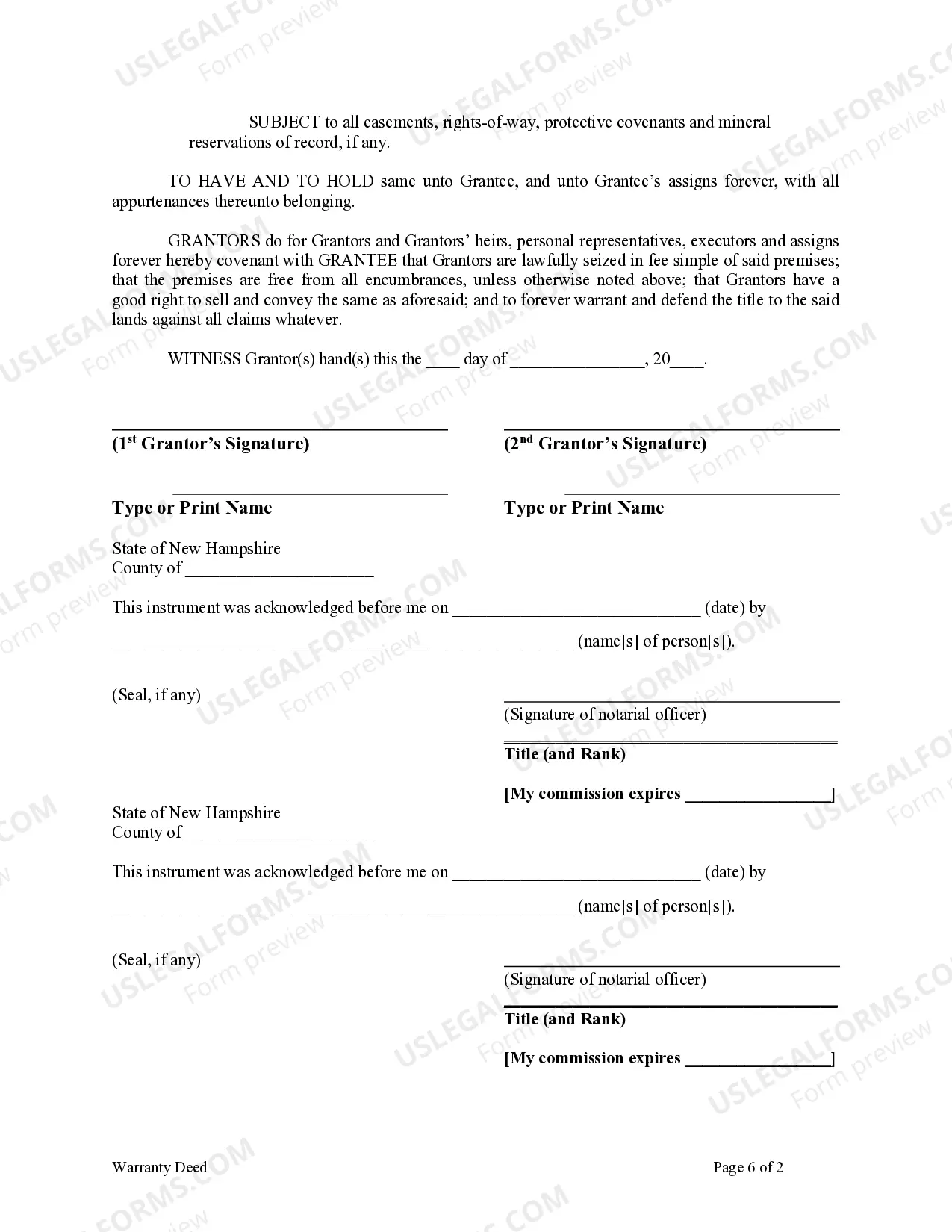
- Covenant of warranty guaranteeing the title is clear of encumbrances, unless stated otherwise.
- Signature lines for both grantors and a notary acknowledgment section.





When this form is needed
This form is necessary when a husband and wife wish to transfer ownership of real estate to a corporation. This scenario may arise during business developments, asset restructuring, or estate planning, ensuring that the couple maintains their rights to any subsurface resources while transferring ownership of the surface land.
Who this form is for
- Married couples transferring property to a corporation.
- Corporations acquiring real estate from individual spouses.
- Legal representatives handling property transactions for couples.
How to prepare this document
- Identify the property by providing its full legal description.
- List both grantors' names (husband and wife) and the corporation's name as the grantee.
- Specify any reservations regarding oil, gas, and mineral rights.
- Sign the document in the presence of a notary public.
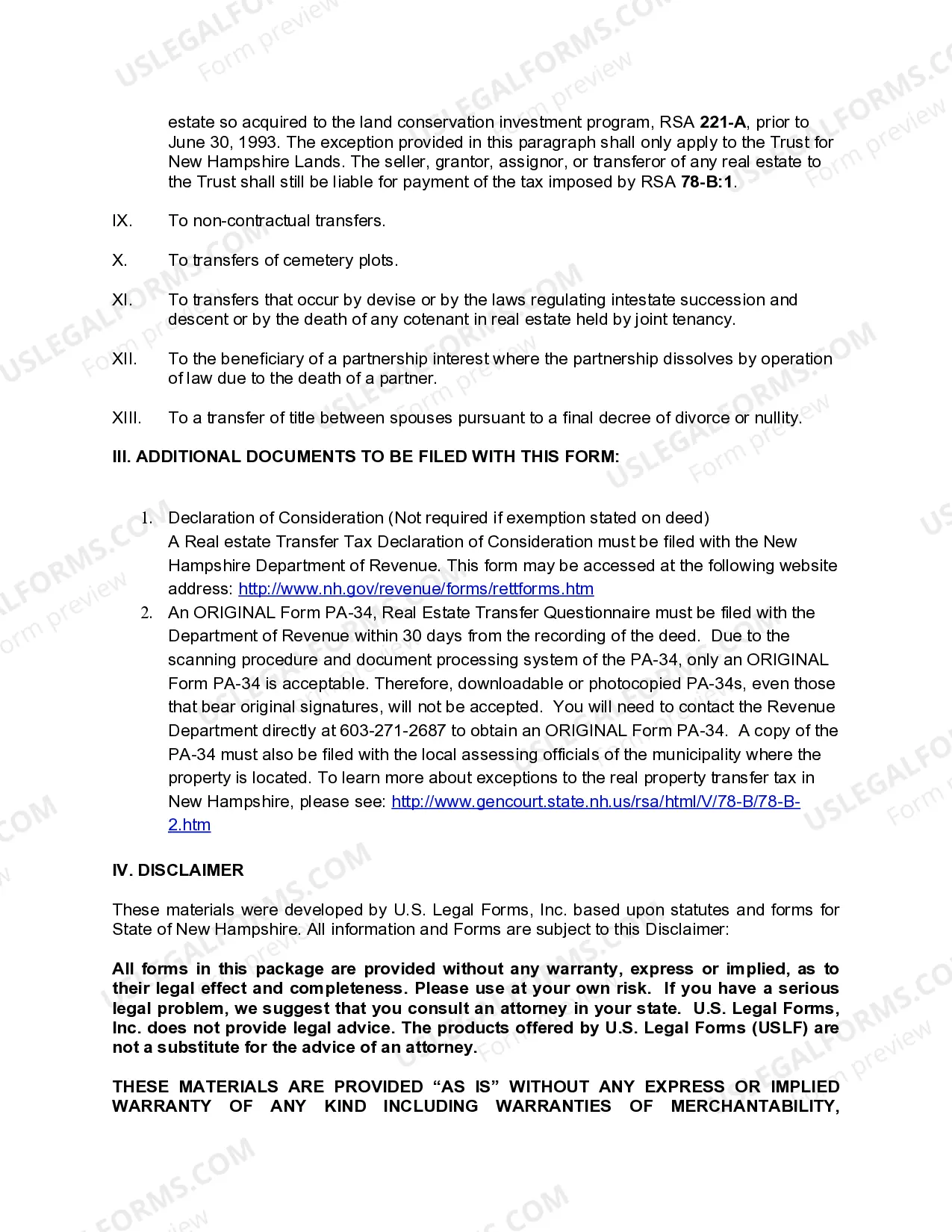
- File the necessary supporting documents with the New Hampshire Department of Revenue.
Is notarization required?
This document requires notarization to meet legal standards. US Legal Forms provides secure online notarization powered by Notarize, allowing you to complete the process through a verified video call, available 24/7.
Get your form ready online
Our built-in tools help you complete, sign, share, and store your documents in one place.
Make edits, fill in missing information, and update formatting in US Legal Forms—just like you would in MS Word.
Download a copy, print it, send it by email, or mail it via USPS—whatever works best for your next step.
Sign and collect signatures with our SignNow integration. Send to multiple recipients, set reminders, and more. Go Premium to unlock E-Sign.
If this form requires notarization, complete it online through a secure video call—no need to meet a notary in person or wait for an appointment.
We protect your documents and personal data by following strict security and privacy standards.

Make edits, fill in missing information, and update formatting in US Legal Forms—just like you would in MS Word.

Download a copy, print it, send it by email, or mail it via USPS—whatever works best for your next step.

Sign and collect signatures with our SignNow integration. Send to multiple recipients, set reminders, and more. Go Premium to unlock E-Sign.

If this form requires notarization, complete it online through a secure video call—no need to meet a notary in person or wait for an appointment.

We protect your documents and personal data by following strict security and privacy standards.
Typical mistakes to avoid
- Failing to include a detailed legal description of the property.
- Not notarizing the deed, which is essential for validity.
- Overlooking the reservation clause regarding oil, gas, and minerals.
- Not filing the Declaration of Consideration with the form.
Benefits of completing this form online
- Instant access to a professionally drafted legal document.
- Edit and complete the form conveniently on your computer.
- Reduce the risk of errors with built-in form fields for easy completion.
- Secure downloading and storage of your legal documents.
Main things to remember
- This Warranty Deed is specifically designed for transferring property from a married couple to a corporation.
- Legal validity requires both signatures and notarization.
- Failure to include important details like the legal description or mineral reservations can lead to complications.
Looking for another form?
Form popularity
FAQ
Let's start with the definition of a deed: DEED: A written instrument by which one party, the Grantor, conveys the title of ownership in property to another party, the Grantee. A Warranty Deed contains promises, called covenants, that the Grantor makes to the Grantee.
Signing - According to New Hampshire Law (§ 477:3) the Grantor must sign the quit claim deed in the presence of a Notary Public. Recording - Once notarized, the quit claim deed must be filed with the County Recorder's Office in the city or county where the property is located.
Failure to record a deed effectively makes it impossible for the public to know about the transfer of a property. That means the legal owner of the property appears to be someone other than the buyer, a situation that can generate serious ramifications.
Contrary to normal expectations, the Deed DOES NOT have to be recorded to be effective or to show delivery, and because of that, the Deed DOES NOT have to be signed in front of a Notary Public. However, if you plan to record it, then it does have to be notarized as that is a County Recorder requirement.
A warranty deed guarantees that: The grantor is the rightful owner of the property and has the legal right to transfer the title.The title would withstand third-party claims to ownership of the property. The grantor will do anything to ensure the grantee's title to the property.
It's important to note that a warranty deed does not actually prove the grantor has ownership (a title search is the best way to prove that), but it is a promise by the grantor that they are transferring ownership and if it turns out they don't actually own the property, the grantor will be responsible for compensating
The requirements for a valid deed are a grantor, a grantee, a writing and subscription, delivery, and acceptance.Thus, an unrecorded deed is valid as between the parties and as to all those who have notice thereof. (Cal.
Both the warranty deed and deed of trust are recorded with the county clerk or recorder. Generally, the lender sends the documents to be recorded after the closing.The original warranty deeds are often mailed to the grantee after they are recorded.