Nebraska Letter from Tenant to Landlord containing Notice that premises in uninhabitable in violation of law and demand immediate repair
Overview of this form
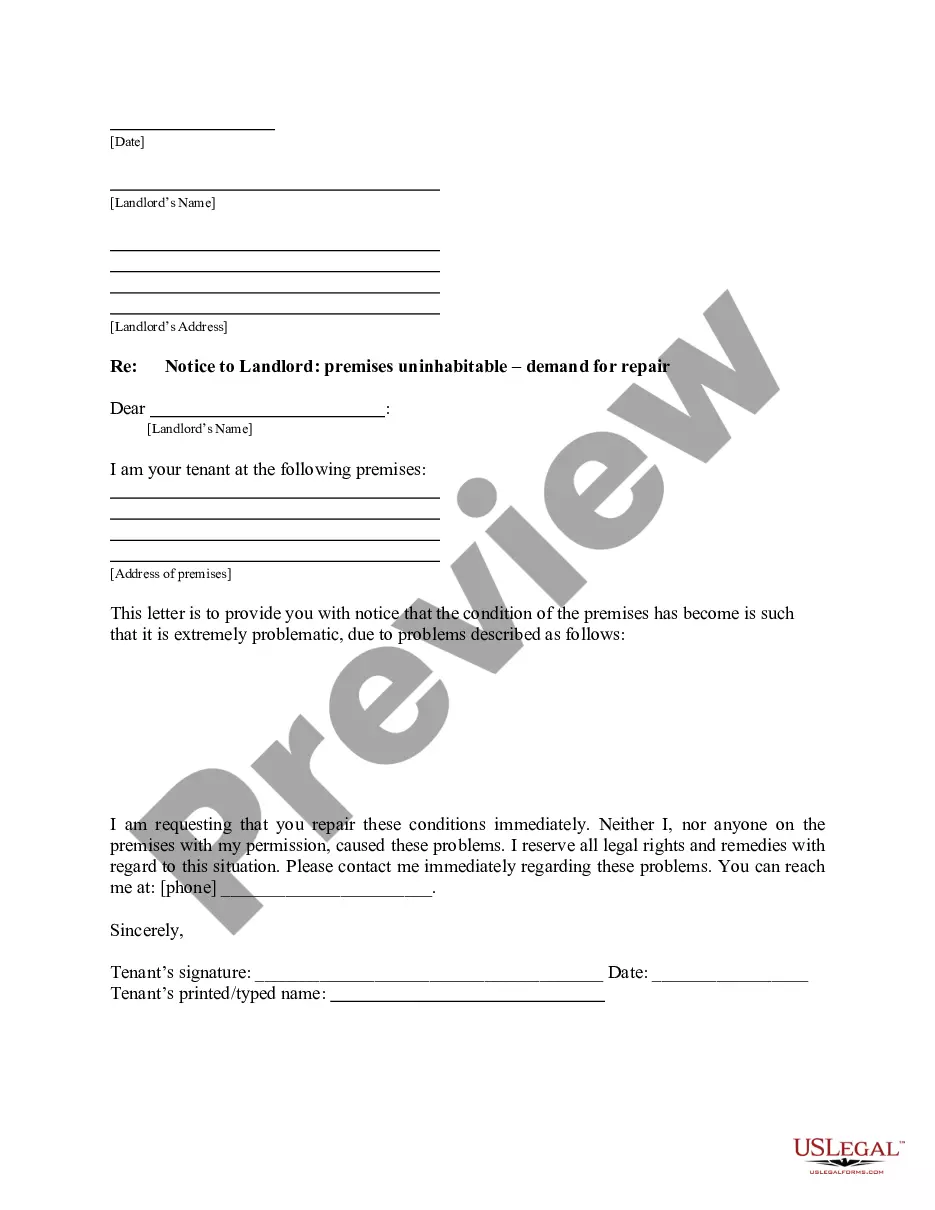
This letter is used by a tenant to formally notify the landlord that the rental property is uninhabitable, which is a violation of applicable laws. The Letter from Tenant to Landlord also includes a demand for immediate repairs. If the landlord fails to make the necessary repairs, the tenant may have legal grounds to terminate the lease or reduce rent payments. This form serves a critical purpose in ensuring tenants have a clear, documented way to address hazardous or unsuitable living conditions.
Main sections of this form
- Tenant's name and contact information
- Landlord's name and contact information
- A detailed description of the uninhabitable conditions
- A demand for immediate repair or action
- Signature lines for the tenant and date


When this form is needed
This form should be used when a tenant has identified serious issues in their rental unit that make it uninhabitable. Examples include problems such as significant leaks, infestations, lack of heat, or violations of safety codes. It is important to use this form as a first step in addressing these issues formally with the landlord.
Who can use this document
This form is intended for:
- Residential tenants experiencing uninhabitable conditions in their rental properties
- Tenants who wish to document their communication with the landlord
- Individuals considering lease termination or rent reduction due to property issues
Completing this form step by step
- Provide your name and contact information at the beginning of the form.
- Enter the landlord's name and their contact information.
- Clearly describe the issues in the rental property that make it uninhabitable.
- Make a direct demand for the landlord to take immediate action to remedy the situation.
- Sign and date the letter to formalize your request.
Does this form need to be notarized?
This form does not typically require notarization unless specified by local law. However, having it notarized may lend additional credibility to the communication.
Get your form ready online
Our built-in tools help you complete, sign, share, and store your documents in one place.
Make edits, fill in missing information, and update formatting in US Legal Forms—just like you would in MS Word.
Download a copy, print it, send it by email, or mail it via USPS—whatever works best for your next step.
Sign and collect signatures with our SignNow integration. Send to multiple recipients, set reminders, and more. Go Premium to unlock E-Sign.
If this form requires notarization, complete it online through a secure video call—no need to meet a notary in person or wait for an appointment.
We protect your documents and personal data by following strict security and privacy standards.

Make edits, fill in missing information, and update formatting in US Legal Forms—just like you would in MS Word.

Download a copy, print it, send it by email, or mail it via USPS—whatever works best for your next step.

Sign and collect signatures with our SignNow integration. Send to multiple recipients, set reminders, and more. Go Premium to unlock E-Sign.

If this form requires notarization, complete it online through a secure video call—no need to meet a notary in person or wait for an appointment.

We protect your documents and personal data by following strict security and privacy standards.
Common mistakes to avoid
- Failing to provide specific details about the issues in the property.
- Not including contact information for both the tenant and the landlord.
- Neglecting to sign and date the letter.
- Using vague language that does not clearly outline the demands.
Why complete this form online
- Convenient access to the form for immediate completion and delivery.
- Editability allows for customization to match specific circumstances.
- Provides a reliable source of documentation for future reference.
- Using this letter establishes a formal record of the complaint, which may be useful in future legal proceedings.
- This form emphasizes the tenant's rights and obligations under state law regarding repairs and habitability.
Main things to remember
- This form allows tenants to formally notify their landlords of uninhabitable conditions.
- It serves as a document for potential future legal actions if repairs are not made.
- Completing and sending the form correctly is crucial for protecting tenant rights.
Looking for another form?
Form popularity
FAQ
Filing a complaint with state or local health or building inspectors (who may fine a landlord who fails to correct the problem within a set amount of time, or actually condemn the property in severe cases) suing the landlord for the difference between the monthly rent and the value of the unit with defects, or.
You can file a lawsuit for negligence against the manager of a real estate property in the same way you can sue the owner of any type of business. Generally speaking, with certain exceptions, filing a lawsuit for negligence against a property manager is a straightforward process.
Know your state's landlord/tenant laws. Read and respond to the court summons. Try to work out a settlement. Consider legal counsel. Show up for court. Look sharp and provide evidence.
If you're seeking damages for emotional distress caused by a landlord's discrimination, or punitive damages for especially blatant and intentional discrimination, a lawsuit may well be your best bet. Understand what's involved in suing your landlord. You may file a lawsuit in either federal or state court.
The 14-day/30-day notice must say how the tenant is breaching the lease and that the lease will automatically terminate 30 days (or more) from the date of the notice unless the tenant fixes the problem within 14 days of the date of the notice.
Uninhabitable conditions can include dangerous ones, such as holes in the floor, unsafe or exposed wiring, or non-working air conditioning in dangerously hot summer months. Gross infestations of roaches, fleas or other pests are also uninhabitable conditions.
What is the Law? In California, there is no legal definition for unsafe living conditions. Generally, the rule of thumb is that if your living environment affects your health or safety, then it can be considered an unsafe living condition.
The landlord had a duty to reasonably maintain the property; The landlord knew or should have known of the dangerous condition; The landlord breached their duty by failing to repair/fix the dangerous condition;
When a tenant damages property eviction is a legal recourse. You'll want to make sure you follow the proper eviction steps which include serving a proper eviction notice. If a tenant is severely damaging a rental property they are violating the lease and may be evicted for this infraction.