North Carolina General Warranty Deed from Corporation to Two Individuals
Understanding this form
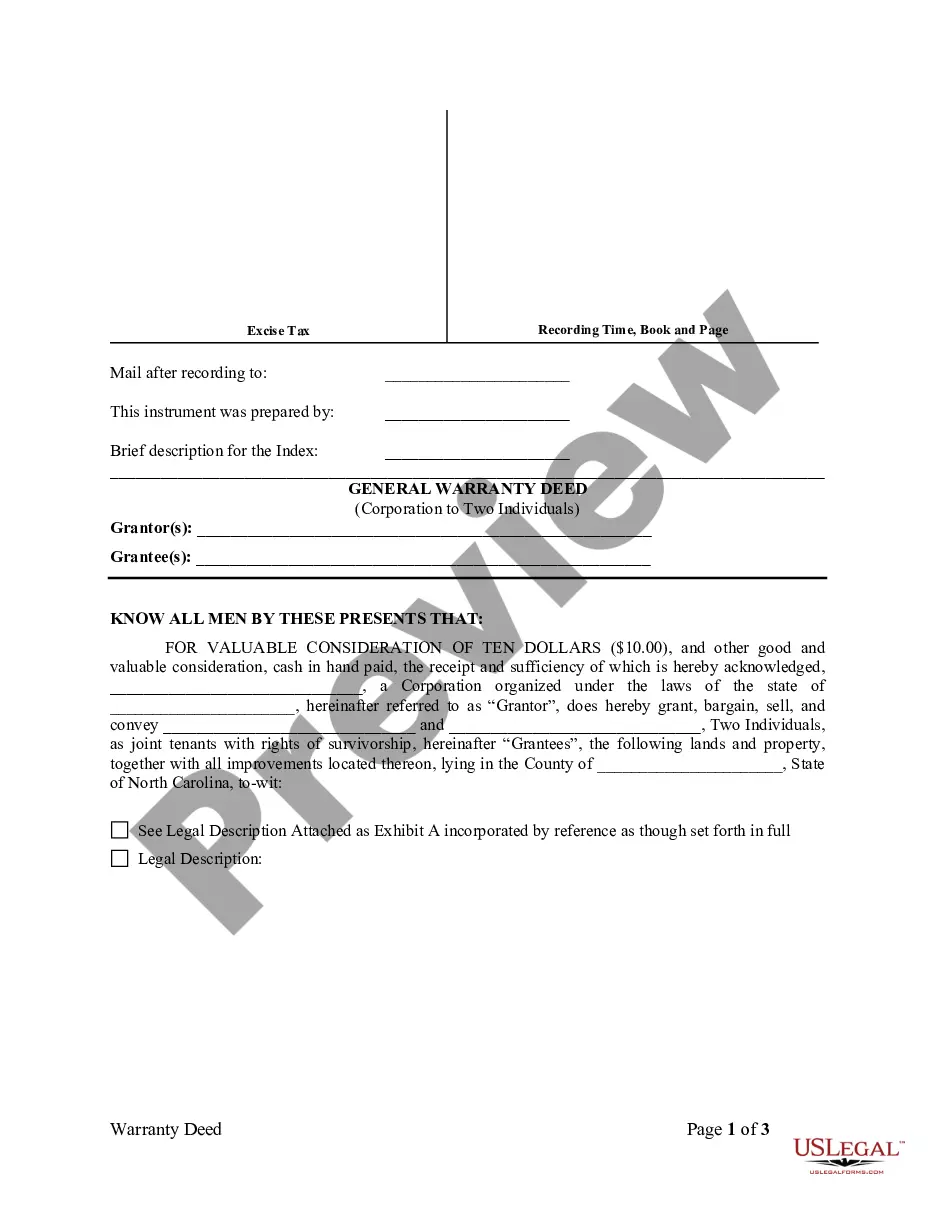
The General Warranty Deed from Corporation to Two Individuals is a legal document used to transfer property ownership from a corporation to two individual parties. This form ensures that the property is conveyed along with a guarantee of title, meaning the corporation is asserting it has full ownership and the right to sell the property without any undisclosed encumbrances. Unlike other deeds, this warranty deed provides comprehensive assurances regarding the quality of the title being conveyed, making it a more secure option for the grantees.
What’s included in this form
- Grantor and grantee identification: Details about the corporation and the two individual grantees.
- Property description: A clear description of the property being transferred.
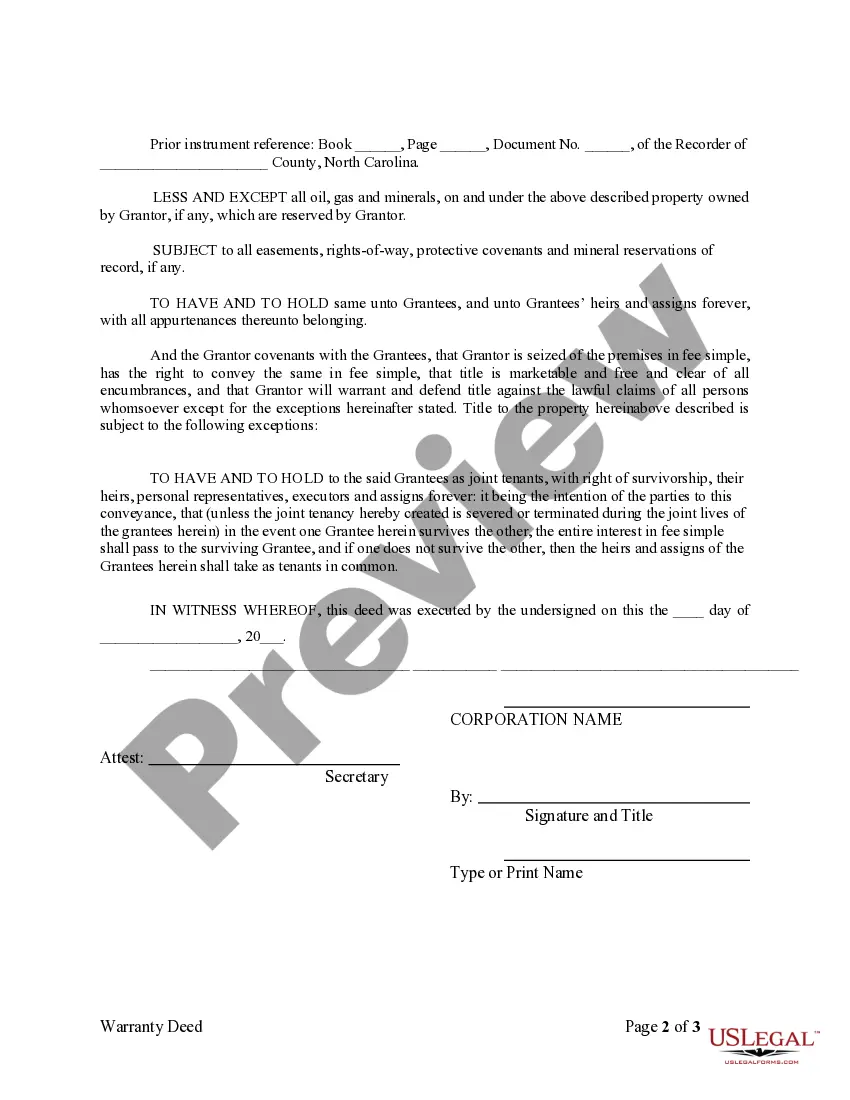
- Warranties by the grantor: Assurances regarding ownership and the absence of legal claims against the property.
- Rights of survivorship: Specifies how the property will be handled in the event of the death of one grantee.
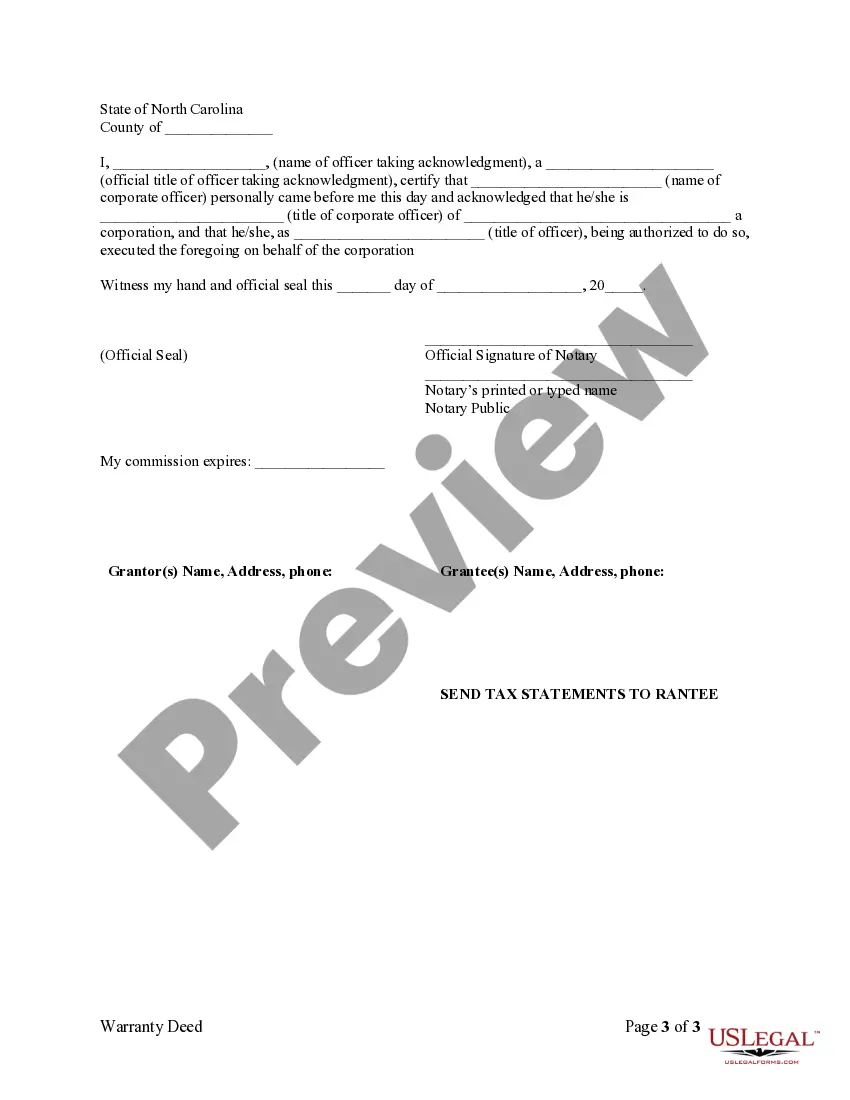
- Notarization section: A space for the notary public to provide verification of signatures.




Situations where this form applies
This deed is used when a corporation wishes to transfer property ownership to two individuals. It is appropriate when both parties want to ensure their rights to the property, particularly when they intend to hold it as joint tenants with rights of survivorship. It is most commonly used in real estate transactions involving corporate entities, such as business property transfers or asset liquidation.
Who can use this document
- Corporations looking to convey property ownership to individuals.
- Individuals receiving property from a corporation.
- Legal professionals assisting clients in real estate transactions involving corporations.
- Those involved in estate planning where corporate-held property is distributed among joint heirs.
Instructions for completing this form
- Identify the parties: Fill in the names of the corporation (grantor) and the two individuals (grantees).
- Specify the property: Provide a detailed description of the property being conveyed, typically attached as an exhibit.
- Outline the consideration: State the amount of consideration exchanged for the property.
- Define the rights of survivorship: Indicate that the grantees will hold the property as joint tenants with rights of survivorship.
- Complete the notarization section: Ensure an official notarizes the deed after all signatures are obtained.
Does this document require notarization?
Yes, this form must be notarized to be legally valid. It is important to have the deed witnessed by a notary public, confirming the identities of the parties involved and the authenticity of the signatures. US Legal Forms offers integrated online notarization, providing secure and convenient video calls for the notarization process.
Get your form ready online
Our built-in tools help you complete, sign, share, and store your documents in one place.
Make edits, fill in missing information, and update formatting in US Legal Forms—just like you would in MS Word.
Download a copy, print it, send it by email, or mail it via USPS—whatever works best for your next step.
Sign and collect signatures with our SignNow integration. Send to multiple recipients, set reminders, and more. Go Premium to unlock E-Sign.
If this form requires notarization, complete it online through a secure video call—no need to meet a notary in person or wait for an appointment.
We protect your documents and personal data by following strict security and privacy standards.

Make edits, fill in missing information, and update formatting in US Legal Forms—just like you would in MS Word.

Download a copy, print it, send it by email, or mail it via USPS—whatever works best for your next step.

Sign and collect signatures with our SignNow integration. Send to multiple recipients, set reminders, and more. Go Premium to unlock E-Sign.

If this form requires notarization, complete it online through a secure video call—no need to meet a notary in person or wait for an appointment.

We protect your documents and personal data by following strict security and privacy standards.
Mistakes to watch out for
- Not providing a complete and accurate property description, which can lead to legal disputes.
- Failing to ensure both grantees understand their rights under joint tenancy.
- Omitting required signatures or notarization, rendering the deed invalid.
- Incorrectly stating the consideration value that may affect the validity of the deed.
Benefits of using this form online
- Convenience of completing the form from any location at any time.
- Editable fields allow for easy customization before finalizing the document.
- Access to templates drafted by licensed attorneys, ensuring legal compliance.
- Saves time and reduces the need for in-person legal consultations.
Looking for another form?


Form popularity
FAQ
To transfer ownership of land in North Carolina, the owner must execute and file a new deed with the register of deeds for the North Carolina county where the property is located.
Under the Grantor section of the deed, write the name of the person transferring title. Under Grantee, write the name of the person receiving title. Describe the parcel of land. Use the street address and include the North Carolina County where the land is located.
The North Carolina general warranty deed is used to transfer property in North Carolina from one person to another legally. A warranty deed comes with a guarantee from the seller that the property has clear title.
A special warranty deed to real estate offers protection to the buyer through the seller's guarantee that the title has been free and clear of encumbrances during their ownership of the property. It does not guarantee clear title beyond their ownership.
They are (1) covenant for seisin; (2) covenant of the right to convey; (3) covenant against encumbrances; (4) covenant for QUIET ENJOYMENT; (5) covenant of general WARRANTY; and (6) covenant for further assurances.
A warranty deed, also known as a general warranty deed, is a legal real estate document between the seller (grantor) and the buyer (grantee). The deed protects the buyer by pledging that the seller holds clear title to the property and there are no encumbrances, outstanding liens, or mortgages against it.
The name and address of the seller (called the grantor) The name and address of the buyer (called the grantee) A legal description of the property (found on the previous deed) A statement that the grantor is transferring the property to the grantee.
The name and address of the seller (called the grantor) The name and address of the buyer (called the grantee) A legal description of the property (found on the previous deed) A statement that the grantor is transferring the property to the grantee.
A general warranty deed covers the property's entire history. It guarantees the property is free-and-clear from defects or encumbrances, no matter when they happened or under whose ownership.With a special warranty deed, the guarantee covers only the period when the seller held title to the property.