North Carolina Quitclaim Deed from Individual to Husband and Wife
Understanding this form
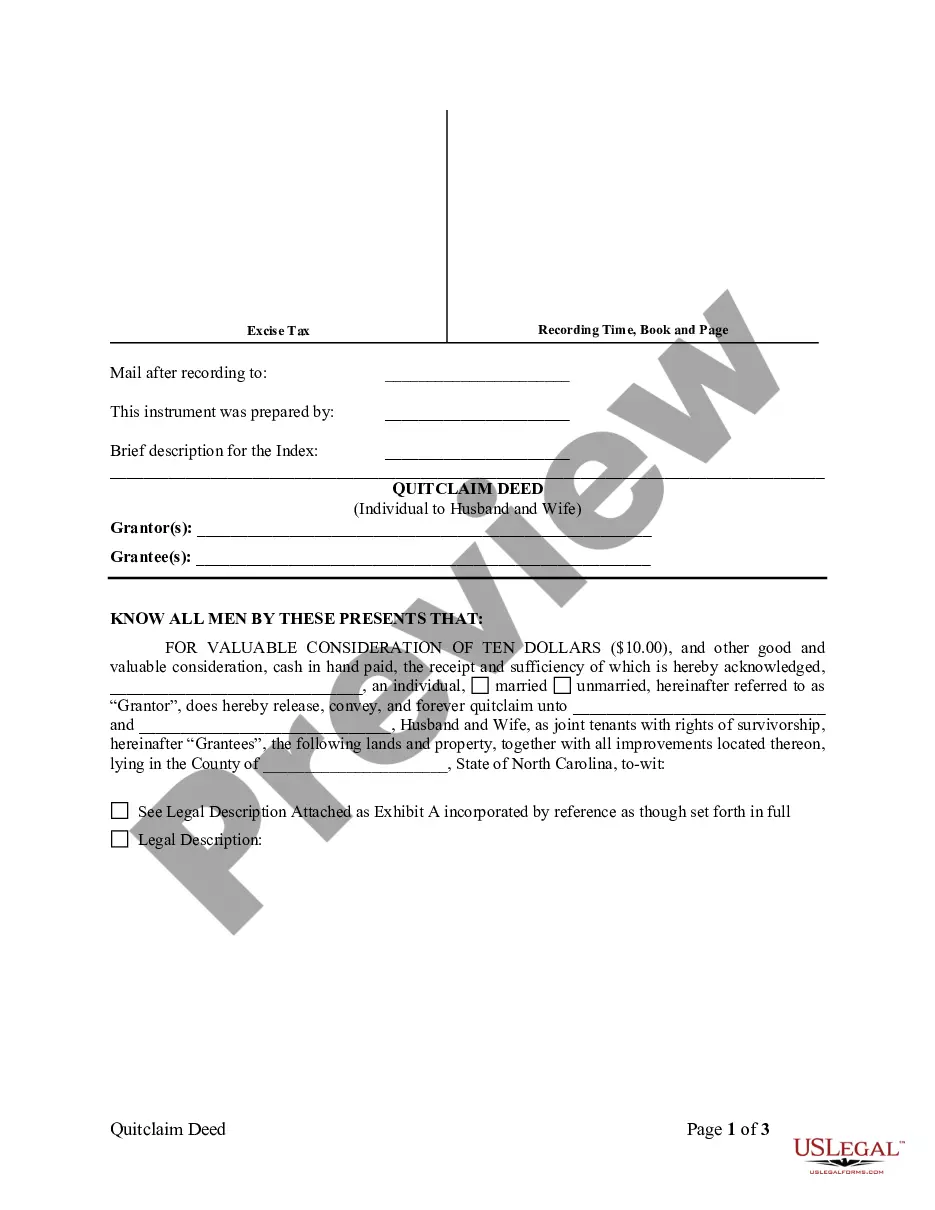
The Quitclaim Deed from Individual to Husband and Wife is a legal document that allows an individual (the Grantor) to transfer property ownership to a married couple (the Grantees). This form is specifically designed for situations where the Grantor wishes to convey property without making any assurances regarding its title. Unlike warranty deeds, this quitclaim deed provides no guarantees about the state of the property title, making it commonly used for intra-family transfers or to clear up property titles between spouses.
What’s included in this form
- Grantor and Grantees Information: Includes names and marital status of the Grantor and Grantees.
- Property Description: A detailed description of the property being transferred, including legal specifications.
- Consideration: Legal acknowledgment of the value exchanged, typically a nominal amount, such as ten dollars.
- Joint Tenancy Clause: Specifies how the Grantees will hold title, ensuring rights of survivorship.
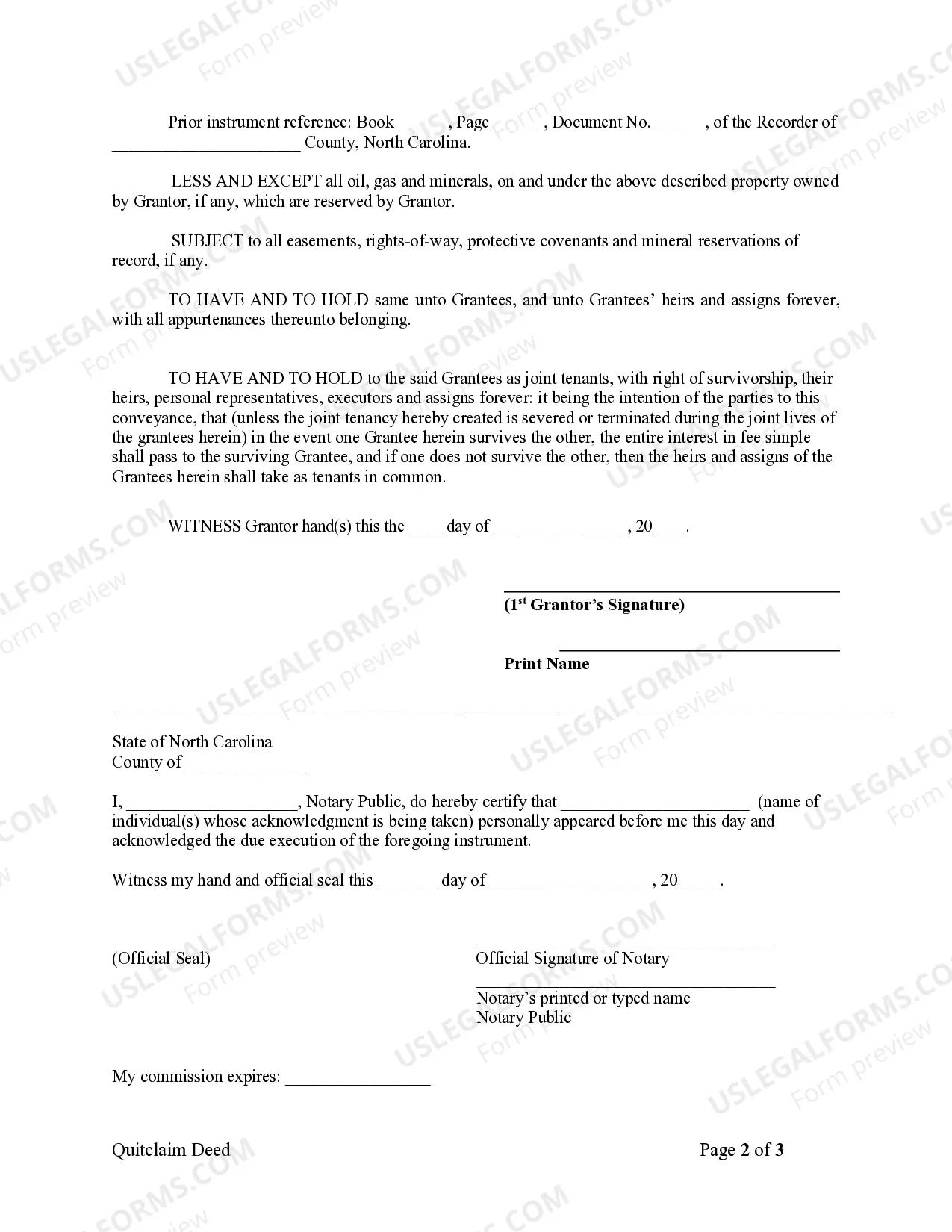
- Notary Section: Area for the notary public to verify signatures and dates, confirming the document's authenticity.






Common use cases
This form is typically used in situations where an individual wishes to transfer property to their spouse. Common scenarios include transferring property as part of estate planning, during a divorce settlement, or to simplify the process of property ownership between married couples. It is an effective way to convey property without involving extensive title checks or warranties.
Who this form is for
- Individuals looking to transfer real estate to their spouse.
- Married couples wishing to clarify ownership of jointly held property.
- Individuals engaged in estate planning or updating property titles.
- People involved in divorce settlements where property division is required.
How to complete this form
- Identify the parties involved, including the full names of the Grantor and Grantees.
- Specify the property being transferred by providing its legal description.
- Fill in the nominal consideration amount, typically ten dollars.
- Indicate the date of execution and ensure both parties sign the document.
- Have the form notarized to confirm the identity of the signers and the authenticity of the document.
Notarization requirements for this form
Yes, this form must be notarized to be legally valid. Notarization helps to confirm the identity of the signers and the authenticity of the document. US Legal Forms offers integrated online notarization, which is available 24/7, secure, and legally equivalent to in-person notarization.
Get your form ready online
Our built-in tools help you complete, sign, share, and store your documents in one place.
Make edits, fill in missing information, and update formatting in US Legal Forms—just like you would in MS Word.
Download a copy, print it, send it by email, or mail it via USPS—whatever works best for your next step.
Sign and collect signatures with our SignNow integration. Send to multiple recipients, set reminders, and more. Go Premium to unlock E-Sign.
If this form requires notarization, complete it online through a secure video call—no need to meet a notary in person or wait for an appointment.
We protect your documents and personal data by following strict security and privacy standards.

Make edits, fill in missing information, and update formatting in US Legal Forms—just like you would in MS Word.

Download a copy, print it, send it by email, or mail it via USPS—whatever works best for your next step.

Sign and collect signatures with our SignNow integration. Send to multiple recipients, set reminders, and more. Go Premium to unlock E-Sign.

If this form requires notarization, complete it online through a secure video call—no need to meet a notary in person or wait for an appointment.

We protect your documents and personal data by following strict security and privacy standards.
Typical mistakes to avoid
- Failing to adequately describe the property being conveyed.
- Not obtaining a notarization, which can invalidate the deed.
- Leaving sections blank, such as names or the date of signing.
- Misunderstanding the implications of joint tenancy versus tenants in common.
Advantages of online completion
- Convenience of downloading the form instantly from any device.
- Editability allows you to fill in specific details as needed.
- Access to legal forms drafted by licensed attorneys for accuracy.
- 24/7 availability means you can create your document any time.
Looking for another form?




Form popularity
FAQ
In California, all property bought during the marriage with income that was earned during the marriage is deemed "community property." The law implies that both spouses own this property equally, regardless of which name is on the title deed.
If the quitclaim deed requires the signature of all co-owners, the deed is invalid unless all co-owners have signed it and the deed is then delivered to the grantee.If one individual owns real estate and desires to add a co-owner such as a spouse, a quitclaim deed might be used.
But you might be wondering if an owner can transfer a deed to another person without a real estate lawyer. The answer is yes. Parties to a transaction are always free to prepare their own deeds.A quitclaim deed, for example, is far simpler than a warranty deed.
It is also crucial that a spouse know about the loan, even if he or she is not on the mortgage. In general, the spouse must sign a deed of trust, the Truth in Lending and Right to Cancel documents. By signing these documents, they are simply acknowledging the existence of the mortgage.
In North Carolina, the rule of thumb for married couples is that one spouse may purchase real property, but both spouses must sign the deed to sell property.If a married person can buy property in cash, with no deed of trust required, then he/she can buy the property without his/her spouse signing anything.
A married person buying property individually The owner needs to sign, but their spouse may not be required to sign documents at closing. North Carolina has a specific statute allowing a married buyer of real estate to sign their purchase-money Deed of Trust without requiring the signature of the buyer's spouse.
In order to transfer ownership of the marital home pursuant to a divorce, one spouse is going to need to sign a quitclaim deed, interspousal transfer deed, or a grant deed, in order to convey the title to the property.
Laws § 47B-8. Recording This form must be submitted, after completion and signature, to the Register of Deeds in the county where the real estate is located. Signing (A§ 47-38) All quit claim deeds are required to be signed with the Grantor(s) being witnessed by a Notary Public.
In divorces, states have two options for dividing property: community property division (where marital property belongs to both spouses equally, regardless of who bought it) or equitable division (where the court divides marital property equitably (justly.) North Carolina is not a community property state.