Montana Warranty Deed to Separate Property of One Spouse to Both Spouses as Joint Tenants
What this document covers
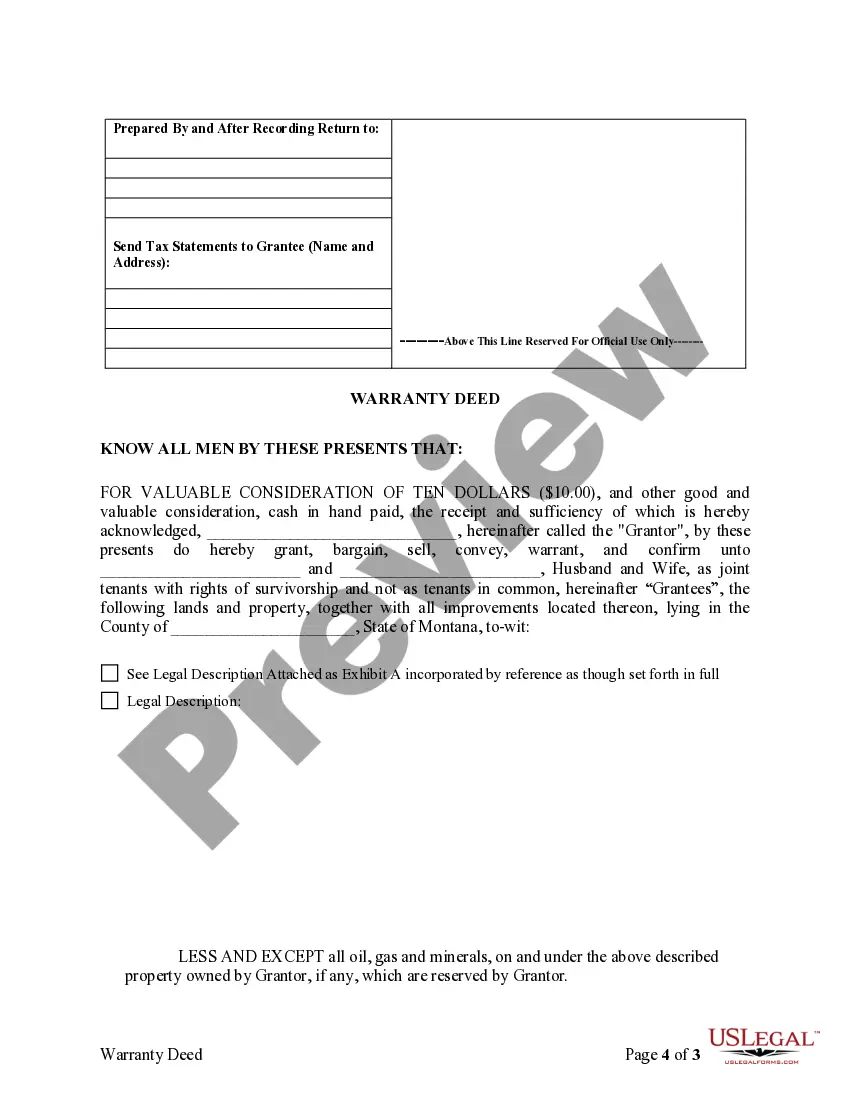
The Warranty Deed to Separate Property of One Spouse to Both Spouses as Joint Tenants is a legal document through which one spouse transfers ownership of property to both spouses. This form establishes joint tenancy, meaning that both spouses will have equal rights to the property and the right of survivorship. Unlike other deed types, this form is specifically designed for situations where a spouse wants to transfer their separate property into joint ownership with their partner, making it distinct in its purpose and legal implications.
Form components explained
- Grantor and Grantee Information: Identifies the spouse transferring the property and the spouse receiving it.
- Property Description: Details the specific property being transferred, including its legal description.
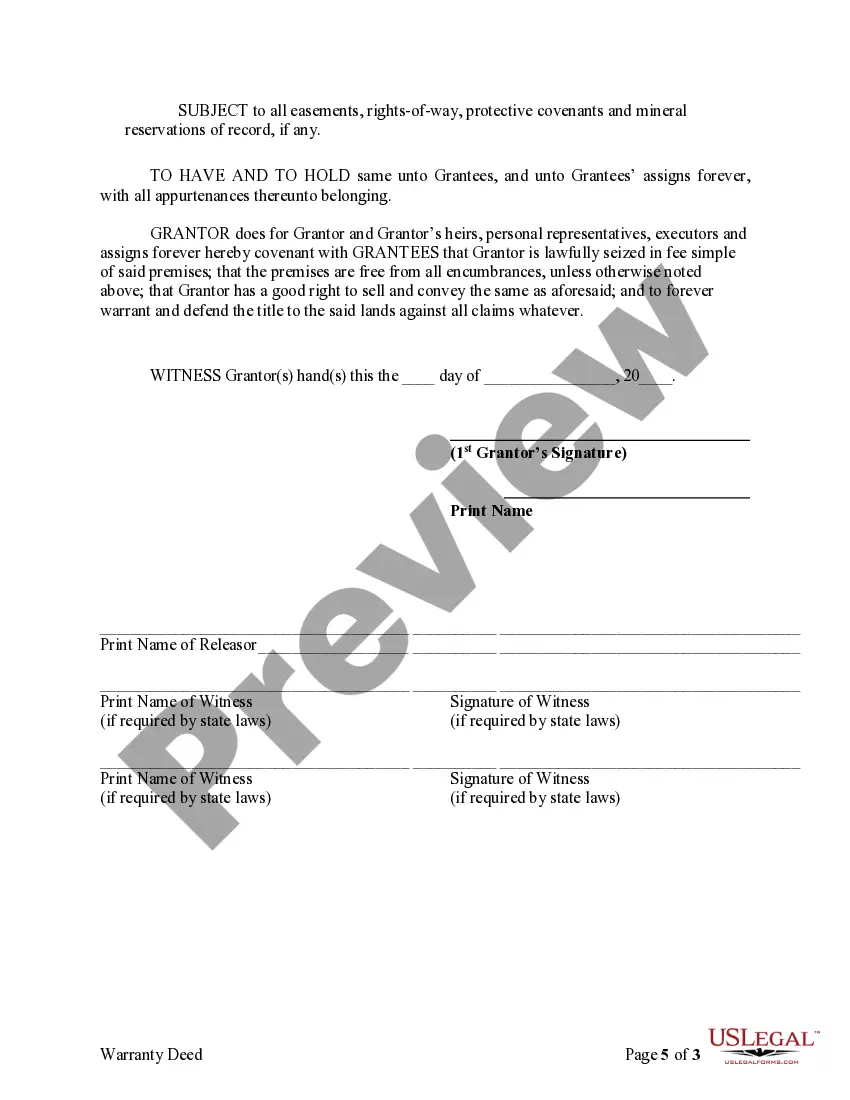
- Covenants: Assures that the grantor has the right to transfer the property and that it is free of encumbrances.
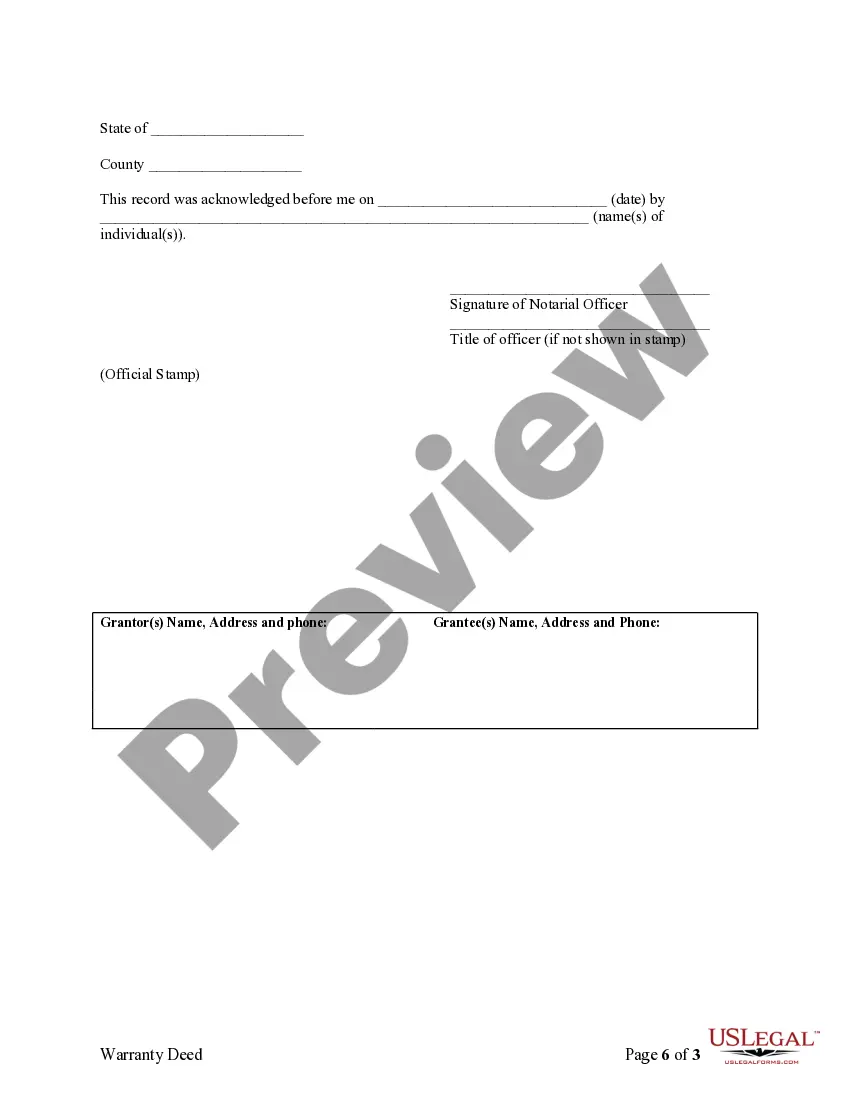
- Execution Section: Requires signatures of the grantor(s) and witnesses, and acknowledgment by a notary public.
- State Acknowledgment: Confirms that the form complies with Montana state laws, including requirements for witnessing and notarization.



When to use this document
This form is used when one spouse wants to transfer their separate property into joint ownership with the other spouse. Situations include marriages where one partner previously owned property before the marriage, or when couples wish to consolidate assets following a significant life event, such as pregnancy or purchasing a new home. It is also beneficial for estate planning, ensuring that property automatically passes to the surviving spouse upon death.
Intended users of this form
- Couples who are legally married and wish to transfer property into joint ownership.
- Spouses with individually owned property looking to simplify estate management.
- Individuals wanting to ensure their property passes to their spouse without going through probate.
- Those seeking to establish joint tenancy for a specific financial or estate planning purpose.
Completing this form step by step
- Identify the parties involved: Fill in the names of the grantor (spouse transferring the property) and grantee (both spouses).
- Specify the property: Enter the legal description and address of the property being transferred.
- Fill in the date: Provide the date of the transfer in the designated field.
- Obtain necessary signatures: Have the grantor sign the deed and, where required, obtain signatures from witnesses.
- Notarize the form: Take the completed form to a notary public for acknowledgment, if required.
Notarization guidance
Notarization is required for this form to take effect. Our online notarization service, powered by Notarize, lets you verify and sign documents remotely through an encrypted video session, available 24/7.
Get your form ready online
Our built-in tools help you complete, sign, share, and store your documents in one place.
Make edits, fill in missing information, and update formatting in US Legal Forms—just like you would in MS Word.
Download a copy, print it, send it by email, or mail it via USPS—whatever works best for your next step.
Sign and collect signatures with our SignNow integration. Send to multiple recipients, set reminders, and more. Go Premium to unlock E-Sign.
If this form requires notarization, complete it online through a secure video call—no need to meet a notary in person or wait for an appointment.
We protect your documents and personal data by following strict security and privacy standards.

Make edits, fill in missing information, and update formatting in US Legal Forms—just like you would in MS Word.

Download a copy, print it, send it by email, or mail it via USPS—whatever works best for your next step.

Sign and collect signatures with our SignNow integration. Send to multiple recipients, set reminders, and more. Go Premium to unlock E-Sign.

If this form requires notarization, complete it online through a secure video call—no need to meet a notary in person or wait for an appointment.

We protect your documents and personal data by following strict security and privacy standards.
Common mistakes to avoid
- Leaving key fields blank, such as property description or signatory names.
- Failing to have the document notarized, which can invalidate the deed.
- Not checking state requirements for witness signatures, which may vary.
- Using incorrect legal property descriptions, leading to potential disputes.
Benefits of completing this form online
- Convenient access: Easily download and complete the form from your computer.
- Editability: Make necessary changes before filling out the final sections.
- Reliability: Forms are drafted by licensed attorneys, ensuring legal accuracy and compliance.
- Efficiency: Complete the form quickly from anywhere, saving time and hassle associated with in-person legal consultations.
Looking for another form?



Form popularity
FAQ
Deciding on Asset Ownership Can Start When You Marry You can own the property as joint tenants or as tenants in common. In a joint tenancy, the partners own the whole property and do not have a particular share in it, while tenants in common each have a definite share in the property.
In estate law, joint tenancy is a special form of ownership by two or more persons of the same property. The individuals, who are called joint tenants, share equal ownership of the property and have the equal, undivided right to keep or dispose of the property. Joint tenancy creates a Right of Survivorship.
In California, the majority of married couples hold their real estate property as joint tenants with right of survivorship. Joint tenancy creates a right of survivorship, so upon the death of one party, his or her share will pass on to the remaining joint tenant(s).
This is known as 'Severing the Joint Tenancy'. It requires service of a written notice of change the 'severance'. It can be done without the other owner's cooperation or agreement. It is recorded at the Land Registry, and the other owner will know it has been done but only 'after the event' so to speak.
A Married Man/Woman, as His/Her Sole and Separate Property: When a married man or woman wishes to acquire title as their sole and separate property, the spouse must consent and relinquish all right, title and interest in the property by deed or other written agreement.
In order to sever the right of survivorship, a tenant must only record a new deed showing that his or her interest in the title is now held in a Tenancy-in-Common or as Community Property.
In California, most married couples hold real property (such as land and buildings) as joint tenants with right of survivorship.For instance, many married couples share real property as joint tenants. This way, upon the death of a spouse, the surviving spouse will own 100% share of the property.
When joint tenants have right of survivorship, it means that the property shares of one co-tenant are transferred directly to the surviving co-tenant (or co-tenants) upon their death. While ownership of the property is shared equally in life, the living owners gain total ownership of any deceased co-owners' shares.
If a home is owned by only one person then it is not registered with the Land Registry as either Joint Tenants or Tenants in Common. It is registered as a Sole Owner, you can only be a joint tenant or tenant in common if there is more than one owner of the property.