Missouri Subcontractor's Notice to Owner by Corporation
About this form
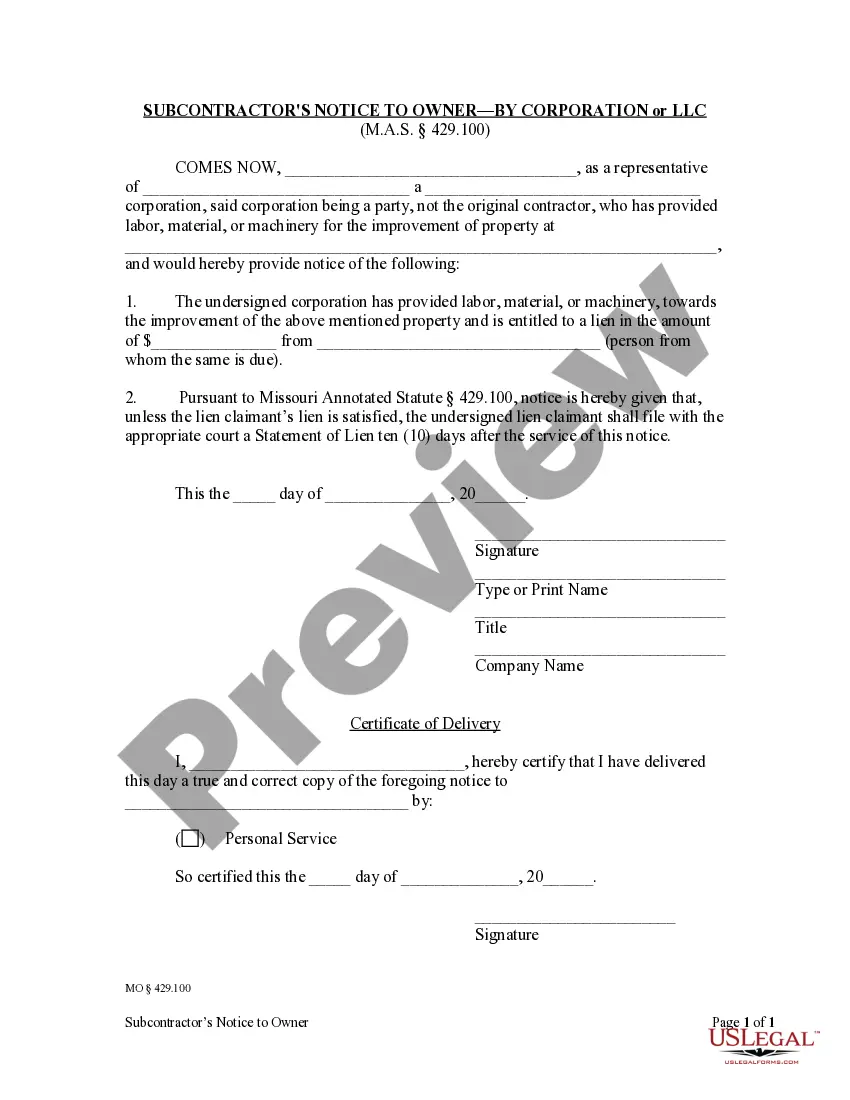
The Subcontractor's Notice to Owner by Corporation is a legal document utilized by subcontractors in Missouri to inform property owners about their entitlement to a lien. This form is distinct from other notices, as it is specifically designed for corporations that provide labor, materials, or machinery, and it is required to be served before filing a lien claim against improved property.
Form components explained
- Identification of the subcontractor corporation and its representative.
- Details of labor, material, or machinery provided for the property improvement.
- Amount of the lien being claimed.
- Notice period before filing a lien claim, set at ten days.
- Certification of delivery to the property owner or their agent.

Common use cases
This form should be used when a corporation that is not the original contractor has supplied materials, labor, or machinery for property improvement and intends to claim a lien. It is essential to provide this notice to the property owner within the specified time frame to protect the corporation's rights under Missouri law.
Who should use this form
- Subcontractor corporations that have worked on a property improvement project.
- Representatives of the corporation who are authorized to file the notice.
- Any party seeking to formalize their claim against a property for unpaid services or materials.
How to prepare this document
- Enter the name of the corporation and the representative completing the notice.
- Specify the description of the property where the work was performed.
- List the amount owed for the labor, materials, or machinery provided.
- Indicate the person from whom the payment is due.
- Sign and date the notice, certifying that it has been delivered to the property owner.
Notarization requirements for this form
In most cases, this form does not require notarization. However, some jurisdictions or signing circumstances might. US Legal Forms offers online notarization powered by Notarize, accessible 24/7 for a quick, remote process.
Get your form ready online
Our built-in tools help you complete, sign, share, and store your documents in one place.
Make edits, fill in missing information, and update formatting in US Legal Forms—just like you would in MS Word.
Download a copy, print it, send it by email, or mail it via USPS—whatever works best for your next step.
Sign and collect signatures with our SignNow integration. Send to multiple recipients, set reminders, and more. Go Premium to unlock E-Sign.
If this form requires notarization, complete it online through a secure video call—no need to meet a notary in person or wait for an appointment.
We protect your documents and personal data by following strict security and privacy standards.

Make edits, fill in missing information, and update formatting in US Legal Forms—just like you would in MS Word.

Download a copy, print it, send it by email, or mail it via USPS—whatever works best for your next step.

Sign and collect signatures with our SignNow integration. Send to multiple recipients, set reminders, and more. Go Premium to unlock E-Sign.

If this form requires notarization, complete it online through a secure video call—no need to meet a notary in person or wait for an appointment.

We protect your documents and personal data by following strict security and privacy standards.
Mistakes to watch out for
- Failing to deliver the notice within the ten-day window required by law.
- Not accurately stating the amount owed for services rendered.
- Omitting details about the property or the work performed.
- Not including a signature or date on the notice, which can invalidate the document.
Advantages of online completion
- Convenient download options that allow immediate access to the formally structured template.
- Editable fields make it easy to input specific information relevant to your case.
- Drafted by licensed attorneys to ensure compliance with legal standards.
- Timely updates to reflect changes in laws or requirements in Missouri.
Legal use & context
- This form is legally binding once properly completed and served to the property owner.
- Failure to provide this notice can jeopardize the right to file a lien, making it essential for the homeowner or contractor to receive it.
- It serves as a formal declaration of the corporation's claim for compensation regarding improvements made.
Looking for another form?









Form popularity
FAQ
The When of Mechanic's Liens Not six months from last invoice. Not six months from when payment is due. Time to Enforce Lien: Six months from the date the lien is filed.
File your lien. If you're claiming a lien on real property, it must be filed in the recorder's office of the county where the property is located. Expect to pay a filing fee between $25 and $50 depending on the location where you file.
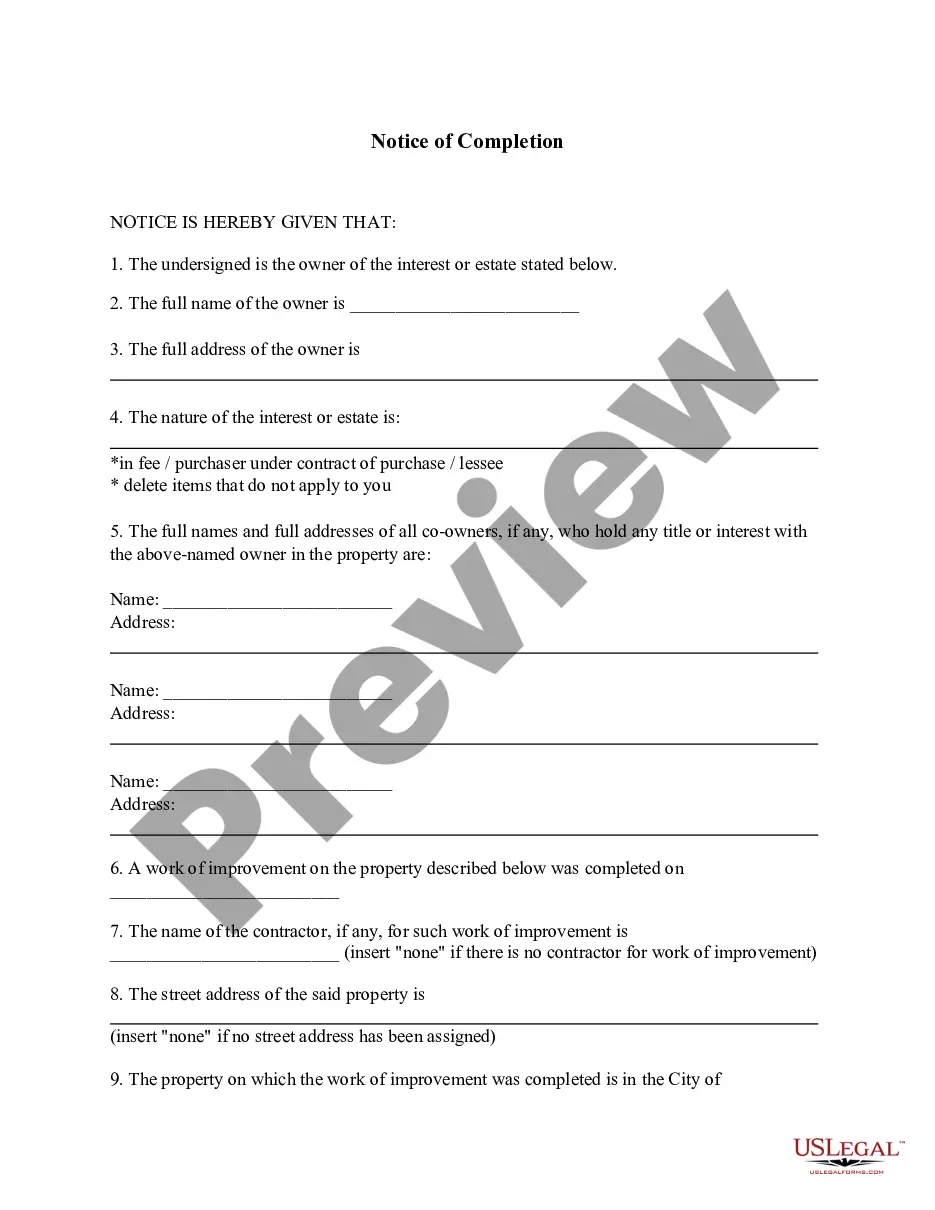
A Notice of Completion Is: Other parties higher up on the payment chain, like prime contractors or general contractors, can file a Notice of Completion too. Here's the bottom line. When an owner files a Notice of Completion, the mechanics lien deadline is shortened.
In Missouri, a mechanics lien must be filed within 6 months after the last day of services or materials were provided. This date is crucial to the rights of the project participant. The lien should be filed with the recorder of deeds in the county where the property is located.
A notice of completion must be served by a project owner within 10 days of the date the notice of completion is filed for recording and must be served on the following: The direct contractor(s); and. Anyone who has served the project owner with a preliminary notice.
Missouri does not require that lien waivers be notarized in order to be effective. However, there are specific signature requirements that apply to residential jobs.
While it's unlikely that just anyone can put a lien on your home or land, it's not unheard of for a court decision or a settlement to result in a lien being placed against a property.
A mortgage creates a lien on your property that gives the lender the right to foreclose and sell the home to satisfy the debt. A deed of trust (sometimes called a trust deed) is also a document that gives the lender the right to sell the property to satisfy the debt should you fail to pay back the loan.