Minnesota Last Will and Testament for Married person with Minor Children
About this form
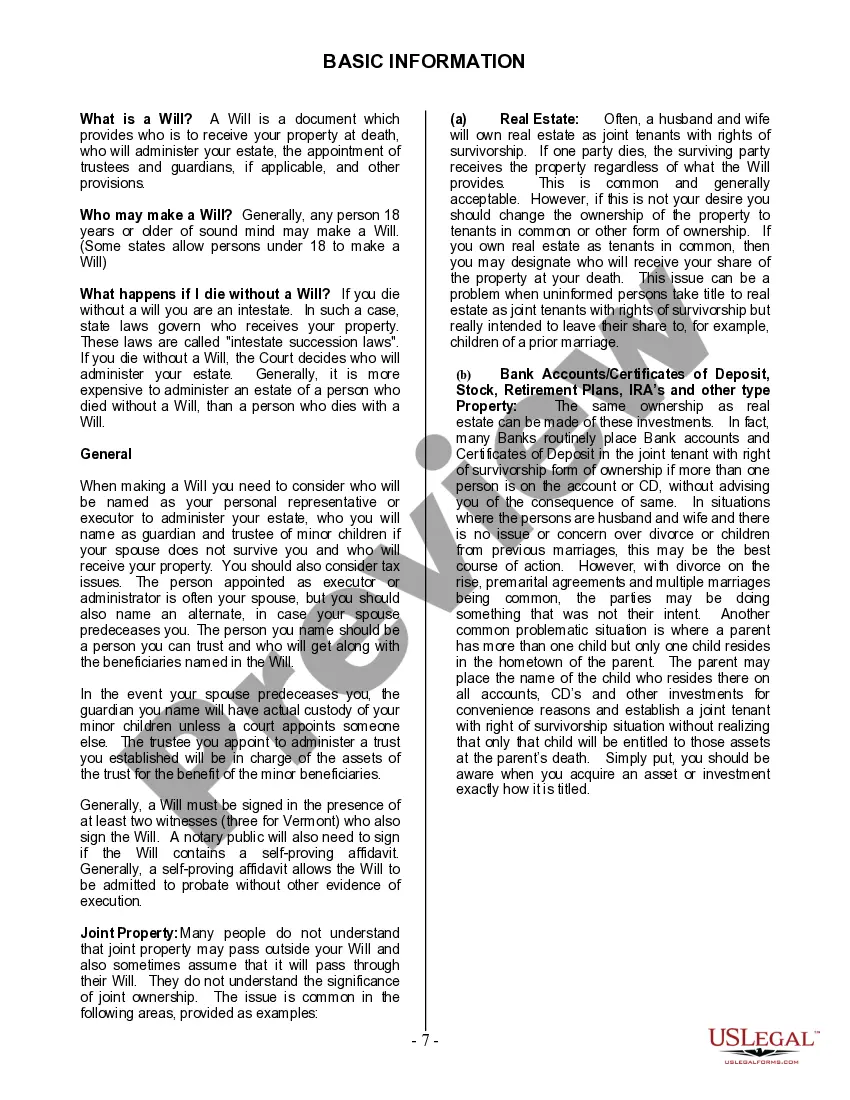
The Last Will and Testament for Married Person with Minor Children is a legal document that outlines how a married individual with minor children wishes their assets to be distributed upon death. This form allows you to appoint a personal representative (or executor), designate beneficiaries for your property, and include provisions for your spouse and children. It is specifically designed to cater to the needs of individuals who want to ensure their minor children are provided for in case of their passing, making it distinct from other forms of wills that do not address guardianship or trust arrangements for minors.
Form components explained
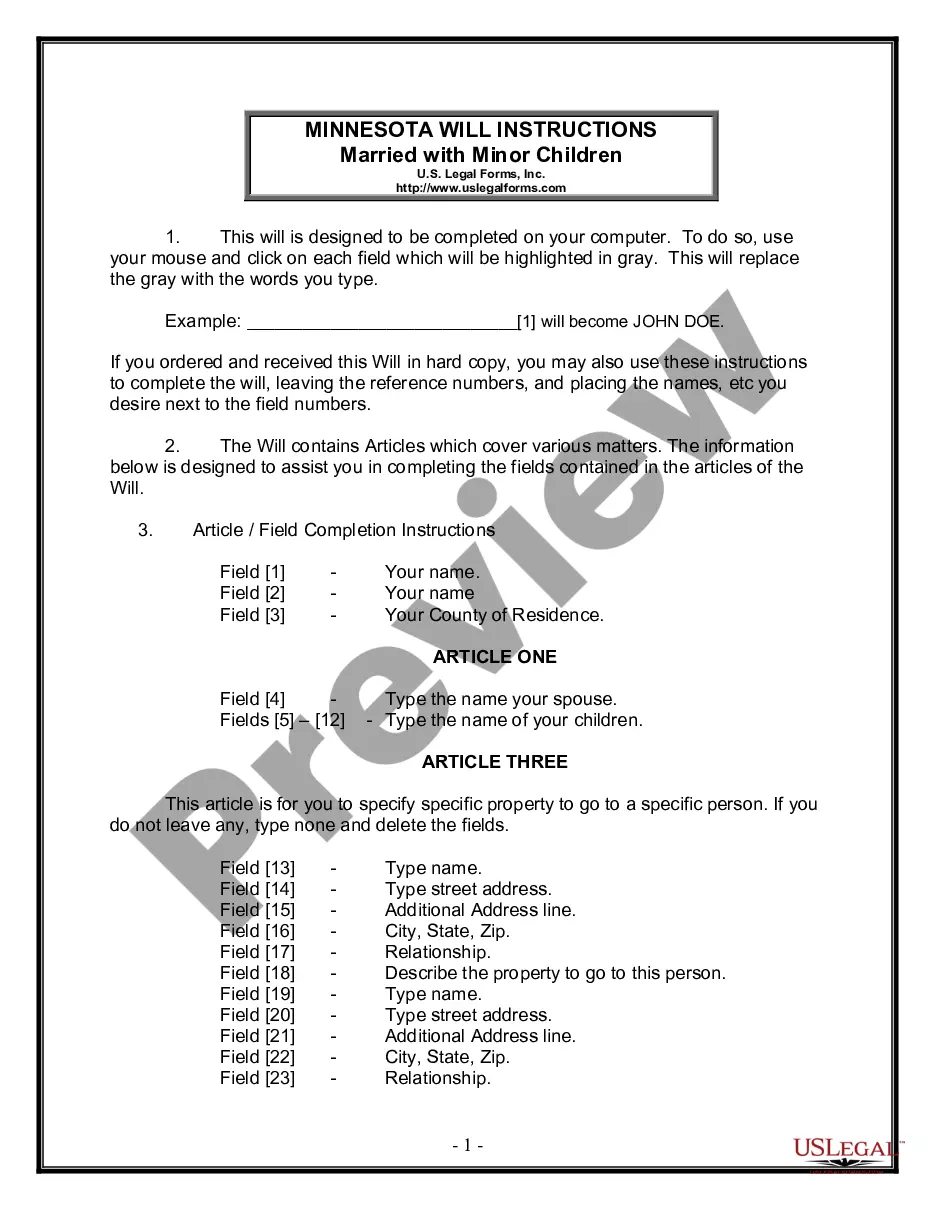
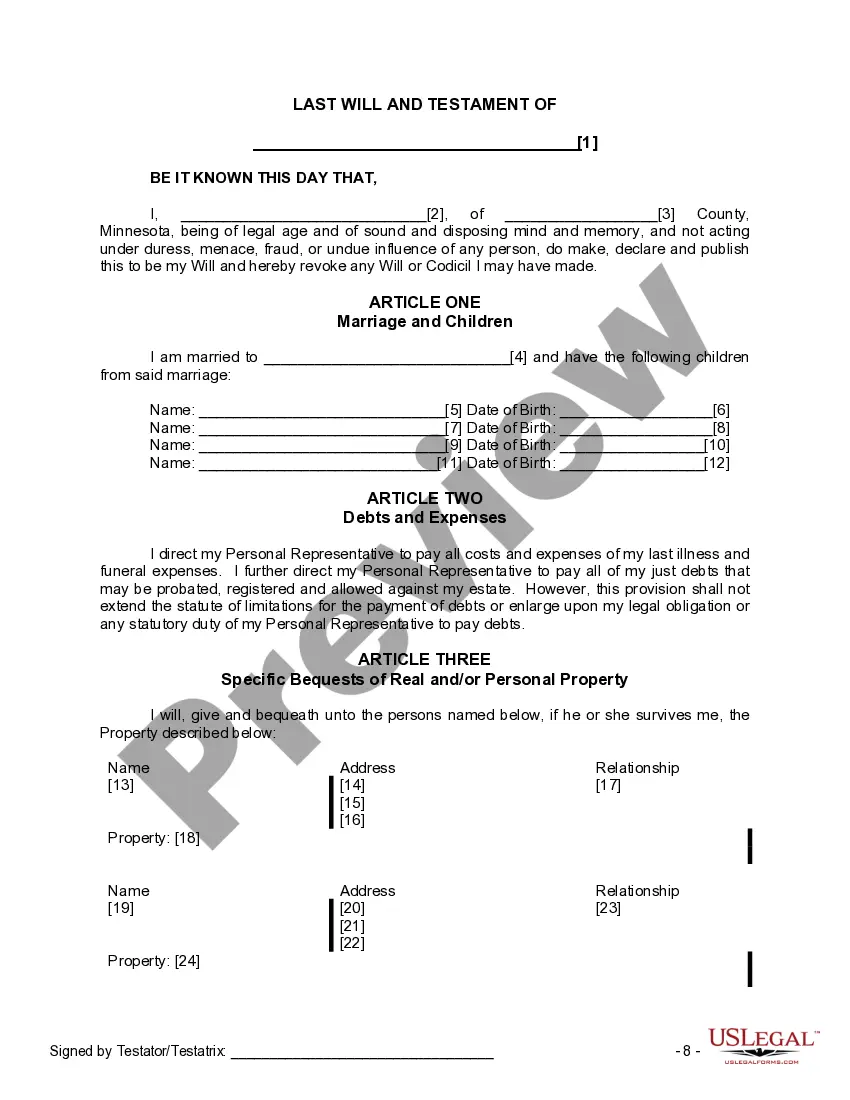
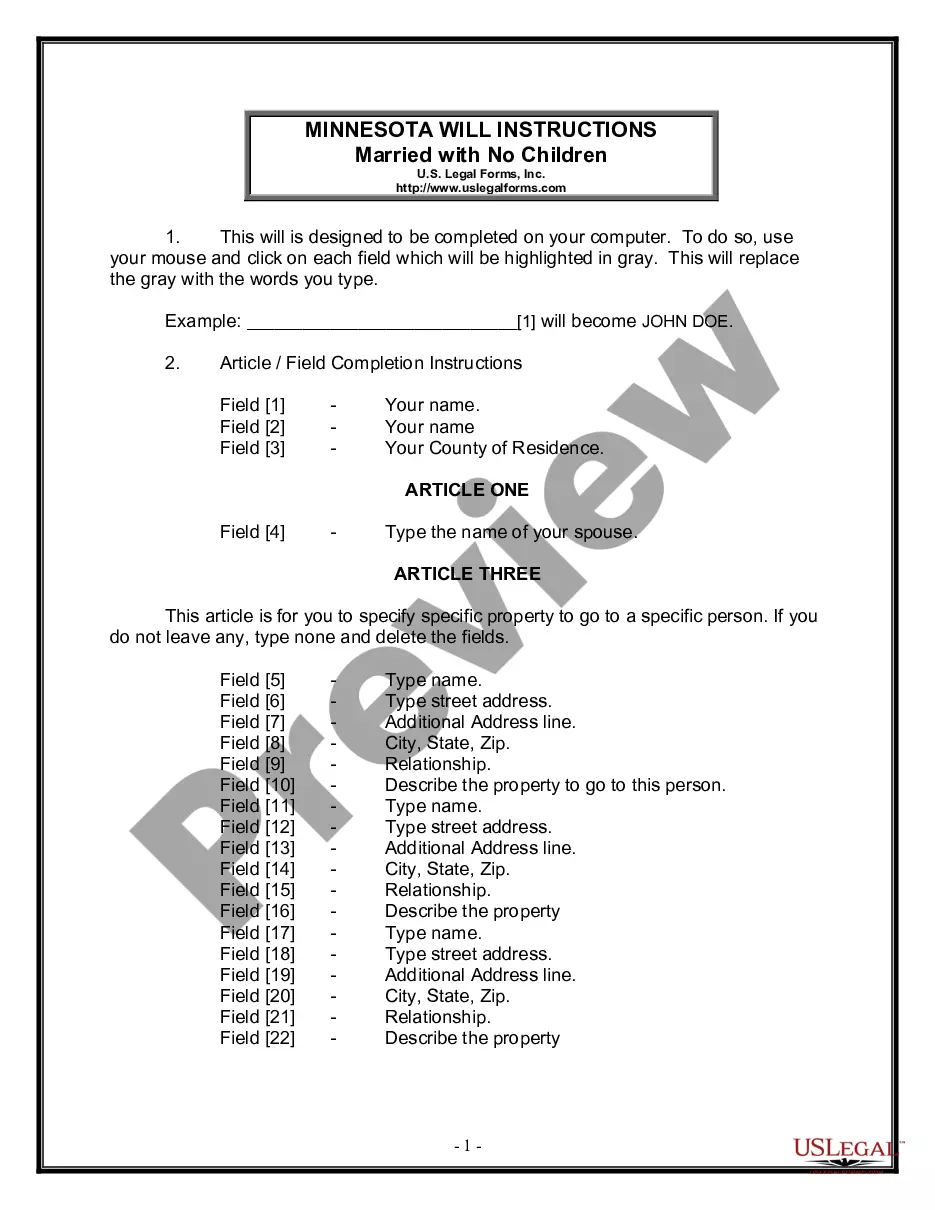
- Article One: Details your marital status and names of your minor children.
- Article Three: Specifies any specific bequests of property to named individuals.
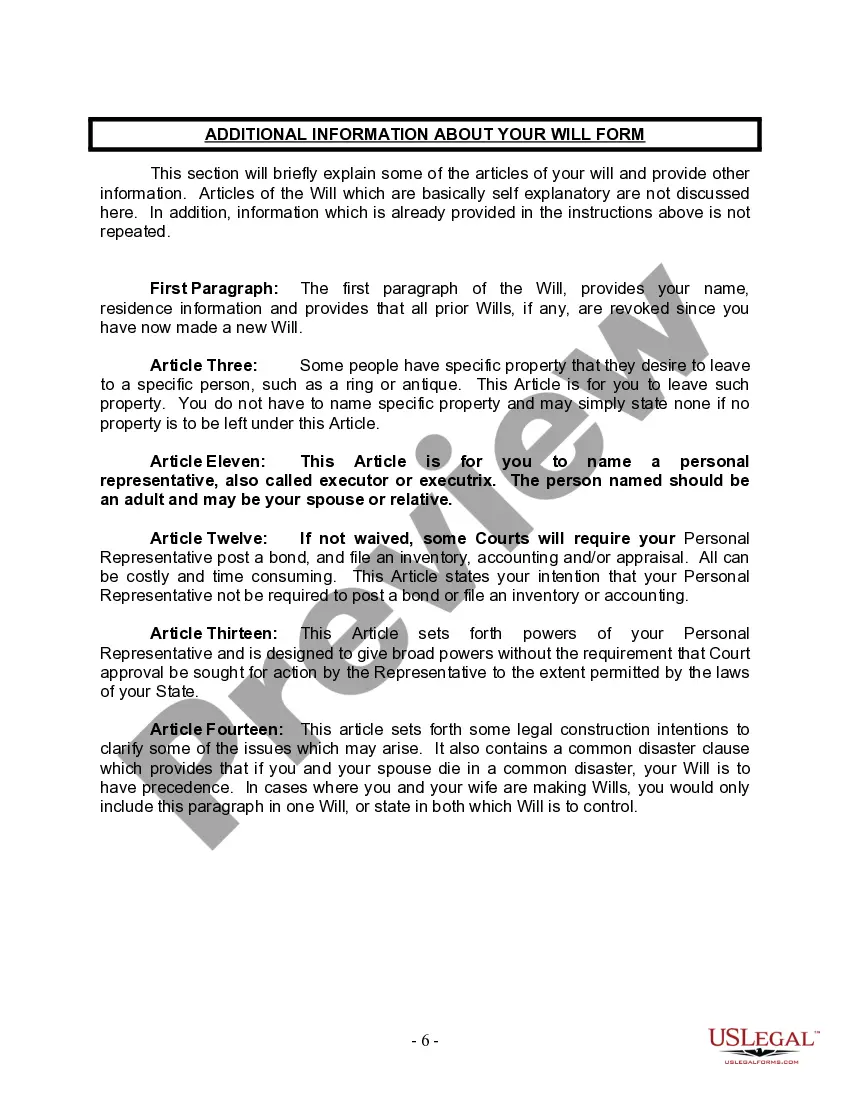
- Article Seven: Establishes a trust for the benefit of minor beneficiaries.
- Article Ten: Appoints a guardian for your minor children.
- Article Eleven: Names your personal representative to administer your estate.
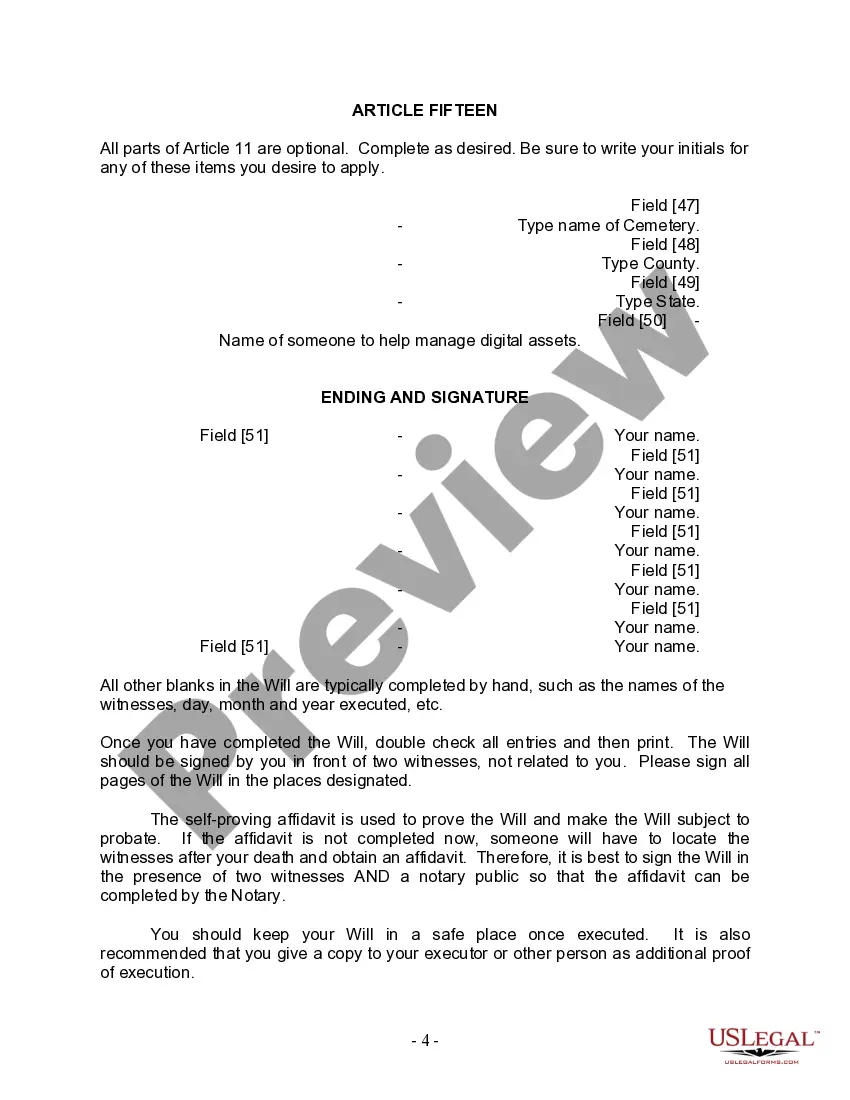
- Self-Proving Affidavit: Allows the will to be admitted to probate without additional evidence of execution.










Situations where this form applies
This form should be used when you are a married individual with minor children and want to prepare for the eventuality of your death. It is especially relevant if you wish to ensure that your assets will be distributed according to your wishes and that guardianship arrangements for your children are clearly specified. Additionally, it is advisable to use this form if you have specific property you want to designate to particular individuals or want to establish a trust for the care of your children.
Who should use this form
- Married individuals with minor children.
- Parents wishing to specify guardianship and manage their children's inheritance.
- Anyone needing to detail how they wish their assets to be distributed after their passing.
Steps to complete this form
- Identify and enter your full name and county of residence.
- Provide the names of your spouse and minor children.
- Specify any specific property to be bequeathed and the recipientsâ details.
- Designate your personal representative and any successor representatives.
- Include any instructions related to guardianship for your minor children.
- Ensure the completed will is signed in the presence of two witnesses and a notary if applicable.
Is notarization required?
Yes, this form must be notarized to be legally valid. It is recommended to sign the will in the presence of two witnesses and a notary public, ensuring that a self-proving affidavit is completed. This makes it easier for your will to be admitted to probate without needing further evidence of execution.
Get your form ready online
Our built-in tools help you complete, sign, share, and store your documents in one place.
Make edits, fill in missing information, and update formatting in US Legal Forms—just like you would in MS Word.
Download a copy, print it, send it by email, or mail it via USPS—whatever works best for your next step.
Sign and collect signatures with our SignNow integration. Send to multiple recipients, set reminders, and more. Go Premium to unlock E-Sign.
If this form requires notarization, complete it online through a secure video call—no need to meet a notary in person or wait for an appointment.
We protect your documents and personal data by following strict security and privacy standards.

Make edits, fill in missing information, and update formatting in US Legal Forms—just like you would in MS Word.

Download a copy, print it, send it by email, or mail it via USPS—whatever works best for your next step.

Sign and collect signatures with our SignNow integration. Send to multiple recipients, set reminders, and more. Go Premium to unlock E-Sign.

If this form requires notarization, complete it online through a secure video call—no need to meet a notary in person or wait for an appointment.

We protect your documents and personal data by following strict security and privacy standards.
Mistakes to watch out for
- Failing to have the will signed by two witnesses, as required.
- Not properly appointing a guardian for minor children.
- Leaving out specific bequests, leading to disputes among beneficiaries.
- Not updating the will to reflect life changes such as marriage, divorce, or the birth of children.
Benefits of using this form online
- Convenient access to legal templates that can be completed at your own pace.
- Edit the document easily to reflect your specific wishes and circumstances.
- Reliable templates drafted by licensed attorneys, ensuring legal validity.
Legal use & context
- This form is legally binding in Minnesota when executed according to state laws.
- A properly executed will can minimize the complexities involved in probate.
- A will permits the distribution of assets according to your wishes rather than state intestacy laws.
Key takeaways
- The Last Will and Testament ensures your wishes are honored after your death.
- Appointing guardians for your minor children is a critical aspect of this form.
- Following proper witnessing and notarization procedures is essential for the form's validity.
Looking for another form?
Form popularity
FAQ
Writing a Minnesota Last Will and Testament for Married person with Minor Children involves several important steps. First, identify a trustworthy guardian for your minor child, as this is a crucial decision that must be documented in your will. Next, clearly outline the distribution of your assets, ensuring that your child's future needs are prioritized. To simplify this process, consider using uslegalforms, which offers easy-to-use templates and resources tailored for your specific needs.
While it may seem logical to name minor children as beneficiaries in your Minnesota Last Will and Testament for Married person with Minor Children, it is essential to consider the implications. Minors cannot directly receive assets until they reach adulthood, which could result in court involvement to manage the inheritance. Instead, you may want to establish a trust or appoint a custodian to ensure your children's inheritance is managed wisely until they are of age.
One of the biggest mistakes people make when creating a Minnesota Last Will and Testament for Married person with Minor Children is failing to update their will after significant life events. Changes such as the birth of a child, divorce, or the acquisition of new assets should prompt a review of your will. Additionally, neglecting to properly name guardians for your minor children can lead to complications and uncertainty. Always ensure that your will accurately reflects your current wishes and circumstances.
Where is common-law marriage allowed? Here are the places that recognize common-law marriage: Colorado, Iowa, Kansas, Montana, New Hampshire (for inheritance purposes only), Oklahoma, Rhode Island, South Carolina, Texas, Utah and the District of Columbia.
You can apply for a marriage license in any Minnesota county, regardless of where you live. Your wedding ceremony can take place anywhere in the state, but it must happen within 6 months after you receive the license.
Copies of certificates of marriage are available from the county that issued the marriage license. Anyone can look up marriage records in Minnesota Official Marriage System (MOMS), a searchable database of marriage certificates. Minnesota counties designed and manage MOMS.
Divorce court forms give you only one choice with real estate--one spouse gets 100% of the house, cabin, or other real estate and the other spouse can have a lien. There are many other ways to divide real estate.
Per Minnesota divorce laws, all marital property shall be divided equitably between the divorcing spouses.If property is classified as non-marital, then that spouse is entitled to all of such property, without having to divide any portion of it with the other spouse.
Being in a so called common law partnership will not give couples any legal protection whatsoever, and so under the law, if someone dies and they have a partner that they are not married to, then that partner has no right to inherit anything unless the partner that has passed away has stated in their will that they
Minnesota abolished common law marriage in 1941. In Minnesota a couple is legally married or just living together. Minnesota does, however, recognize common law marriages that were legally created outside of this state.Couples living outside of legal marriage do not have that same benefit.