Minnesota Mutual Wills Package with Last Wills and Testaments for Married Couple with Minor Children
Overview of this form
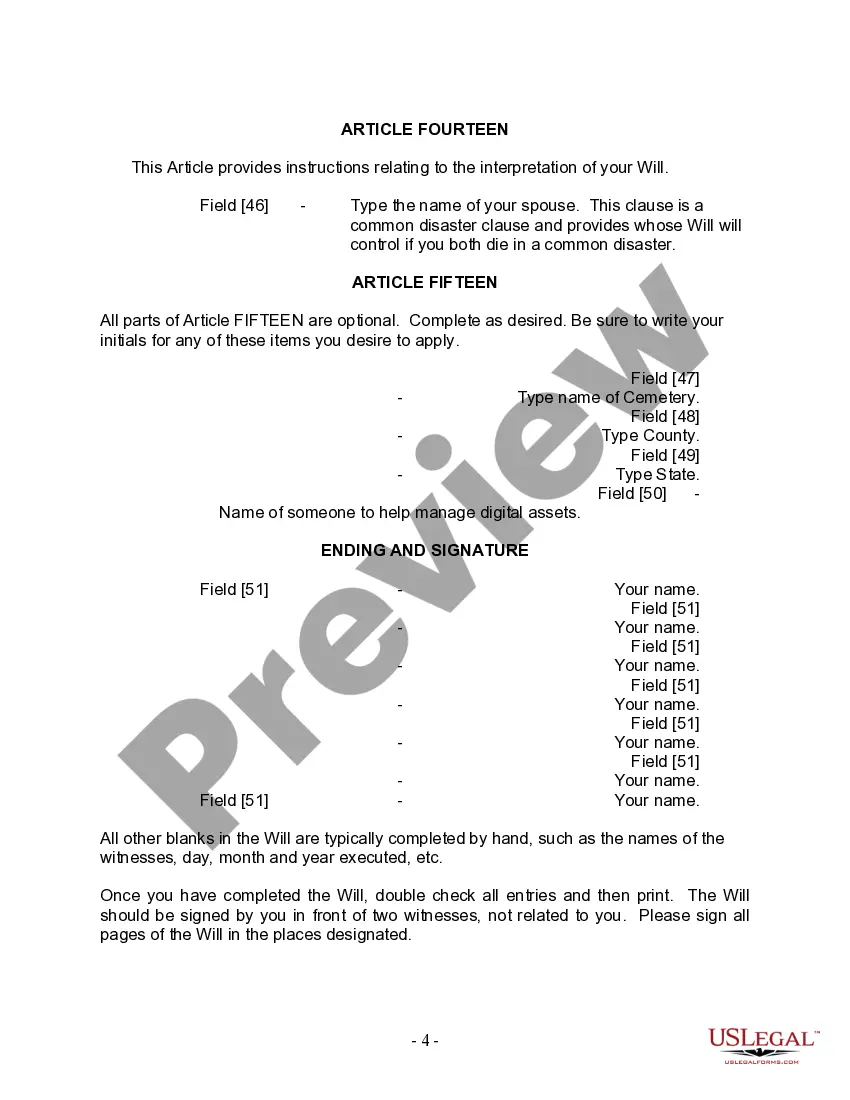
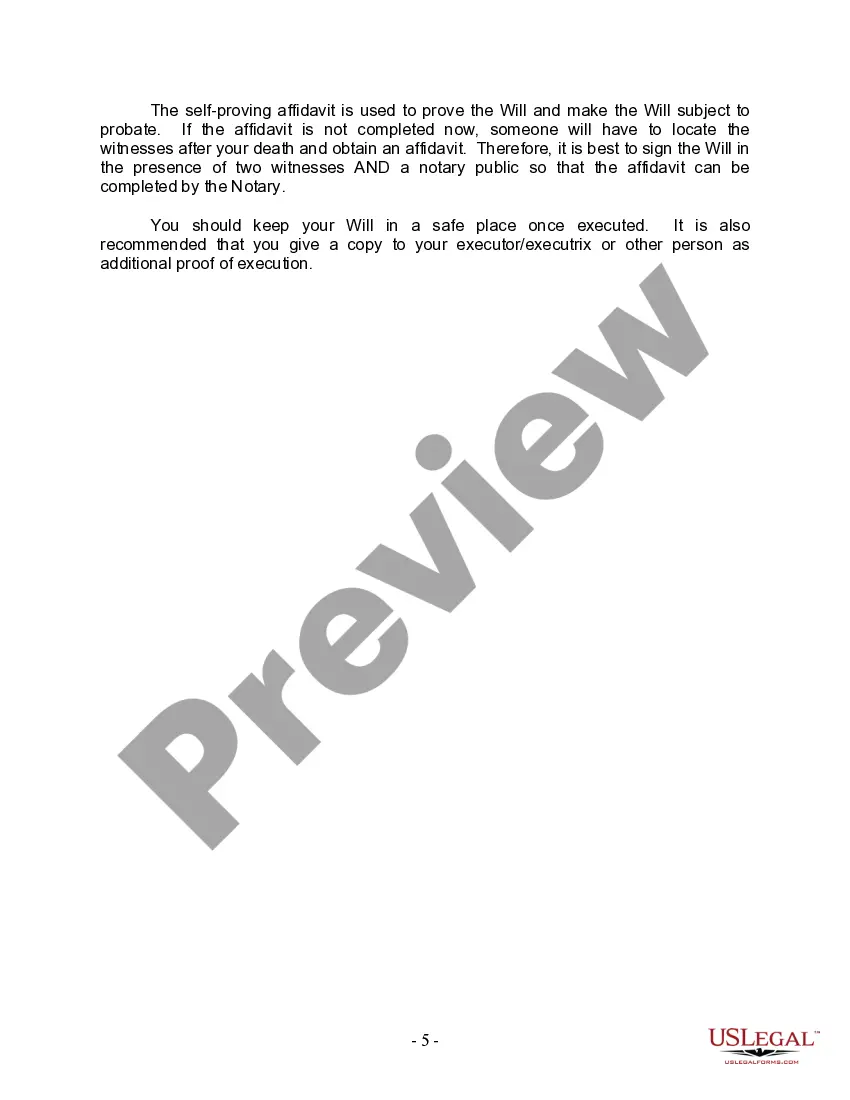
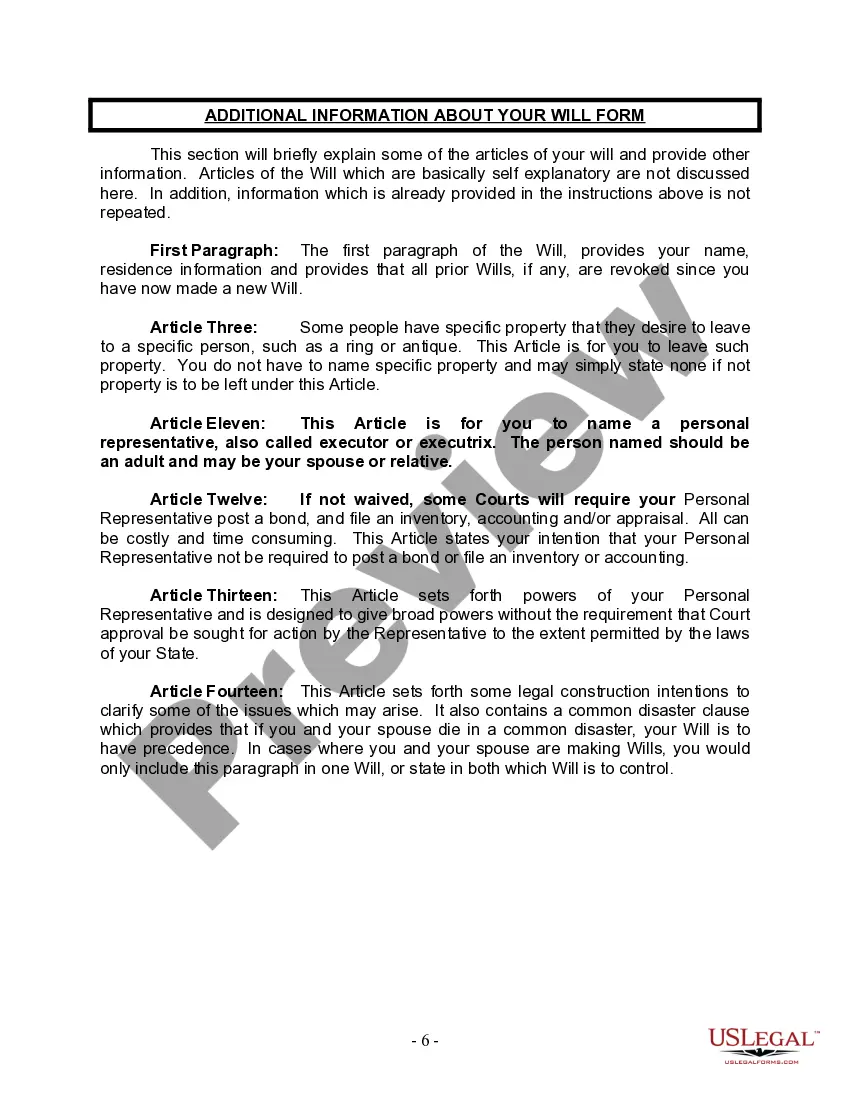
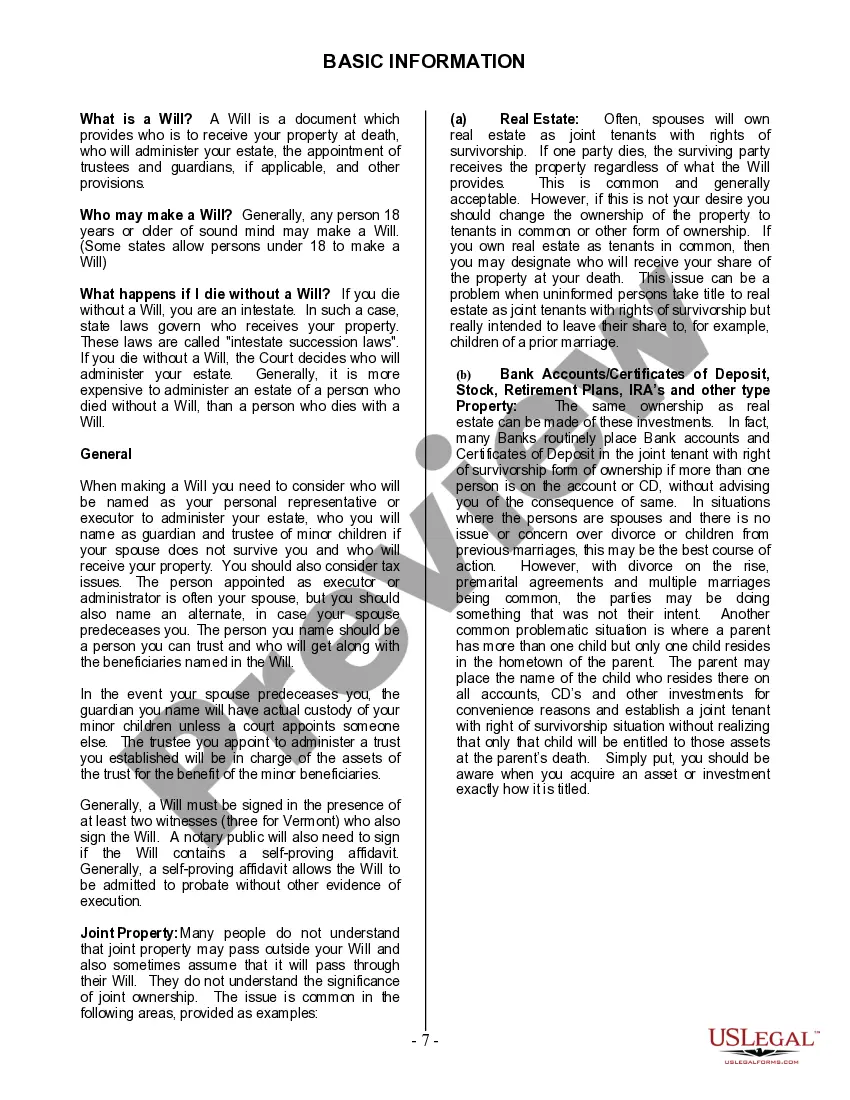
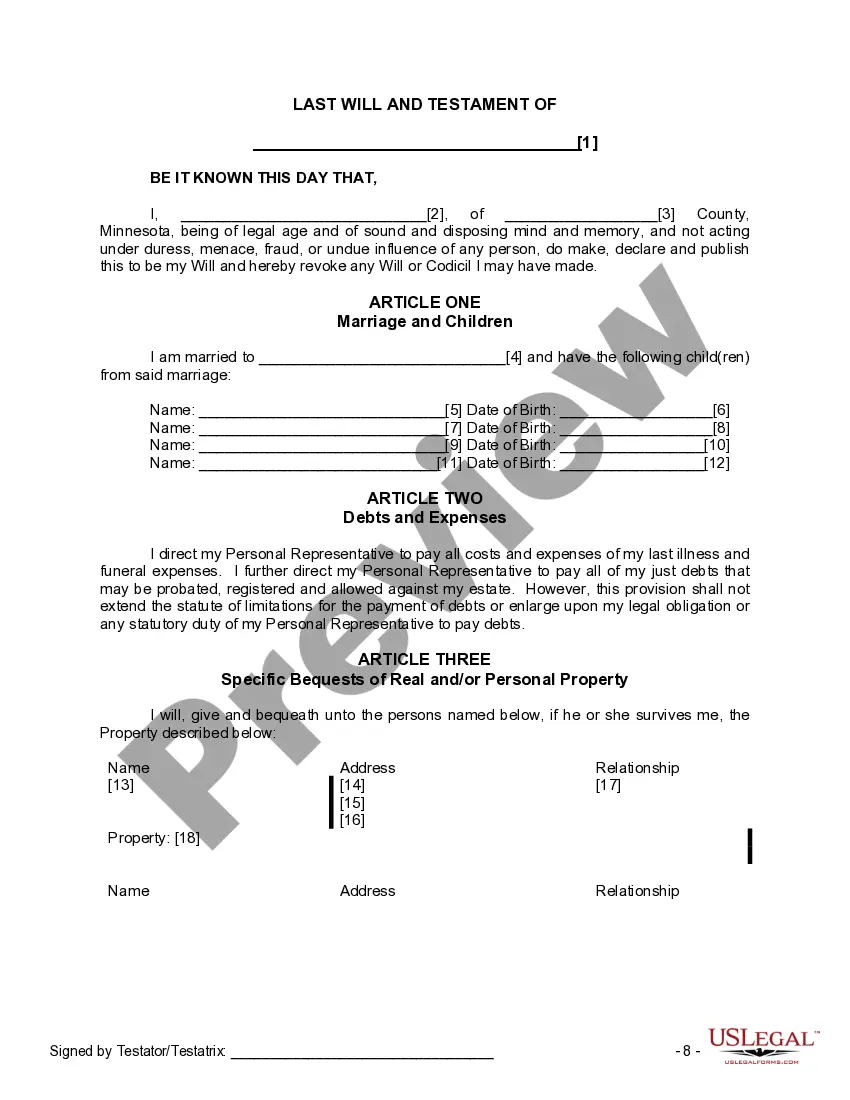
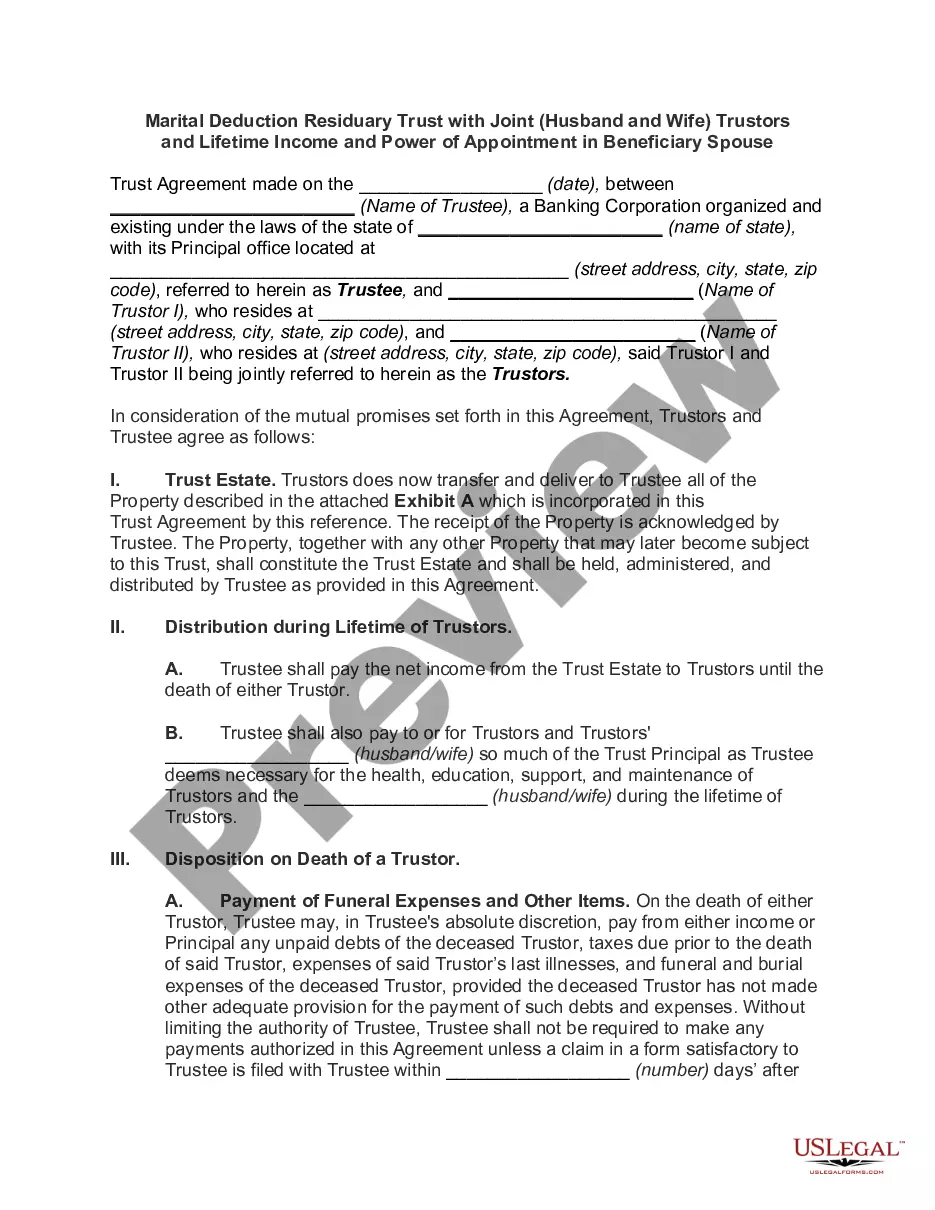
The Mutual Wills Package with Last Wills and Testaments for Married Couples with Minor Children is designed for spouses wanting to make estate planning decisions that protect their children and ensure that their wishes are honored after their passing. This form includes two separate wills that outline how their assets will be distributed, the appointment of a personal representative, and provisions for their minor children, including the establishment of trusts and guardianship arrangements. Unlike standard wills, mutual wills are intended to be binding on both parties, offering additional security for a coupleâs shared intentions regarding their estate.
Key components of this form
- Two Last Wills and Testaments tailored for each spouse.
- Appointment of a personal representative or executor to handle the estate.
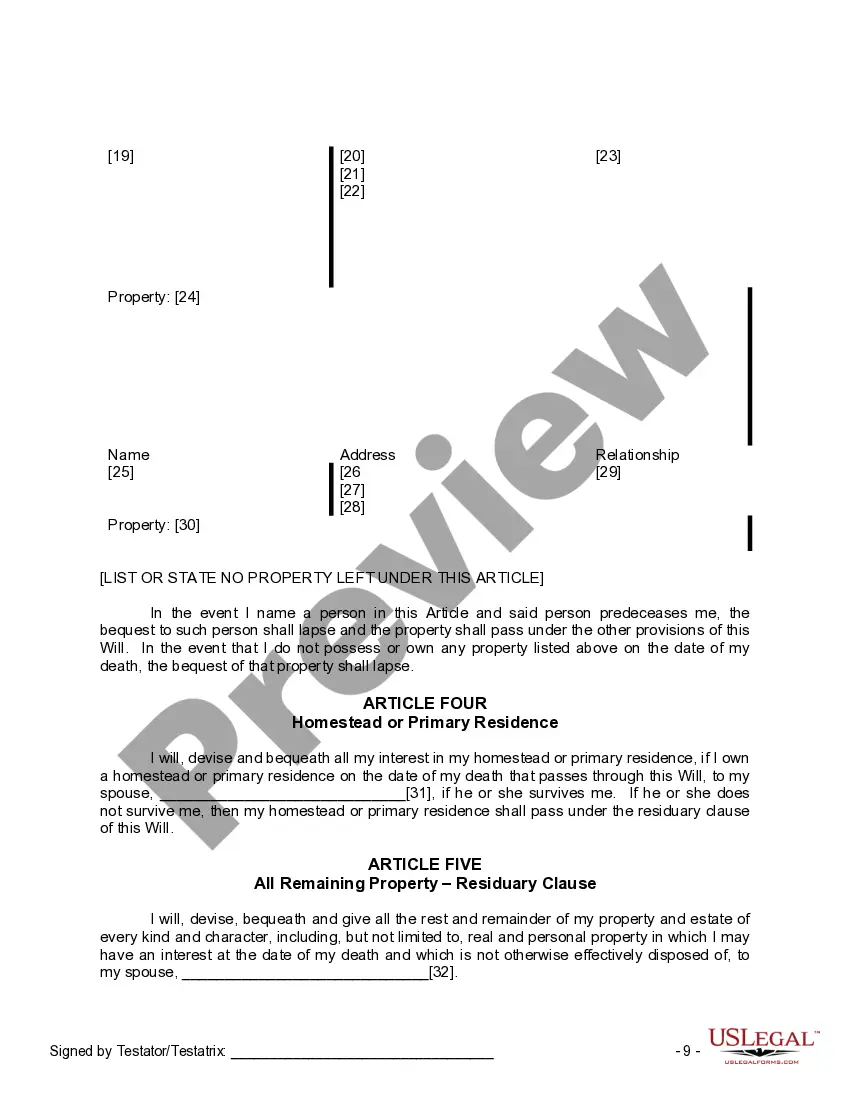
- Details on property distribution, including specific bequests.
- Establishment of a trust for minor children to protect their assets.
- Designate guardianship for any minor children in case both parents pass away.
- Instructions for signing and witnessing to ensure legal validity.




When this form is needed
This mutual wills package is ideal for married couples with minor children who wish to ensure that both parentsâ wishes are respected regarding their assets and care for their children after their death. It is particularly useful when couples agree on how to distribute their estate and want to provide specific instructions for guardianship and trust arrangements for their children. This form is also beneficial when one spouse may be concerned about the other remarrying after their death and potentially altering estate plans.
Intended users of this form
- Married couples with minor children.
- Couples seeking to outline specific distribution of assets.
- Individuals looking for a legally binding arrangement regarding their estate.
- Couples who want to designate guardians for their children.
- Spouses concerned about future asset distribution in the event of death.
Completing this form step by step
- Identify the parties by entering the names of both spouses and their county of residence.
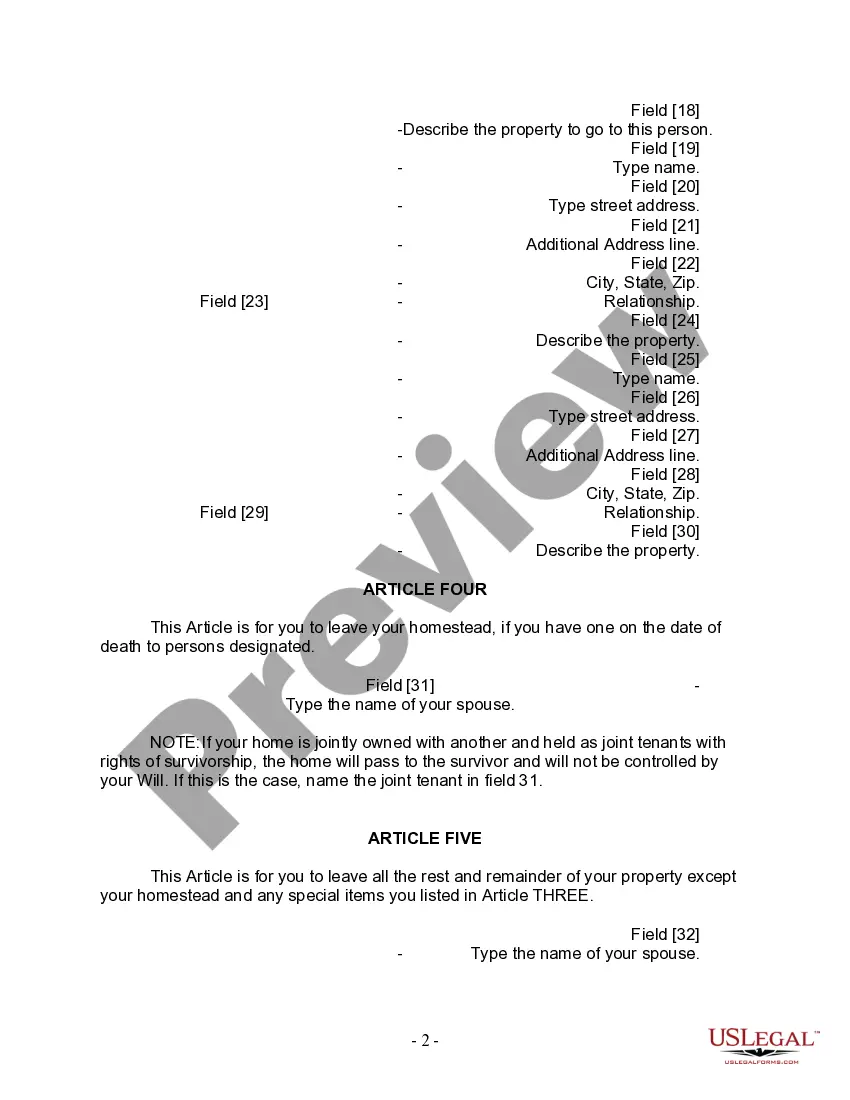
- Designate who will receive specific properties and any bequests by filling out the relevant articles, specifying relationships and property details.
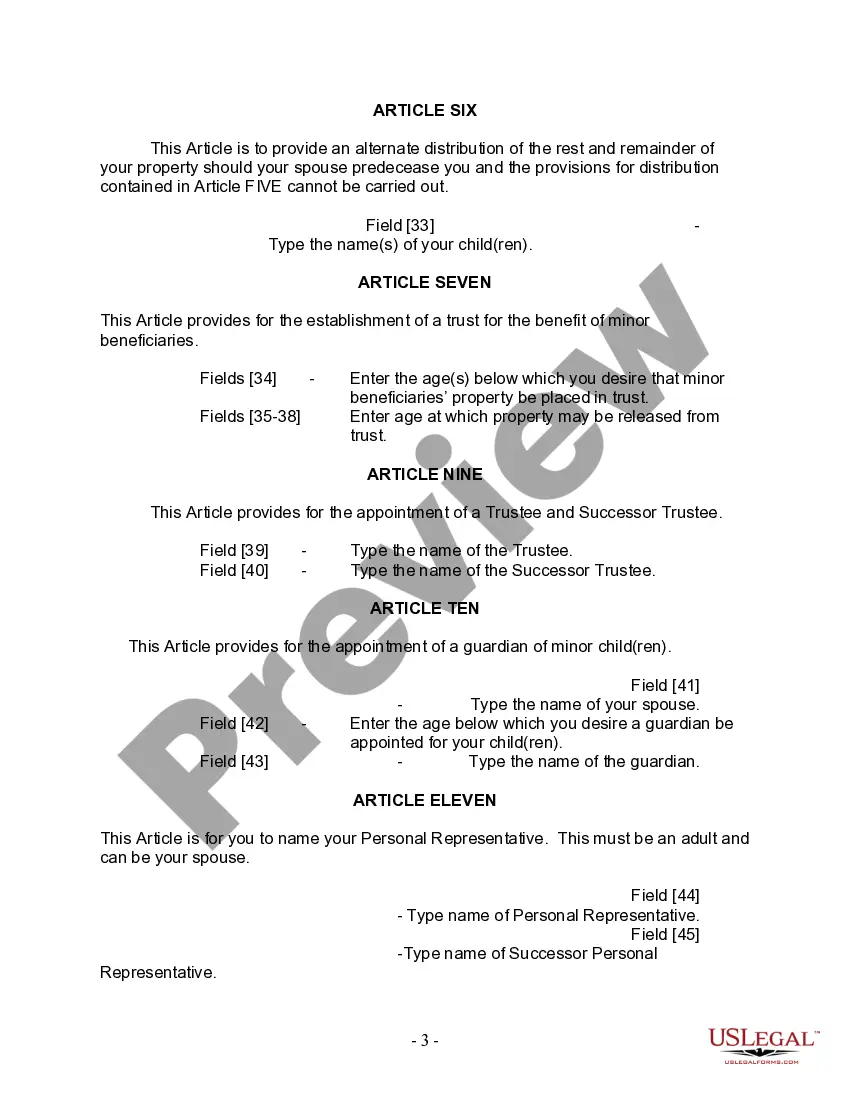
- Appoint a personal representative and any alternates who will manage the estate.
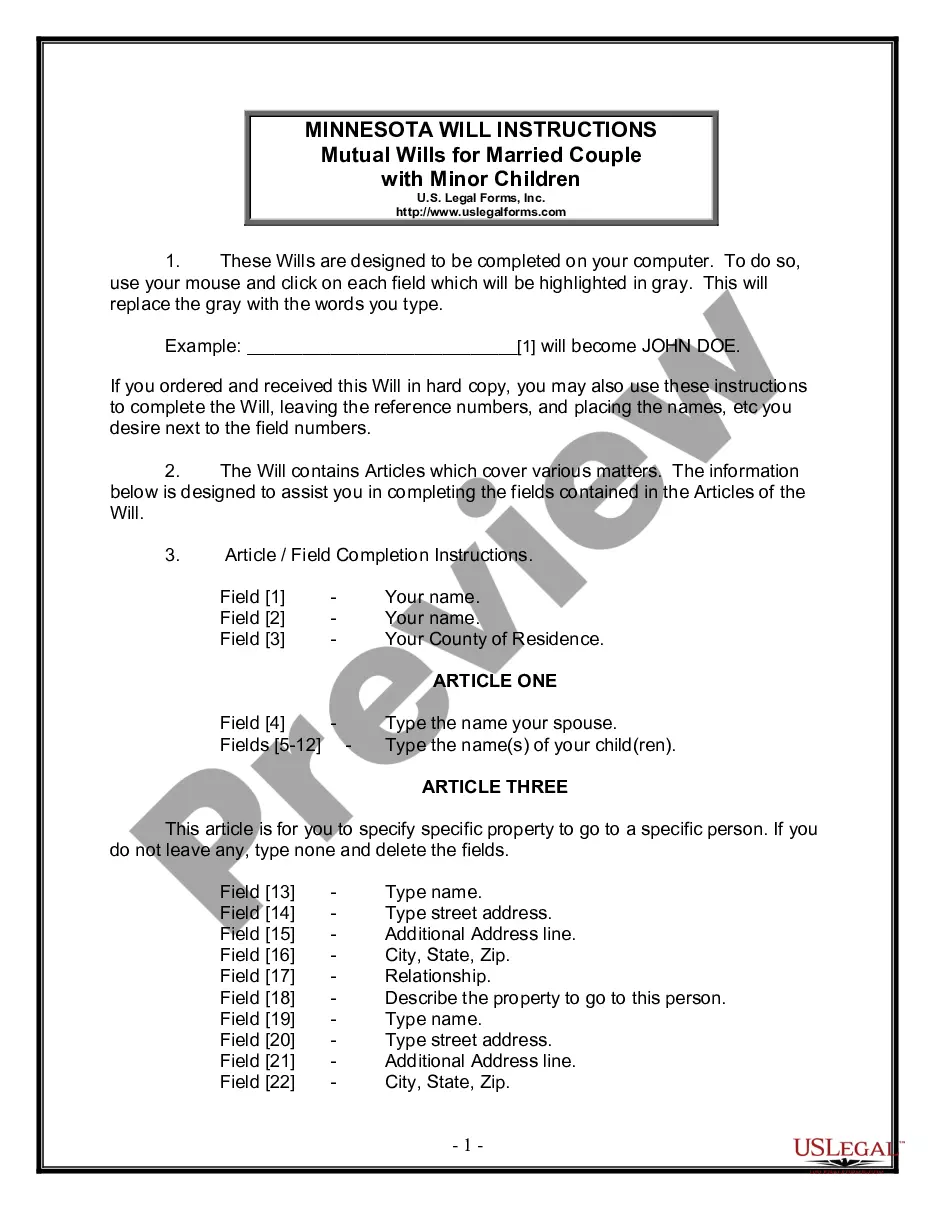
- Provide instructions on the establishment of trusts for minor children, including the age for distribution.
- Ensure the forms are signed by both spouses in the presence of two witnesses as required, and consider notarization for the self-proving affidavit.
Does this form need to be notarized?
Yes, this form must be notarized to be legally valid. It is essential to have the wills signed in front of a notary public to create a self-proving affidavit, simplifying the probate process. U.S. Legal Forms offers integrated online notarization services, allowing you to complete this requirement conveniently via secure video call.
Get your form ready online
Our built-in tools help you complete, sign, share, and store your documents in one place.
Make edits, fill in missing information, and update formatting in US Legal Forms—just like you would in MS Word.
Download a copy, print it, send it by email, or mail it via USPS—whatever works best for your next step.
Sign and collect signatures with our SignNow integration. Send to multiple recipients, set reminders, and more. Go Premium to unlock E-Sign.
If this form requires notarization, complete it online through a secure video call—no need to meet a notary in person or wait for an appointment.
We protect your documents and personal data by following strict security and privacy standards.

Make edits, fill in missing information, and update formatting in US Legal Forms—just like you would in MS Word.

Download a copy, print it, send it by email, or mail it via USPS—whatever works best for your next step.

Sign and collect signatures with our SignNow integration. Send to multiple recipients, set reminders, and more. Go Premium to unlock E-Sign.

If this form requires notarization, complete it online through a secure video call—no need to meet a notary in person or wait for an appointment.

We protect your documents and personal data by following strict security and privacy standards.
Avoid these common issues
- Failing to have the wills signed in the presence of the required witnesses.
- Not explicitly detailing the assets and intended distributions, leading to confusion.
- Omitting assignments for guardianship of minor children.
- Not reviewing or updating the wills after significant life changes.
- Assuming mutual wills cannot be revoked or modified â these can be if both parties agree.
Why complete this form online
- Conveniently fill out the wills from the comfort of your home.
- Templates are drafted by licensed attorneys to ensure legal compliance.
- Easy edits can be made if circumstances change.
- Immediate access to necessary forms without scheduling in-person appointments.
- Guided instructions to help navigate the completion process.
Legal use & context
- This form is legally binding and enforceable provided it is completed in accordance with state laws.
- Regular review is encouraged to keep the document aligned with your current wishes and legal standards.
- In the absence of a will, assets may be distributed according to intestate laws, which may not reflect your desires.
Quick recap
- The mutual wills package is designed for married couples with minor children, ensuring joint intentions are respected.
- Proper execution includes witness signatures and, ideally, notarization for greater legal assurance.
- It provides options for asset protection, distribution, and guardianship for minor children.
- Using this package can simplify estate planning and help alleviate potential family disputes in the future.
Looking for another form?

Form popularity
FAQ
One key disadvantage of a mutual will is that it can limit flexibility for both spouses. Once a mutual will is created, it may restrict either spouse from changing their wishes without the consent of the other. This can be particularly challenging if circumstances change, such as the birth of additional children or changes in financial situations. To navigate these complexities effectively, consider a Minnesota Mutual Wills Package with Last Wills and Testaments for Married Couple with Minor Children that allows for clear communication and planning.
In many cases, a married couple can benefit from having a Minnesota Mutual Wills Package with Last Wills and Testaments for Married Couple with Minor Children. While it might seem simpler to have one will, having two separate wills allows each spouse to express their individual wishes clearly. This approach can also address specific concerns related to minor children, ensuring that both parents' intentions are honored. Ultimately, having separate wills provides clarity and reduces potential conflicts.
Joan of France, Duchess of Berry (age 12), was betrothed in a wedding contract at age 8-days-old, she was officially married at the age of twelve in 1476, to her cousin Louis, Duke of Orleans (aged 14).
During this period, 12-year-olds were granted marriage licenses in Alaska, Louisiana and South Carolina, and 13-year-olds were allowed to marry in Alabama, Florida, Idaho, Kentucky, Louisiana, Mississippi, Missouri, New Hampshire, New Jersey, New Mexico, South Carolina, Tennessee, Texas and Washington.
Massachusetts has the lowest minimum marriage age with parental consent of 14 years old for boys and 12 years old for girls.
Duzdidil Kad0131n (aged 14) was married to Abdulmejid I (aged 16) in 1839. 015eevkefza Kad0131n (aged 16) was married to Abdulmejid I (aged 16) in 1839. Zeynifelek Han0131m (aged 15) was married to Abdulmejid I (aged 16) in 1839. GA¼lcemal Kad0131n (aged 14) was married to Abdulmejid I (aged 17) in 1840.
This is a fact! While 18 is the minimum marriage age in most states, there are exceptions in every state that allow children younger than 18 to marry, typically with parental consent or judicial approval.
Quartz examined marriage ages for countries with at least 5 million people, and for which the United Nations had data for men and women. The very oldest to get married are in Bulgaria at 34, while the youngest are in Niger at almost 21.
In Alaska, Arizona, Connecticut, Florida, Georgia, Maryland, Montana, New Mexico, North Carolina, Oklahoma, Pennsylvania, South Dakota, Tennessee, Virginia, and Wyoming you may get married if you are under the age of 16 only if you have both parental approval and judicial consent.
In Hawaii, parties may get married at the age of 15 with parental consent and/or the consent of a judge. Parental consent is needed in Alabama and Utah at age 14, and in Nebraska and Oregon, the age is 17. As is the case in Texas, ages for males and females to marry differs in some states.