Maine Last Will and Testament for Divorced Person Not Remarried with No Children
About this form
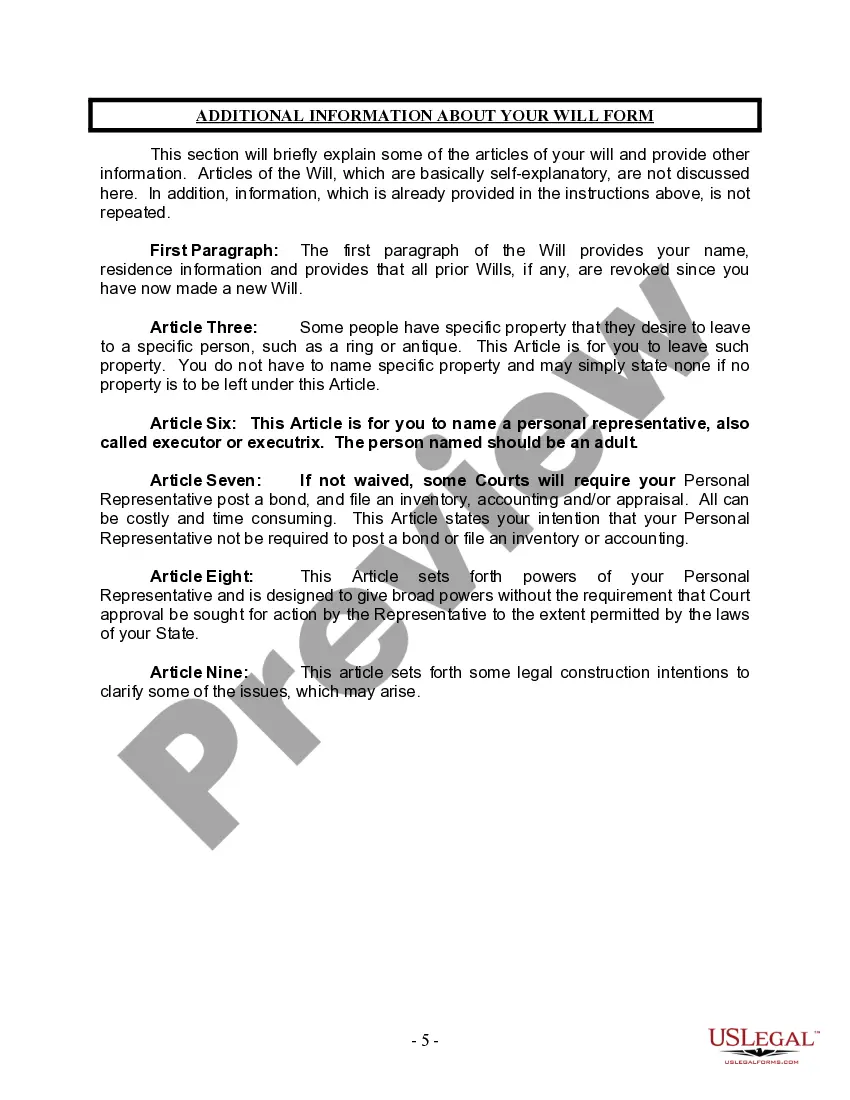
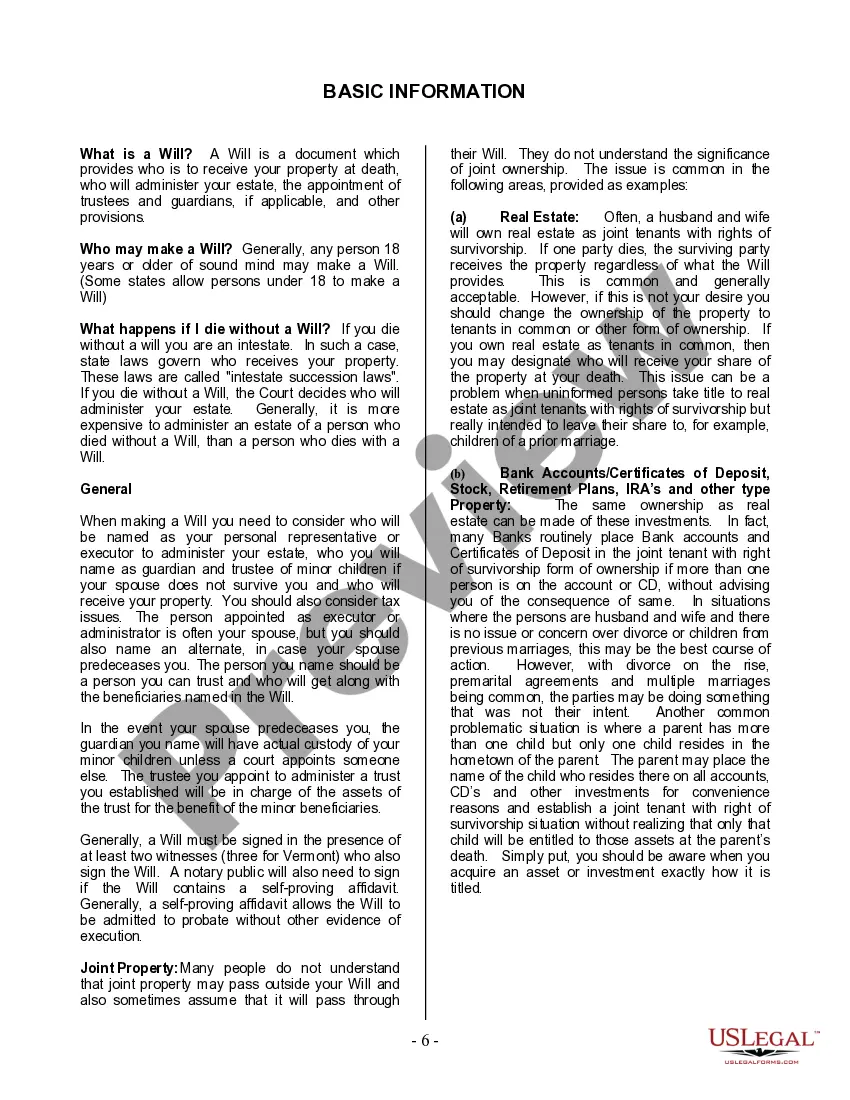
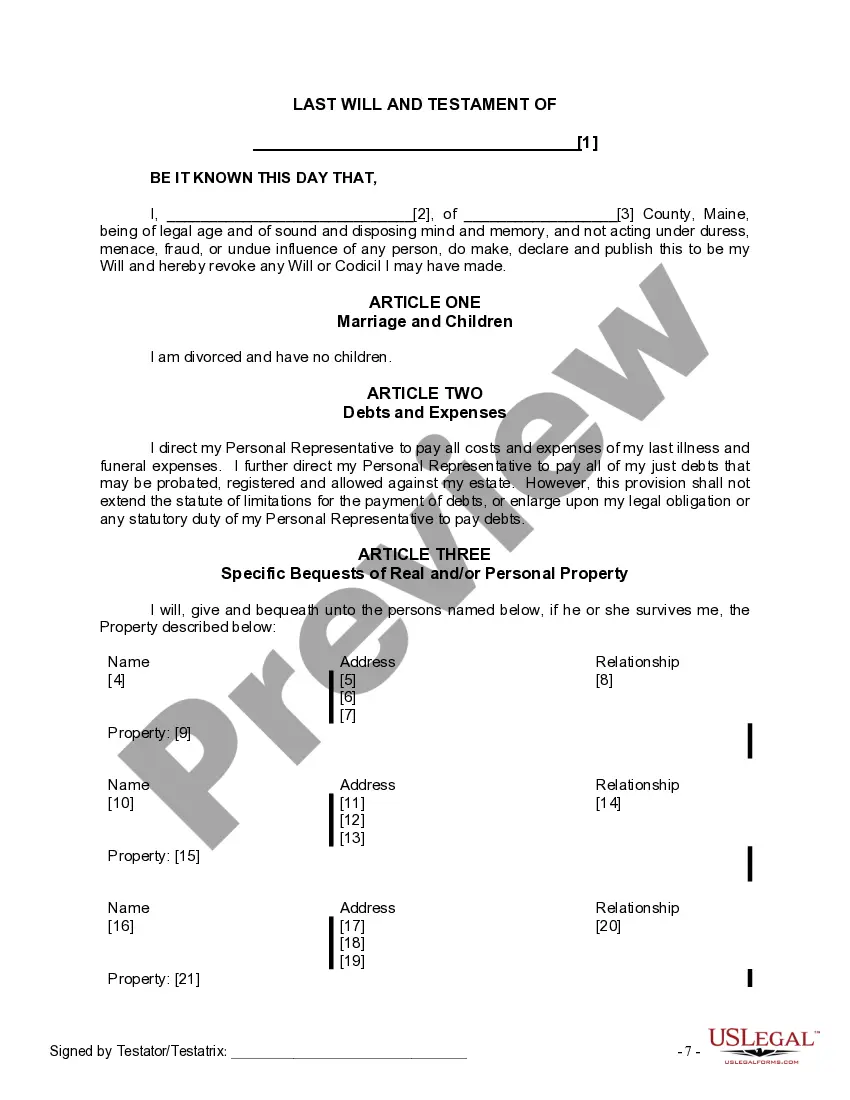
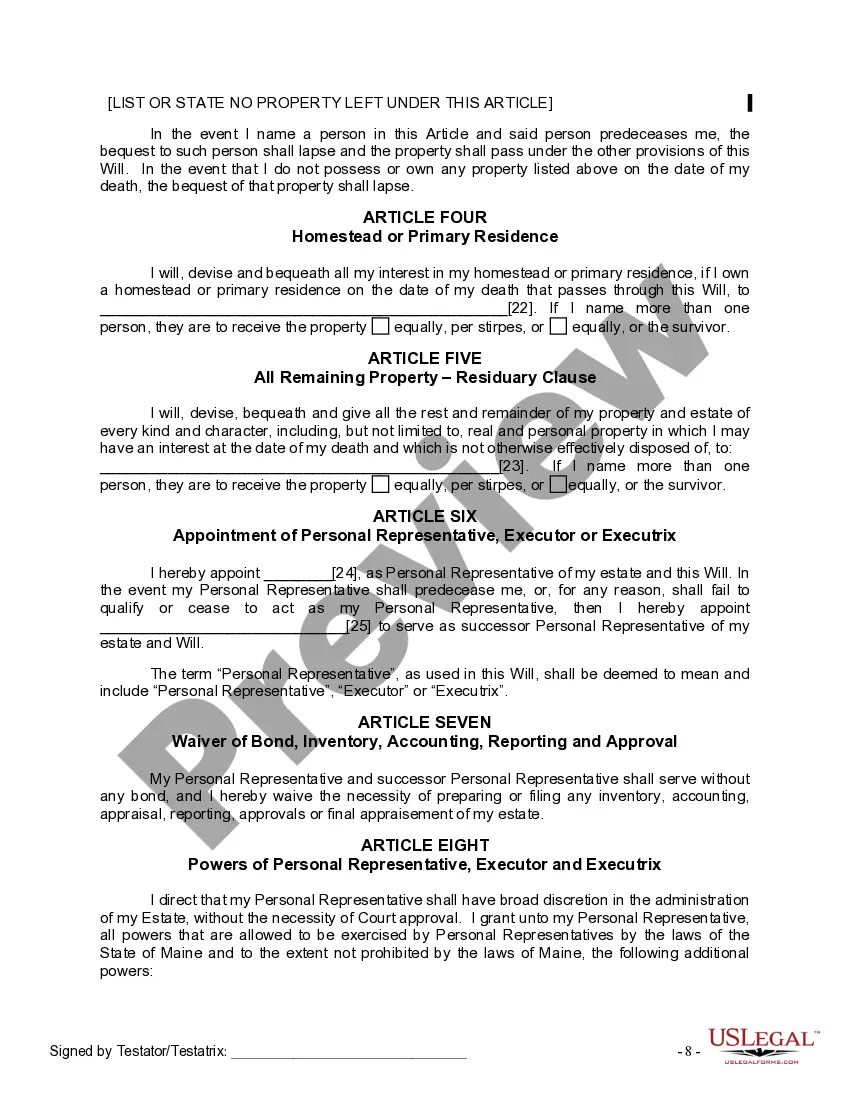
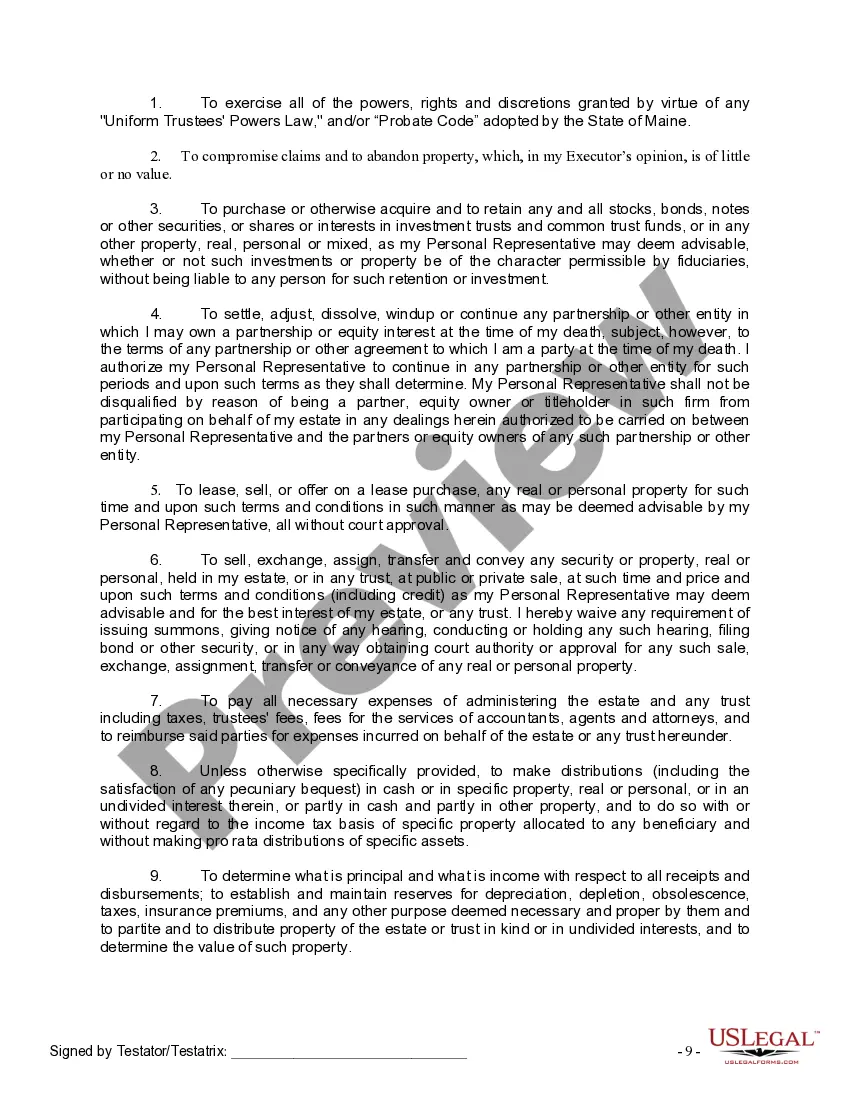
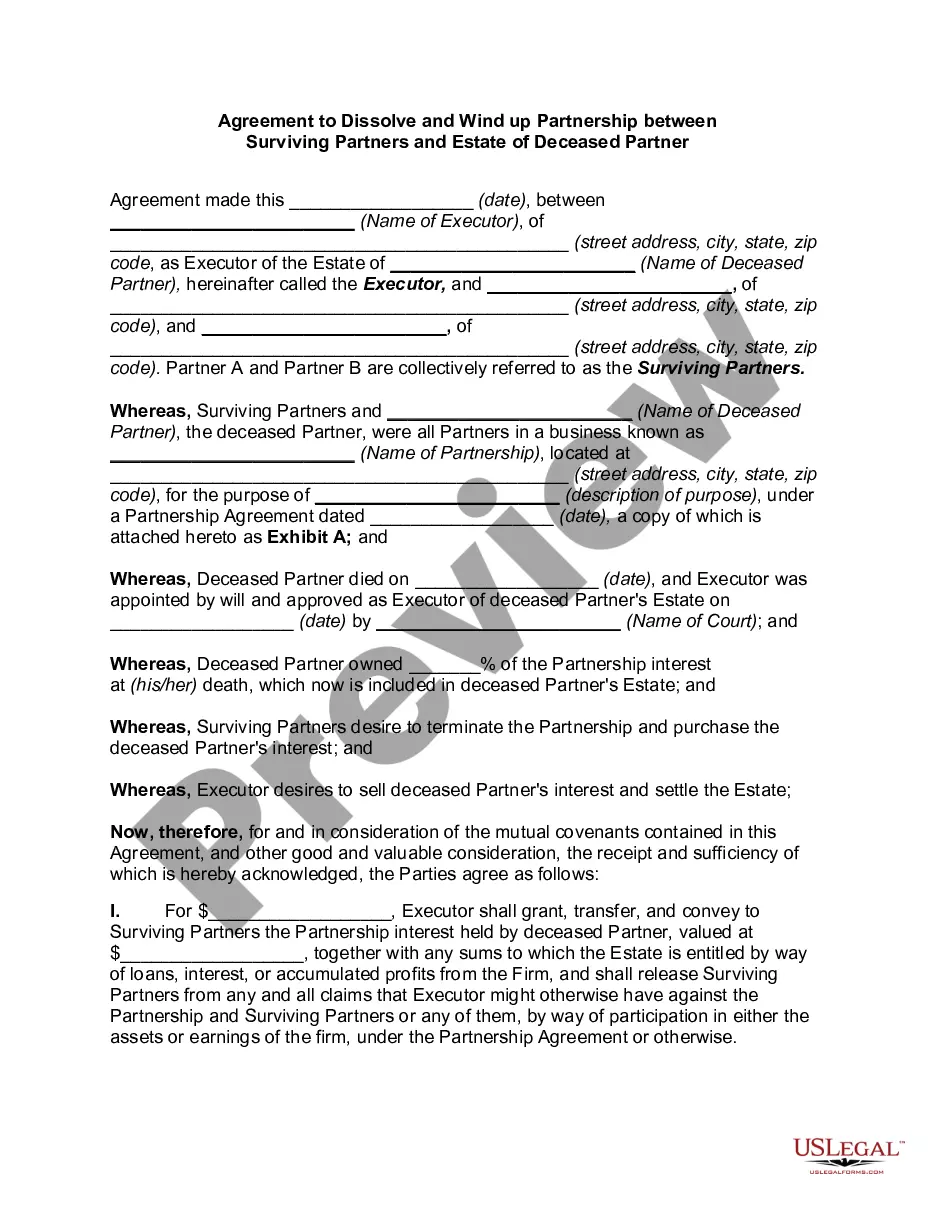
This Last Will and Testament is a legal document tailored for a divorced person who has not remarried and has no children. It establishes clear instructions for the distribution of assets upon death, appoints a personal representative or executor, and includes other essential provisions. This form is specifically designed to address the circumstances and needs of individuals with different familial dynamics, distinguishing it from more general wills.
Key parts of this document
- Executor appointment: Designate a personal representative to manage your estate.
- Specific bequests: Specify individuals who will receive particular items or properties.
- Homestead allocation: Provide instructions for the disposition of your primary residence.
- Residuary clause: Outline who will receive any remaining assets after specific distributions.
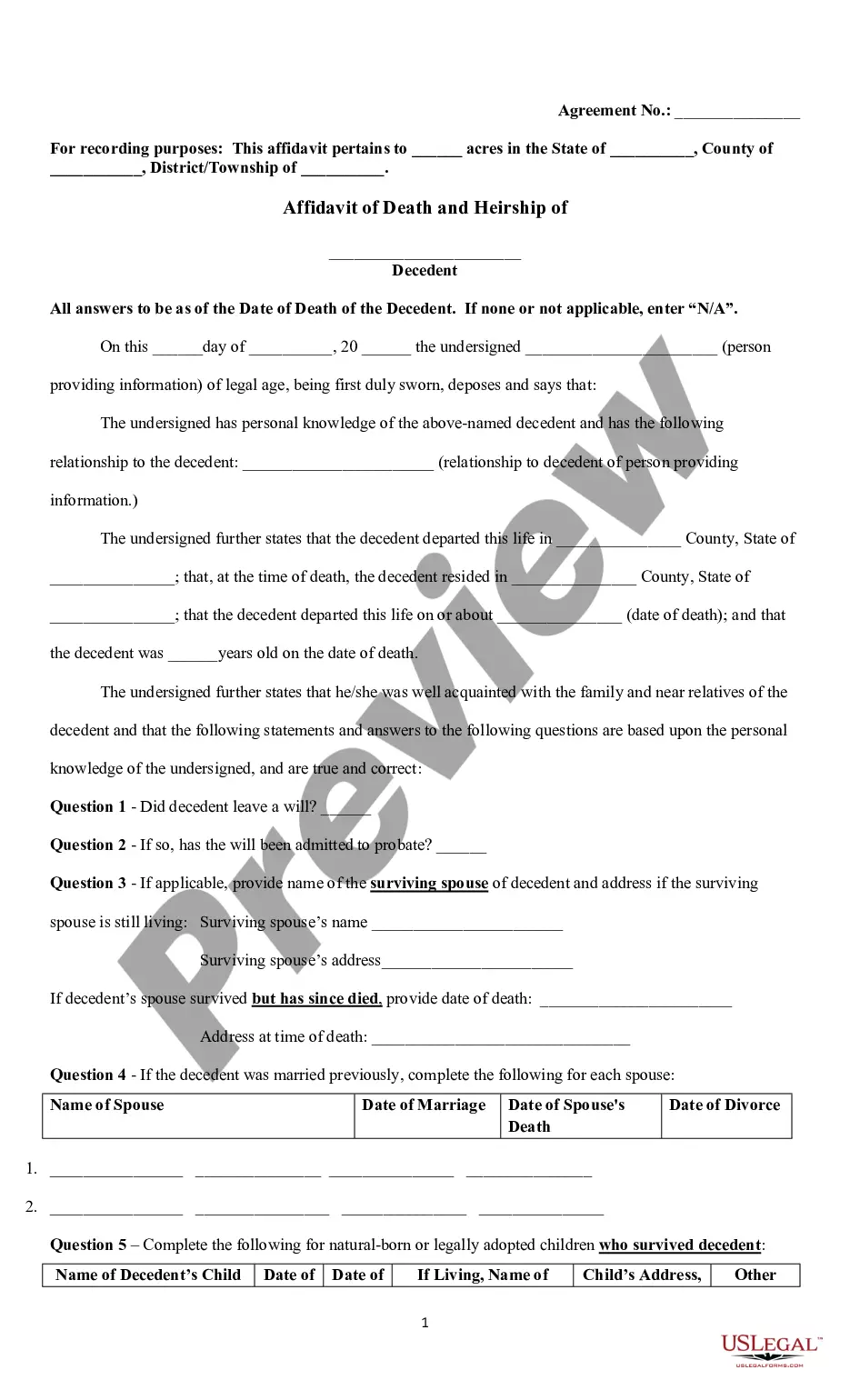
- Witness and notarization requirements: Outline the need for signatures and the possibility of a self-proving affidavit for probate ease.



Situations where this form applies
This form is beneficial in various scenarios, including:
- When you are a divorced individual who has no children and want to dictate asset distribution after your death.
- If you have specific belongings or properties you wish to assign to particular people.
- When you want to take control over the administration of your estate via a trusted personal representative.
Who needs this form
This Last Will and Testament is intended for:
- Divorced individuals who have not remarried.
- Persons without children who want to clarify their wishes regarding their estate.
- Anyone needing a simple, clear, and legally-binding document to ensure their assets are distributed according to their desires.
Steps to complete this form
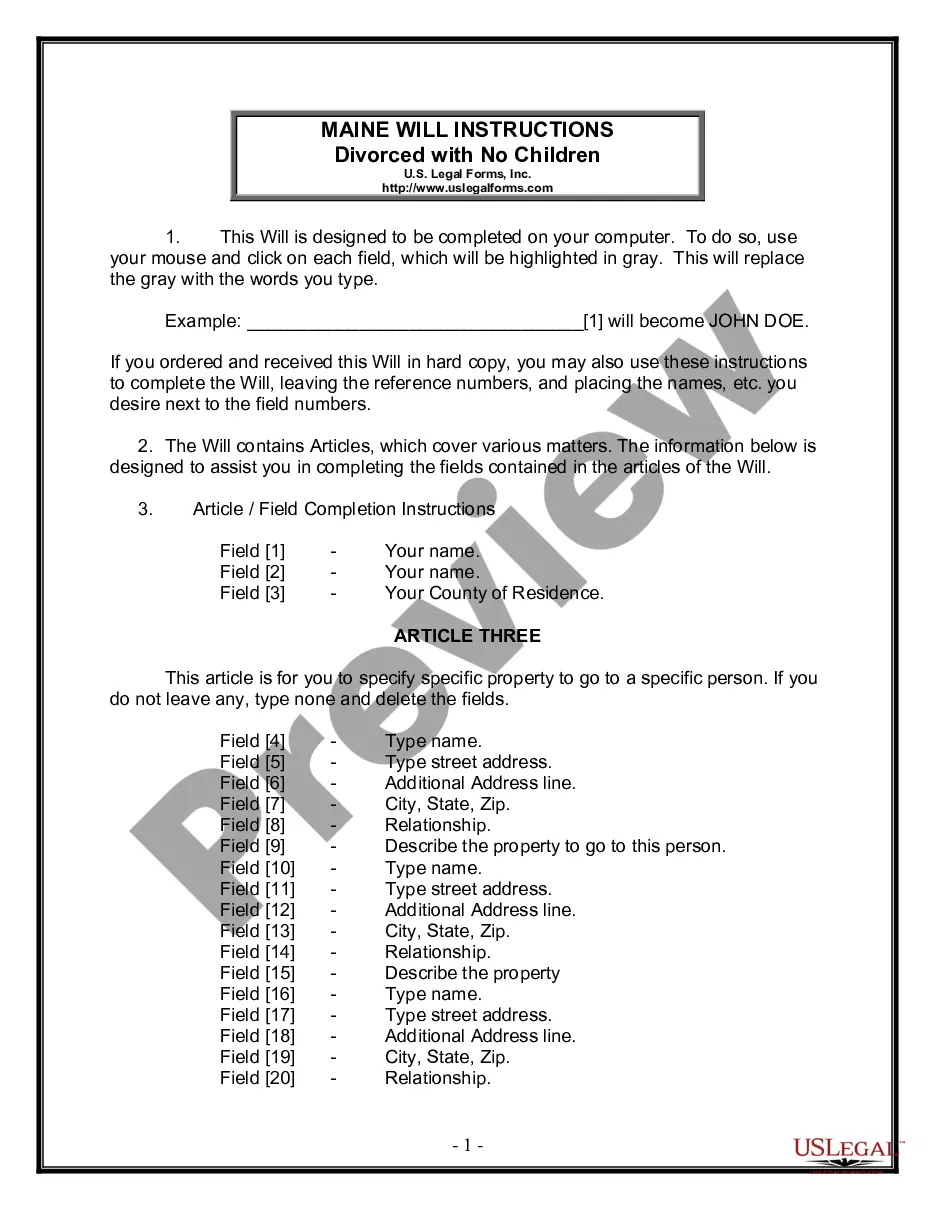
- Begin by entering your full name and residence details.
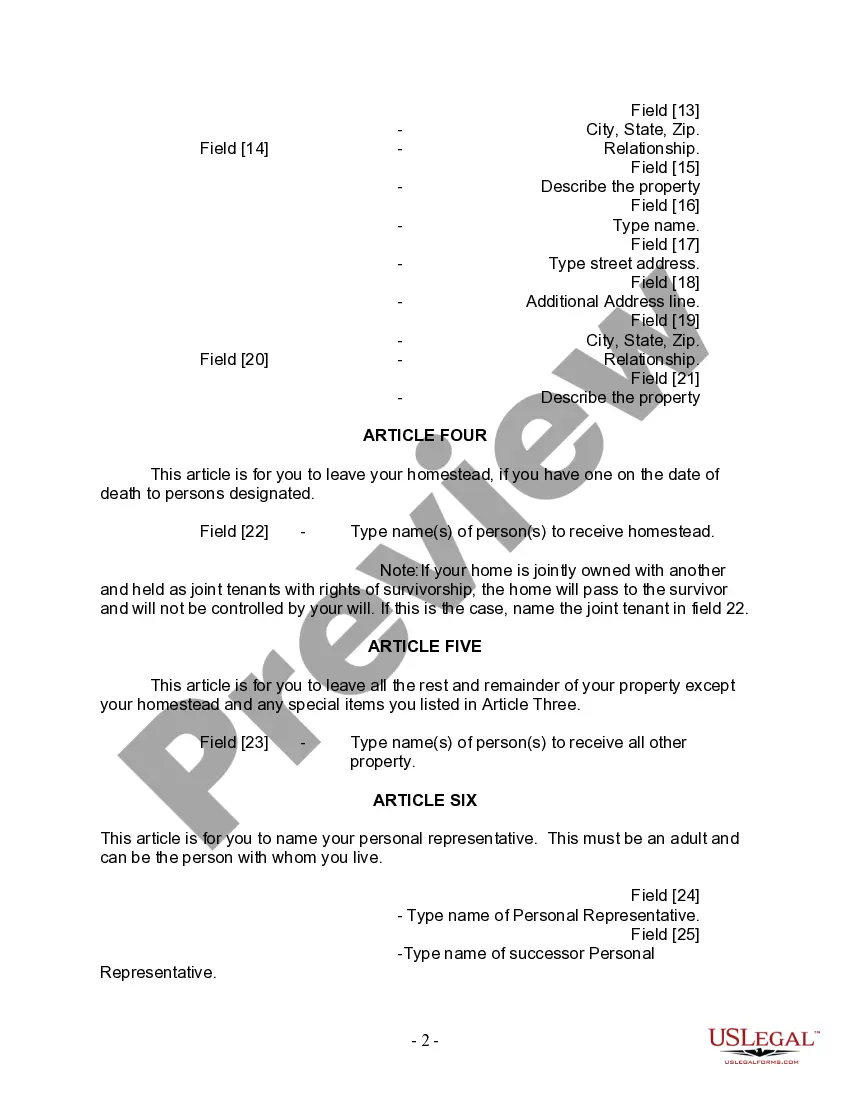
- Designate a personal representative and, if necessary, a successor representative.
- List specific bequests in the specified fields, indicating the recipient and a description of the property.
- Provide details for your homestead or primary residence to ensure it's distributed as intended.
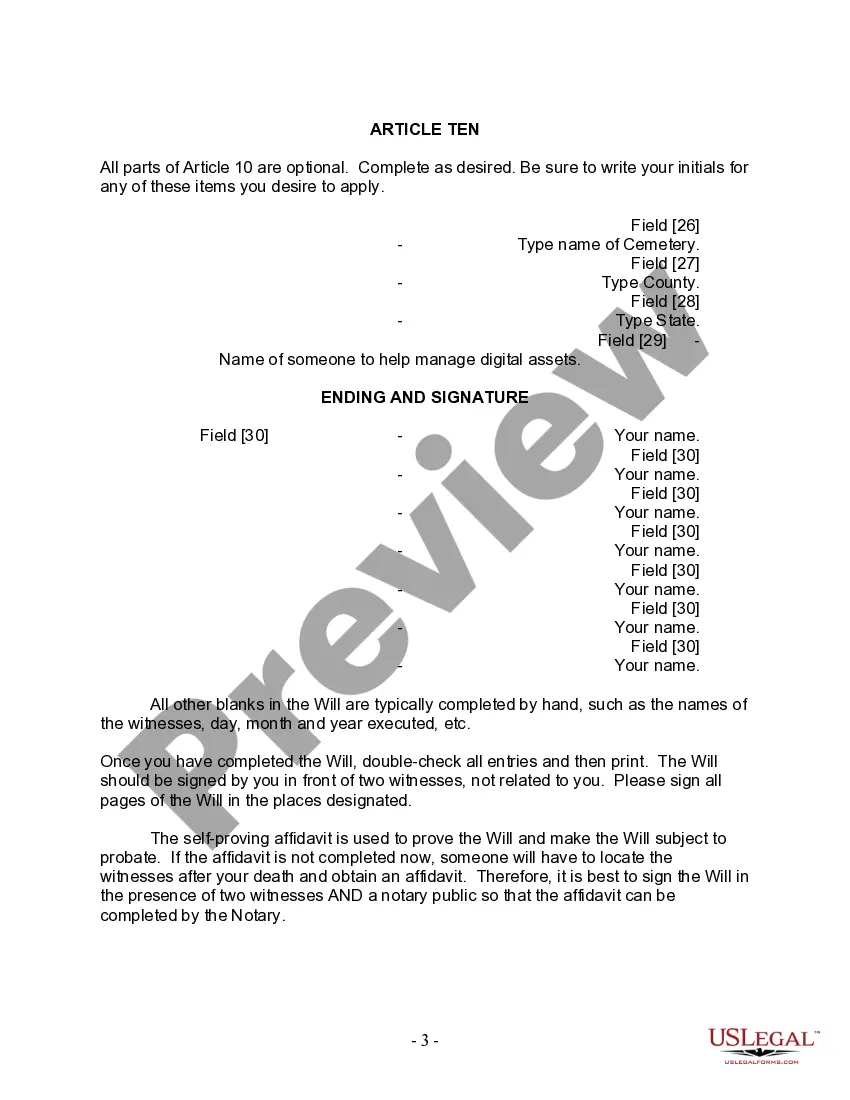
- Ensure all signatures from you and witnesses are collected as required; if using a self-proving affidavit, include it before notarization.
Notarization guidance
Yes, this form must be notarized to be legally valid. A notary's signature is essential to confirm the authenticity of the document and to facilitate the self-proving affidavit process, which can streamline probate.
Get your form ready online
Our built-in tools help you complete, sign, share, and store your documents in one place.
Make edits, fill in missing information, and update formatting in US Legal Forms—just like you would in MS Word.
Download a copy, print it, send it by email, or mail it via USPS—whatever works best for your next step.
Sign and collect signatures with our SignNow integration. Send to multiple recipients, set reminders, and more. Go Premium to unlock E-Sign.
If this form requires notarization, complete it online through a secure video call—no need to meet a notary in person or wait for an appointment.
We protect your documents and personal data by following strict security and privacy standards.

Make edits, fill in missing information, and update formatting in US Legal Forms—just like you would in MS Word.

Download a copy, print it, send it by email, or mail it via USPS—whatever works best for your next step.

Sign and collect signatures with our SignNow integration. Send to multiple recipients, set reminders, and more. Go Premium to unlock E-Sign.

If this form requires notarization, complete it online through a secure video call—no need to meet a notary in person or wait for an appointment.

We protect your documents and personal data by following strict security and privacy standards.
Avoid these common issues
- Failing to sign the will in the presence of two witnesses.
- Not filling out the self-proving affidavit when applicable, which can complicate the probate process.
- Omitting or incorrectly filling in the personal representativeâs details.
Why complete this form online
- Convenience of completing the form at your own pace from any device.
- Editable online format allows for easy updates as life circumstances change.
- Access to forms drafted by licensed attorneys, ensuring legal compliance.
Looking for another form?









Form popularity
FAQ
Include personal identifying information. Include a statement about your age and mental status. Designate an executor. Decide who will take care of your children. Choose your beneficiaries. List your funeral details. Sign and date your Last Will and Testament.
A notarized will does not need to be probated.When a person dies leaving behind a will that is not notarized, the law requires that its validity be ascertained by a notary or by a court. Similarly, any non-notarized modification made to a will must be probated, whether the will is notarized or not.
Notarizing a will is not necessary as long as your will has been properly constructed and witnessed; the court will view it as a legally binding document. However, you may still want to include a self-proving affidavit and get your will notarized, since it can help the probate process move faster.
The Free Last Will and Testament Template for Word is compatible with Word 2003 or later versions.
No, in Maine, you do not need to notarize your will to make it legal. However, Maine allows you to make your will "self-proving" and you'll need to go to a notary if you want to do that. A self-proving will speeds up probate because the court can accept the will without contacting the witnesses who signed it.
In addition, Maine allows a will to be made without witnesses if it is written by hand by the testator and signed at the end. 18-A M.R.S.A. § 2-503. This is called a holographic will.
In most situations, a will template is an easy and inexpensive way to make sure your wishes are known and carried out. Most people can get everything they need by using a will template, with little cost or hassle.
To start the probate process, you need to file an Application for Probate in the probate court in the county where the decedent lived. In Maine, each county has its own probate court. If there is a Will, it needs to be submitted to the probate court. The probate judge will decide whether or not the Will is valid.