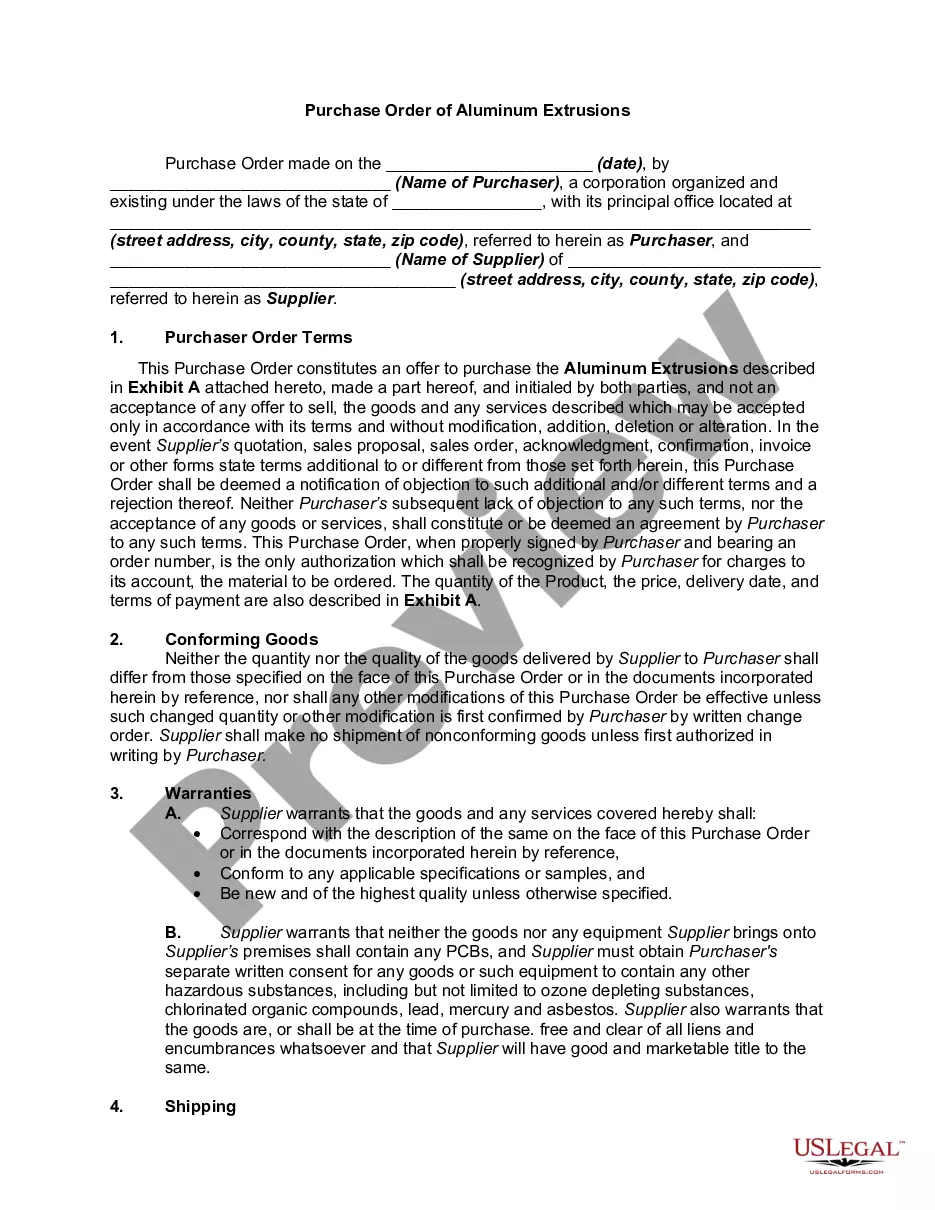
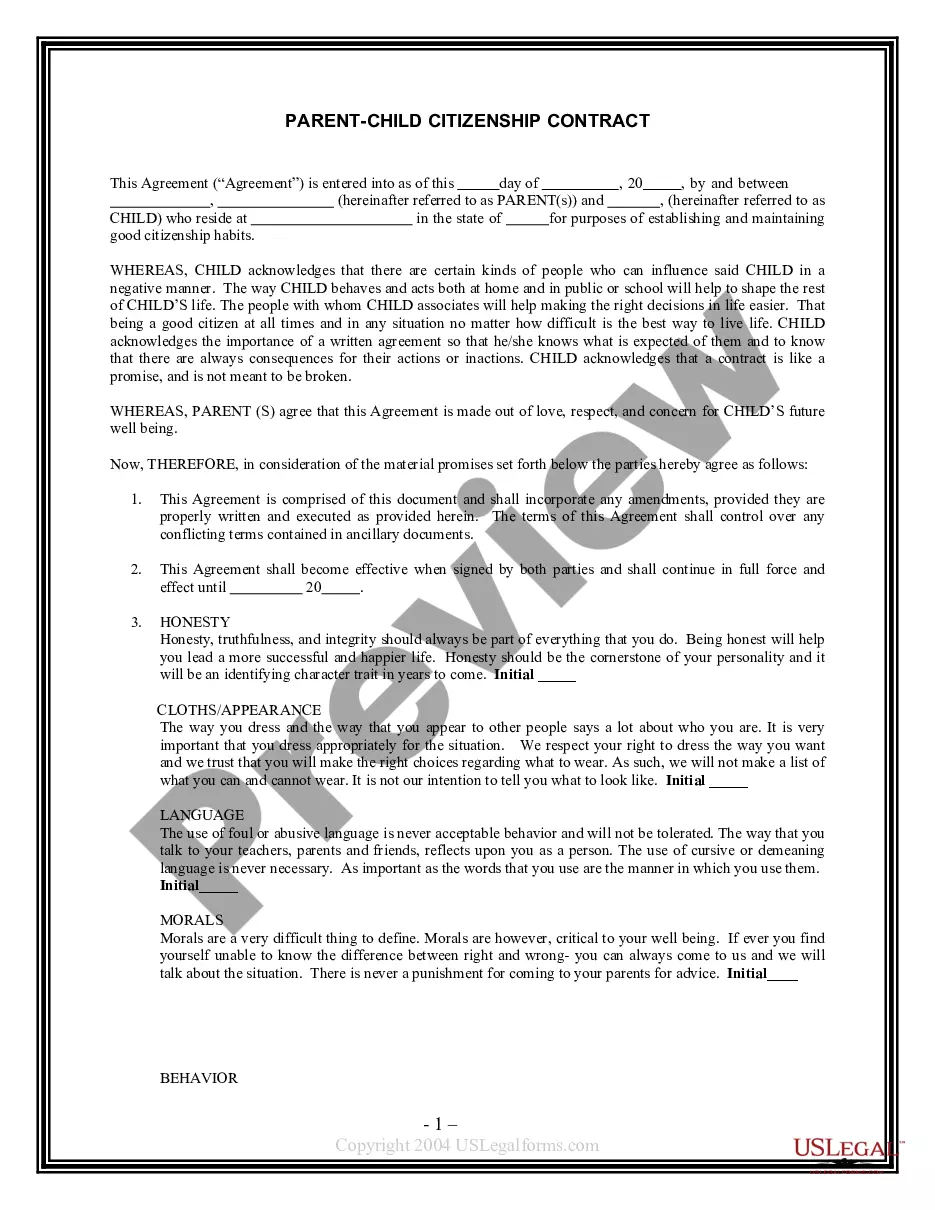
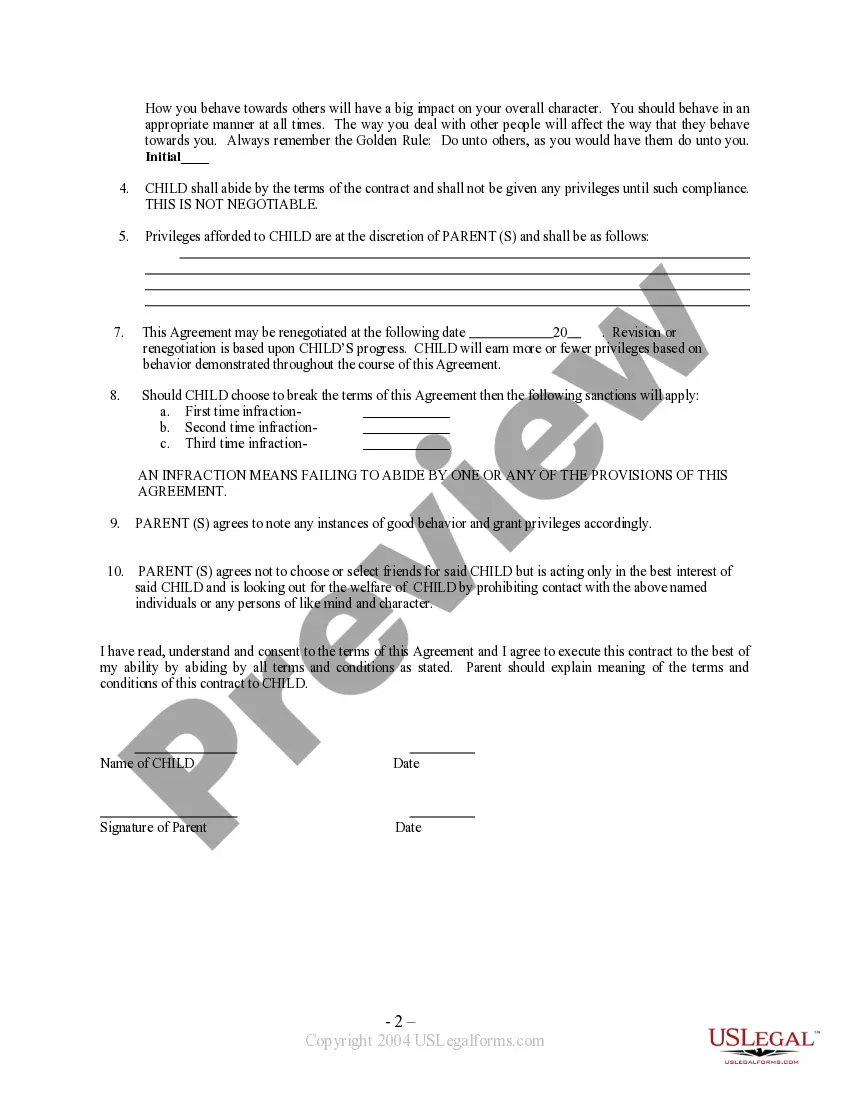
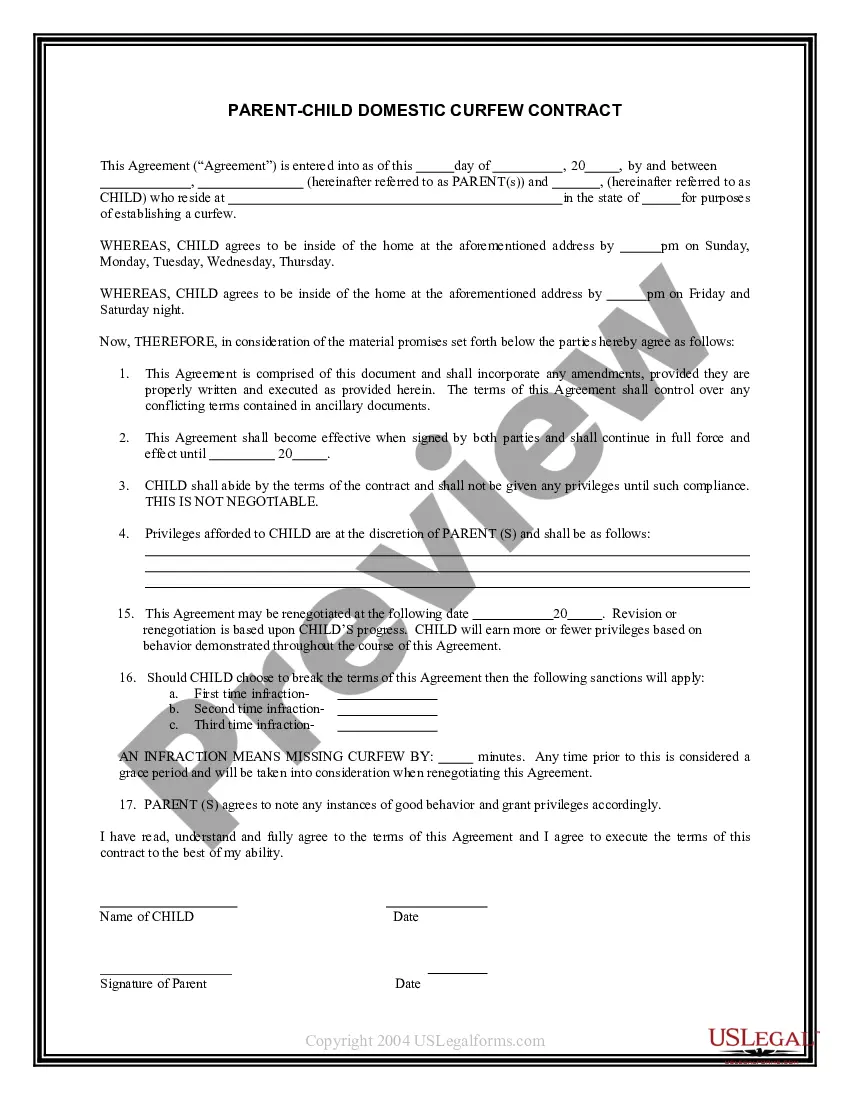
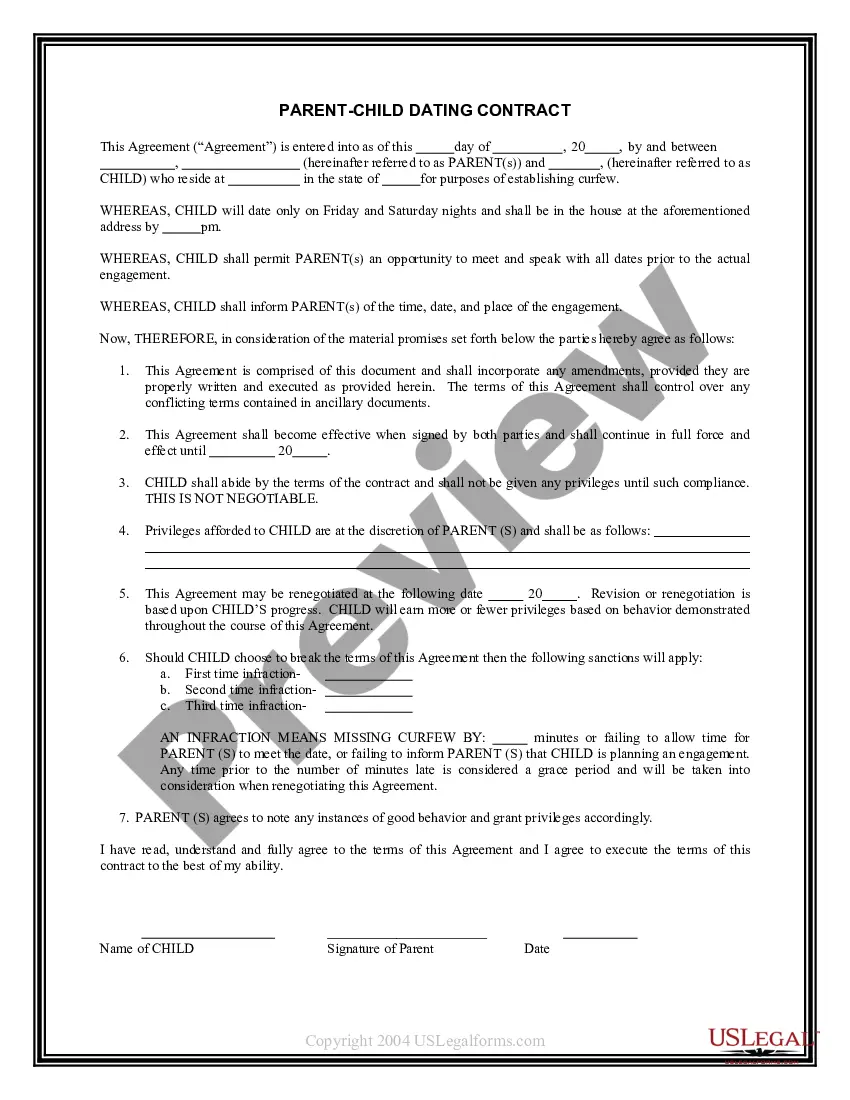
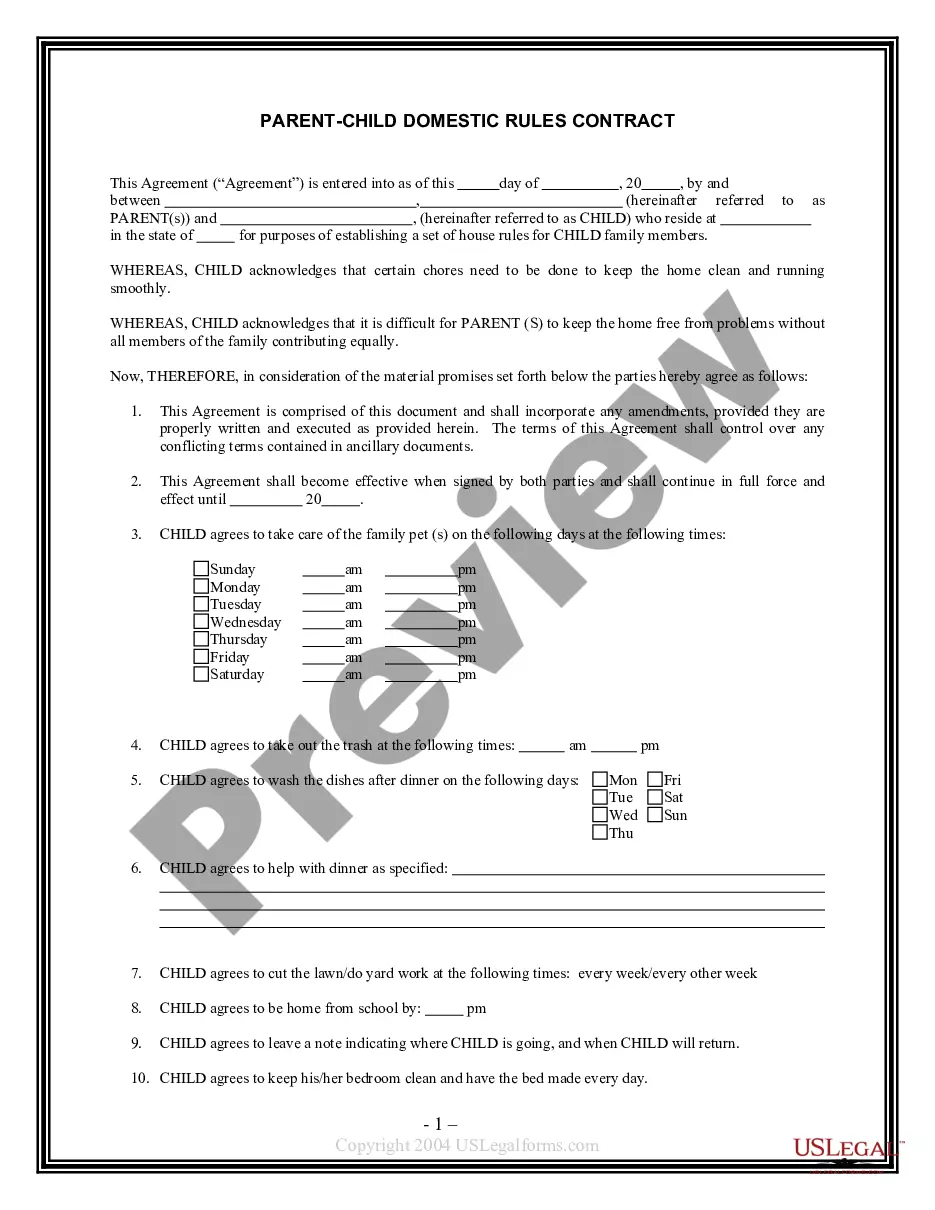
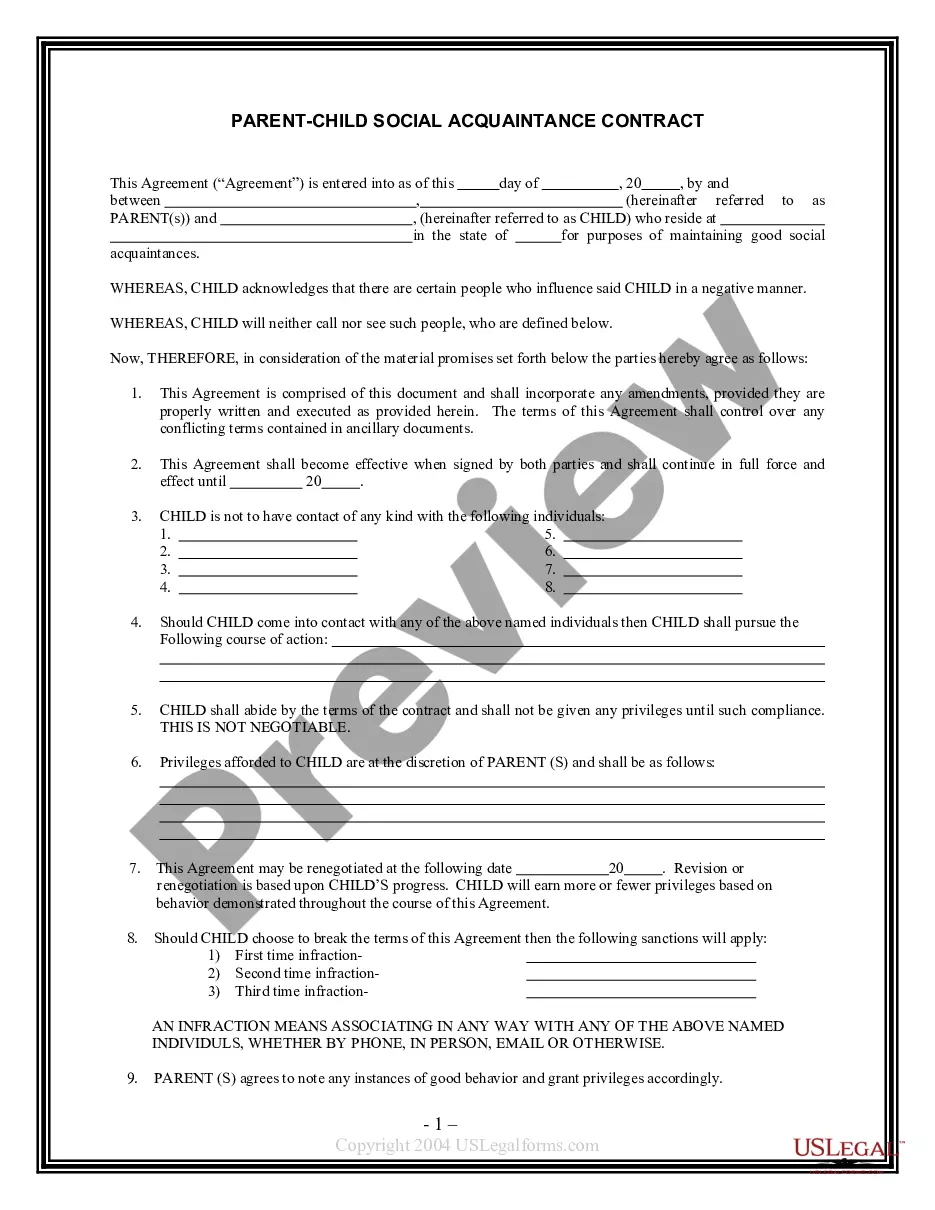
This is a contract between parent(s) and child indicating what is expected of child on a daily basis, including the need to be honest and what types of language child should refrain from using. Privileges are afforded for good behavior and for keeping the terms of the contract. Privileges are withdrawn for poor conduct.
Wayne Michigan Parent - Child Citizenship Contract
Category:
State:
Multi-State
County:
Wayne
Control #:
US-PC05
Format:
Word;
Rich Text
Instant download
Description
Free preview







How to fill out Parent - Child Citizenship Contract?
Creating documents for business or personal obligations is always a significant duty.
When drafting an agreement, a public service application, or a power of attorney, it’s essential to consider all federal and state statutes and regulations for the specific locality.
Nonetheless, smaller counties and even municipalities also have legislative procedures that must be taken into account.
To find the template that meets your needs, use the search tab in the header of the page. Double-check that the template adheres to legal standards and click Buy Now. Select the subscription option, then Log In or create an account with US Legal Forms. Use your credit card or PayPal account to pay for your subscription. Download the selected file in your preferred format, print it, or fill it out electronically. The remarkable aspect of the US Legal Forms library is that all documents you have ever purchased remain accessible—you can find them in your profile under the My documents section at any time. Join the platform and readily acquire verified legal forms for any purpose with just a few clicks!
- All these aspects render it challenging and time-consuming to formulate Wayne Parent - Child Citizenship Contract without expert guidance.
- It’s simple to prevent unnecessary expenses on attorneys crafting your documents and produce a legally acceptable Wayne Parent - Child Citizenship Contract independently, utilizing the US Legal Forms online library.
- This library is the most extensive online collection of state-specific legal templates that are professionally verified, ensuring their authenticity when you select a sample for your county.
- Previously registered users merely need to Log In to their accounts to download the necessary form.
- If you don't have a subscription yet, follow the step-by-step instructions below to acquire the Wayne Parent - Child Citizenship Contract.
- Examine the page you’ve accessed and verify if it includes the sample you need.
- In order to do this, utilize the form description and preview if these features are available.
Form popularity
FAQ
What Is U.S. Citizenship? America follows the English common law rule of "right of soil." In short, citizenship is determined by one's place of birth. Those born in the U.S. or its territories (like Puerto Rico, the Virgin Islands and Guam), are American citizens regardless of their parents' citizenship status.
A child who is born to U.S. citizen parents (or in some cases, to only one U.S. citizen parent) outside the U.S. may automatically become a U.S. citizen. This is called "acquisition" of U.S. citizenship.
Whether you become a U.S. citizen at birth or after birth depends on a number of factors, including: Your date of birth; The citizenship and marital status of your parents; Your parents' physical presence and residence in the United States before your child's birth.
Alternative documents might include two or more affidavits of birth (sworn letters written by relatives or other persons with personal knowledge of the facts of a child's birth), as well as medical records, school records, and religious records (such as certificate of baptism issued by a church) showing the names of
For a U.S. citizen child to petition for a parent, the child must be at least 21 years of age.
The short answer to the Can I get a green card through my child? question is yes but there are some caveats. The most difficult limitation is the child's age. Only parents of a U.S. citizen who is at least 21 years old will be considered immediate relatives that are eligible for a green card right away.
After you become a citizen of the United States, you may help your parents become lawful permanent residents of the United States. To do so, you need to sponsor your parent. You are eligible to get a Green Card for parents if you are a U.S. citizen and at least 21 years old.
Alternative documents might include two or more affidavits of birth (sworn letters written by relatives or other persons with personal knowledge of the facts of a child's birth), as well as medical records, school records, and religious records (such as certificate of baptism issued by a church) showing the names of
You may be a U.S. citizen if you were born abroad to at least one parent that was a U.S. citizen. If you were born abroad to two U.S. citizens and at least one of your parents lived in the United States at some point in his or her life, then in most cases you are a U.S. citizen.
There are two general ways to obtain citizenship through U.S. citizen parents: at birth, and after birth but before the age of 18. Congress has enacted laws that determine how citizenship is conveyed by a U.S. citizen parent (or parents) to children born outside of the United States.