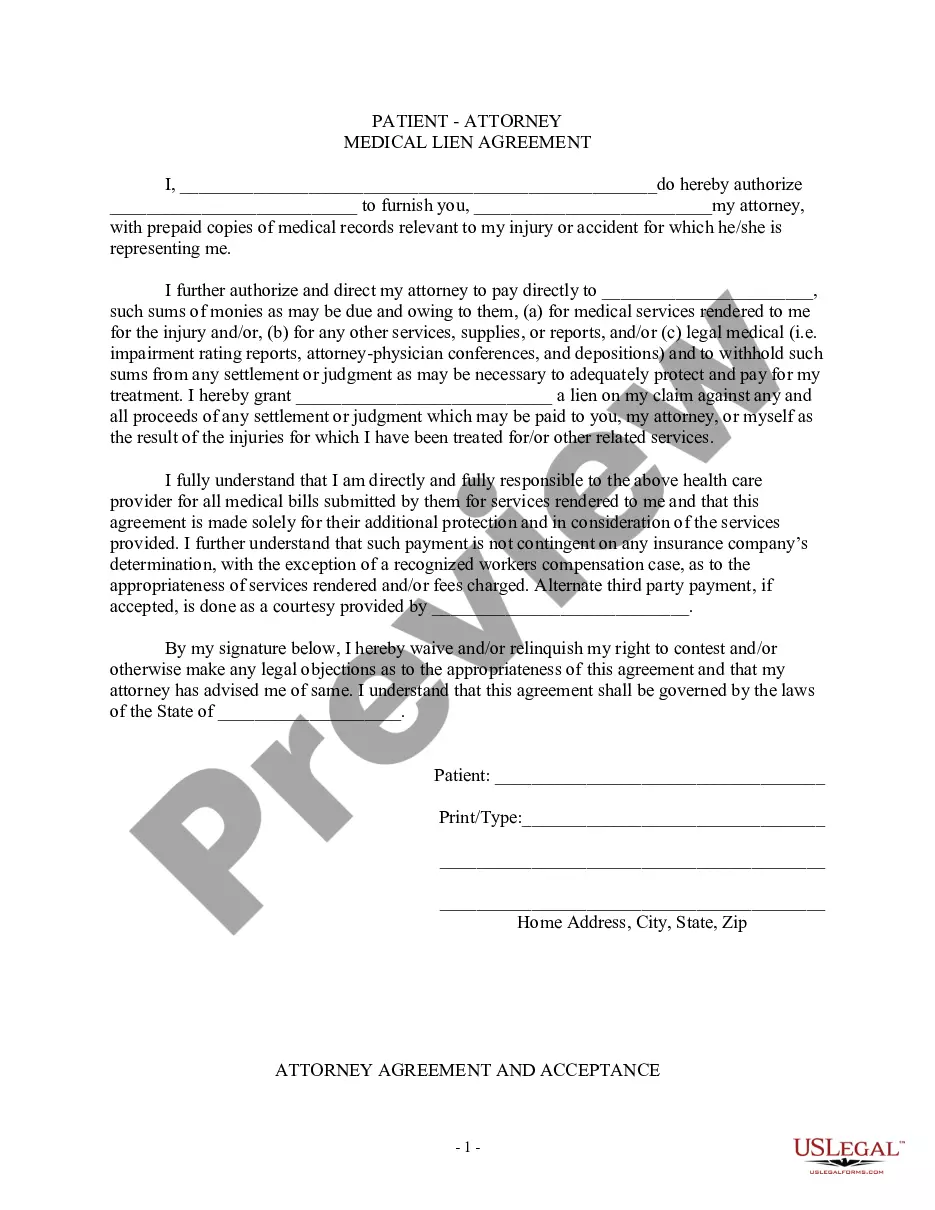
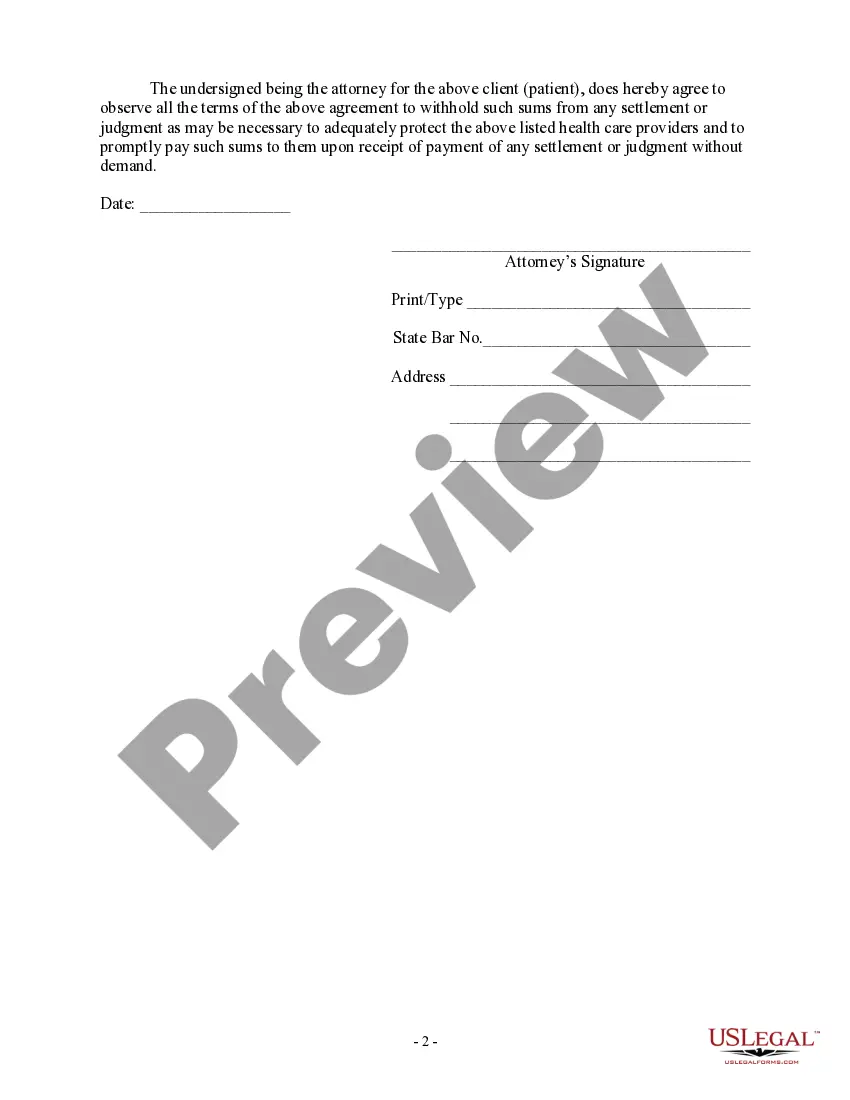
This form is a Medical Lien Agreement. The clien authorizes a health care provider to furnish his/her attorney with prepaid copies of certain medical records relevant to the client's injury or accident. The client also acknowledges that he/she is directly responsible to the health care provider for all medical bills submitted by them for services rendered.
Franklin Ohio Patient - Attorney Medical Lien Agreement
State:
Multi-State
Category:
County:
Franklin
Control #:
US-LIEN-01
Format:
Word;
Rich Text
104 downloads
Description
Free preview
Get your form ready online
Our built-in tools help you complete, sign, share, and store your documents in one place.
Built-in online Word editor
Make edits, fill in missing information, and update formatting in US Legal Forms—just like you would in MS Word.
Export easily
Download a copy, print it, send it by email, or mail it via USPS—whatever works best for your next step.
E-sign your document
Sign and collect signatures with our SignNow integration. Send to multiple recipients, set reminders, and more. Go Premium to unlock E-Sign.
Notarize online 24/7
If this form requires notarization, complete it online through a secure video call—no need to meet a notary in person or wait for an appointment.
Store your document securely
We protect your documents and personal data by following strict security and privacy standards.

Make edits, fill in missing information, and update formatting in US Legal Forms—just like you would in MS Word.

Download a copy, print it, send it by email, or mail it via USPS—whatever works best for your next step.

Sign and collect signatures with our SignNow integration. Send to multiple recipients, set reminders, and more. Go Premium to unlock E-Sign.

If this form requires notarization, complete it online through a secure video call—no need to meet a notary in person or wait for an appointment.

We protect your documents and personal data by following strict security and privacy standards.
Looking for another form?

How to fill out Patient - Attorney Medical Lien Agreement?
Creating legal documents can be challenging. Furthermore, if you choose to enlist a lawyer to draft a business contract, documents for property transfer, prenuptial agreement, divorce forms, or the Franklin Patient - Attorney Medical Lien Agreement, it could result in significant expenses.
So, what is the most cost-effective approach to conserve time and finances while drafting valid documents that fully comply with your state and local laws? US Legal Forms is a fantastic option, whether you are seeking templates for personal or business use.
Don't be concerned if the form does not meet your needs—search for the correct one in the header.
- US Legal Forms boasts the largest online collection of state-specific legal documents, offering users the latest and professionally verified templates for any situation, all conveniently located in one spot.
- As a result, if you require the most recent iteration of the Franklin Patient - Attorney Medical Lien Agreement, you can effortlessly find it on our platform.
- Acquiring the documents takes minimal time.
- Those who already possess an account should ensure their subscription is current, Log In, and choose the sample by clicking on the Download button.
- If you have not yet subscribed, here is how you can obtain the Franklin Patient - Attorney Medical Lien Agreement.
- Browse the page and confirm there is a sample for your region.
- Review the form description and utilize the Preview option, if available, to confirm that it is the sample you need.
Form popularity
FAQ
Hospitals and medical service providers are required to take the following steps to secure a lien: Send a notice to the injured individual that includes their name, address, date of the accident, name and location of the hospital or provider claiming the lien, and the name of the liable person if known.
Do You Have to Pay the Hospital if There is No Lien Filed? Whether there is a lien or not, you still have an obligation to pay the hospital's bills. If you fail to do so, they have four years from the date the services were provided to sue you to collect on the bills.
A lien or subrogation interest is the right of a third party to receive reimbursement directly from your settlement or judgment in a personal injury claim.
Hospitals and medical service providers are required to take the following steps to secure a lien: Send a notice to the injured individual that includes their name, address, date of the accident, name and location of the hospital or provider claiming the lien, and the name of the liable person if known.
Put simply, a medical lien is a security interest that medical providers place against any recovery you may receive in your claim. It attaches to, or claims, a portion of a settlement, verdict, award, or whatever compromise you or your attorneys may have secured.
- (a) In order to perfect such lien, the agent or operator of the hospital, before or within one hundred twenty (120) days after any such person shall have been discharged therefrom, shall file in the office of the clerk of the circuit court of the county in which the hospital is located, and in the county wherein the
Do You Have to Pay the Hospital if There is No Lien Filed? Whether there is a lien or not, you still have an obligation to pay the hospital's bills. If you fail to do so, they have four years from the date the services were provided to sue you to collect on the bills.
A medical lien, in short, is the ability of a healthcare provider (doctor, radiologist, hospital, etc.) to place request for payment on your personal injury claim to recoup any money that is owed to them for treatment as a result of that specific accident.
In the state of Texas, hospitals and other emergency medical providers are able to file a hospital lien. This enables the provider to place a lien or hold on payment from any money the injured victim recovers from a negligent third-party.
A medical lien, in short, is the ability of a healthcare provider (doctor, radiologist, hospital, etc.) to place request for payment on your personal injury claim to recoup any money that is owed to them for treatment as a result of that specific accident.