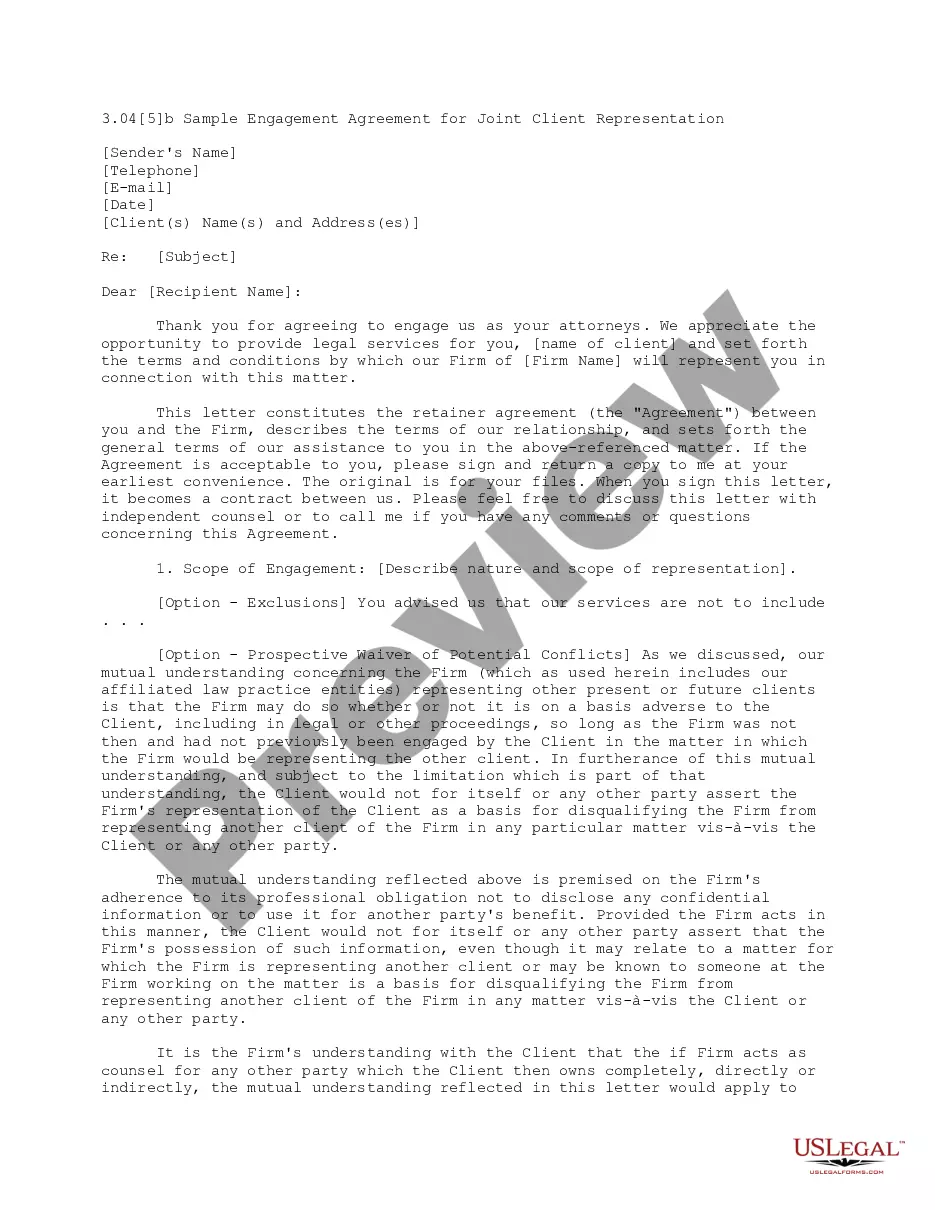
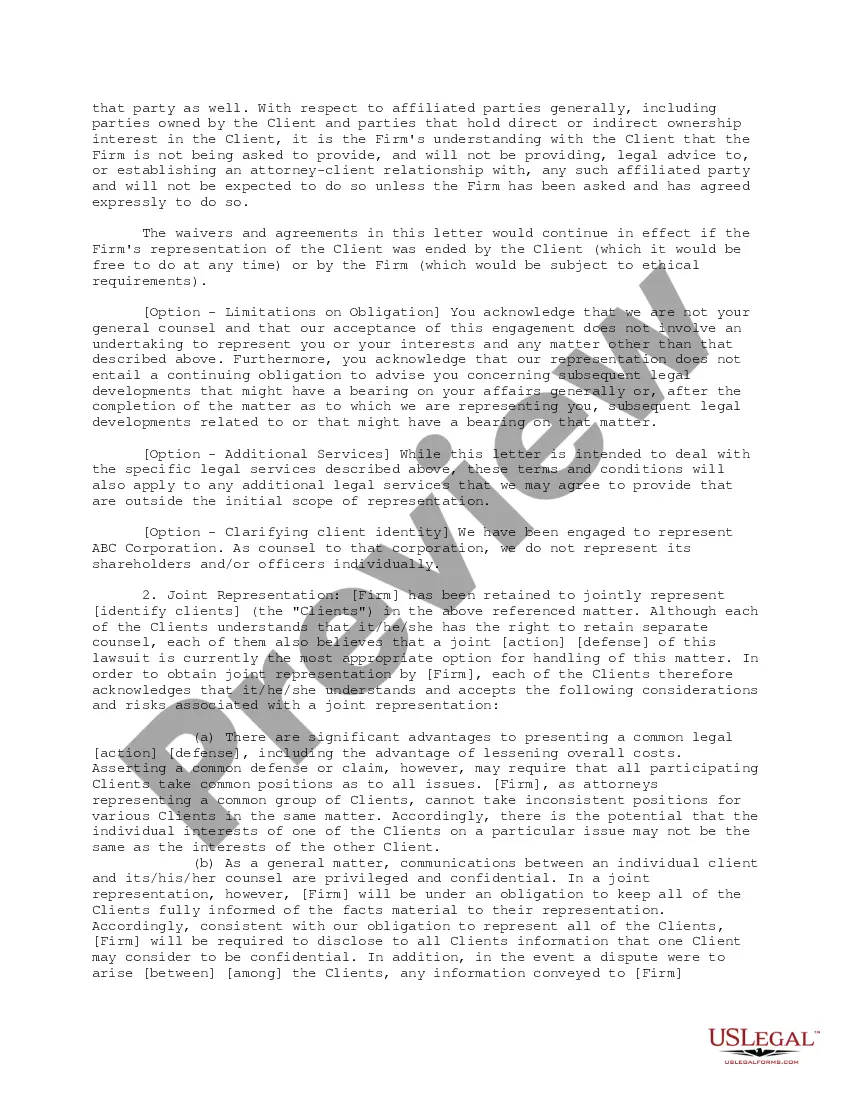
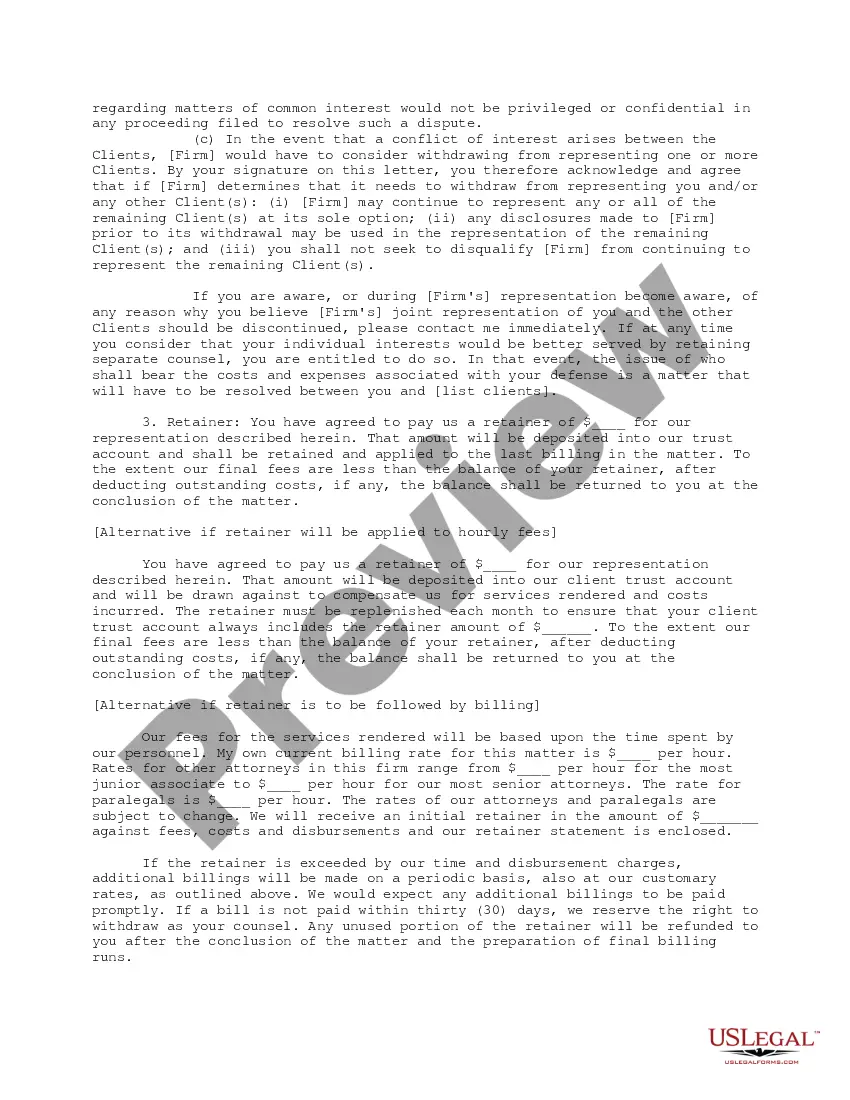
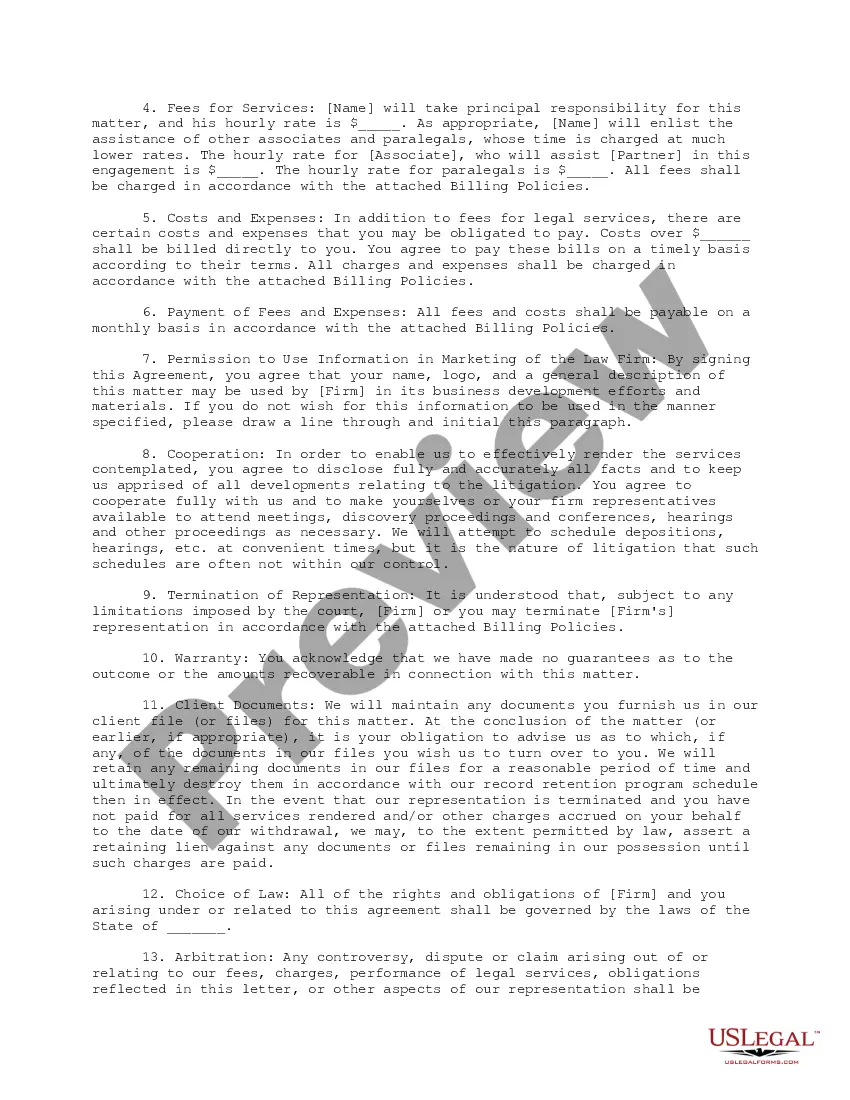
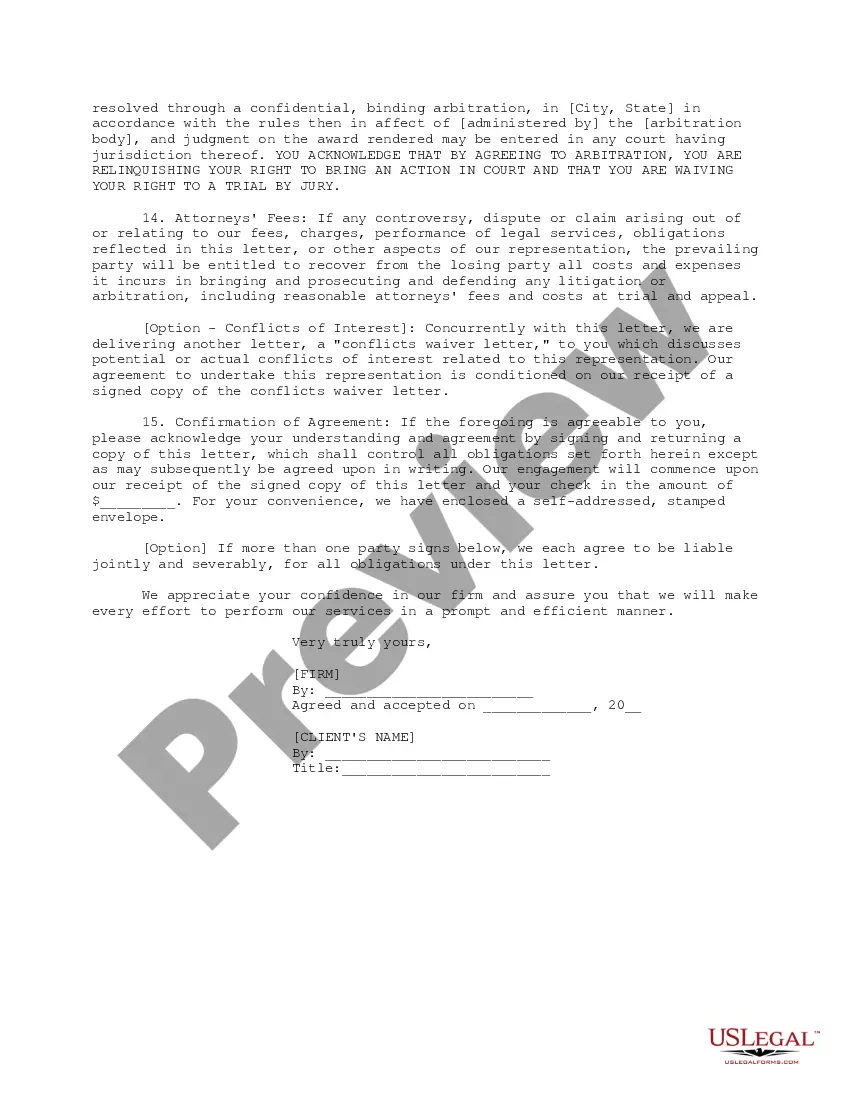
This is an engagement letter for joint client representation. It covers the nature and scope of the representation, any exclusions, potential conflicts of interest, retainer, fees, costs and expenses, arbitration, and other issues.
Hillsborough Florida Engagement Agreement for Joint Client Representation
State:
Multi-State
Category:
County:
Hillsborough
Control #:
US-L03045B
Format:
Word;
PDF;
Rich Text
81 downloads
Description
Free preview
Get your form ready online
Our built-in tools help you complete, sign, share, and store your documents in one place.
Built-in online Word editor
Make edits, fill in missing information, and update formatting in US Legal Forms—just like you would in MS Word.
Export easily
Download a copy, print it, send it by email, or mail it via USPS—whatever works best for your next step.
E-sign your document
Sign and collect signatures with our SignNow integration. Send to multiple recipients, set reminders, and more. Go Premium to unlock E-Sign.
Notarize online 24/7
If this form requires notarization, complete it online through a secure video call—no need to meet a notary in person or wait for an appointment.
Store your document securely
We protect your documents and personal data by following strict security and privacy standards.

Make edits, fill in missing information, and update formatting in US Legal Forms—just like you would in MS Word.

Download a copy, print it, send it by email, or mail it via USPS—whatever works best for your next step.

Sign and collect signatures with our SignNow integration. Send to multiple recipients, set reminders, and more. Go Premium to unlock E-Sign.

If this form requires notarization, complete it online through a secure video call—no need to meet a notary in person or wait for an appointment.

We protect your documents and personal data by following strict security and privacy standards.
Looking for another form?



How to fill out Engagement Agreement For Joint Client Representation?
Statutes and guidelines in every area vary from one jurisdiction to another.
If you're not a lawyer, it’s simple to become overwhelmed by numerous standards when it comes to creating legal documents.
To prevent costly legal fees when assembling the Hillsborough Engagement Agreement for Joint Client Representation, you require a confirmed template valid for your region. That’s when utilizing the US Legal Forms platform becomes exceptionally beneficial.
This is the easiest and most cost-effective method to obtain current templates for any legal situations. Find them all with just a few clicks and maintain your paperwork in order with US Legal Forms!
- US Legal Forms is a reliable web repository, trusted by millions, offering over 85,000 state-specific legal documents.
- It’s an excellent choice for both professionals and individuals seeking do-it-yourself templates for various personal and business situations.
- All documents can be reused: once you buy a template, it remains available in your account for future access.
- Thus, if you have an account with an active subscription, you can simply Log In and re-download the Hillsborough Engagement Agreement for Joint Client Representation from the My documents section.
- For first-time users, it’s essential to follow a few additional steps to obtain the Hillsborough Engagement Agreement for Joint Client Representation.
- Review the page content to confirm you’ve selected the correct specimen.
- Utilize the Preview feature or examine the form description if it’s provided.
- Search for another document if there are discrepancies with any of your requirements.
- Click the Buy Now button to acquire the template when you identify the right one.
- Select one of the subscription options and log in or set up a new account.
- Decide how you wish to pay for your subscription (via credit card or PayPal).
- Choose the format you want to save the file in and press Download.
- Fill out and sign the template on paper after printing or complete the process electronically.
Form popularity
FAQ
The Privilege in Joint Representations The attorney-client privilege exists between a lawyer and each client in a joint engagement. The privilege applies to communications between the lawyer and each client regarding the engagement; it also applies to communications among joint clients and their common attorneys.
Privileged communication, in law, communication between persons who have a special duty of fidelity and secrecy toward each other. Communications between attorney and client are privileged and do not have to be disclosed to the court.
Under the co-client doctrine, communications between co-clients and their attorneys are protected by the privilege against parties outside the joint representation but are available among the co-clients in adverse litigation.
The California Rules generally permit a lawyer to represent multiple clients with conflicting interests so long as all the clients have provided their informed written consent.
Under joint defense privilege, communications between client and his own lawyer remain protected by attorneyclient privilege when disclosed to co-defendants or their counsel for purposes of common defense..
Joint Representation simply means that a lawyer represents more than one client in the same dispute or matter. The rules governing the practice of law allow for joint representation, but also require the lawyer to make disclosures so that the parties.
The joint defense privilege allows one group of clients and their counsel to communicate with another group of clients and their separate counselall without allowing their common adversary (the plaintiff) to discover those communications.
The California Rules generally permit a lawyer to represent multiple clients with conflicting interests so long as all the clients have provided their informed written consent.
If attorneys have multiple clients in the same matter, they must disclose the existence of any current or potential conflicts, and where possible and proper, obtain waivers of such conflicts in compliance with the applicable rules of professional responsibility.
Common exceptions include the following: A counselor formally reporting to or consulting with administrative supervisors, colleagues or supervisors who share professional responsibility (i.e. in this instance all recipients of such information are similarly bound to regard the communication as privileged);