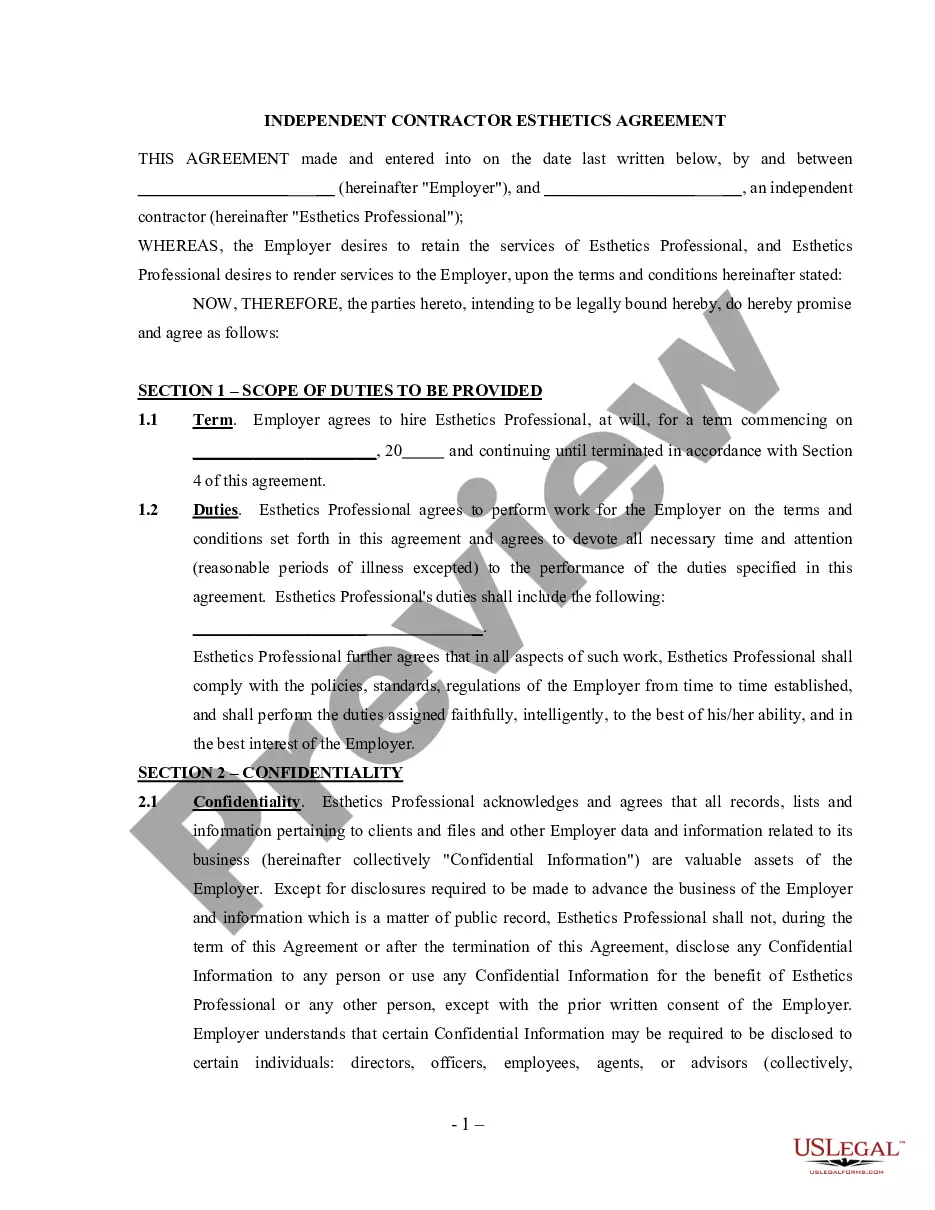
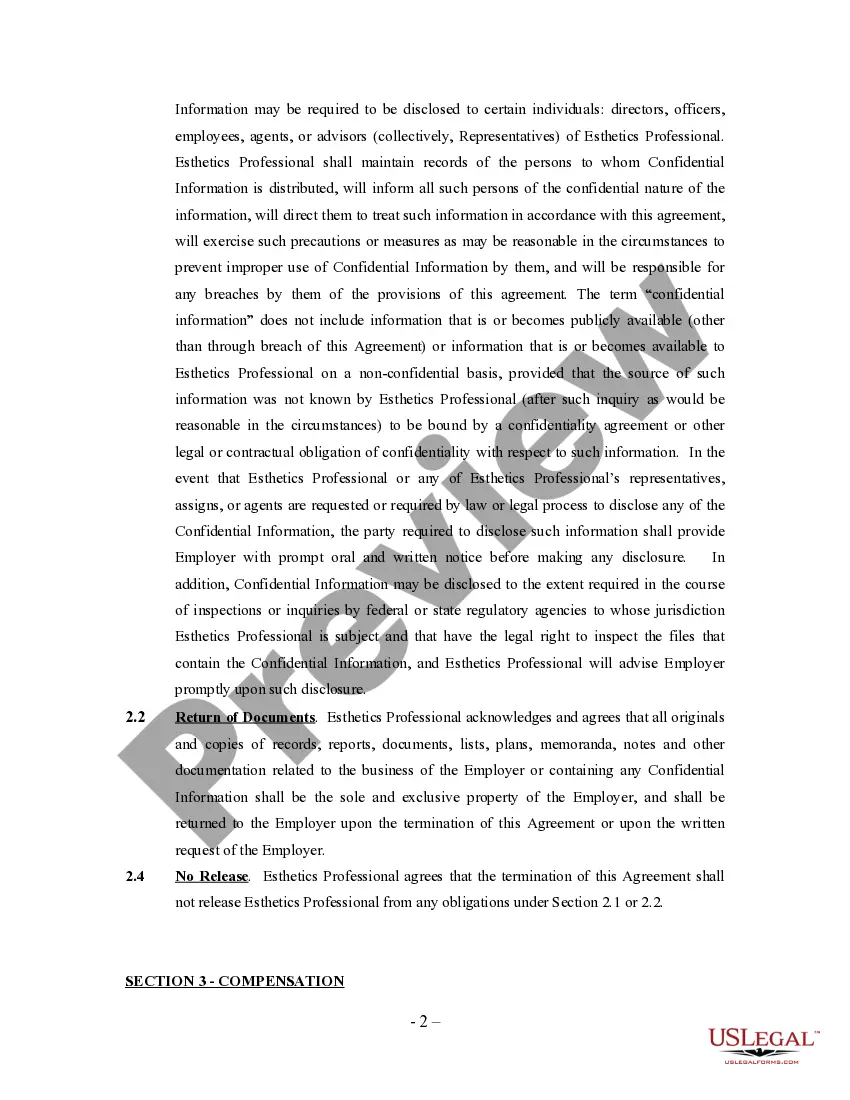
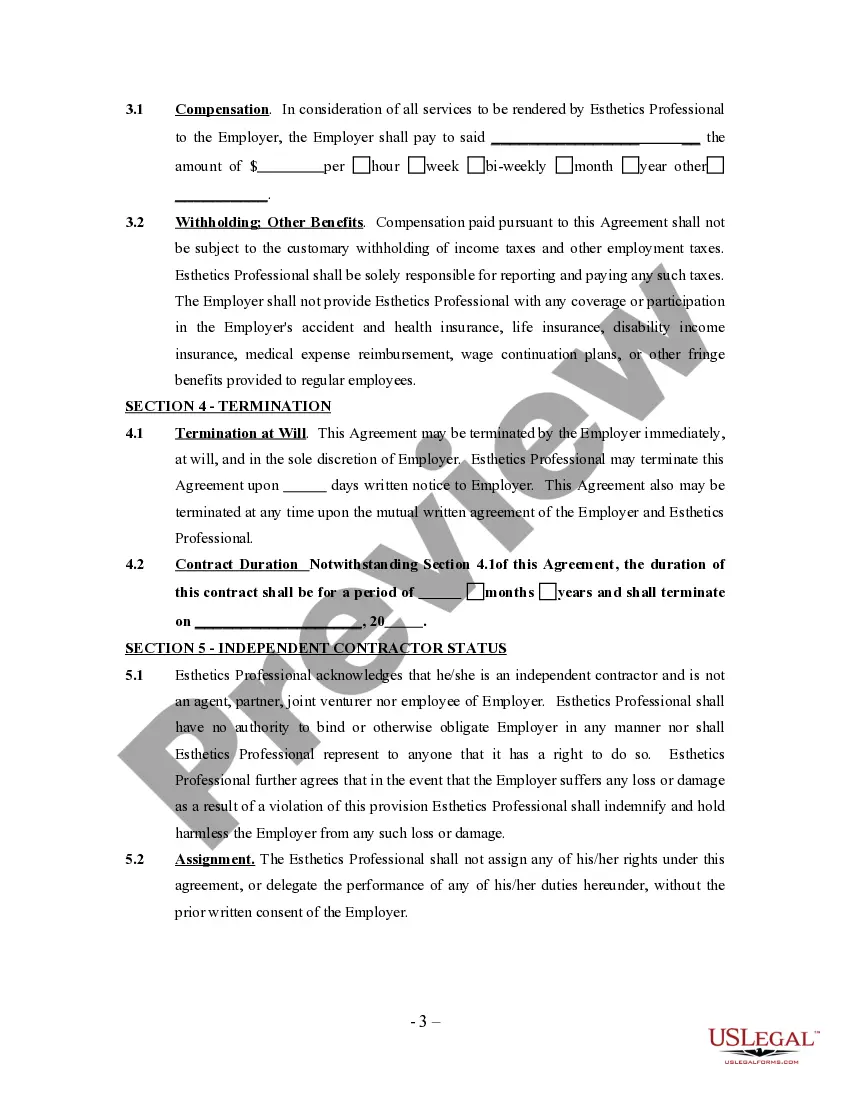
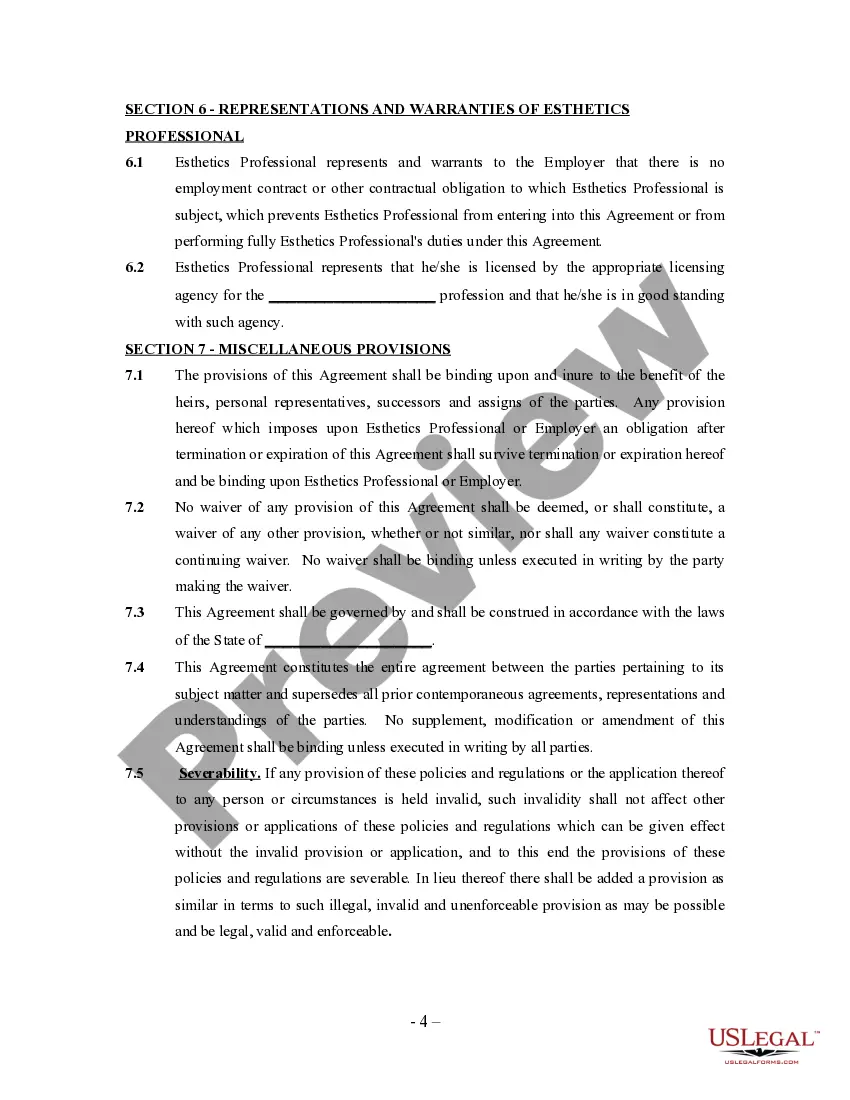
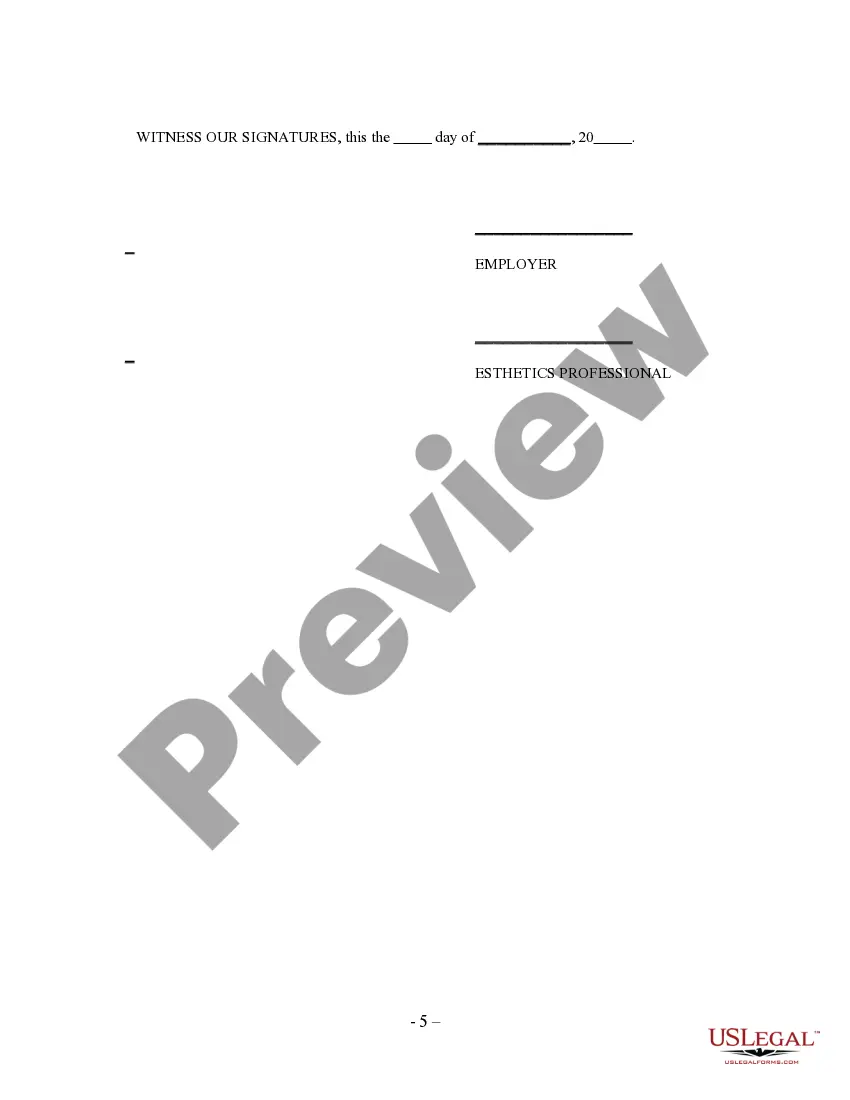
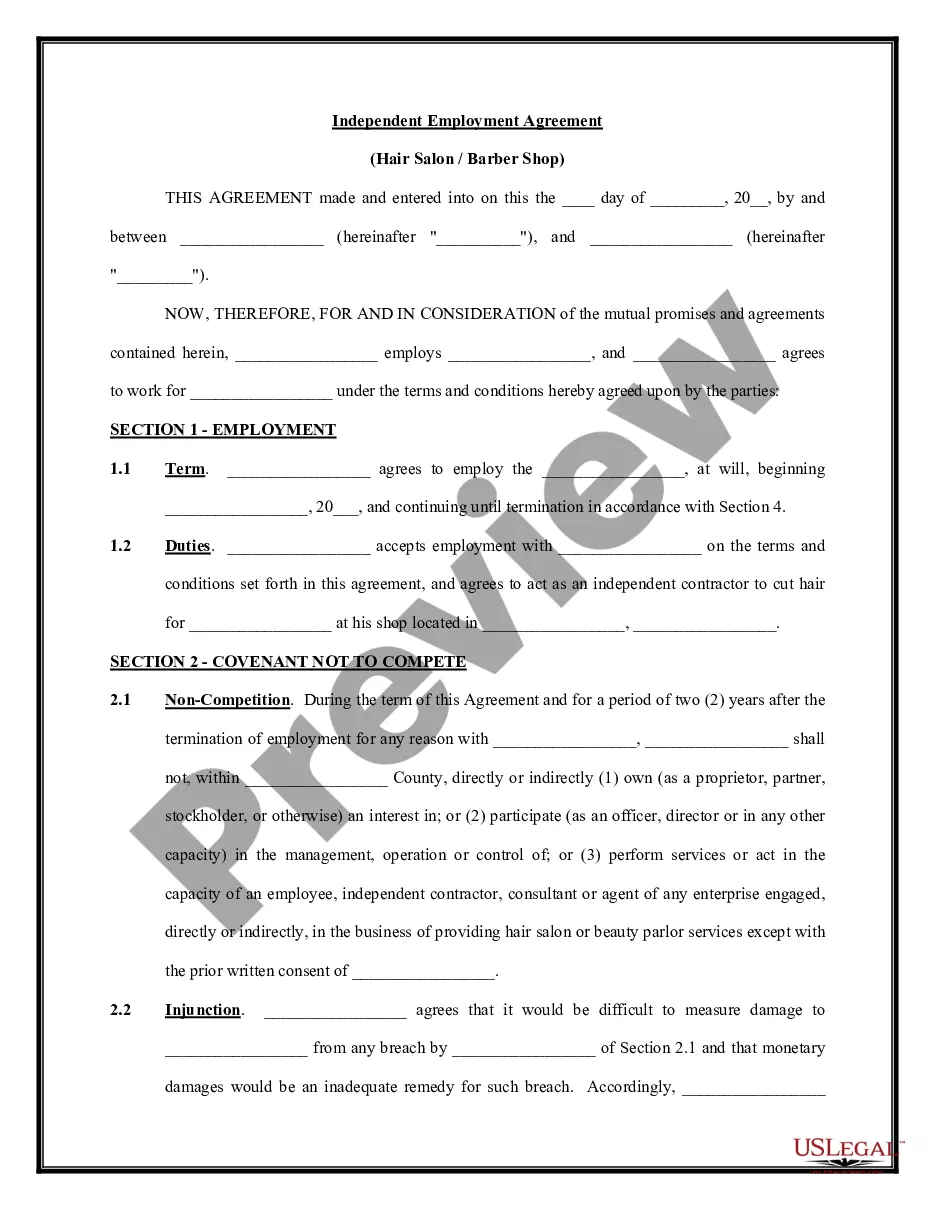
Employer contracts with an Esthetic Professional as an independent contractor to provide esthetic services for clients or customers of Employer.
Cook Illinois Self-Employed Independent Contractor Esthetics Agreement
State:
Multi-State
County:
Cook
Control #:
US-INDC-141
Format:
Word;
Rich Text
139 downloads
Description
Free preview
Get your form ready online
Our built-in tools help you complete, sign, share, and store your documents in one place.
Built-in online Word editor
Make edits, fill in missing information, and update formatting in US Legal Forms—just like you would in MS Word.
Export easily
Download a copy, print it, send it by email, or mail it via USPS—whatever works best for your next step.
E-sign your document
Sign and collect signatures with our SignNow integration. Send to multiple recipients, set reminders, and more. Go Premium to unlock E-Sign.
Notarize online 24/7
If this form requires notarization, complete it online through a secure video call—no need to meet a notary in person or wait for an appointment.
Store your document securely
We protect your documents and personal data by following strict security and privacy standards.

Make edits, fill in missing information, and update formatting in US Legal Forms—just like you would in MS Word.

Download a copy, print it, send it by email, or mail it via USPS—whatever works best for your next step.

Sign and collect signatures with our SignNow integration. Send to multiple recipients, set reminders, and more. Go Premium to unlock E-Sign.

If this form requires notarization, complete it online through a secure video call—no need to meet a notary in person or wait for an appointment.

We protect your documents and personal data by following strict security and privacy standards.
Looking for another form?



How to fill out Self-Employed Independent Contractor Esthetics Agreement?
Do you require to swiftly produce a legally-enforceable Cook Self-Employed Independent Contractor Esthetics Agreement or perhaps any other document to oversee your individual or business matters.
You can choose one of the two alternatives: reach out to an expert to compose a legal document on your behalf or completely draft it yourself.
First and foremost, carefully check if the Cook Self-Employed Independent Contractor Esthetics Agreement conforms to your state's or county's regulations.
If the form contains a description, be sure to confirm its applicable use.
- Fortunately, there's a different option - US Legal Forms.
- It will assist you in obtaining well-drafted legal documents without incurring exorbitant fees for legal services.
- US Legal Forms provides an extensive collection of over 85,000 state-specific document templates, including the Cook Self-Employed Independent Contractor Esthetics Agreement and form bundles.
- We supply documents for a wide range of life situations: from divorce forms to real estate papers.
- Having been in business for more than 25 years, we have a stellar reputation among our clients.
- Here’s how you can join them and obtain the required document without unnecessary hassles.
Form popularity
FAQ
By Lisa Guerin, J.D. For most types of projects you hire an independent contractor (IC) to do, the law does not require you to put anything in writing. You can meet with the IC, agree on the terms of your arrangement, and have an oral contract or agreement that is legally binding.
Becoming an independent contractor is one of the many ways to be classified as self-employed. By definition, an independent contractor provides work or services on a contractual basis, whereas, self-employment is simply the act of earning money without operating within an employee-employer relationship.
What Is an Independent Contractor? An independent contractor is a self-employed person or entity contracted to perform work foror provide services toanother entity as a nonemployee. As a result, independent contractors must pay their own Social Security and Medicare taxes.
Simply put, being an independent contractor is one way to be self-employed. Being self-employed means that you earn money but don't work as an employee for someone else.
A contract should contain everything agreed upon by you and your licensed contractor. It should detail the work, price, when payments will be made, who gets the necessary building permits, and when the job will be finished. The contract also must identify the contractor, and give his/her address and license number.
Self-employed people are sometimes referred to as contractors, or independent contractors; these terms mean the same thing. A contractor is engaged by a principal (the other party) to perform services under a contract for services (commonly called an independent contractor agreement).
An independent contractor agreement is a legally binding document signed by a 1099 employee and the company that hires them. It outlines the scope of work and the terms under which that work will be completed, which goes a long way to making sure both parties are on the same page about the project from the start.
Ask for Clear Work Expectations Examples of work, including 3D architectural drafts or photos of a similar job, are even more helpful. The idea is that you want to know when your work is done. If your contracting employer states that your work was somehow inadequate, they have grounds to potentially not pay you.
To set yourself up as a self-employed taxpayer with the IRS, you simply start paying estimated taxes (on Form 1040-ES, Estimated Tax for Individuals) and file Schedule C, Profit or Loss From Business, and Schedule SE, Self-Employment Tax, with your Form 1040 tax return each April.
How do I create an Independent Contractor Agreement? State the location.Describe the type of service required.Provide the contractor's and client's details.Outline compensation details.State the agreement's terms.Include any additional clauses.State the signing details.